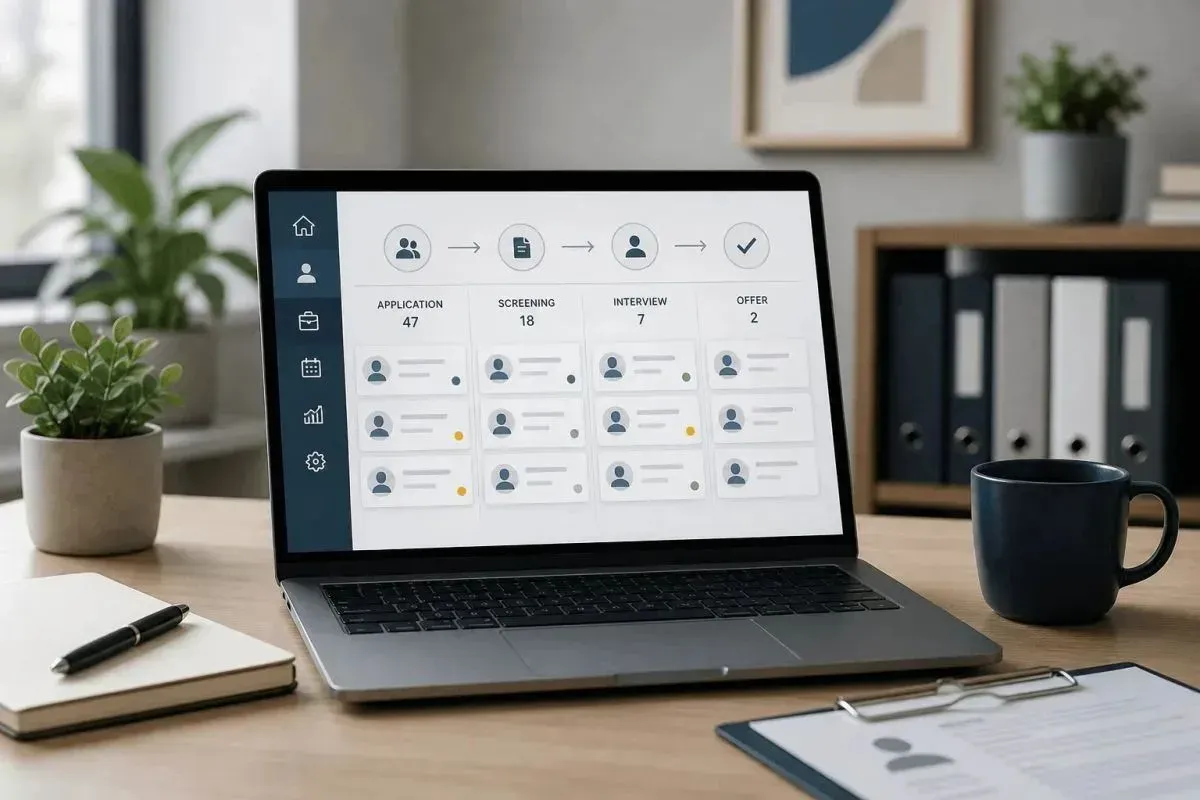

You’re choosing how to screen resumes without losing qualified candidates to a formatting error or an overly strict filter. An applicant tracking system can store applications, extract resume details, and apply rules your team sets, but those are separate functions. Understanding the difference gives you a practical way to check the candidate experience, question AI scores, and keep hiring decisions under human review.
TLDR:
-
Use an applicant tracking system to keep your applications and hiring stages in one shared place.
-
Check AI screening outputs against resumes; people retain hiring decision authority.
-
Format your resume in one column and check autofilled fields before submitting.
-
Free ATS resume checkers can flag issues, but no universal passing score exists.
-
Software tracks candidates, but sourcing and closing capacity comes from people; some tools pair free ATS software with on-demand fractional recruiters in one shared system.
Applicant Tracking System Meaning and Purpose
Resumes sit in one inbox; interview feedback lands in another. An applicant tracking system, or ATS, gives employers a shared place to organize applications and move candidates through hiring stages. A 2011 SHRM article describes the ATS as a tool that automated the storing and processing of resumes and later improved resume parsing.
Recruiters, hiring managers, and HR teams use it to track progress and coordinate next steps. Job seekers typically interact with an ATS through application forms and candidate communications, such as interview invitations or status updates.
How an Applicant Tracking System Works
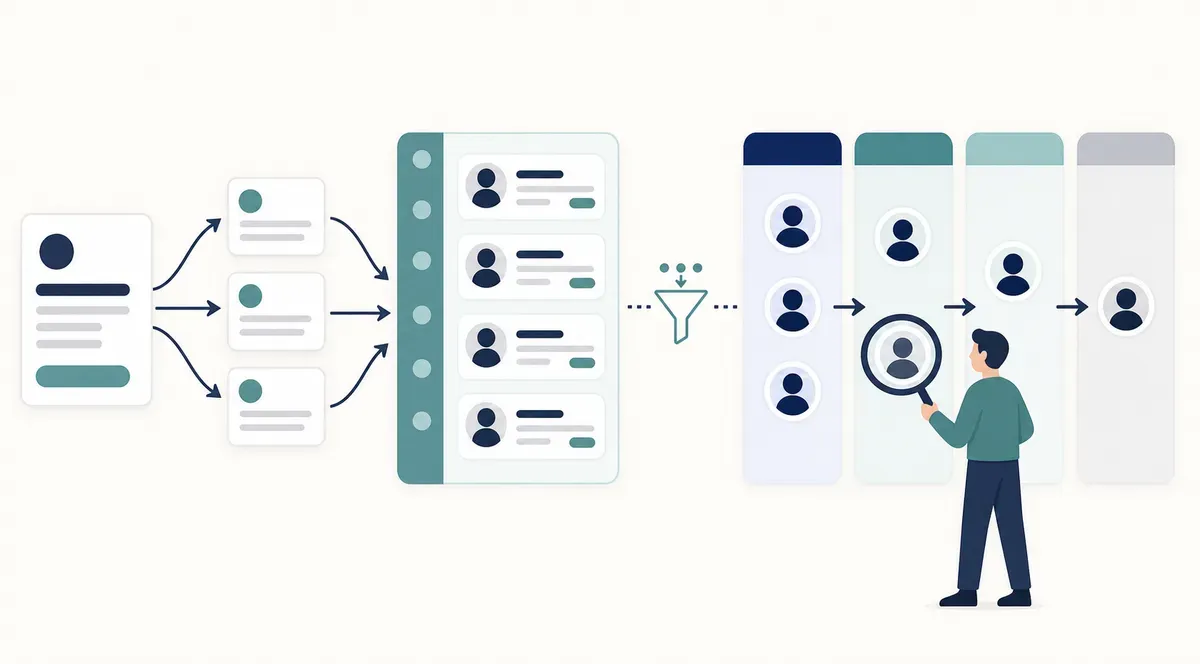
An applicant tracking system connects job posting, application review, and hiring stages. The employer creates a job and distributes it to job boards. Applications become candidate records; resume parsing extracts work history and other details into fields.
Storage is separate from screening: employer-configured rules may flag responses or reject disqualifying answers. People assess candidates and make hiring decisions, moving selected applicants through interviews, offers, and onboarding handoff after acceptance.
Core Applicant Tracking System Features
Applicant tracking system features vary by product and plan. Compare these features:
-
Candidate profiles with searchable resumes.
-
Configurable hiring stages for each role.
-
Interview scheduling with calendar connections.
-
Feedback forms for consistent assessments.
-
Email templates for recurring messages.
-
Reporting on candidate sources and time in stages.
-
Email and HR tool integrations.
-
Multi-board job posting to distribute openings. Distribution does not include sponsored placement; paid promotion is separate.
Benefits of an ATS for Employers and Candidates
An applicant tracking system keeps records together, which can reduce the chance of applications getting lost in inboxes when teams use it consistently. Consistent workflows can help candidates hear back sooner when teams assign and follow through on updates.
To assess whether it helps, track:
-
How long candidates wait at each stage.
-
How many candidates complete applications.
-
Whether hiring managers use the system.
Faster hiring and better hires also depend on review habits and hiring criteria.
Types of Applicant Tracking Systems and Example Uses
-
A standalone applicant tracking system can suit startups managing applications without replacing existing HR tools.
-
A recruiting module within an HR suite can connect hiring with employee records.
-
An agency-configured ATS can help staffing firms manage submissions across clients.
An ATS tracks open-role hiring; a recruitment CRM supports prospect relationships; an HR information system manages employee records. Personal application trackers organize job seekers’ searches. These functions can overlap, and understanding the types of applicant tracking systems can clarify which setup fits a given team.
AI in Applicant Tracking Systems
AI in an applicant tracking system can extract resume details, match candidates to role criteria, draft job descriptions, and summarize interviews. Unlike fixed rules triggered by preset answers, AI generates interpretations or text that may contain errors. In 2021, the EEOC launched an initiative on AI and algorithmic fairness so that AI tools used in hiring and other employment decisions comply with federal civil rights laws.
Employers set criteria; human reviewers should check outputs against source material and retain decision authority, a pattern described further in how AI recruiting tools work inside an ATS.
An AI score reflects the tool’s configuration, not proof of candidate quality or freedom from bias.
ATS Limitations, Screening Risks, and Data Privacy
Parsing errors and inaccessible forms warrant software checks; restrictive filters warrant process review. Define candidate-data access, retention, and deletion procedures. Mayer Brown’s 2023 analysis of EEOC guidance notes that employers may bear Title VII responsibility for vendor-built tools. A vendor’s assurances do not necessarily shield them from liability. This guidance dates from 2023, and federal agency priorities on AI in hiring have shifted since then, so check current EEOC positions. Employer responsibility under Title VII for selection procedures still applies.
| Evidence | Scope and caution |
|---|---|
| 2021 high-skill screening finding: 88% of employers surveyed believed qualified high-skills candidates are vetted out because they do not match the exact job description criteria. | HBS/Accenture measured employer beliefs about screening criteria, not resume rejection rates or how any specific ATS behaves. |
| NYC audit and notice requirements: audit within one year before use; notice at least 10 business days beforehand. | Covers qualifying automated employment decision tools, not every ATS. |
How Recruiters Review and Filter ATS Resumes
Recruiters may search resumes for skills, apply eligibility filters, then read matching applications. Parsing extracts information; searches retrieve terms; filters check requirements. Recruiters weigh experience and evidence, while optional scores offer tool-specific guidance.
For applicants wondering how to beat an applicant tracking system, accurate qualifications and readable examples matter, while employers researching applicant tracking systems for recruiting weigh pricing, integrations, and job-board reach instead. Hidden keywords and keyword stuffing cannot replace missing experience. There is no universal passing score across systems or employers.
ATS-Friendly Resume Formatting and Templates
A single-column applicant tracking system resume template keeps formatting simple:
NAME
Email | Phone
SKILLS
[Relevant skills]
EXPERIENCE
[Title], [Company] | [Dates]
- [Action and measurable result]
EDUCATION
[Degree], [School]
For PDF or DOCX, follow the employer’s accepted formats. Avoid scans. Check reading order in a plain-text editor and correct autofilled fields before submitting.

Use job-description terminology that accurately describes your experience. No template works perfectly across all systems.
Free ATS Resume Checkers and Resume Tests
A free ATS resume checker can flag issues, but cannot access an employer’s screening rules or provide an authoritative hiring score. Look for:
-
Readable-text extraction to check parsing.
-
Job-description comparisons that suggest concrete edits.
-
Clear free-use limits and privacy terms.
For a manual resume test, compare copied text with the original and check application previews for omissions. Treat Reddit advice as anecdotal, not a universal workaround for employer-specific configurations.
Applicant Tracking System Costs and Free Options
Free applicant tracking system plans have ongoing feature limits; free trials expire. Subscriptions may charge by user or usage, plus implementation or integration fees.
Recruiters comparing free options should check:
-
Job and user allowances.
-
Candidate-history access, reporting, and data exports.
-
Support coverage and upgrade triggers.
Job seekers looking for a free ATS resume scan or template download need resume tools instead of employer ATS software, which is a separate category from the best applicant tracking systems for recruitment that hiring teams assess.
Choosing an ATS for Your Hiring Needs
Choosing an applicant tracking system depends on hiring volume and workflow complexity:
-
Bootstrapped startups can weigh total cost and data portability.
-
Small hiring teams can test collaboration features and integrations.
-
Organizations with complex workflows, regardless of headcount, can check permissions and approval paths. Comparing top ATS systems side by side can speed this evaluation.
During trials, run an actual application through interview scheduling, including accessibility checks. Our comparison of applicant tracking systems covers broader vendor lists.
Implementing or Upgrading an Applicant Tracking System
Before rolling out an applicant tracking system, map workflows, clean candidate data, assign permissions, connect integrations, review screening rules, test applications, and train the team.
Consider upgrading when missing integrations, unreliable reports, or restrictive limits block work. Check ownership before replacing software for coordination problems: unclear responsibilities require process changes.
Compare agreed hiring metrics before and after implementation, accounting for changes in role mix and staffing, a process covered in more depth in this enterprise applicant tracking systems guide.
Where ATS Software Ends and Recruiting Capacity Begins
An ATS records applications, moves candidates through stages, and keeps feedback in one place. It does not source passive candidates, write outreach, screen for a specialized skill, or close an offer. A team hiring a few roles a year, with a founder who has time to review applicants, can often run on an ATS alone. A team hiring across several functions, filling a senior or specialized role, or lacking anyone with recruiting hours typically hits a capacity limit that no configuration change resolves.
The alternative to doing everything in-house is layering a fractional recruiter on top of the same system: the ATS holds the pipeline, and the recruiter handles sourcing, screening, and closing for the hours the team needs. Working from one shared pipeline can reduce duplicate outreach and status-update handoffs, and candidate data stays in the employer’s own records when the engagement ends. A fractional recruiter can also work inside an ATS the team already uses, so the decision turns on whether recruiting hours are missing, not on which software is in place. Fractional support tends to fit companies hiring roughly 5-50 roles per year, with a first full-time recruiter often worth considering around 15-20 annual hires.
Dover’s ATS and Optional Fractional Recruiting Support
Dover’s ATS is free and includes unlimited jobs, users, and candidate tracking. Premium costs $199/month and includes up to 2,000 AI candidate scores monthly for human review. AI scoring is not available on the free tier, which raises the question of how the Dover ATS can be free at all.
You can hire fractional recruiters to work alongside your team in the same shared candidate pipeline, so both sides see sourcing activity and candidate flow in real time instead of reconciling separate inboxes. Each recruiter sets their own rate. Getting started takes an $800 refundable deposit, with no long-term contracts. That pairing of software and recruiter capacity is the structure behind Dover’s applicant tracking system, and the ATS runs on its own for teams that do not need a recruiter.
FAQs
Is a free applicant tracking system enough if your team has fewer than 20 people?
Team size alone does not determine fit; your hiring workflow and data-access needs matter more. A free plan may cover candidate tracking while limiting candidate-history access or data exports. Before committing, check whether the plan’s limits fit your recordkeeping and reporting needs.
What should you do if an AI candidate score conflicts with your recruiter’s assessment?
Treat the disagreement as a reason to review the evidence, not as an automatic rejection or approval. Compare the resume and interview notes with your role criteria, check whether the scoring prompt reflects those criteria, and document the human reviewer’s decision. A score can miss relevant experience or give too much weight to a weak signal.
How do you move candidates from a spreadsheet into an ATS without losing track of active interviews?
Check candidate records and next steps for consistency before importing; a file upload alone does not preserve your hiring process. If your ATS supports bulk candidate uploads through CSV, test a small batch and check field mapping before importing the remaining records. Keep the original spreadsheet until you have checked candidate counts, assigned owners, and confirmed every active interview’s next step.
Do you need a recruiter if you already use an ATS?
An ATS organizes applications and hiring stages but does not source candidates, run outreach, or close offers, so it adds no recruiting capacity on its own. Teams with low hiring volume and time to review applicants can often manage with software alone. A recruiter typically becomes worth considering when roles are senior or specialized, several searches run at once, or no one on the team has hours for sourcing. A fractional recruiter can often work inside an ATS you already use and typically bills for hours instead of a percentage of salary. Some tools pair a free ATS with on-demand fractional recruiters, which gives the hiring team and the recruiter shared visibility into sourcing activity and candidate flow in one pipeline.
Final Thoughts on Finding Your ATS Fit
More features won’t fix unclear hiring responsibilities. The useful next step is finding where your team needs better tools, clearer ownership, or more recruiting capacity. Dover is one example of the layered model: a free applicant tracking system paired with on-demand fractional recruiters in a single shared system, where the software holds the pipeline and the recruiter adds capacity as roles require it.