
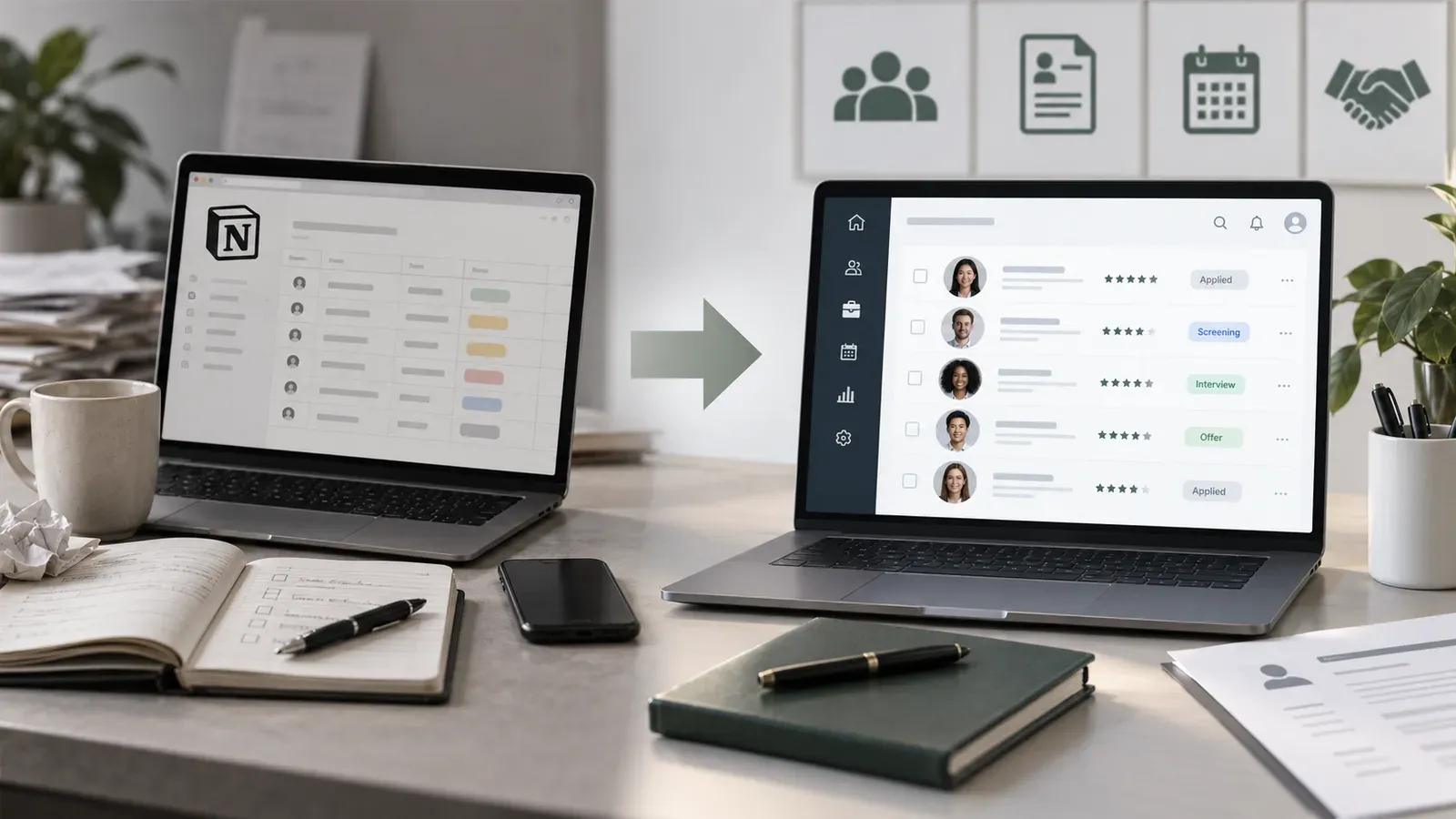
Hiring without dedicated recruiting infrastructure forces founders into a constant arbitrage between speed and control: every hour spent organizing a spreadsheet or a Notion doc is an hour not spent interviewing, and every candidate who slips through a cluttered inbox is a search that restarts from scratch. The tools most founders already have on hand (Notion, Google Sheets, Airtable) were built for project management and data storage, not for running a repeatable hiring process under pressure.
TLDR:
-
Notion works for basic organization, but falls short once applications start scaling.
-
A dedicated ATS can post to multiple job boards with one click and auto-imports candidate data.
-
Candidate ranking, bulk actions, and auto-synced communications keep your pipeline from becoming a manual chore.
-
Notion may suffice if you hire exclusively through referrals or only need to fill a single role.
-
Some free ATS tools take under 15 minutes to set up and include automated scheduling, compliance handling, and team collaboration.
Notion vs. a Dedicated ATS: What Changes When Applications Start Arriving
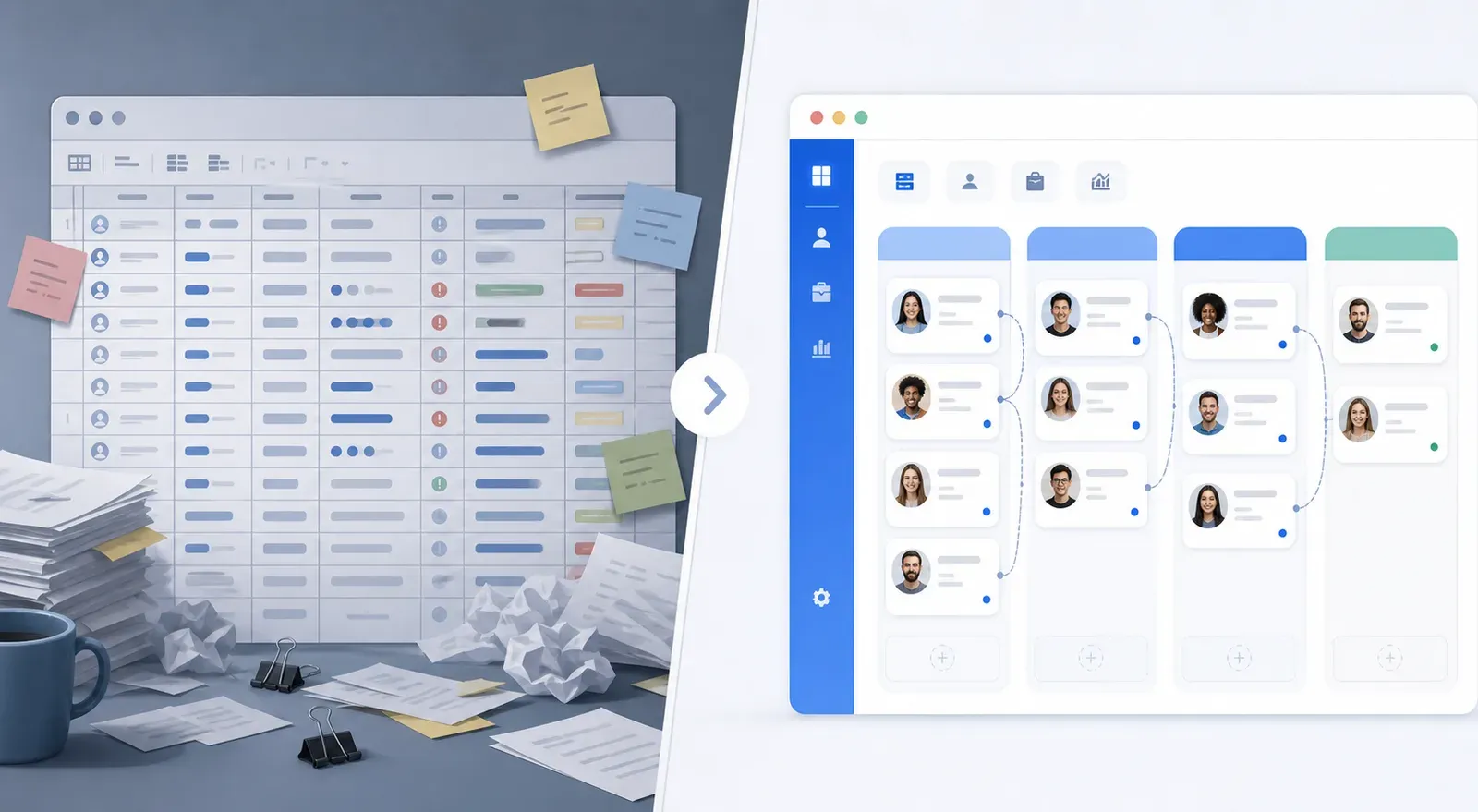
Most early-stage founders start with whatever tool is already open on their screen. Notion, Google Sheets, or Airtable can hold a short list of candidates and feel functional enough when hiring is still occasional. The problem shows up once applications start arriving in volume: spreadsheets break down fast, columns get reformatted, rows go stale, email threads multiply across people, and no one has a clear picture of where each candidate stands. These tools were built for knowledge management and data storage, and they don’t have the infrastructure to run a repeatable hiring process under pressure.
A dedicated ATS changes the mechanics of hiring, not merely the interface. Job postings go out to 100+ boards from one place. Application data flows in automatically. Candidate communications stay attached to profiles instead of scattered across inboxes. Here are the three biggest reasons to use Dover over Notion as your ATS, plus a look at how each approach stacks up for different hiring situations:
| Approach | Job Board Distribution | Candidate Ranking | Pipeline Organization | Scheduling Automation | Recruiter Support | Cost |
|---|---|---|---|---|---|---|
| Notion / Spreadsheet | Manual | Manual | Manual, breaks at scale | None | None | Free |
| Dedicated ATS (e.g. Dover) | 100+ boards, one click | AI-powered scoring | Automated, synced | Built-in | DIY | Free (or $199/mo premium) |
| ATS + Fractional Recruiter | 100+ boards, one click | AI + human review | Shared real-time pipeline | Built-in | On-demand, $75 to $125/hr avg. | $2,000 to $7,000/hire avg. |
#1: One-Click Job Board Postings
With an ATS, you can post your job openings to multiple popular job boards with just one click. Candidates can then apply using a standardized application form, and their information is automatically imported into your ATS. No more cluttered inboxes or manual data entry.
#2: Application Review and Ranking
Dover lets you set up search criteria to analyze and rank candidates based on their qualifications and fit for the role. As a result, you can quickly identify the best applicants without spending hours reviewing every single resume – a growing concern as application volumes keep rising.
According to Bullhorn’s 2026 ATS usage report, 78% of firms with AI tools built into their ATS saw revenue growth, compared to 51% of firms that did not. AI-powered candidate scoring is now a baseline feature in purpose-built ATS platforms, not a premium add-on – meaning a free, dedicated ATS can do screening work that previously required either a paid upgrade or a recruiter handling every application manually. Notion and spreadsheets have no equivalent.
#3: Everything stays organized automatically
Once you start receiving a high volume of applications, an ATS helps keep everything organized. Email communications and calendar events are automatically synced to each candidate’s profile, and you can easily bulk reject or advance candidates through your hiring process.
Other Benefits of Using a Proper ATS
Built-in Features That Save Hours
There are many reasons you’ll be glad you set up one of the best ATS for startups from the start:
-
Automated interview scheduling and reminder emails for candidates
-
Customizable careers page with minimal setup
-
Collaborative hiring with team member access and notes
-
It takes under 5 minutes to set up
-
It’s free! See how Dover keeps the ATS free.
When the ATS Alone Is Enough, and When It Isn’t
When a Fractional Recruiter Adds Value on Top of Your ATS
An ATS handles the infrastructure side of hiring: posting jobs, collecting applications, organizing candidate data, and keeping communications on track. For many early-stage roles, especially when you’re getting healthy inbound volume, that’s all you need to scale your startup’s hiring process.
There are situations, though, where sourcing and pipeline management alone won’t close a role. According to SHRM recruiting benchmarks 2025, competitive roles and senior positions take considerably longer to fill and often require more than inbound volume. Senior or specialized positions often require proactive outreach to candidates not actively job hunting. Roles in competitive markets need someone who knows how to craft compelling outreach and move quickly on strong candidates. And if your team has no recruiting bandwidth, the ATS becomes a tool with no one driving it.
That’s the inflection point where a fractional recruiter paired with your ATS tends to outperform the DIY approach. The ATS remains the single source of truth, since all sourcing notes, outreach history, and candidate data live in one place, while the recruiter handles the active work: building target lists, running outreach campaigns, conducting initial screens, and keeping the process moving. Because both the recruiter and your internal team work inside the same system, there’s no coordination overhead or duplicated outreach. You keep full visibility into every step without managing the process yourself. Some teams go a step further and layer in a fractional recruiting agency on top of their ATS; Dover is the infrastructure those agencies run on, so the pipeline, the outreach history, and the candidate data all stay in one shared system regardless of who is doing the work.
Dover’s model is built around this architecture: a free ATS that serves as the shared pipeline and the base on which fractional recruiting agencies are built, with access to fractional recruiters averaging $75 to $125/hour who can step in for specific searches and step back out when the role is filled, no retainer, no long-term contract. Recruiters in the marketplace carry vetted reviews, so you can choose based on real client feedback instead of guesswork. Most roles come in at $2,000 to $7,000 per hire on average, depending on complexity and recruiter hours.
When Notion Might Be a Better Fit
While an ATS is the clear choice for most growing startups, there are a few scenarios where Notion or a similar tool might suffice:
-
If you are exclusively hiring through referrals, and you don’t want to do any sourcing or receive any applicants (e.g. for your 1st employee)
-
If you prefer an ad-hoc interview process for every candidate you interview (some founders believe this to be better, but it’s more likely to make your company look disorganized)
As a founder, your time is limited. A purpose-built ATS handles the repetitive coordination work, including job distribution, candidate tracking, and scheduling, so you can focus on the interviews and decisions that actually matter. Notion and Google Sheets may seem like an easy starting point, but they break down the moment applications start arriving in volume. With BLS job openings data consistently showing millions of unfilled roles, competition for qualified candidates has never been more unforgiving of a slow or disorganized process. The question isn’t whether to make the switch; it’s how much hiring complexity you want to carry on your own before you do.
How Dover Bridges the Gap Between ATS and Recruiter
Dover’s free ATS covers the foundational infrastructure early-stage teams need: one-click posting to 100+ job boards, a no-code careers page, automated interview scheduling, and a shared pipeline where every candidate interaction is logged. AI-powered candidate scoring is available on the premium plan at $199/month; the base tier carries no cost, with no limits on jobs or users. For most teams filling inbound-driven roles, that infrastructure is the only tooling required.
When inbound volume alone is not enough to close a role, Dover serves as the infrastructure layer that fractional recruiting agencies are built on, not merely a vendor marketplace. Recruiters in the network carry verified reviews visible to clients before any engagement starts, so you can assess fit without relying on word of mouth. They handle sourcing, outreach, and initial screens without a retainer or long-term contract, averaging $75-$125/hour and $2,000-$7,000 per hire depending on role complexity. Because the recruiter and the hiring team work inside the same shared pipeline, there is no coordination overhead and no duplicated effort, which is the core structural advantage over running a recruiter engagement alongside a separate tracking tool.
FAQs
What is the best free applicant tracking system for a team just starting to hire?
For a team just starting to hire, the best free ATS is one that handles job board distribution, standardized applications, and candidate pipeline management without requiring a paid upgrade to access those basics. Dover’s free ATS covers all three: it syndicates roles to 100+ job boards in one click, collects applications through a branded careers page with no developer setup, and organizes candidates in a shared pipeline with automated scheduling. The base tier has no per-seat or per-listing fees and no limit on jobs or users, so a team filling its first few roles pays nothing. AI-powered resume scoring is available on the $199/month premium plan for teams that want it, but the free tier is fully functional for inbound-driven hiring.
What tools should I use to post jobs to multiple boards at once without paying per listing?
A dedicated ATS with built-in multi-board distribution is the most cost-effective path. Dover’s free ATS syndicates openings to 100+ job boards, including LinkedIn and Indeed, from a single posting with no per-listing charge. Tools like Notion or Google Sheets have no equivalent; to post across multiple boards through those, you would manually copy and paste each listing and track applications separately. Paid tools like Greenhouse, Lever, and Workable do offer multi-board posting, but they carry monthly platform fees that typically run into the hundreds or thousands of dollars per month. For a startup that wants broad distribution without that overhead, a free ATS with native job board syndication is the structurally better option.
Should I use Notion or Dover’s ATS to manage my first few hires?
Dover’s free ATS takes under 5 minutes to set up and handles job board distribution, candidate ranking, and scheduling automation that Notion cannot do. The setup cost is low enough that switching makes sense before application volume becomes a problem. Notion may hold up if you’re filling a single role exclusively through referrals and don’t expect inbound applications, but it breaks down quickly once candidates start arriving from multiple sources.
What’s the fastest way to go from zero to a functioning hiring pipeline without a recruiter?
A free ATS like Dover gets you a careers page, one-click posting to 100+ job boards, and automated candidate organization in under 5 minutes, with no developer or recruiting background needed. That covers the infrastructure side; you review applicants and run interviews yourself, which works well when inbound volume is healthy and the role doesn’t require proactive outreach.
How do I know when to add a fractional recruiter on top of my ATS?
The clearest signal is a role that’s been open for weeks without surfacing quality candidates, which usually means inbound alone isn’t enough and proactive sourcing is needed. Senior, technical, or competitive roles where passive candidates need to be pursued directly are the most common trigger; the ATS stays as the shared pipeline, and the recruiter handles outreach, initial screens, and process momentum without requiring a retainer or long-term contract.
Can I build a recruiting pipeline without JavaScript or a developer?
Yes. Dover’s no-code careers page builder lets you collect applications directly through a branded page with knockout questions, all without any developer involvement. Job postings go to 100+ boards in one click, and candidate data lands automatically in your pipeline.
Is Dover’s ATS free, or does AI-powered candidate screening cost extra?
The core ATS, including the careers page, job board distribution, pipeline management, scheduling, and team collaboration, is free with no limits on jobs or users. AI-powered resume scoring and the Interview Notetaker are available on the premium plan at $199/month; the free tier does not include those features.
Final Thoughts on Choosing Between Notion and a Real ATS
For founders who have been running their hiring process out of a spreadsheet or a Notion doc, the gap between that approach and a proper system is smaller to close than it looks. Dover’s free ATS covers job distribution to 100+ boards, candidate pipeline organization, scheduling, and team collaboration at no cost, which removes the usual tradeoff between staying lightweight and having functional infrastructure. The recruiter marketplace sits on top of that same pipeline: fractional recruiter support averaging $75-$125/hour is available without taking on full-time recruiting headcount or a long-term retainer, and every recruiter in the marketplace carries vetted real reviews so you can choose with confidence. Dover also serves as the infrastructure layer that fractional recruiting agencies run on, meaning the same system scales whether you’re working with an individual recruiter or a full agency team. Whether that combination is the right fit depends on your hiring volume and the complexity of the roles you are filling, but for most early-stage teams, it covers the range from a first hire to a steady pipeline without requiring a structural overhaul to scale up.