

A fractional recruiter for startups works as a part-time hiring partner who manages sourcing, screens candidates, and runs the recruitment process without becoming a permanent headcount expense. Whether you actually need one right now depends on a few concrete signals, and recognizing them early can save you from spending another quarter stuck in the same hiring loop.
TLDR:
-
Fractional recruiters work part-time on sourcing, screening, and coordinating hires, with Dover marketplace hires averaging about $4,000.
-
Contingency agencies charge 15 to 25% of first-year salary per hire; fractional recruiters can cost under $10,000 for a two-month search.
-
The model fits startups hiring 2 to 5 roles at once without enough volume to support a full-time recruiter.
-
Demand for fractional and flexible talent models grew substantially between 2022 and 2024 as remote work and tighter funding environments increased interest in flexible hiring support.
-
Some tools pair free ATS software with on-demand recruiting support at $2,000 to $7,000 per hire, no retainer required.
What Is a Fractional Recruiter?
A fractional recruiter is a hiring professional who works with a company through a fractional employment arrangement, taking on the same responsibilities a full-time in-house recruiter would handle, but without the overhead of a permanent headcount. They source candidates, manage pipelines, run interviews, and advise on hiring strategy, all scoped to whatever hours or roles a company actually needs covered at a given time.
The “fractional” framing comes from the engagement model. Instead of hiring someone full-time at a fixed salary, a startup buys a fraction of that person’s capacity, often measured in hours per week or tied to specific open roles. Harvard Business Review has noted that part-time executive arrangements are common in startups and spreading to other organizations. This makes the cost structure variable by design.
How Fractional Recruiting Differs from Other Hiring Support
There are several ways companies bring in external recruiting help, and the distinctions matter for what you actually get:
-
A contingency recruiter only gets paid when they place a candidate, which can create incentives around speed over fit. They typically charge a percentage of the placed candidate’s first-year salary, often 15 to 25 percent. The structural differences between contingency and retained search models are worth reviewing before engaging either.
-
A retained search firm charges fees upfront regardless of outcome, which works well for senior or highly specialized searches but carries real financial risk for early-stage teams with limited runway.
-
A staffing agency fills roles quickly, often with a bench of pre-screened candidates, but tends to focus on volume and high-turnover categories instead of the technical or culture-sensitive hires most startups care about.
-
A fractional recruiter, by contrast, works as an embedded partner. They learn the company, the hiring bar, and the team context, and then operate like an internal recruiter would, just without the full-time commitment or salary.
The embedded nature is what separates fractional recruiting from most alternatives. You get someone who owns the process end-to-end instead of someone handing off a shortlist and stepping back.
How Fractional Recruiting Works

Common Engagement Models
-
Some fractional recruiters work on a set number of hours per week, embedded enough to attend syncs, write job descriptions, and manage candidate pipelines without being a full-time headcount cost.
-
Others are brought in for a defined search, scoping their involvement around a specific role or batch of roles until those positions are filled.
-
On-demand arrangements are more fluid, where a startup can pull in recruiting support for a sprint and step back when hiring slows.
Across all of these, the recruiter owns sourcing, outreach, screening, and interview coordination, with the founder staying involved in final decisions.
The Cost of Fractional Recruiting vs. Alternatives
Pricing structures vary enough across recruiting models that comparing them on a per-hire basis tends to be more useful than comparing hourly or monthly rates in isolation.
Contingency agencies typically charge 15 to 25% of a candidate’s first-year salary. SHRM research has found that hiring costs can be substantial when recruiting, onboarding, training, and productivity impacts are considered. On a $120,000 engineering hire, the contingency fee alone falls between $18,000 and $30,000, paid once the candidate accepts. Retained search firms charge similar percentages but split payments across the engagement, often requiring an upfront retainer before any work begins.
Fractional recruiters work on hourly or monthly rates that recruiters set themselves, depending on seniority and specialization. Through Dover’s marketplace, hires average about $4,000, well under a typical agency fee.
| Model | Typical Cost Structure | Estimated Cost (Single $120K Hire) | Best Fit |
|---|---|---|---|
| Contingency agency | 15 to 25% of first-year salary | $18,000 to $30,000 | One-off urgent hires |
| Retained search | 20 to 30% of salary, split across engagement | $24,000 to $36,000 | Executive or highly specialized roles |
| Fractional recruiter | Hourly or monthly retainer | $3,000 to $12,000 (varies by hours) | Startups with ongoing or repeating hiring needs |
| In-house recruiter | Salary + benefits + overhead | $90,000 to $130,000+ annually | Companies with consistent high-volume hiring |
The math changes depending on hiring volume. A startup filling three to five roles per year through a contingency agency could spend more in fees than it would cost to bring on a part-time fractional recruiter for the full year. In-house hiring makes more economic sense once the pipeline is dense enough to keep a full-time person consistently occupied, which for most early-stage teams means somewhere north of eight to ten roles annually.
When Startups Actually Need a Fractional Recruiter
Most startups don’t need a fractional recruiter from day one. The need tends to surface at specific inflection points, and recognizing them early can save you from months of slow hiring or misallocated budget.
The signals worth paying attention to
A few patterns show up repeatedly at companies that bring in fractional recruiting support:
-
You’re hiring multiple roles at once and your founders or managers are spending more time on recruiting than on their actual work. At that volume, the coordination overhead alone can consume a disproportionate share of leadership bandwidth.
-
You have a funded runway to hire but no internal recruiter yet. Hiring your first full-time recruiter is a real commitment, and it only makes sense once your hiring volume is consistent enough to warrant the headcount.
-
Your last search took months longer than expected and you’re not sure why. A fractional recruiter can diagnose the breakdown and fix it faster than rebuilding the process from scratch internally.
-
You’re entering a new function you’ve never hired for before, like your first GTM hire or first infrastructure engineer. Sourcing strategy and candidate bar look completely different across disciplines.
Fractional Recruiter vs. Full-Time Recruiter: Making the Choice
Choosing between fractional and full-time recruiters comes down to how many roles you’re filling and how predictable your hiring volume is. A full-time recruiter makes sense when you’re consistently filling five or more roles at a time; the fully-loaded cost of $90,000 to $130,000 annually is easier to absorb when that headcount is always busy. If hiring spikes around a funding round or product launch and then slows, fractional recruiting lets you scale capacity up and pull back without paying a fixed salary during quiet periods.
| Factor | Full-Time Recruiter | Fractional Recruiter |
|---|---|---|
| Hiring volume | Consistent, high-volume (5+ roles active) | Intermittent or project-based |
| Cost structure | Fixed annual salary + benefits | Variable, based on hours or per-hire |
| Speed to start | Weeks to hire and onboard | Often days |
| Cultural depth | Deep, builds over time | Moderate; depends on engagement length |
| Best fit | Series B+ with dedicated people ops | Seed to Series A, or specific hiring surges |
What to Look for in a Fractional Recruiter
Not every recruiter who takes on part-time work qualifies as a strong fractional partner. The difference shows up quickly once searches get difficult.

A few criteria worth applying:
-
Startup experience in particular. Recruiting at a 10-person startup requires different judgment than corporate HR. Look for someone who has closed offers against competing packages and knows how to sell equity and mission, instead of only title and comp.
-
Functional depth in the roles you’re hiring. A recruiter who has spent years on technical searches may struggle with GTM hiring, and vice versa. Ask for examples from the same function.
-
Full-cycle ownership. Some contractors cover sourcing and hand off from there. If you need interview coordination, candidate coaching, and offer management, confirm that’s in scope upfront.
-
A clear communication style. Vague status updates are a red flag. Good fractional recruiters report pipeline metrics, flag blockers early, and operate transparently inside your process instead of around it.
-
Verifiable placements. Ask for roles filled at similar-stage companies, and ask what happened to those hires six to twelve months later.
How Dover Brings Fractional Recruiting and Free ATS Together
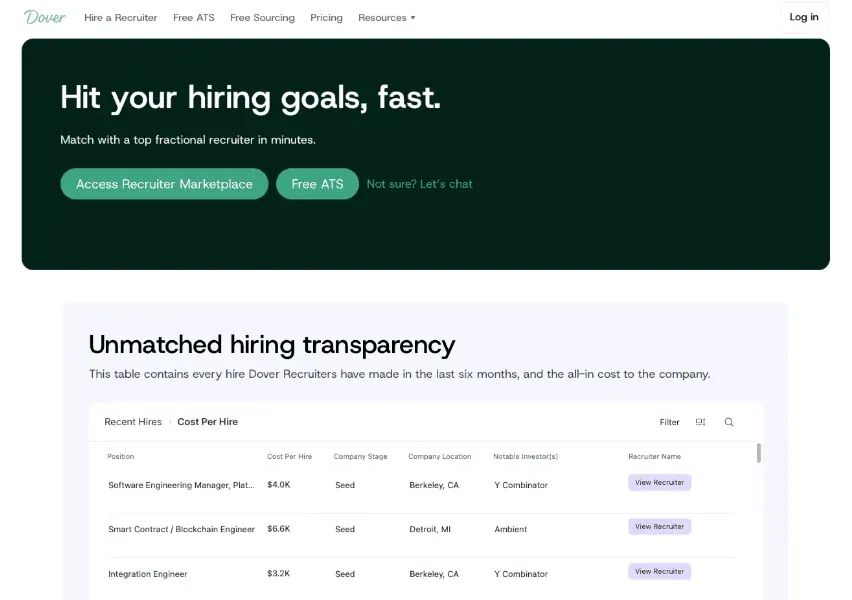
Dover sits at an interesting intersection: it offers a free ATS that any startup can set up in minutes, paired with access to fractional recruiters who work on a per-hire basis. The two components are designed to work together, but they don’t have to. A founder can use the ATS to manage candidates, and post to 50+ job boards without paying anything. When a search gets complicated, or when hiring volume picks up faster than the team can absorb, they can bring in a fractional recruiter through Dover at $2,000-$7,000 per hire, with no retainer required.
Recruiters set their own rates and bill only for time worked, so founders can scope the engagement to what the search actually needs.
What this structure avoids is the all-or-nothing tradeoff that defines most recruiting options. You can hire a full-time recruiter you may not have enough work for yet, pay contingency fees that run 20-30% of first-year salary, or try to run searches manually while building the company. Dover’s model lets a small team hold the search infrastructure themselves and pull in experienced recruiting support when the search actually calls for it.
Frequently Asked Questions
What is fractional recruiting?
Fractional recruiting is hiring support delivered on a part-time or contract basis, where a professional recruiter handles sourcing, pipeline management, interviews, and hiring strategy without the overhead of a permanent headcount. You pay only for the hours or work you actually need instead of committing to a full-time salary.
Fractional recruiter vs. contingency agency: what’s the actual difference?
A fractional recruiter works as an embedded partner who learns your company and hiring bar, operating like an internal recruiter without the full-time commitment. Contingency agencies only get paid when they place a candidate, which creates incentives around speed over fit, and they typically charge 15 to 25% of first-year salary ($18,000 to $30,000 on a $120,000 hire).
Can I use a fractional recruiter if I’m only hiring two roles this year?
Fractional recruiting makes the most economic sense when you’re hiring five or more roles annually. For one or two roles per year, the onboarding overhead may outweigh the return, and you might be better off running those searches internally or bringing in targeted help only for sourcing.
Final Thoughts on Fractional Recruiting for Startups
Understanding what is fractional recruiting and whether it fits your stage comes down to one assessment: has hiring become a real job inside your company without becoming anyone’s actual job title? For most early-stage teams, that gap is exactly where a fractional recruiter for startups adds the most value. If you need an on-demand recruiter who can step in for a defined search without the overhead of a permanent hire, Dover’s model is worth looking at: a free ATS paired with fractional recruiter access on a per-hire basis, so you hold the process yourself and pull in support only when the search calls for it.