

Everyone asks about fractional recruiter cost, but the real answer depends on how often you hire and how much help you actually need. Filling one role might take $2,000 in recruiter hours, while steady hiring can land closer to $4,000 per month. The difference comes down to pricing models, scope of work, and how fractional recruiting compares to agencies or full-time hires. This overview breaks down the common pricing options, real-world scenarios, and what founders should expect to pay as hiring ramps up or slows down.
TLDR:
-
Fractional recruiters set their own rates, with per-hire costs typically ranging $2,000-$7,000 (higher or lower depending on role complexity and hours needed), compared to agency fees that often run $25,000 or more per placement.
-
You pay only for hours used with no contracts, often saving 60-70% compared to the fully loaded cost of a full-time recruiter.
-
Founders often spend 15-25 hours per week on DIY recruiting tasks, costing $3,000-$5,000 in lost productivity.
-
Some modern solutions connect you with vetted fractional recruiters starting at $800 refundable deposit.
-
Fractional recruiter cost scales with hiring demand, making it easier to spend more during growth spurts and less when hiring slows.
What Is a Fractional Recruiter?
A fractional recruiter is an experienced hiring professional who works with your company part-time or project-based instead of full-time. You bring them in exactly when needed, without committing to a permanent hire.
These recruiters typically have 10-15 years of experience in talent acquisition and handle the full recruitment cycle: sourcing candidates, screening resumes, conducting interviews, and closing talent. The difference is you pay hourly or per project instead of a full-time salary with benefits.
For startups, fractional recruiters bridge the gap between expensive agencies (charging 15-25% of first-year salary) and full-time recruiters (costing $85,000-$170,000 annually once you factor in salary, benefits, and overhead). You get recruiting help during busy hiring periods without overhead when things slow down. Choosing the right recruiter is key to making this model work.
Fractional Recruiter Pricing Models Explained
Fractional recruiters work on three main pricing structures, each suited for different hiring needs and budgets.
The hourly billing model gives you the most flexibility. You pay only for time spent, with no contracts or placement fees. For a deeper breakdown of fractional recruiter costs, check out our detailed guide. This works well if you need help sourcing candidates for a single role or want recruiting support that scales with your hiring pipeline.
Monthly retainers make sense when you have consistent hiring volume. You get a set number of hours each month at a predictable cost, though you’re committed to paying during slower periods.
Contingency fees mirror traditional agency pricing. Most startups avoid this model since the whole point is escaping expensive percentage-based agency fees.
How Much Does a Fractional Recruiter Actually Cost?
Hires through Dover’s marketplace cost about $4,000 on average (median around $2,700), though the total varies with role complexity and hours needed. For 2-3 positions quarterly, you might typically spend somewhere in the $8,000-$12,000 range, compared to a single agency placement at $18,000-$30,000 or more.
For ongoing hiring needs, 10 hours weekly typically runs $3,000 to $5,000 monthly depending on hourly rate, or roughly $48,000-$60,000 annually on average. That’s around 60-70% less than a $150,000+ full-time recruiter with benefits.
Most Dover customers have spent an average of $2,000-$7,000 per hire. A startup filling five roles per quarter invests $15,000-$25,000 total instead of six figures through agencies.
| Fractional Recruiter | Traditional Agency | In-House Recruiter | |
|---|---|---|---|
| Typical cost | $2,000-$7,000 per hire on average | $18,000-$30,000 per hire (15-25% of salary) | $85,000-$170,000 per year (loaded) |
| Pricing structure | Recruiters set their own rates, no contract | Percentage of first-year salary, per placement | Annual salary plus benefits overhead |
| Flexibility | Start or stop anytime, scale with hiring volume | Fixed per engagement, exclusivity clauses common | Fixed overhead year-round regardless of hiring pace |
| Recruiter focus | Dedicated to your roles and culture | Multiple clients, volume-driven incentives | Dedicated to your company full-time |
| Best for | Seed through Series B, sporadic or burst hiring | One-off urgent fills with no internal capacity | Consistent hiring at 10+ roles per month |
| Pipeline ownership | Candidate data stays in your ATS | Sourcing intelligence leaves with the agency | Full internal ownership from day one |
Fractional Recruiters vs. Traditional Recruiting Agencies
Traditional recruiting agencies operate on contingency fees, charging 15-25% of first-year salary. For a $120,000 role, that’s $18,000-$30,000 per placement.
Agencies work on volume, juggling dozens of searches and often submitting the same candidate to multiple companies. Their incentive is closing deals fast, not finding your best fit.
Fractional recruiters work differently. You get a dedicated recruiter who learns your company and culture, focusing exclusively on your open roles. They integrate into your hiring process like an internal team member, not a vendor pushing candidates.
The service model matters too. With fractional recruiters, you control the relationship and hours invested. With agencies, you’re locked into their process and fee structure with minimal transparency into their work.
Fractional Recruiters vs. In-House Recruiters
An in-house recruiter may cost $60,000-$120,000 annually in salary, plus benefits (30-40% on top), software, and onboarding. The real cost reaches $85,000-$170,000 per year.
If you’re making fewer than 8-10 hires monthly, a full-time recruiter is often underutilized. A fractional recruiter through Dover’s marketplace costs about $4,000 per hire on average. At five hires quarterly, that’s $20,000 versus $42,500 for a quarter of an in-house recruiter’s loaded cost.
In-house recruiters work best for consistent, high-volume hiring. Series B companies filling 10+ roles monthly benefit from dedicated headcount who understand your brand and build long-term pipelines.
For early-stage startups with sporadic hiring, fractional recruiters deliver senior-level expertise without overhead. Scale support up during growth spurts and down when hiring slows.
When Should Startups Hire a Fractional Recruiter?
Fractional recruiting makes sense when you’re spending more than 20 hours weekly on hiring tasks. If your founder or team is stuck sourcing candidates, screening resumes, and coordinating interviews instead of building product or closing customers, outside help pays for itself.
Another clear signal: you need to fill 8-10 roles in the next few months. That’s too much for founders to handle alone but not enough volume to support a $150,000+ full-time recruiter. A fractional recruiter gives you professional support scaled to your actual hiring load.

Watch for hiring bottlenecks slowing your business. Missing revenue targets because you can’t close a sales hire fast enough? Product roadmap stalled waiting for engineers? These delays cost far more than a fractional recruiter’s hourly rate.
Seed through Series B companies get the most value from fractional recruiting. Your hiring needs fluctuate as you close funding rounds, launch products, or enter new markets. You need recruiting firepower that ramps up and down with your growth curve.
Hidden Costs of Not Using a Fractional Recruiter
Founders managing their own recruiting lose 15-25 hours weekly to hiring tasks. At $200+ per hour in opportunity cost, that’s $3,000-$5,000 in lost productivity each week.
Time-to-hire directly impacts growth. Every extra month a key role sits open delays product launches, revenue growth, or fundraising milestones. An engineering role unfilled for three months costs you an entire quarter of development work.
Bad hires hurt worse. Without recruiting expertise, startups can hire the wrong person, leading to turnover within the first year. Between severance, lost productivity, and restarting the search, some estimates suggest a bad hire can cost 2-3x their annual salary, though figures vary widely across studies.
Six months of DIY recruiting at 20 hours weekly equals 480 hours you could have spent closing deals, shipping features, or talking to investors. Two hires through a fractional recruiter at about $4,000 each cost roughly $8,000 while freeing up 400+ hours of your time.
How Dover’s Recruiter Marketplace Improves on Traditional Fractional Recruiting
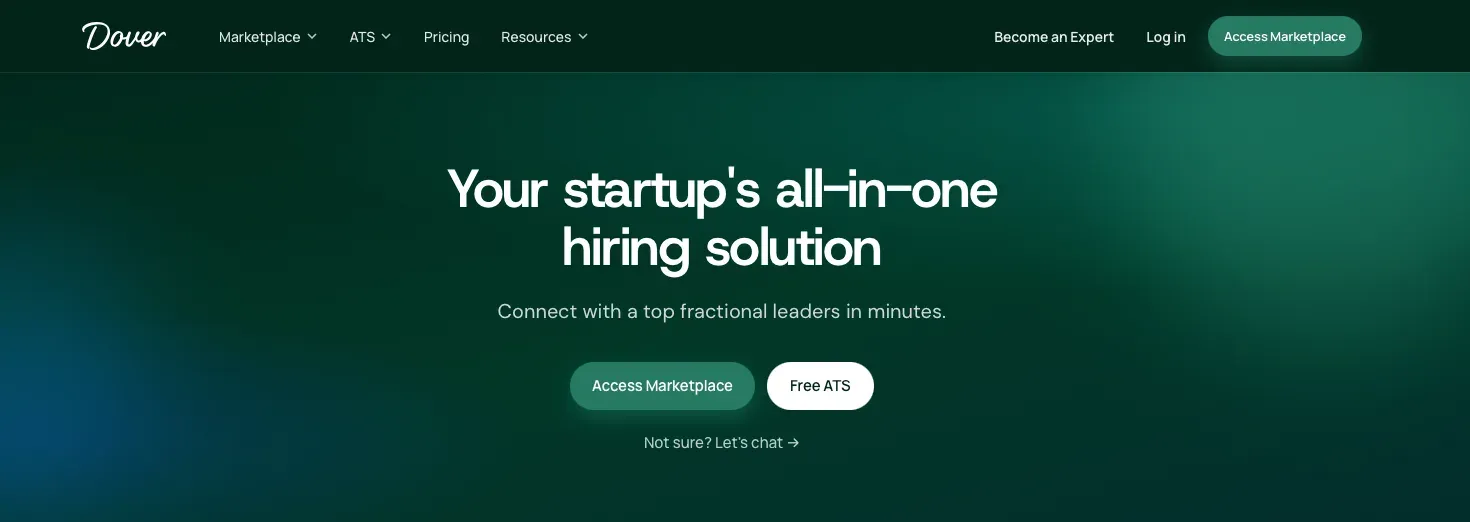
Dover is the infrastructure fractional recruiting agencies are built on: a shared ATS, on-demand recruiter access, and full pipeline visibility in one system. Companies get access to experienced fractional recruiters built for startup hiring without relying on expensive agencies or premature full-time recruiting hires, and founders manage hiring in one place while staying close to every decision.
Recruiter quality and flexibility sit at the core of Dover’s model. The network is highly selective, with experienced recruiters carrying verified reviews from prior startup engagements and 10 to 15 years of hiring experience across engineering, product, sales, marketing, and leadership roles. Companies work directly with recruiters focused on their open positions and can scale support across multiple roles when hiring picks up. There are no contracts or placement fees, and teams pay only for hours used after starting with an $800 fully refundable deposit.
Everything runs through Dover’s free ATS, which creates a shared system where the fractional recruiter and the hiring team work from the same pipeline in real time. Both sides see sourcing activity, candidate feedback, and stage progress as it happens, so there is no coordination overhead from handoff emails, no duplicate outreach to the same candidates, and no context lost if a search runs longer or priorities shift. Hiring managers can post jobs to 100 plus boards, track referrals, score applicants, and coordinate interviews without extra software or handoffs. If hiring needs change, teams can switch recruiters without restarting searches.
Frequently Asked Questions
How much should I budget for a fractional recruiter per hire?
Most companies spend an average of $2,000-$7,000 per hire when working with a fractional recruiter, though costs can be higher or lower depending on role complexity and seniority. This typically covers 20-30 hours of work, covering sourcing, screening, and closing candidates at rates each recruiter sets.
What’s the difference between a fractional recruiter and a traditional recruiting agency?
Fractional recruiters work hourly as an extension of your team, focusing exclusively on your roles and culture fit, while agencies charge 15-25% placement fees ($18,000-$30,000+ per hire) and often submit the same candidates to multiple companies with less personalized attention.
Can I start working with a fractional recruiter without a long-term contract?
Yes, most fractional recruiters work on flexible hourly arrangements with no contracts required. With Dover’s marketplace, you can start with an $800 refundable deposit and pay only for hours used, scaling up or down based on your hiring needs.
How long does it typically take a fractional recruiter to fill a role?
A fractional recruiter dedicating around 20 hours across 3-4 weeks can usually fill a standard role, though timeline varies based on role difficulty, your interview speed, and market conditions for that specific talent pool.
Do I need an ATS to work with a fractional recruiter?
Not necessarily, but a shared system is what removes coordination overhead. When a fractional recruiter and the hiring team work from the same ATS, both see sourcing activity, candidate feedback, and pipeline progress in real time, with no handoff emails, no duplicate outreach to the same candidates, and no context lost if the search extends or priorities change. Without shared visibility, updates move through email or spreadsheets, which slows feedback loops and makes it harder to course-correct mid-search. Some free ATS tools can be running in under five minutes and post to 100 or more job boards automatically, so there is little reason to wait. The cleanest setup pairs the ATS and the fractional recruiter in one shared system from the start of the first search.
Final Thoughts on the Cost of Fractional Recruiters
Fractional recruiter cost typically falls between $2,000 and $7,000 per hire, offering a clear contrast to the $18,000 to $30,000 fees charged by traditional agencies. This model gives teams access to experienced recruiting support without paying for unused time or long-term headcount. Dover’s approach pairs a free ATS with vetted fractional recruiters in one shared system, so the hiring team and the recruiter work from the same pipeline without switching tools or managing separate workflows. If you are comparing recruiting options, this cost guide shows how Dover helps companies control spend while keeping hiring momentum strong.
-recruiting-hero-ba99639a.zcrlfqTR_Z1g1uIg.webp)