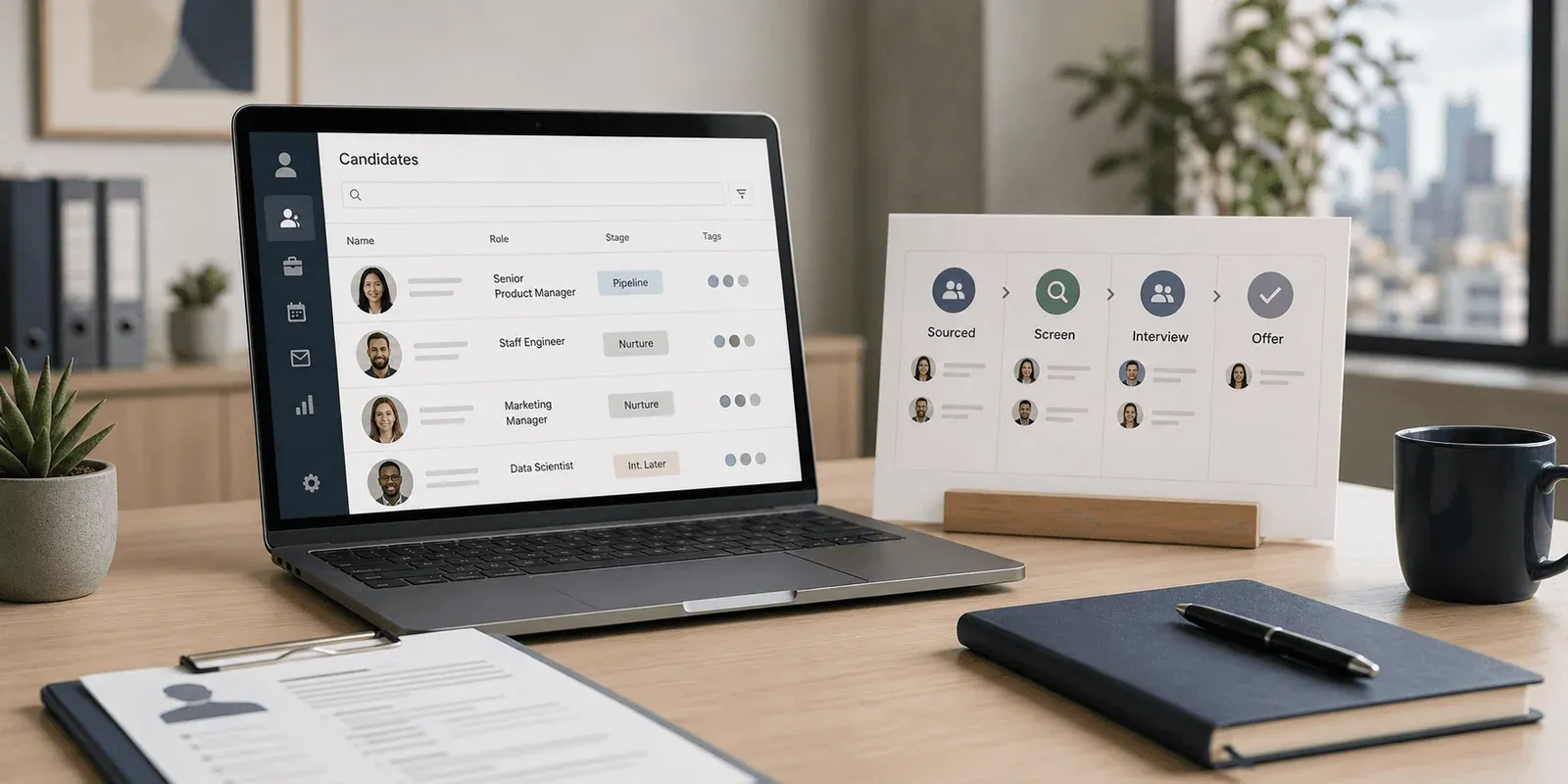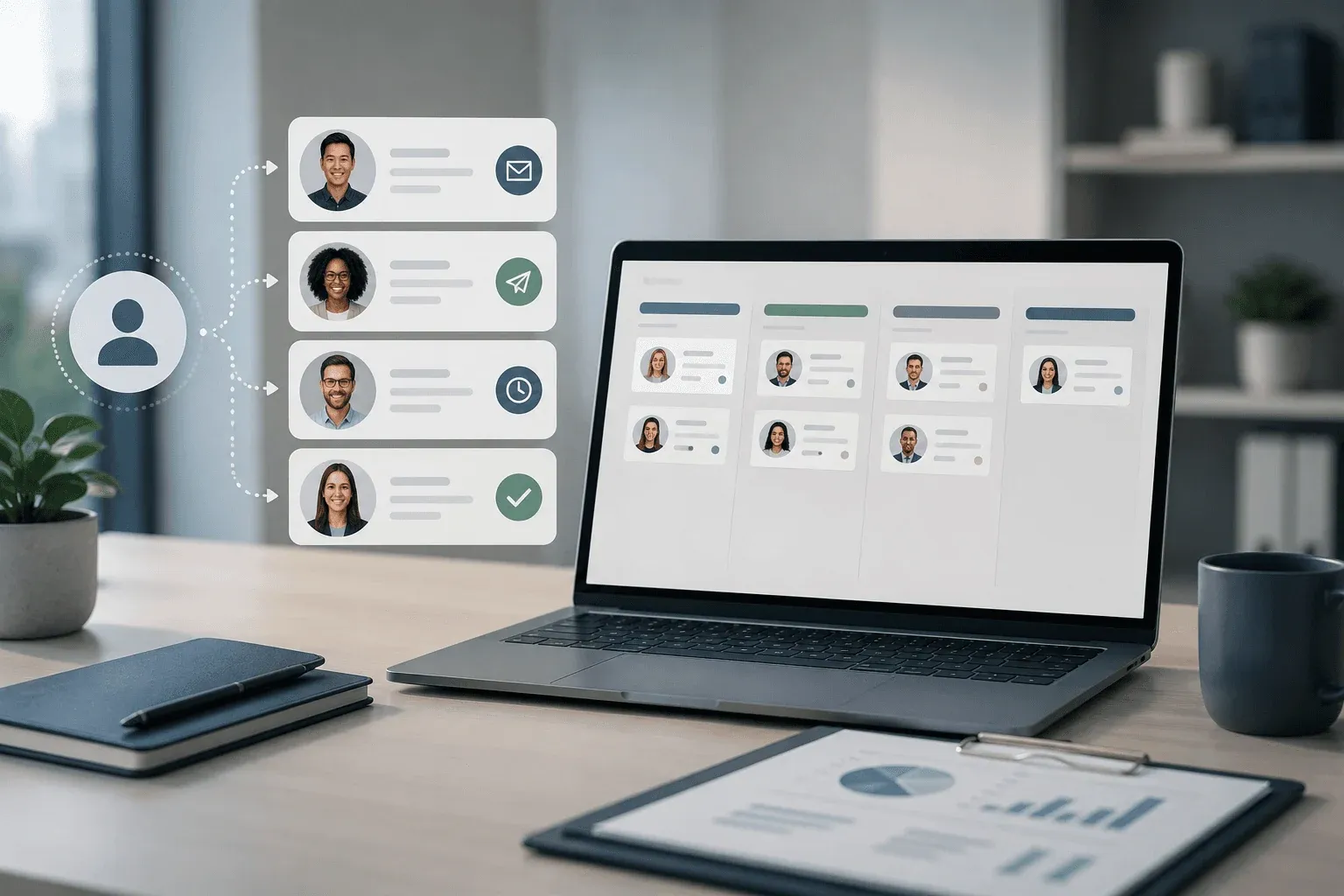

For early-stage teams without a dedicated recruiter, hiring tends to operate reactively: a role opens, the search starts from scratch, and the process stalls on whoever has the least bandwidth that week. Understanding how to use an ATS to reduce time-to-hire as a startup changes that pattern. The right setup automates coordination work, keeps candidates moving through a defined pipeline, and gives founders and hiring managers a repeatable process they can run without losing weeks to manual scheduling and scattered feedback. This guide covers what to look for in a system, how to configure it for speed, and when to bring in additional support to keep hiring from becoming a bottleneck.
TLDR:
-
An ATS cuts time-to-hire by automating job distribution, tracking candidates through stages, and removing scheduling delays.
-
Build a standing pipeline before you need it so new roles pull from warm candidates instead of starting from scratch.
-
Use time-in-stage reporting weekly to spot where candidates stall and fix the right bottleneck.
-
A fractional recruiter can accelerate hiring when your ATS generates more applicant volume than your team can review.
-
Free ATS tools with built-in recruiter support let startups access $4,800 per hire instead of contingency firm rates.
Why Startups Use an ATS to Reduce Time-to-Hire
Every week a role stays open is a week of lost output and a higher chance your top candidate accepts an offer elsewhere. An ATS cuts time-to-hire by removing friction across a manual process. Instead of tracking candidates in spreadsheets or losing applicants to slow follow-up, the entire workflow lives in one place. Hiring cycles can shrink by 60% when job postings, scheduling, and offers run through a single system. Choosing the right system matters when bandwidth is limited.
A few ways an ATS reduces time-to-hire in practice:
-
Automated job distribution posts a role to multiple boards at once.
-
Structured stages keep candidates moving and make bottlenecks easy to spot.
-
Integrated scheduling removes back-and-forth that adds days to the process.
-
Centralized records mean anyone on the team can get up to speed without asking for a recap.
What to Look for in an ATS Before You Reduce Time-to-Hire
Not every ATS will actually help you hire faster. Some are built for enterprise teams with dedicated recruiters. The wrong system adds friction instead of removing it.
-
Pipeline visibility: A clear view of where every candidate stands keeps things moving and prevents slow follow-up.
-
Automated scheduling and communication: Candidates should be able to book time directly, with automated status updates so your team isn’t buried in coordination.
-
Job board integrations: Single-source syncing to major job boards keeps listings current without extra work.
-
Reporting on time-related metrics: Built-in stage-level reporting shows where candidates stall and how long roles stay open.
-
Setup time: A system that runs in under a day beats one with more features that never gets configured.
How Reducing Time-to-Hire Fits Into Your Full Hiring Pipeline
Most early-stage teams lose time between pipeline phases, not within them. An ATS creates a shared record of where each candidate stands and who acts next, keeping handoffs from stalling the search.

There are a few specific ways this shows up in practice:
-
Keeping sourcing and screening in sync means that as new applicants come in, they get routed immediately against your criteria instead of accumulating in an inbox for someone to sort later.
-
Interview scheduling stops being a coordination tax when interviewers have visibility into the pipeline and candidates can book directly into available slots without back-and-forth email chains.
-
Offer decisions move faster when the team has a documented evaluation trail to reference, instead of reconstructing impressions after interviews have already faded.
When each phase hands off cleanly to the next, time-to-hire shrinks as a natural result of the process working, not because anyone is cutting corners on assessment.
When to Bring in a Fractional Recruiter to Support Reducing Time-to-Hire
A fractional recruiter steps in as a part-time hiring specialist without a full-time overhead, owning sourcing, screening, and coordination when internal bandwidth runs thin.
This tends to work well when:
-
You are hiring three or more roles at once and cannot review volume fast enough to keep candidates warm.
-
Time-to-hire has stretched to the point where you are losing finalists to faster competitors.
-
Roles require sourcing in a tight talent pool that job board postings alone will not reach.
-
Your ATS is running but no one has consistent time to work it.
A fractional recruiter does not replace your ATS; they fill the human gaps automation cannot, particularly candidate communication and judgment calls on fit.
The Cost of Getting Reducing Time-to-Hire Wrong as a Startup
Top candidates leave the market within 10 days, yet the typical role takes a median 44 days to fill. At a startup, that gap can mean a delayed launch or a team covering holes for months.
-
Wasted hours on screening tasks an ATS handles automatically
-
Candidate drop-off when top applicants accept competing offers mid-funnel
-
Inconsistent evaluations that slow final decisions
How Dover Helps Startups Reduce Time-to-Hire Without the Overhead
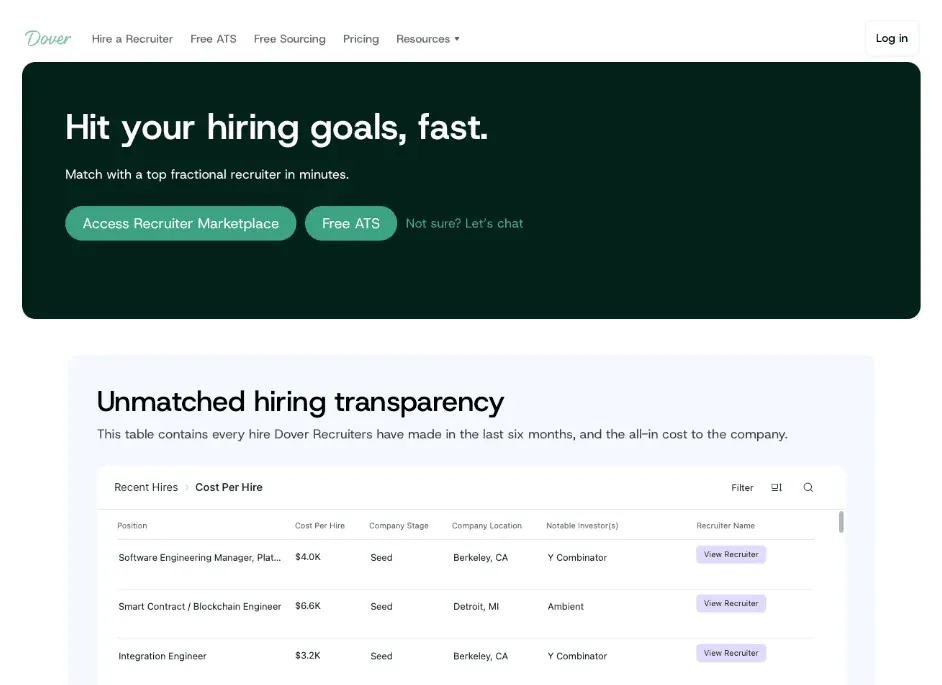
Dover’s free ATS removes several of the manual bottlenecks that slow early-stage teams down. Instead of juggling spreadsheets or paying for recruiting infrastructure you’ll outgrow, you get a structured hiring workflow that keeps candidates moving without requiring a dedicated recruiter to run it.
The setup takes under five minutes, and once your jobs are live, Dover automatically syncs them to over 50 job boards. That kind of distribution would otherwise require manual posting across channels, which quietly eats hours that founders and operators rarely have.
Where Dover tends to make a measurable difference for startups is in the handoff between sourcing and screening. Instead of letting inboxes fill up while a hiring manager context-switches between other work, Dover’s AI screening tools can filter applicants against your criteria so the candidates who reach your team are already pre-qualified. That said, human review still matters, especially for senior or niche roles where fit depends on factors that go beyond a job description.
Dover also keeps recruiter costs in a predictable range. For startups that need more than software, Dover’s recruiting support runs about $4,800 per hire, which is a fraction of what a contingency firm typically charges. For teams that want recruiter hours without a full engagement, hourly support is available, with recruiters setting their own rates.
The practical result is that time-to-hire can shrink not because the process gets rushed, but because fewer steps fall through the cracks between sourcing, screening, and scheduling.
Frequently Asked Questions
Can I reduce time-to-hire without hiring a full-time recruiter?
Yes. An ATS automates job board posting, scheduling, and candidate tracking so founders can run a faster process without dedicated headcount. Fractional recruiting support at $4,800 per hire costs far less than a full-time recruiter.
What’s the fastest way to spot where my hiring process is actually stalling?
Pull time-in-stage reports weekly. A lag on first response is a process gap; stalling at the final round is a scheduling or decision problem. The data tells you where to fix things.
How does an ATS actually cut time-to-hire for startups?
Automated job distribution posts roles to 50+ boards at once, structured pipelines keep candidates moving, and integrated scheduling removes email back-and-forth, fewer dropped candidates, faster decisions.
Free ATS vs paid ATS for reducing time-to-hire?
Free options like Dover cover the core features early hiring needs (automated posting, scheduling, pipeline visibility, and reporting) without per-seat costs. Paid enterprise systems add features most startups won’t need until 100+ employees.
Final Thoughts on How to Use an ATS to Reduce Time-to-Hire as a Startup
Knowing how to use an ATS to reduce time-to-hire as a startup is less about picking the right software and more about building a repeatable process around it. The tools that cut weeks off a hiring cycle are not complicated, but they only work when someone has configured the pipeline, set the stage criteria, and committed to reviewing time-in-stage data regularly. For most early-stage teams, that discipline is the gap, not the technology. Dover was built with this in mind: a free ATS that distributes jobs to over 50 boards automatically, keeps candidates moving through a structured pipeline, and connects to recruiting support when internal bandwidth runs out. Whether you are filling your first technical role or hiring across three functions at once, the path to a shorter time-to-hire starts with getting the right system in place and running it consistently.