Approximately 98% of Fortune 500 companies rely on an applicant tracking system (ATS) to run their hiring, and that same technology is now within reach for startups and growing teams. An ATS helps you track candidates, cut down on manual work, and keep your hiring process organized from the first job post to the final offer. If your startup is filling roles and feeling the friction, this article covers the top benefits of ATS platforms and why adding one to your hiring stack makes sense.
TLDR:
-
A GetApp survey found 86% of recruiters say an ATS reduced their time-to-hire, with 79% reporting better hire quality.
-
Automating job postings, resume scoring, and interview scheduling keeps candidates moving without manual follow-up.
-
An ATS handles pipeline tracking and team coordination, but does not add sourcing capacity for senior or specialized roles.
-
When searches grow complex, pairing an ATS with a fractional recruiter can cover the gap without a full-time hire.
-
Some tools combine free ATS software with on-demand recruiting support at $2,000 to $7,000 per hire, no retainer required.
An Introduction to Applicant Tracking Systems
First things first: an ATS, or applicant tracking system, is a software solution designed to help simplify the recruiting and hiring process. Features and functionality vary by tool, but generally you get capabilities to help you track candidates, automate manual tasks in the hiring process and make more great hires in a fraction of the time.
The Case for Startups Using an ATS
If you run a startup, you know that any way you can save time is a win. Think about your recruiting and hiring process. Are there frequent frustrations and bottlenecks? Does top talent sometimes slip through the cracks because you didn’t move their application forward fast enough? Do you want to fill a position sooner than later? Do you want to save time and money by making your hiring process more efficient? If your answer is yes to any of these questions, then you could benefit from an applicant tracking system.
An ATS can prevent the hiring process from becoming chaotic, helping you to track candidates and keep them organized through every step of the process. There’s also the fact that your hiring team members are likely wearing multiple hats, and you don’t necessarily have an expert recruiter on board. That’s where an ATS comes in. You don’t have to be an expert to use one, and it gives you incredible tools to run a professional startup hiring pipeline.
Top ATS Benefits for Startup Hiring
Applicant tracking systems offer numerous benefits for startups. Let’s go over some of the biggest benefits that you’ll reap when you add an ATS to your hiring software stack.
| ATS Benefit | What It Does | Best For |
|---|---|---|
| Speed up recruiting | Automates job posting, resume scoring, and candidate tracking | Cutting time-to-hire across all roles |
| Keep your team connected | Centralizes internal feedback and automates candidate communications | Teams with multiple hiring stakeholders |
| Make data-driven decisions | AI scoring surfaces top candidates first and tracks pipeline metrics | Roles where hire quality matters most |
| Scale with your growth | Handles unlimited job postings and manages high-volume applicant flow | Startups in active growth phases |
1. Speed Up the Recruiting Process
A GetApp survey found that more than 86% of recruiters say an ATS has reduced their time-to-hire, and SHRM’s 2025 recruiting benchmarks put median time-to-fill at around 44 days. Even modest reductions in that window give startups a real edge in competitive hiring. An ATS lets you automate and organize key parts of the process, cutting the chance of errors like missing a follow-up with a top candidate.
Here are a few ways that platforms like Dover can greatly speed up the recruiting process:
-
Generate job descriptions: Dover offers job description templates and 50+ job board integrations. Instead of spending hours drafting and posting individually, you get broader reach in seconds.
-
Automate sorting: Dover’s AI-powered resume scoring pushes top candidates to the front of your applicant stack. You still review every candidate, but the strongest options surface first.
-
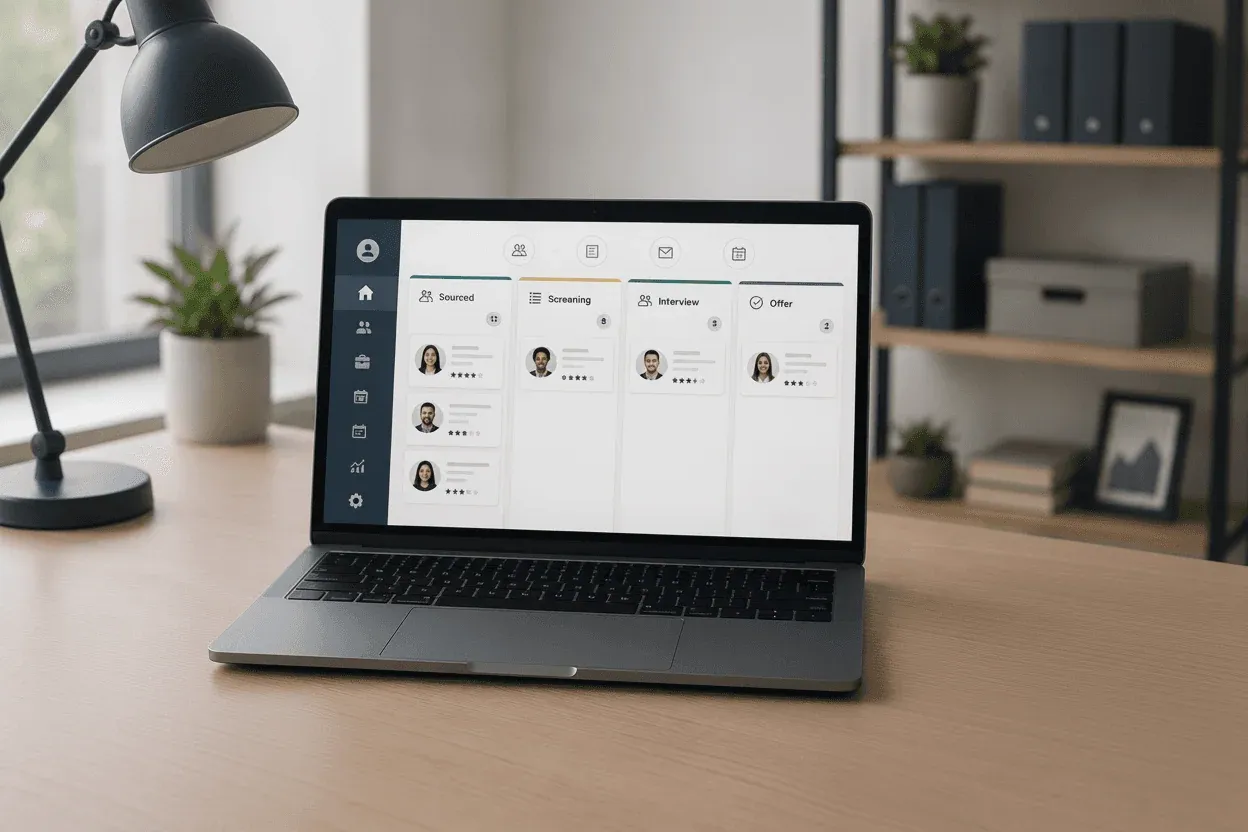
Track candidates: A clear dashboard shows where every candidate stands in the pipeline, giving your team a top-down view at a glance.
2. Keep Your Hiring Team Connected
Communication and collaboration are key to making great hires. An ATS centralizes feedback from all hiring stakeholders in one place, so the whole team works from the same information when making decisions about candidates.
Externally, an ATS can also help you keep candidates engaged and moving through the hiring process by automating responses and interview scheduling. Whether you’re letting a candidate know you received their application, sending a polite rejection email or scheduling the next phase of an interview, you can count on candidates receiving timely and professional communications to keep them up to date. This makes the candidate experience better and helps you avoid missing out on top talent.
3. Make Data-Driven Hiring Decisions
Remember the GetApp survey that said most recruiters mentioned their ATS reduced their time-to-hire? That wouldn’t matter much if those candidates weren’t good quality, but GetApp also found that 79% of recruiters found that there has been an increase in the quality of the hires once they started using an ATS. In other words, most recruiters feel like ATS platforms help them make better hires, faster. This includes getting more value from past applicants through candidate rediscovery.
Dover’s AI-powered applicant scoring surfaces top candidates first, so your team spends time on the strongest options instead of sorting through every application manually. Getting quality candidates into the pipeline faster means fewer gaps and more hires who stay.
4. Keep Pace With Your Startup’s Growth
Scaling the hiring for startups process gets harder as headcount grows, but an ATS keeps pace. Unlimited job postings and organized applicant flows mean your hiring team stays on top of volume without getting buried in manual tracking.
Automation matters more as volume picks up. Routine tasks like status updates, rejections, and scheduling happen without manual input, freeing your team to focus on the candidates who need a closer look.
That said, an ATS handles the infrastructure: pipeline tracking, automation, and team coordination. It does not add recruiting capacity. When searches become more specialized, roles are senior, or hiring volume picks up faster than the team can manage, the software layer alone may not cover everything. At that point, pairing an ATS with a fractional recruiter can be the more practical approach. The pipeline stays organized and visible in the system, while a dedicated recruiter handles sourcing and outreach in parallel, without the overhead of a full-time hire or a traditional agency contract.
How to Choose the Right Recruiting Software
Now that you know the benefits of an applicant tracking system, the natural next step is to find an ATS for your startup. But where do you even start? As with many software solutions, there are a lot of ATS options out there. You’ll need to make sure your ATS has all of the features you need to get the benefits we covered here, and you’ll also need to make sure it fits your budget.
It can be frustrating to wade through the numerous ATS options only to end up with one that is too complicated or costly for your startup. The fact is, a lot of applicant tracking systems aren’t really built for startups. Fortunately, that’s where we come in.
How Dover Fits Into Your Startup’s Hiring Stack
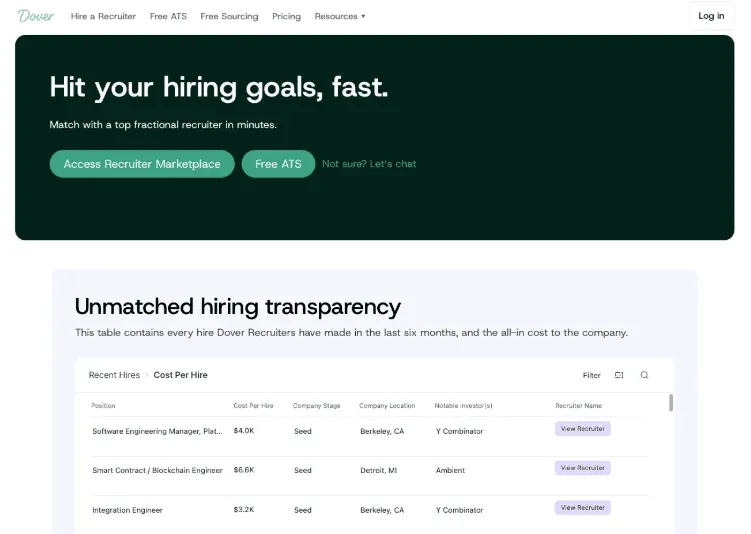
Dover’s free ATS is built with startup hiring in mind. Setup takes under five minutes, there are no per-seat fees, and the system handles everything from AI-powered resume scoring to one-click job posting across 50+ job boards. For teams without a dedicated recruiter, that covers the mechanics of running an organized hiring process from the first role forward.
Dover’s recruiter marketplace adds a layer that most ATS tools leave out. When a search becomes more demanding (a senior role, a competitive market, a position where passive candidates matter), hiring managers can bring in experienced fractional recruiters who work directly inside the same system. Recruiters handle sourcing, outreach, and candidate management while the hiring team retains full pipeline visibility. Recruiters set their own rates, with no retainer or contract required. SHRM’s 2025 cost-per-hire data puts the average non-executive hire at $5,475 before agency fees, which gives that $2,000 to $7,000 per-hire range some useful market context.
Because both pieces run in one system, there is no handoff friction. The hiring team sees sourcing activity and candidate flow in real time, and the recruiter works with the same context the team has already built. Free ATS software handles day-to-day pipeline management; on-demand recruiting capacity covers searches that need more active work. That structure keeps hiring organized without requiring full-time recruiting headcount or a traditional agency relationship.
Frequently Asked Questions
Do I need a recruiter if I’m already using an ATS?
An ATS organizes your pipeline and automates routine tasks; a recruiter adds sourcing capacity and manages candidate relationships. For inbound-heavy or lower-complexity roles, an ATS alone often covers the work. For senior, specialized, or competitive searches, pairing an ATS with a fractional recruiter fills the gap without the overhead of a full-time hire.
What’s the difference between an ATS and full recruiting support?
An ATS is software: it tracks applicants, automates communications, and keeps hiring teams coordinated. It does not source candidates or build relationships with passive talent. Full recruiting support adds that human layer, and when both run in one system, the recruiter sources directly into the pipeline while the hiring team retains full visibility.
How do I know if my startup is ready for an ATS, or if I need to hire a full-time recruiter?
An ATS makes sense from your very first hire. A full-time recruiter typically becomes worth the investment around 15 to 20 annual hires. Between those points, an ATS paired with a fractional recruiter (typically $2,000 to $7,000 per hire) covers most startup hiring needs without the overhead of a salaried headcount.
Final Thoughts on Scaling Startup Hiring With an ATS
Getting hiring right at an early stage is less about finding the perfect tool and more about building a process that keeps good candidates moving. An applicant tracking system (ATS) handles the infrastructure side of that problem. Dover takes it a step further by pairing free pipeline management with access to fractional recruiters when a search needs dedicated sourcing. Whether a startup is filling its first role or its fifteenth, organized tracking paired with on-demand recruiting capacity covers most of what early-stage hiring requires, without the overhead of a full-time recruiter or the cost of a traditional agency.