ATS with Fractional Recruiter: Complete Guide for Startups (April 2026)

Dover

April 20, 2026

4 mins

Hiring gets messy when your tools and people aren’t aligned. One system tracks candidates, another holds recruiter activity, and you’re left piecing together what’s actually happening. An ATS with fractional recruiter support fixes that by bringing both sides into the same workflow, where sourcing, outreach, and feedback live in one place from the start. Instead of managing updates across tools, your team can stay focused on decisions while the process runs in the background. For startups trying to keep hiring clear without adding extra layers, working with a recruiting solution that combines both pieces can simplify things early.

TLDR:

  • Fractional recruiters work inside your ATS for full visibility, costing $2,000-$7,000 per hire vs $18,000-$30,000 agency fees.

  • Free ATS software paired with fractional recruiting covers infrastructure and capacity without fixed overhead.

  • Fractional recruiting works best for startups making 5-50 hires yearly; consider full-time around 15-20 annual hires.

  • Shared candidate pipelines prevent duplicate outreach and keep your team and recruiter aligned in real time.

  • Some solutions combine a free ATS with vetted fractional recruiters in one system for startups hiring without headcount commitment.

Hiring gets messy when your tools and people aren’t aligned. One system tracks candidates, another holds recruiter activity, and you’re left piecing together what’s actually happening. An ATS with fractional recruiter support fixes that by bringing both sides into the same workflow, where sourcing, outreach, and feedback live in one place from the start. Instead of managing updates across tools, your team can stay focused on decisions while the process runs in the background. For startups trying to keep hiring clear without adding extra layers, working with a recruiting solution that combines both pieces can simplify things early.

TLDR:

  • Fractional recruiters work inside your ATS for full visibility, costing $2,000-$7,000 per hire vs $18,000-$30,000 agency fees.

  • Free ATS software paired with fractional recruiting covers infrastructure and capacity without fixed overhead.

  • Fractional recruiting works best for startups making 5-50 hires yearly; consider full-time around 15-20 annual hires.

  • Shared candidate pipelines prevent duplicate outreach and keep your team and recruiter aligned in real time.

  • Some solutions combine a free ATS with vetted fractional recruiters in one system for startups hiring without headcount commitment.

What a Fractional Recruiter Does within Your ATS

What a Fractional Recruiter Does within Your ATS

Traditional recruiting agencies operate like a black box. You hand over a job description, and somewhere off in the distance, a recruiter works their process. You get updates when they feel like sharing them, and you rarely see what's actually happening.



A fractional recruiter works differently. Instead of running a parallel process you can't see, they work inside your applicant tracking system alongside your team. Every candidate they source shows up in your pipeline. Every outreach, every status change, every note lands in the same place your hiring manager is already looking. There's no separate spreadsheet to align or status call to schedule just to find out where things stand.

In practice, a fractional recruiter embedded in your ATS typically owns sourcing, outreach, screening, and interview coordination, all within the same system your team already uses, while you retain full visibility at every step.

Why Startups Pair Free ATS Tools with Fractional Recruiting

Why Startups Pair Free ATS Tools with Fractional Recruiting

Most early-stage startups face the same tension: hiring is urgent, but budgets are thin and headcount needs change month to month. A full-time recruiter costs $85,000-$170,000 annually in loaded costs. A traditional agency charges 15-25% of first-year salary per placement. Neither works when you're making five hires this quarter and possibly zero next quarter.

Free ATS software solves the infrastructure problem without adding fixed overhead. Fractional recruiting solves the capacity problem without long-term commitments. Together, they cover both sides of the equation.

The pairing also makes practical sense from a workflow standpoint. When a fractional recruiter steps into a role that already has structure, a job posting, a pipeline, a feedback process, they can move fast from day one instead of spending their first hours building scaffolding. The ATS is the foundation; the recruiter is the person who runs on top of it.

Cost Comparison: Fractional Recruiters vs Traditional Agency Fees

Cost Comparison: Fractional Recruiters vs Traditional Agency Fees

Traditional agencies charge a percentage of salary, which means the better the candidate you hire, the more you pay. A $120,000 engineer at 20% costs $24,000 in fees. That's the penalty for offering competitive compensation.

Fractional recruiters flip this. You pay hourly, so your fee stays flat regardless of what the candidate earns.

Model

Fee Structure

Cost on a $120K Hire

Traditional Agency

15-25% of salary

$18,000-$30,000

Fractional Recruiter

Hourly billing

Roughly $2,000-$7,000

Full-Time Recruiter

Annual loaded cost

$85,000-$170,000/year

SHRM puts the average cost-per-hire at around $4,700 across all companies. In some cases, fractional recruiting can approach that range, though costs vary depending on role seniority and hiring complexity. Traditional agency fees often blow well past it, especially on senior roles where salaries are high and placement fees scale with them.

When Fractional Recruiting Makes More Sense Than a Full-Time Hire

Hiring volume is the clearest signal. If you're filling fewer than five roles a year, a fractional recruiter covers the work without the overhead. If you're consistently closing more than 50 roles a year, a full-time recruiter likely earns their salary. Between those two points, fractional is usually the smarter call.

Most seed to Series C startups land squarely in that middle range. Hiring needs spike during a fundraise, slow down during product crunch, then accelerate again. That variability makes a $170,000 annual commitment hard to support when you might only need heavy recruiting support for six months out of twelve.

A useful rule of thumb: consider a full-time recruiter when you're consistently making 15 to 20 or more hires per year. Below that threshold, fractional gives you the same expertise with far less fixed cost.

ATS Features That Matter Most for Fractional Recruiting Teams

Not every ATS feature matters equally when a fractional recruiter is involved. Some are nice to have. A few are genuinely load-bearing.



The ones that count:

  • Shared candidate pipelines so the recruiter and your team see the same stages, same candidates, and same status in real time without anyone waiting on a status update email.

  • Activity logs that track who sourced whom, preventing duplicate outreach to the same candidate from different directions.

  • Centralized notes and feedback so interview impressions stay in one place instead of scattered across inboxes.

  • Job board distribution that the recruiter can manage directly without needing a separate login or tool.

  • AI-powered applicant scoring to triage inbound volume before it lands on anyone's plate.

What you want to avoid is an ATS that forces the recruiter to work outside the system. The moment they're maintaining a separate tracker, you've lost the visibility that makes fractional collaboration worth it.

How ATS Integration Prevents Duplicate Outreach and Candidate Confusion

When multiple recruiters work separate tools, the same candidate can get contacted two or three times about the same role. Top candidates notice this, and a disorganized outreach experience can quietly damage how people perceive your company before a single interview takes place.

A shared ATS removes this problem structurally. When your fractional recruiter logs every sourced candidate directly into the same system your team uses, anyone checking that profile can see it has already been contacted. No guessing, no cross-referencing spreadsheets, no "did we already reach out to this person?" conversations.

Activity logs do the heavy lifting here. Every touchpoint, who reached out, when, and through which channel, stays attached to the candidate record. Your recruiter works from that record. Your team works from that record. There is no room for confusion to grow.

Setting Up Your Free ATS before Engaging a Fractional Recruiter

Getting your ATS configured before a fractional recruiter joins saves everyone time. A recruiter who walks into a blank system has to build before they can recruit.

A few things worth setting up first:

  • Create job postings with clear descriptions and distribute them to job boards so candidates are already flowing in when your recruiter gets started.

  • Define your interview stages so the pipeline reflects your actual hiring process, not a generic template.

  • Set up a careers page to capture inbound applicants from day one, giving your recruiter a live pool to work with immediately.

  • Decide which stages your team owns versus what you're handing off, so there's no overlap or confusion about who's responsible for what.

That last point matters most. Knowing your handoff points before the recruiter starts means they can begin sourcing and screening from day one.

Getting your ATS configured before a fractional recruiter joins saves everyone time. A recruiter who walks into a blank system has to build before they can recruit.

A few things worth setting up first:

  • Create job postings with clear descriptions and distribute them to job boards so candidates are already flowing in when your recruiter gets started.

  • Define your interview stages so the pipeline reflects your actual hiring process, not a generic template.

  • Set up a careers page to capture inbound applicants from day one, giving your recruiter a live pool to work with immediately.

  • Decide which stages your team owns versus what you're handing off, so there's no overlap or confusion about who's responsible for what.

That last point matters most. Knowing your handoff points before the recruiter starts means they can begin sourcing and screening from day one.

Dover: Free ATS Plus Vetted Fractional Recruiters in One System
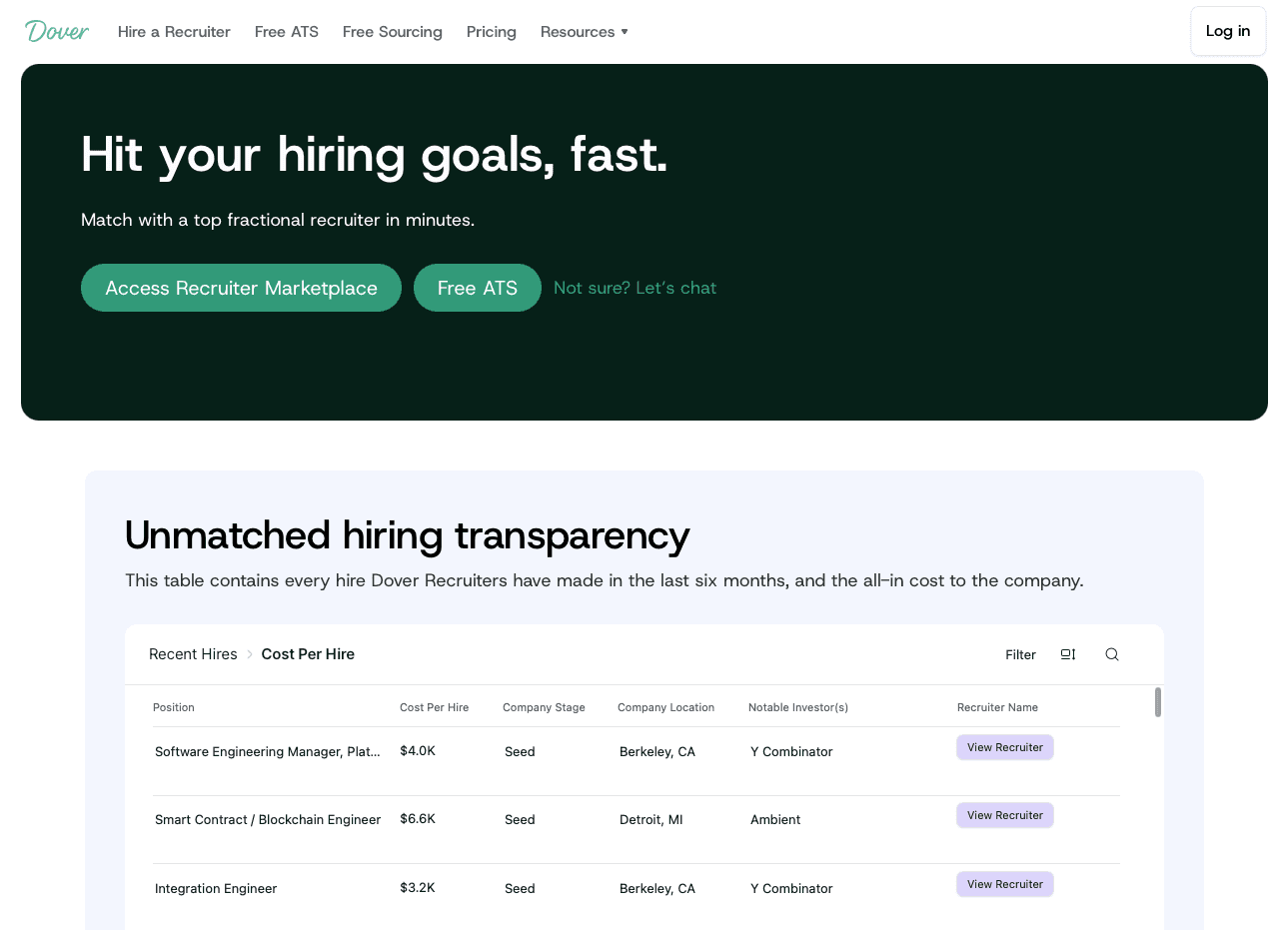
Most startups cobble together an ATS and a recruiter separately, then spend time making them work together. Dover skips that entirely.

The ATS is free. The recruiter marketplace connects you with vetted fractional recruiters who already work inside it. Because both sides live in one system, there's no onboarding friction, no orientation period, and no lag between when a recruiter starts and when they're actually productive.

Dover approaches fractional recruiting from a different starting point than most services. Recruiters in the network come with deep startup hiring backgrounds and are matched to roles where they have relevant experience. Every sourced candidate, every stage update, and every piece of recruiter activity shows up in the same pipeline your team is already watching. Cost-per-hire data, funnel metrics, and recruiter performance are all visible without chasing anyone for a report.

For startups hiring between 5 and 50 roles a year, that combination of free infrastructure plus on-demand expertise covers the full recruiting function without a full-time headcount commitment.

Most startups cobble together an ATS and a recruiter separately, then spend time making them work together. Dover skips that entirely.

The ATS is free. The recruiter marketplace connects you with vetted fractional recruiters who already work inside it. Because both sides live in one system, there's no onboarding friction, no orientation period, and no lag between when a recruiter starts and when they're actually productive.

Dover approaches fractional recruiting from a different starting point than most services. Recruiters in the network come with deep startup hiring backgrounds and are matched to roles where they have relevant experience. Every sourced candidate, every stage update, and every piece of recruiter activity shows up in the same pipeline your team is already watching. Cost-per-hire data, funnel metrics, and recruiter performance are all visible without chasing anyone for a report.

For startups hiring between 5 and 50 roles a year, that combination of free infrastructure plus on-demand expertise covers the full recruiting function without a full-time headcount commitment.

Frequently Asked Questions

Can I use a fractional recruiter without paying for expensive ATS software?

Yes. Many free ATS tools work well with fractional recruiters, letting you manage candidates and track recruiter activity in one system without subscription fees. Dover combines a free ATS with access to fractional recruiters who work directly inside it.

ATS with fractional recruiter vs hiring a full-time recruiter?

A fractional recruiter working in your ATS costs roughly $2,000 to $7,000 per hire and scales up or down with your needs, while a full-time recruiter runs $85,000 to $170,000 annually in loaded costs. For companies hiring fewer than 15 to 20 roles per year, fractional recruiting paired with an ATS offers the same expertise without the fixed headcount commitment.

What's the best way to prevent duplicate outreach when working with a fractional recruiter?

Work inside a shared ATS where every sourced candidate and outreach attempt gets logged in one place. Activity logs show who contacted which candidates and when, so your team and recruiter can see the same information without cross-referencing separate spreadsheets or trackers.

How much does fractional recruiting actually save compared to traditional agencies?

Fractional recruiters bill hourly and typically cost $2,000-$7,000 per hire, while traditional agencies charge 15-25% of first-year salary, around $18,000-$30,000 for a $120,000 hire. The savings come from paying for hours worked instead of a percentage of compensation.

When should I set up my ATS before bringing on a fractional recruiter?

Set up job postings, define interview stages, and launch your careers page before the recruiter starts so they walk into a live system with candidates already flowing in. This lets them start sourcing and screening immediately instead of spending their first hours building infrastructure.

Can I use a fractional recruiter without paying for expensive ATS software?

Yes. Many free ATS tools work well with fractional recruiters, letting you manage candidates and track recruiter activity in one system without subscription fees. Dover combines a free ATS with access to fractional recruiters who work directly inside it.

ATS with fractional recruiter vs hiring a full-time recruiter?

A fractional recruiter working in your ATS costs roughly $2,000 to $7,000 per hire and scales up or down with your needs, while a full-time recruiter runs $85,000 to $170,000 annually in loaded costs. For companies hiring fewer than 15 to 20 roles per year, fractional recruiting paired with an ATS offers the same expertise without the fixed headcount commitment.

What's the best way to prevent duplicate outreach when working with a fractional recruiter?

Work inside a shared ATS where every sourced candidate and outreach attempt gets logged in one place. Activity logs show who contacted which candidates and when, so your team and recruiter can see the same information without cross-referencing separate spreadsheets or trackers.

How much does fractional recruiting actually save compared to traditional agencies?

Fractional recruiters bill hourly and typically cost $2,000-$7,000 per hire, while traditional agencies charge 15-25% of first-year salary, around $18,000-$30,000 for a $120,000 hire. The savings come from paying for hours worked instead of a percentage of compensation.

When should I set up my ATS before bringing on a fractional recruiter?

Set up job postings, define interview stages, and launch your careers page before the recruiter starts so they walk into a live system with candidates already flowing in. This lets them start sourcing and screening immediately instead of spending their first hours building infrastructure.

Final Thoughts on Free ATS Tools and Fractional Recruiting

An ATS with fractional recruiter support gives startups a way to run a structured hiring process without committing to full-time recruiting headcount too early. It keeps everything visible, reduces coordination overhead, and lets teams stay close to each hire without getting buried in execution. Dover brings this model together by pairing a free ATS with experienced recruiters who work directly inside it, so hiring moves forward without the usual disconnect between tools and people.

An ATS with fractional recruiter support gives startups a way to run a structured hiring process without committing to full-time recruiting headcount too early. It keeps everything visible, reduces coordination overhead, and lets teams stay close to each hire without getting buried in execution. Dover brings this model together by pairing a free ATS with experienced recruiters who work directly inside it, so hiring moves forward without the usual disconnect between tools and people.