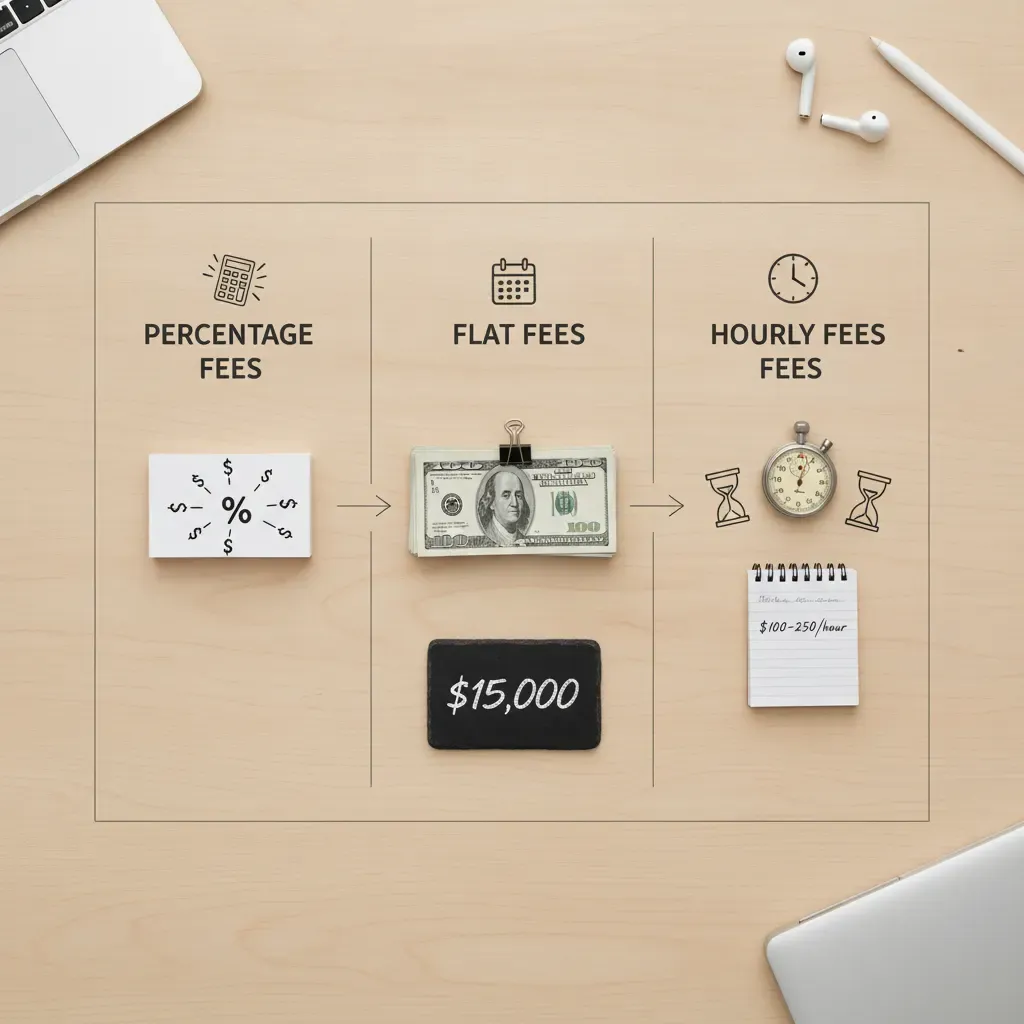

Your hiring budget is likely one of the largest line items you’ll manage this year, but the true cost of hiring changes dramatically depending on how you bring people on. Agency fees, full-time recruiters, and embedded or fractional models all carry very different price tags once you account for volume, time, and risk. This guide breaks down how each hiring model actually works, what you’ll pay per hire at different stages, and why the cheapest option on paper often isn’t the lowest-cost choice in practice.
TLDR:
-
Agency fees typically cost 20-30% of salary ($24K-$36K for a $120K hire), while embedded recruiting is billed by the hour and has tended to land in the low thousands per hire.
-
In-house recruiters break even around 6-8 hires annually but cost $24K per hire at lower volumes.
-
Hidden costs like failed hires and open role revenue loss can multiply your recruiting spend by 5x.
-
Cost per hire only makes sense in context; volume and predictability determine which model is actually cheapest.
-
Some modern fractional recruiting solutions can deliver meaningful cost savings versus agencies, with no contracts or long-term commitments.
Understanding the True Cost Per Hire in 2026
Cost per hire breaks down to a simple calculation: total recruiting spend divided by number of hires. The most widely cited benchmark puts average cost per hire around $4,700, according to the Society for Human Resource Management.
But this number changes dramatically based on your hiring model and which expenses you’re actually tracking. Internal costs like recruiter salaries, interview time, and software stack up differently than external costs such as agency fees, job board postings, and background checks.
For early-stage companies, this isn’t background noise. For small teams, cost per hire consistently ranks among the most closely tracked HR metrics, especially for companies under 50 employees where each hire materially impacts runway. When runway is tight, understanding where each recruiting dollar goes becomes critical to scaling your team without burning cash.
What Traditional Recruiting Agency Fees Actually Cost
Recruitment agencies charge 20-30% of first-year salary as a contingency recruiting placement fee, payable when your candidate accepts the offer.
For a $120,000 engineering hire, expect $24,000 to $36,000 in agency fees. A $90,000 product manager costs $18,000 to $27,000. An executive at $200,000 runs $40,000 to $60,000.
The percentage varies by role complexity and negotiating power. Standard corporate roles often land around 20%, while specialized tech positions or executive searches push toward 25-30%. First-time clients typically pay more than companies with existing agency relationships.
Many agencies offer a replacement or refund guarantee window, but you still lose time and opportunity cost if the hire fails. If you hire multiple people for the same role within the guarantee period, you’ll owe fees on subsequent hires.
The Complete Cost of In-House Recruiting
In-house recruiting costs can land in the low double-digits as a percentage of salary once you account for recruiter compensation, benefits, and recruiting tools. A full-time tech recruiter runs $80,000-$120,000 annually in base salary, with another $20,000-$30,000 for health insurance, payroll taxes, ATS subscriptions, LinkedIn Recruiter licenses, sourcing tools, and office overhead. Internal costs like these stack up differently from external costs such as agency fees, job board postings, and background checks.
Job advertising adds a recurring line item that compounds quickly. Standard postings on Indeed and LinkedIn typically run $100 to $500 per listing per month; sponsored or promoted listings climb to $200 to $1,000+ per role depending on targeting and competition. LinkedIn Recruiter licenses, often necessary for proactive sourcing, cost $8,000 to $10,000 per seat annually. Niche technical boards like Dice and Stack Overflow Jobs add another $500 to $1,500 per post. A company running 10 hires per year across three active job boards could easily spend $15,000 to $25,000 annually on advertising alone, before counting a dollar of recruiter salary.
The per-hire math works cleanly at scale. If your recruiter closes 10 hires per year at an average salary of $100,000, you’re spending roughly $12,000 per hire after dividing total cost by placements. But volume swings change the equation quickly. Drop to five hires and your per-hire cost doubles to $24,000.
You’re also betting on finding a recruiter who can hire across multiple functions. An engineering recruiter may struggle to fill your first sales or marketing roles, forcing you to pay agency fees anyway.
Embedded Recruiting Costs and How the Model Works
Embedded recruiting brings in an external recruiter who works alongside your team on an hourly or monthly subscription basis. These recruiters use your ATS, attend your standups, and source candidates under your company’s brand. You pay only for hours worked and can scale up or down as hiring needs change. In some cases, fractional recruiting agencies operate on this same model at an organizational level, building their service delivery on shared platforms that give clients full pipeline visibility and real reviews of recruiter performance. A shared ATS is what makes the model work cleanly: both the recruiter and the hiring team see the same pipeline in real time, which cuts coordination overhead and prevents duplicate outreach. Vetted reviews of recruiter performance, visible before you engage anyone, remove the guesswork of picking the right person for a role.
Pricing Structure
Most embedded recruiters charge $100-$250 per hour depending on experience level and role complexity. As detailed in the fractional recruiter hourly rate vs. agency fees breakdown, that difference compounds quickly. A typical month of support runs 40-80 hours, translating to $4,000-$20,000 per month.
Dover’s fractional recruiters follow this model. Each recruiter sets their own rate and you agree terms with them directly, with no long-term contract; companies have most often spent $2,000 to $7,000 per hire, which is an observed range rather than a quote. On a $120,000 engineering role that usually compares favorably against a $30,000 agency fee, though the actual figure depends on the recruiter and how long the search runs.
Hidden Costs That Double Your True Hiring Expenses
Recruiter fees are only part of what a hire actually costs. The hard costs on a $100K offer include payroll taxes (roughly $7,650 in FICA alone, plus state taxes), plus a benefits package running $10,000 to $15,000 per year, onboarding, training, and equipment at $2,500 to $5,000, background checks and pre-employment screening at $50 to $200 per candidate, and job board advertising at $100 to $500 per listing. Before you’ve made a single offer, these line items can add $20,000 to $25,000 to what a hire actually costs beyond the salary number.
Soft costs are harder to see but compound just as quickly. A five-person interview loop spending four hours each can cost over $1,000 in fully loaded labor for every finalist, and that figure understates the real drain. If a hiring manager spends 8 hours across kickoff, screening reviews, interviews, and debrief, that’s roughly $600 per candidate reviewed at a $150K loaded salary, including every reviewed candidate, finalists and early-stage reviewers alike. Multiply that across a typical funnel of 10 to 15 reviewed candidates and panel coordination alone can exceed $6,000 to $9,000 per open role.
Failed hires compound the damage. Replacing someone within their first year means paying recruiting costs twice, plus severance and lost productivity. Some estimates suggest bad hires cost roughly five times their annual salary when you include training waste and team impact.
Open roles drain revenue. For a $150,000 sales hire expected to generate $1M annually, each month of vacancy can represent roughly $80K+ in delayed potential revenue, before you account for ramp time and attainment variability. Engineering roles delay product launches. Every week a critical position stays empty means overworked teams and missed deadlines.
Startup Hiring Benchmarks: What You Should Actually Be Spending
Many early-stage startups aim to keep non-technical hiring in the $3,000-$5,000 per-hire range. Technical hiring costs jump to $10,000-$20,000 per engineer due to specialized sourcing requirements and extended interview processes. For startups weighing agency recruiting vs. recruiter marketplace options, the per-hire math changes considerably at each of these tiers. Executive placements start at $28,000 and climb based on seniority.
Tracking cost per hire matters more than hitting exact benchmarks. If you’re spending $15,000 on a mid-level role that similar companies fill for $5,000, you’re either overpaying for recruiting services or burning internal time on coordination.
Stage affects targets. Pre-seed companies hiring their first five employees should stay closer to $2,000-$3,000 per hire. Series A teams can support $5,000-$7,000, while Series B companies typically spend $8,000-$12,000 as quality bars rise.
When Each Hiring Model Makes the Most Financial Sense
| Factor | Staffing Agency | In-House Recruiter | Embedded/Fractional |
|---|---|---|---|
| Typical cost per hire | 20-30% of salary ($18K-$36K) | ~$12K at 10 hires/yr, $24K at 5 hires/yr | Hourly at a recruiter-set rate; often $2K-$7K |
| Best hiring volume | 1-2 hires/yr | 6+ hires/yr | 2-8 hires/yr |
| Contract required | Per-placement fee | Full-time employment | No contract, hourly |
| Employer brand control | Low (external) | High | High (works inside your ATS) |
| Risk on failed hire | Replacement window only | Severance + rehire cost | Pay only hours used |
The decision comes down to annual hiring volume and predictability, not upfront cost.
Hiring 1-2 people per year makes agencies or fractional recruiters the right choice. An occasional $4,000-$7,000 spend beats paying a full-time salary for underutilized capacity.
The 3-6 hire range fits embedded or fractional models. You need consistent recruiting support without enough volume to support overhead. Monthly engagement with the same recruiter builds institutional knowledge without the commitment.
Six or more hires annually tips the math toward in-house. At this volume, a dedicated recruiter’s fixed cost drops below $15,000 per hire while giving you full control over candidate experience and employer branding.
Unpredictable hiring needs favor flexible models. If you’re closing three roles this quarter but none next quarter, pay-as-you-go fractional recruiting beats carrying fixed headcount.
How Dover’s Fractional Recruiting Delivers Agency Quality at Embedded Pricing
Fractional recruiting agencies run on the Dover platform, a shared layer that gives clients full pipeline visibility inside their own ATS and real vetted reviews of each recruiter before any engagement begins. The ATS itself is free for unlimited users and jobs, with a $199/month Premium tier for AI applicant scoring and AI note taking. Startups can see exactly where candidates stand, review recruiter track records from other companies, and engage experienced recruiters who handle sourcing, screening, and closing like an in-house team member, paying only for hours used.
Companies have most often spent $2,000 to $7,000 per hire through Dover against $18,000 to $36,000 through traditional agencies, though recruiters set their own rates and every engagement is priced with the recruiter rather than quoted by the platform. Hourly and retainer structures remove the percentage-of-salary fee entirely; pay-per-hire is available for teams that prefer it. Because Dover is the infrastructure layer fractional recruiting agencies run on, clients see real vetted reviews of recruiter performance before committing, so they get more than a rate card and a name.
You start with an $800 deposit that is 100% refundable, and no long-term contract. Scale up when you’re actively hiring, pause when you’re not. Choose which recruiters match your needs instead of getting assigned whoever’s available.
FAQs
Can I pause fractional recruiting services between hiring pushes?
Yes, fractional recruiting works on a pay-as-you-go model with no long-term contracts. You can ramp up support when actively hiring multiple roles and pause completely during slow periods, paying only for hours actually worked instead of carrying fixed monthly costs.
What tools do fractional recruiters typically use?
Fractional recruiters generally work inside the client’s existing ATS so all pipeline activity is visible to both the recruiter and the hiring team in real time. This shared system removes coordination overhead and prevents duplicate outreach to the same candidates. When a fractional recruiter is embedded in the ATS from day one, the handoff between external support and internal hiring managers stays clean. Some fractional recruiting agencies are built on shared platforms that provide this ATS layer as part of their service.
What recruiting models do most YC-backed startups actually use?
Early YC companies tend to start with founder-led recruiting, where founders source and close the first 5 to 10 hires themselves. As hiring volume picks up past that threshold, fractional or embedded recruiters are a common next step: they slot into the team’s existing process without requiring a full-time headcount commitment. Traditional agency search tends to be reserved for executive or highly specialized roles where speed outweighs cost. In-house recruiters become the default model later, typically once a company is consistently closing 6 to 8+ hires per year and needs dedicated recruiting infrastructure. The practical constraint for most YC-stage teams is that hiring volume is uneven: a burst of 4 to 5 roles one quarter, then nothing, which makes fixed-cost models harder to support economically at seed and Series A than pay-as-you-go fractional support.
Final Thoughts on Reducing Your Cost Per Hire
Getting hiring economics right isn’t about chasing industry averages; it’s about understanding the true cost of hiring as your team grows. When you factor in volume, speed, and the risk of mis-hires, the cheapest option on paper often isn’t the one that saves the most money. Fractional recruiting offers a way to control spend without delaying hires or carrying fixed overhead, giving founders flexibility as plans change. Dover supports this approach by letting teams work with experienced recruiters on their own timeline, paying only for the hours used while keeping costs aligned with actual hiring needs.