You’re comparing ATS connections, but tool counts don’t tell you whether your assistant can handle a weekly pipeline review. Choosing an ATS MCP integration starts with matching the available tools to your actual task, then checking permissions, support, and costs before committing.
TLDR:
- An ATS MCP integration can give your AI assistant live hiring records instead of copied snapshots.
- Check who maintains each connector; an MCP listing does not prove native ATS support.
- Budget for connector fees, AI subscriptions, usage charges, and maintenance beyond your ATS bill.
- Test read-only requests, match candidate IDs, and confirm revoked access fails.
- Check that the assistant’s permissions and data access match what the connected user can do in the ATS.
- Require human approval before sending messages, changing stages, or rejecting applicants.
What ATS MCP Integration Means for Your Hiring Workflow
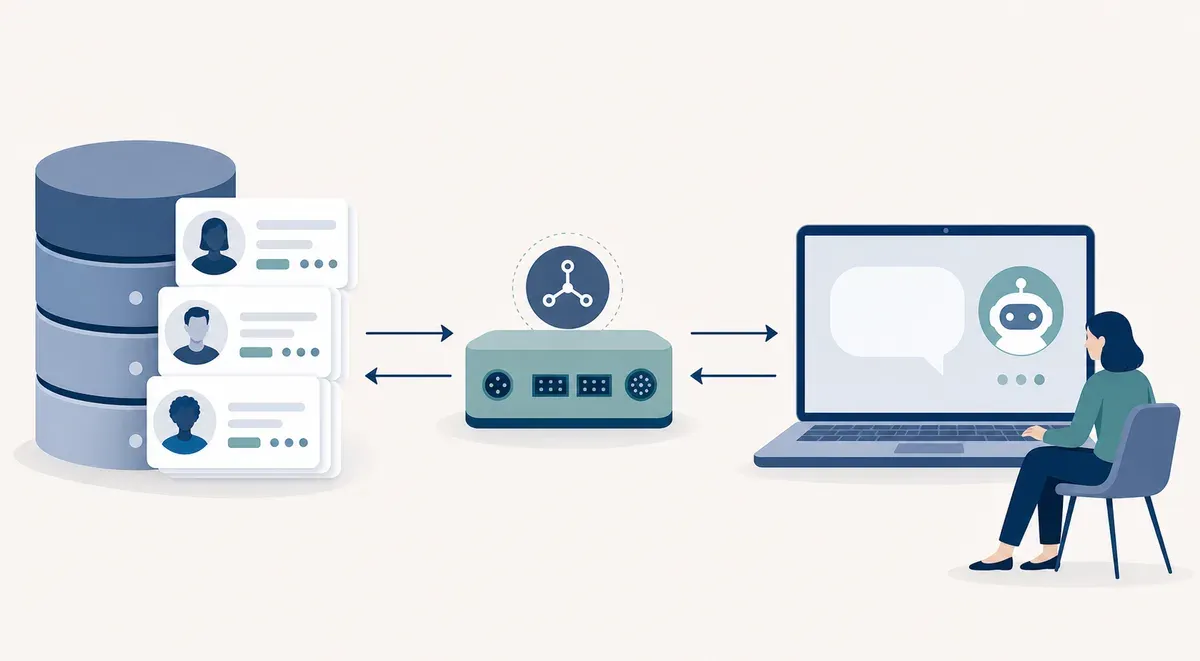
Copying candidate information into an AI assistant adds manual work and gives it only a snapshot. An ATS MCP integration connects your ATS and assistant through Model Context Protocol, an open-source standard for connecting AI applications to external systems.
The assistant acts as an MCP client, connecting to a server that exposes approved recruiting data and actions. MCP provides standardized access to approved tools. Depending on the connection, assistants can access live hiring records instead of requiring resume uploads. Built-in AI recruiting tools inside an ATS, by contrast, run inside the recruiting software.
How to Assess ATS MCP Connections
An ATS MCP integration listing does not prove native support. Distinguish vendor-maintained servers from third-party connectors and community projects, then check:
- Who maintains the server and provides support?
- Which assistants and recruiting records are supported, including recruiting workflows from Claude?
- Can it read data, write changes, or both?
- How do authentication and permissions work?
- What does access cost? Is availability general, beta, or restricted?
Availability and pricing may change. Confirm current terms with the provider before committing; future access is not guaranteed.
Matching an ATS MCP Connection to Your Workflow
Workflow fit depends on your hiring requirements: for example, a server with many tools still cannot support a pipeline review if none can retrieve applications and their current stages. The table below lists Dover’s native connection as a reference point for the columns worth checking on any option.
| ATS and connector | Maintenance model | Documented capabilities | Starting price | Free tier | Suitable workflow | Validate |
|---|---|---|---|---|---|---|
| Dover | Native, Dover-built MCP integration | Connects AI assistants to hiring data; Premium includes unlimited MCP requests | Free; Premium $199/month | Yes; unlimited jobs and users, limited monthly MCP requests | Assistant access to hiring data, with human hiring judgment | Setup requirements, monthly request allowance, separate AI assistant costs |
MCP Versus APIs and Conventional ATS Integrations
MCP standardizes how an assistant finds and calls exposed tools; an ATS API can still handle the underlying data requests. Knit, for example, wraps ATS API actions as tools agents can call.
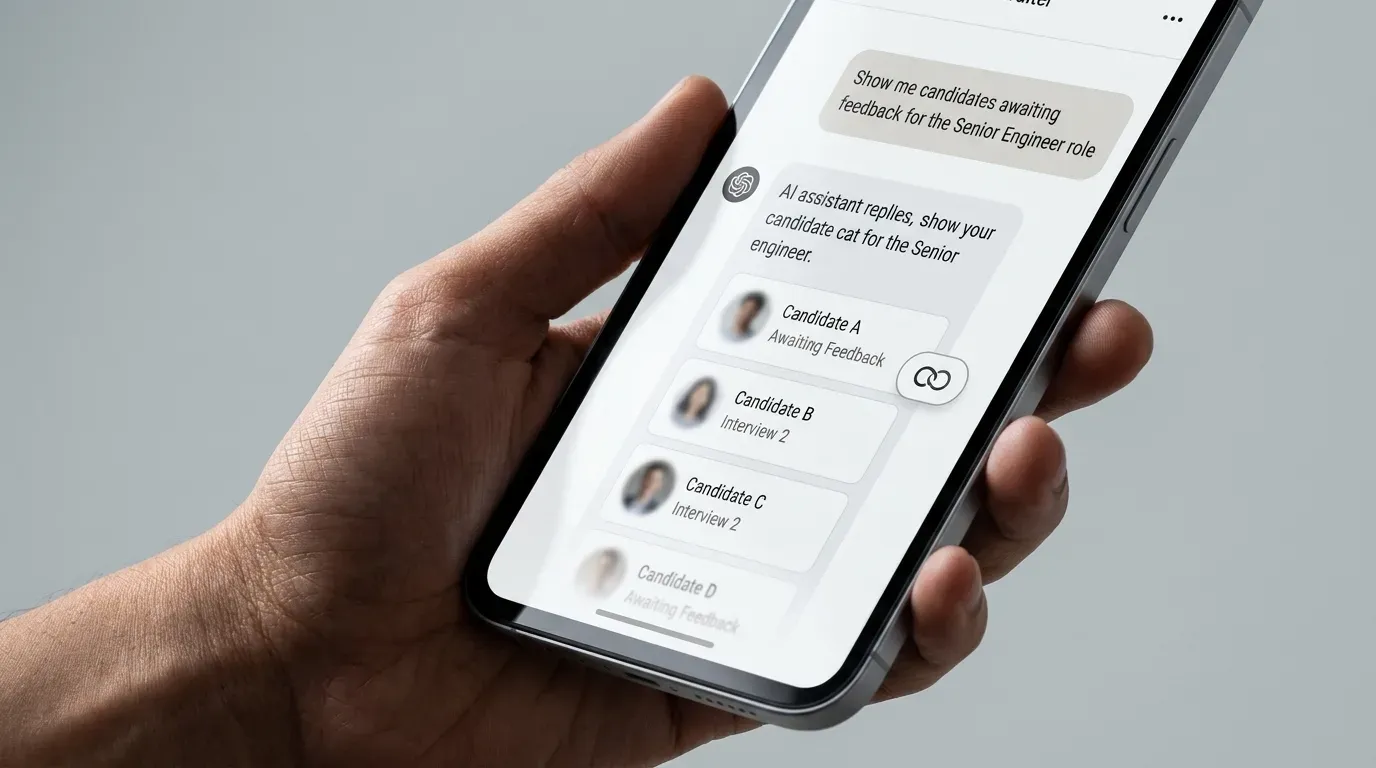
An ATS MCP integration can support conversational requests such as “show candidates awaiting feedback.” For repeatable tasks like sending a notification whenever an application arrives, a conventional event-driven integration may be simpler to test and maintain.
MCP does not automatically expose every API endpoint or bypass access restrictions.
Recruiting Workflows an MCP Connection Can Support
An ATS MCP integration can support candidate-history retrieval, interview-feedback summaries, pipeline updates, and outreach drafts where server tools and authorized data permit. Test prompts such as:
- “Summarize recorded interview feedback and link to the underlying candidate records.”
- “Show applications waiting for hiring-manager review.”
Keep reading and drafting separate from actions that affect candidates. Sending messages, changing stages, rejecting applicants, or issuing offers warrants explicit human review before execution. Ask the assistant to flag missing information instead of filling gaps in a candidate’s history.
When Software Alone Is Not Enough
An ATS with MCP access can retrieve records, summarize feedback, and draft messages. It does not source passive candidates, persuade a senior engineer to take a call, or free up hours when nobody on the team has recruiting bandwidth. A founder hiring a few roles a year can often run an ATS and an assistant without outside help. Once hiring volume climbs or a role is senior or specialized, a fractional recruiter or fractional recruiting agency can work inside that same ATS and handle sourcing, screening, and closing, while the assistant keeps pipeline summaries current for the whole hiring team.
Connecting an ATS to an AI Assistant
ATS MCP integration setup varies by server and AI assistant. Remote servers run elsewhere; local servers run in your environment. Follow the server’s setup guide and check that your assistant supports its transport and authentication method; the MCP authorization specification describes how the protocol approaches access control.
- Confirm account eligibility and select an approved server.
- Check client compatibility, then authenticate as documented.
- Verify the connected organization and user permissions.
- Inspect available tools and test a narrowly scoped, read-only request.
- Compare returned record identifiers with the ATS.
- Test that the assistant’s access matches what the connected user can do in the ATS (see the next section).
- Revoke the connection and confirm subsequent access fails.
Test That Permissions and Data Access Match the ATS
An assistant should never see or change more than the person who connected it. Before you rely on a connection, test that its permissions and data access line up with that person’s access in the ATS:
- Compare visibility. Ask for the jobs, candidates and stages the user can see in the ATS. The assistant should return the same records, with nothing extra and nothing missing.
- Try something out of bounds. Connect as a user with limited access, such as a hiring manager on a single job, and ask about a job or candidate outside that hiring team. The request should come back empty or be refused.
- Check write access separately. Ask for a change the user isn’t allowed to make in the ATS. It should fail instead of going through.
- Retest after a role change. If you change a user’s role or hiring-team assignment, reconnect and confirm the assistant’s access matches the new setup.
If the assistant can reach anything the user couldn’t open in the ATS, stop and fix the connection before using it with real candidate data.
Security and Human Oversight for Recruiting Data
Map candidate data through your ATS MCP integration, from the ATS through the connector to the AI assistant. For each service, verify:
- Which sensitive fields leave the ATS and how long copies remain.
- Whether access follows least privilege and credentials stay out of prompts.
- Whether audit records identify the user, tool call, and resulting change.
OWASP’s MCP security guidance covers untrusted tool inputs and outputs and tool poisoning; the same caution applies to resume text and other candidate-supplied content. Require human confirmation for external messages and irreversible changes, with recovery procedures where possible. MCP connectivity does not guarantee compliance, accurate assessments, or appropriate hiring decisions.

The Full Cost of an ATS MCP Integration
An ATS MCP integration can involve costs beyond the ATS subscription:
- ATS subscription and any separate API or MCP access entitlement.
- Third-party connector fees for the connection, separate from any ATS integrations you already rely on.
- AI assistant subscription, which may require separate payment.
- Usage-based charges, including MCP request limits on free ATS access.
- Implementation work and ongoing maintenance.
Compare quotes against a defined workflow, such as a weekly pipeline review, including expected request volume and staff time. A low entry price matters less if the connection cannot support that workflow, which is why assessing a free ATS for startups alongside its MCP capabilities is worthwhile.
Common Integration Failures and How to Diagnose Them
If a candidate is missing, check the ATS, then the tool response. An overlooked returned record suggests an interpretation problem; an access error points to the connection.
- Authentication failure: check for expired credentials.
- Missing tools: inspect the server’s exposed tool list.
- Insufficient permissions: check the connected user’s access.
- Unsupported fields: compare requests with the tool schema.
- Pagination gaps: check continuation tokens.
- Rate limits: inspect retry guidance.
- Unreliable matches: use stable candidate IDs.
After an ambiguous write response, verify the ATS record before retrying to prevent duplicates.
Choosing and Testing the Right Connection
Let your ATS requirements guide the connection choice, using AI recruiting tools for startups as wider context. A supported native ATS MCP integration may reduce setup work; a managed connector may fit your current stack. A custom server suits specialized needs only with engineering ownership. Before committing resources, review the best AI recruiting tools and these AI-powered recruiting platforms.
Run a time-boxed, read-only pilot. Track record accuracy, permission boundaries, task completion, manual corrections, and total cost. Keeping your current workflow is reasonable if the connection adds complexity or cannot safely support the task.
How Dover Fits Into an MCP-Connected Hiring Workflow
Dover’s native ATS MCP integration connects AI assistants to hiring data. We built this connection, so our perspective reflects that stake.
What the Dover MCP Does
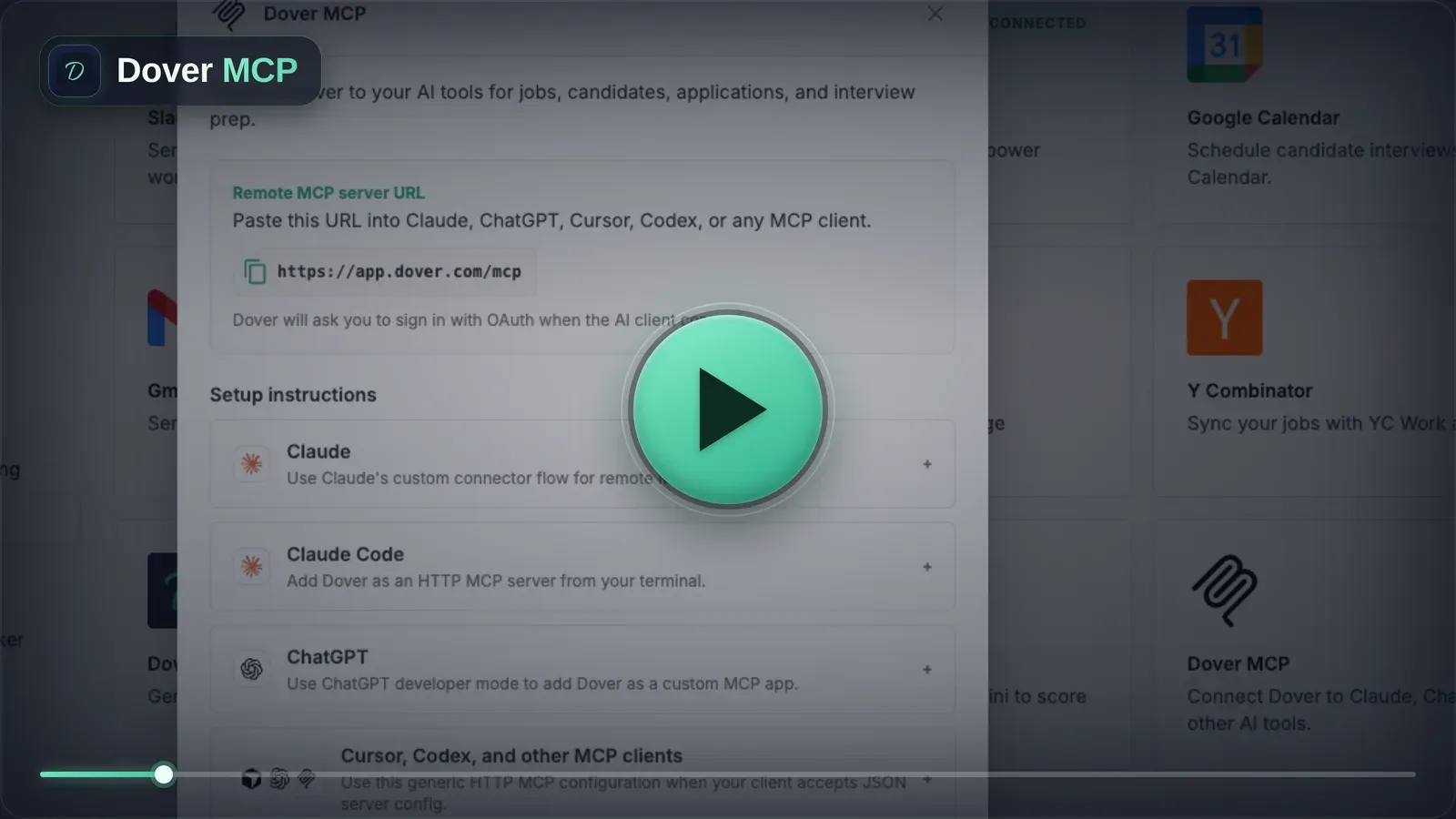
The Dover MCP connects Claude, ChatGPT, Cursor, Codex and other MCP-compatible tools to the jobs, candidates, applications and interview workflows in your Dover account. You sign in with OAuth when the assistant connects. From there, an assistant can:
- Look up jobs: list your jobs and read a job’s interview plan.
- Find and review candidates: search by name or email, pull an application, and see a candidate’s interviews and feedback.
- Surface top applicants: list the inbound applications for a job, ranked by AI match score.
- Prepare interviews: pull interview prep for a candidate and fill in your feedback form from your notes.
- Update the pipeline: add jobs and candidates, move a candidate to a new stage, snooze them, apply tags and add notes.
What the assistant can see or change depends on the permissions you have as a member and on your hiring team, so it works with the same boundaries you have in Dover. Setup is a few steps: the MCP server help guide covers Claude, Claude Code, ChatGPT, Cursor and Codex, and the Dover MCP page has one-click connect links.
Two Prompts to Try First
Start with read-only requests, then move on to changes once you trust the results:
- “Show me my open jobs. For each one, list the top five inbound applications and tell me what makes each one stand out.”
- “I’m interviewing [candidate name] tomorrow. Pull their application and any past interview feedback, then give me a one-page prep brief with three questions to ask.”
Both read records and write nothing back, so they’re a safe way to confirm the connection returns accurate data. When you’re ready to try an action, such as moving a candidate to a new stage, ask the assistant to describe the change first and confirm it yourself.
Pricing
Our free tier includes unlimited jobs and users, with limited monthly MCP requests; our explanation of how the Dover ATS is free covers the full model. Premium costs $199/month and includes unlimited MCP requests and AI applicant scoring.
Working With Fractional Recruiters
Optional fractional recruiters work in the same ATS (as described in this ATS with fractional recruiter guide), so the recruiter and the hiring team see the same pipeline in real time. A shared pipeline can reduce duplicate outreach and handoff overhead. Dover is also the layer fractional recruiting agencies are built on, and marketplace recruiters build their track record through verified founder reviews. The average cost per hire on Dover’s marketplace is $4.8k across all roles, though costs vary by role complexity and recruiter, and there is no long-term contract. Hiring judgment remains with people.
FAQs
What is an ATS MCP integration and how does it differ from a standard ATS API connection?
MCP standardizes how an assistant finds and calls exposed tools, but it does not replace the ATS API underneath. An ATS MCP integration connects an AI assistant to your hiring data through the Model Context Protocol, so you can ask conversational questions like “show candidates awaiting feedback” instead of writing custom API queries. A standard ATS API still handles the underlying data requests, and MCP sits on top of it as a structured layer. MCP does not automatically expose every API endpoint or bypass access restrictions, so the two approaches have different setup requirements and failure modes.
How do I test an ATS MCP integration before allowing it to make changes to candidate records?
Run a time-boxed, read-only pilot: authenticate as documented, inspect the server’s exposed tool list, and send a narrowly scoped request (for example, retrieving a single candidate’s stage). Then compare the returned record identifiers against your ATS directly. Check that what the assistant can see and change matches what the connected user can do in the ATS, such as by asking about a job outside their hiring team. Revoke the connection and confirm that subsequent access fails before expanding permissions. Keep read and draft tasks separate from any action that affects candidates until record accuracy and permission boundaries hold up, and set up a recovery procedure for ambiguous write responses.
What does an ATS MCP integration cost beyond the ATS subscription?
The total typically includes your ATS subscription (Dover’s free tier covers unlimited jobs and users with limited monthly MCP requests; Premium is $199/month with unlimited requests), any third-party connector fees if you are not using a native integration, your AI assistant subscription, usage-based charges tied to request volume, and implementation or ongoing maintenance work. A low entry price matters less if the connection cannot support your actual workflow. Compare quotes against a defined task, such as a weekly pipeline review, including expected request volume and staff time, before committing.
Do I need a recruiter if my ATS already connects to an AI assistant?
An ATS stores and organizes candidate records, and a connected assistant can retrieve and summarize them, but neither one sources passive candidates, persuades a candidate to take a call, or adds recruiting hours. Whether you need a recruiter depends mostly on hiring volume and role complexity. A founder hiring a few roles a year can often run an ATS and an assistant alone. Senior or specialized roles, or a team with no recruiting bandwidth, are where outside help tends to matter. A fractional recruiter can work inside the same ATS, so the recruiter and hiring team see one pipeline, which can reduce duplicate outreach. The average cost per hire on Dover’s marketplace is $4.8k across all roles, though costs vary by role complexity and recruiter. Dover’s free ATS paired with on-demand fractional recruiters is one example of this layered setup.
Final Thoughts on MCP for Hiring Workflows
Your ATS MCP integration should support human judgment. A small pilot lets you test record access before allowing changes. Teams at different hiring stages will weigh these tradeoffs differently: a founder running a few searches a year may need only read access and weekly summaries, while a team with heavier volume may want write permissions, audit records, and firm limits on what the assistant can change. Where hiring capacity is the constraint instead of record access, Dover’s model is one example of the layered approach: a free ATS paired with on-demand fractional recruiters in one shared system.