

You’re hiring but your stack is either missing pieces or priced for a company ten times your size. Choosing an AI-powered recruitment platform means sorting through tools that each solve one slice of the funnel, add sourcing on top of a stack you have to build yourself, or cover the full workflow at a price that rules them out before you even get to the demo. Here’s how six of the most talked-about options actually stack up.
TLDR:
-
Most AI recruiting tools cover one slice of the funnel and require an existing ATS before they deliver any value.
-
Enterprise options like Phenom start at around $100,000 annually; sourcing add-ons like SeekOut and hireEZ carry custom contracts with no free tier.
-
AI screening tools can score and filter inbound applicants, but none of the six tools reviewed do this autonomously without human oversight.
-
Some tools pair a free ATS with on-demand recruiting support at an average cost per hire of $4.8k, with no long-term contract required.
-
Contingency models charge 15-25% of first-year salary on placement; hourly and retainer fractional models decouple recruiter fees from candidate salary, removing the incentive to push higher-compensated candidates.
What Is an AI-Powered Recruitment Platform?
An AI-powered recruitment platform is software that uses AI to handle or assist with recruiting tasks that traditionally required manual effort: sourcing candidates, screening resumes, scoring applicants, sending outreach, and scheduling interviews.
The distinction from a standard ATS matters. A basic applicant tracking system tracks candidates through a pipeline. An AI-powered tool actively works the pipeline, surfacing qualified people, flagging mismatches, and reducing the volume of repetitive decisions a recruiter has to make, a pattern examined in LinkedIn’s Future of Recruiting 2025.

The category covers a wide range. Some tools focus narrowly on one function, like automated chat-based screening or sourcing from a candidate database. Others attempt to cover the full hiring workflow. A few combine software with human recruiting support, which is a different architectural choice than pure automation. What they share is AI doing work that used to require a recruiter’s time, though the quality and scope of that work varies considerably across tools.
How We Ranked AI-Powered Recruitment Platforms
Ranking these tools required a consistent set of criteria, because “AI recruitment software” covers products that barely resemble each other.
Here’s what we weighted:
-
Breadth of AI functionality: Does the tool cover sourcing, screening, scoring, and scheduling, or just one slice of the workflow?
-
Cost structure and transparency: Is pricing public? Is there a free tier? Does the model charge per hire, per seat, or require an enterprise contract? (For a broader look, see our roundup of the best AI recruiting tools.)
-
Team fit: Is the tool built for early-stage and growing teams, or does it assume dedicated recruiting operations and a large HR org?
-
Integration requirements: Can the tool stand alone, or does it require an existing ATS to function?
-
Software vs. human support: A few tools in this category pair software with on-demand recruiting expertise, which is a meaningfully different architectural choice from pure automation, and we assessed it as such.
Feature Comparison Table of AI-Powered Recruitment Platforms
| Dover | Sapia.ai | Phenom People | SeekOut | hireEZ | Humanly | |
|---|---|---|---|---|---|---|
| Starting Price | Free / $199/mo | Custom | Custom (~$100K+ min) | Custom (~$10K+/yr) | $169 to $199/recruiter/mo | Custom |
| Free Tier Available | Yes | No | No | No | No | No |
| Built-in ATS | Yes | No | No | No | No | No |
| AI Candidate Screening/Scoring | Yes | Yes | Yes | No | No | Yes |
| Outbound Sourcing Tools | Yes | No | Yes | Yes | Yes | No |
| Interview Scheduling | Yes | No | Yes | No | No | Yes |
| On-Demand Human Recruiter Access | Yes | No | No | No | No | No |
| No Long-Term Contract Required | Yes | No | No | No | No | No |
| Designed for Startups/SMBs | Yes | No | No | No | No | No |
Best Overall AI-Powered Recruitment Platform: Dover
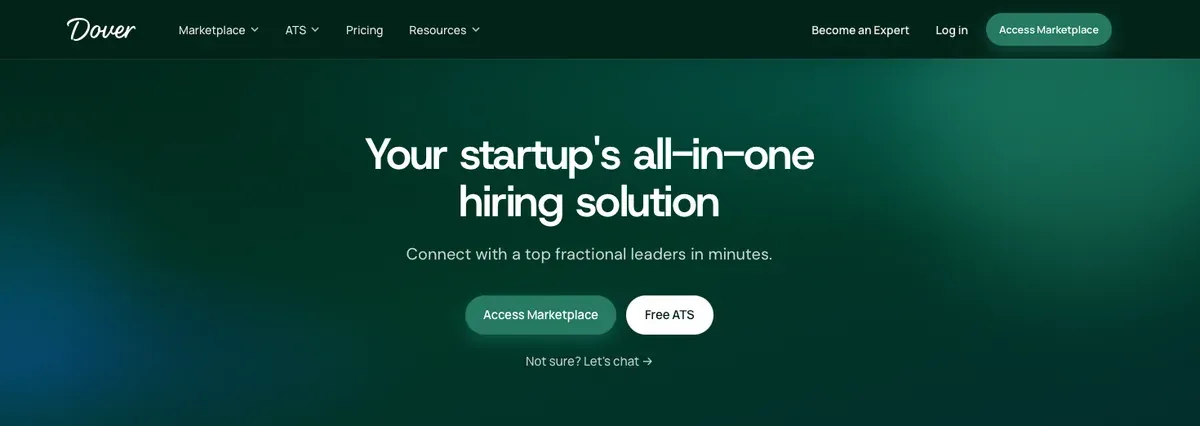
Sure, we may be biased here, but the structural case is worth stating plainly.
Most of the tools on this list solve one half of the hiring problem. Software-only tools handle pipeline management, screening, and scheduling but stop when sourcing gets hard or a role is senior enough to require active recruiting judgment. Agency and contingency models add human effort but fragment candidate data and misalign recruiter incentives around salary. Dover is built around a third model: a free ATS paired with a marketplace of fractional recruiters, all operating inside the same pipeline. The ATS handles infrastructure from day one; when a search outgrows self-serve, a fractional recruiter plugs in on top of it, without a system switch or loss of candidate history.
-
Free ATS with unlimited users and jobs, interview scheduling, and one-click distribution to 50+ job boards, plus a Premium plan ($199/month) that adds AI applicant scoring, an AI interview notetaker, and advanced scheduling
-
Average cost per hire of $4.8k, no long-term contracts, and an $800 refundable deposit to start
-
Fractional recruiters and internal teams work from the same pipeline with real-time visibility, unlike agency or software-only models that fragment candidate data across systems
-
Hourly and retainer pricing is disconnected from candidate salary, so recruiters have no incentive to push higher-compensated candidates or manufacture urgency around competing offers
-
Scales from self-serve ATS to full-cycle recruiting support without changing systems
Sapia.ai
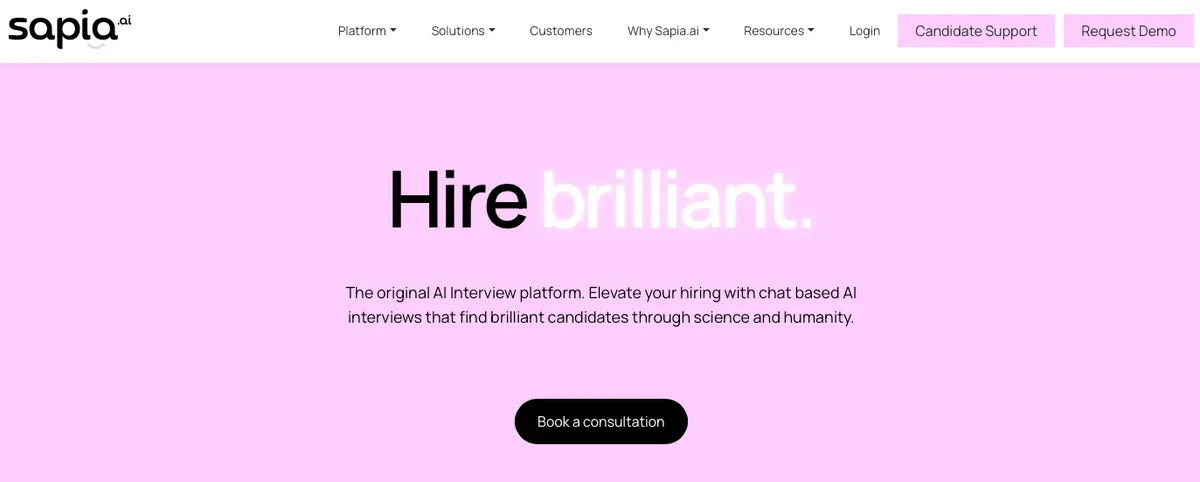
Sapia.ai targets enterprise HR teams running high-volume, repeatable hiring where consistent shortlisting across hundreds of applicants is the primary constraint. Its core product is AI-powered chat interviews that screen candidates asynchronously and surface structured insights to reduce manual review load at scale.
-
AI chat-based interviews that screen candidates asynchronously, with structured scoring and data-driven candidate insights
-
Workforce and HR analytics reporting to track hiring patterns over time
-
Custom pricing billed per hire, not per interview
Research from the World Economic Forum on AI hiring outcomes found that candidates screened through AI-led interviews advanced to human interview stages at nearly twice the rate of those reviewed by resume alone. The tool covers one slice of the funnel. It does not include an ATS, sourcing tools, or recruiter services, so teams need a separate stack alongside it.
Phenom People
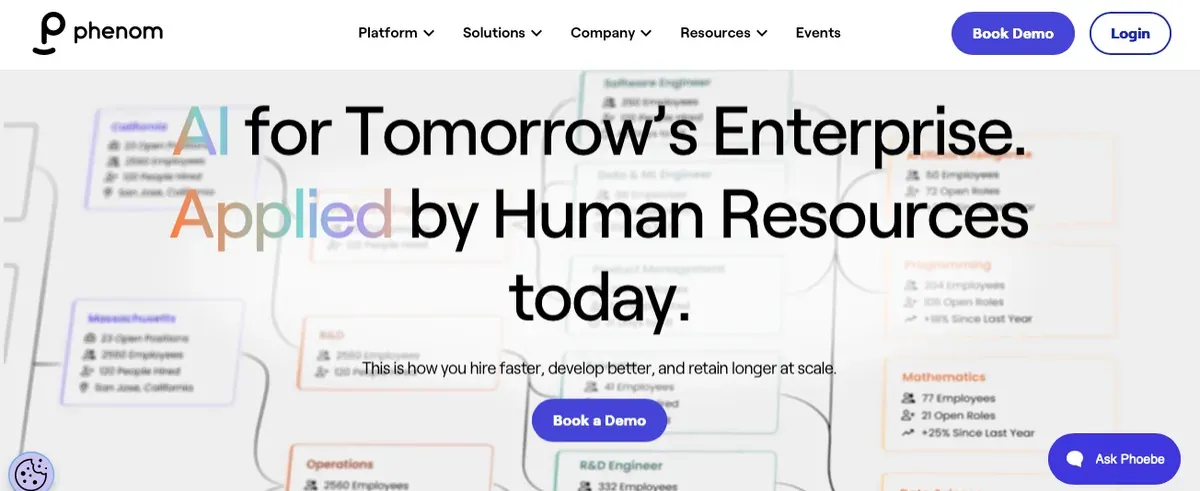
Phenom connects candidate experience, recruiter automation, employee career pathing, and hiring manager tools inside one system. It’s genuinely full-stack for enterprise talent acquisition.
-
AI-driven career site personalization and candidate matching
-
High-volume recruiter automation and pipeline management
-
Internal mobility and employee career pathing tools
-
Talent CRM and analytics across the hiring lifecycle
The price reflects the scope. Minimum contracts start at around $100,000 annually, with no pricing listed publicly. For large enterprises with dedicated talent acquisition teams and an implementation runway to match, it may be worth it.
SeekOut
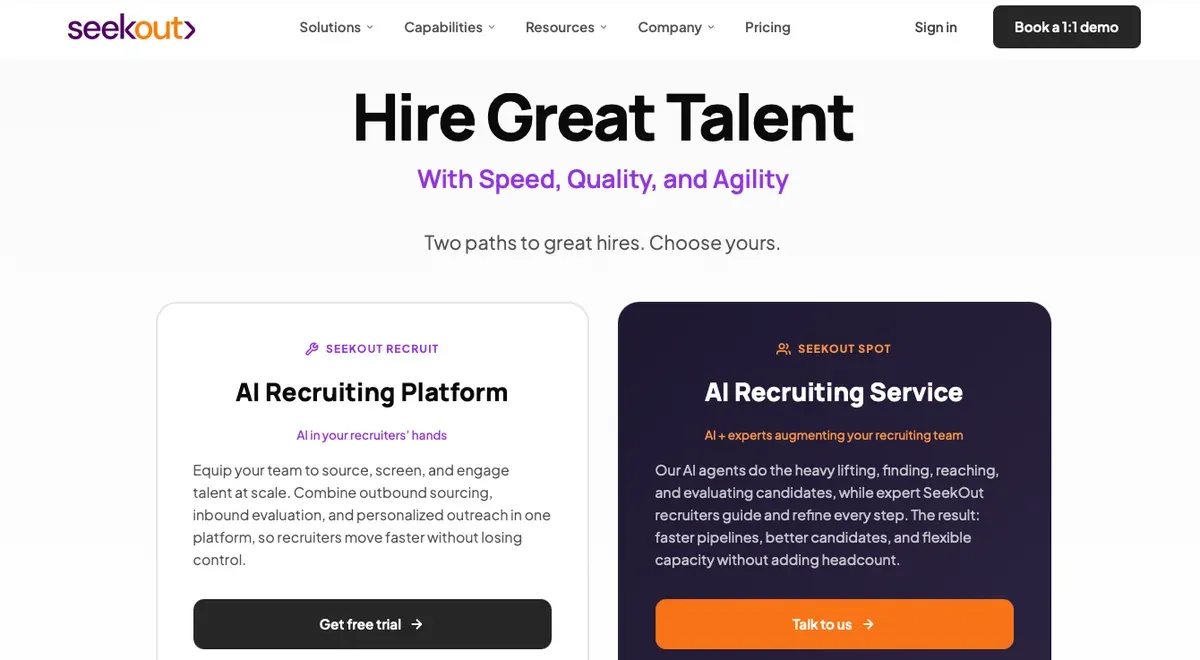
SeekOut focuses on one part of the funnel: finding and engaging passive candidates through AI candidate sourcing across a large multi-source talent database.
-
AI candidate search with diversity sourcing filters and talent analytics
-
Outreach and engagement tools for passive candidate pipelines
-
Integrates with existing ATS and CRM tools
The scope is intentionally narrow. SeekOut is a sourcing layer that sits on top of existing recruiting infrastructure, not a standalone system. SeekOut contracts run from ~$10,000 to $90,000+ depending on team size and features, with no public pricing listed. There’s no built-in ATS, no candidate screening automation, and no recruiter services included.
For mid-market and enterprise teams that already have a full recruiting stack and need deeper passive sourcing capabilities layered in, that’s a defensible purchase. See how SeekOut compares to Dover if you’re weighing both.
hireEZ
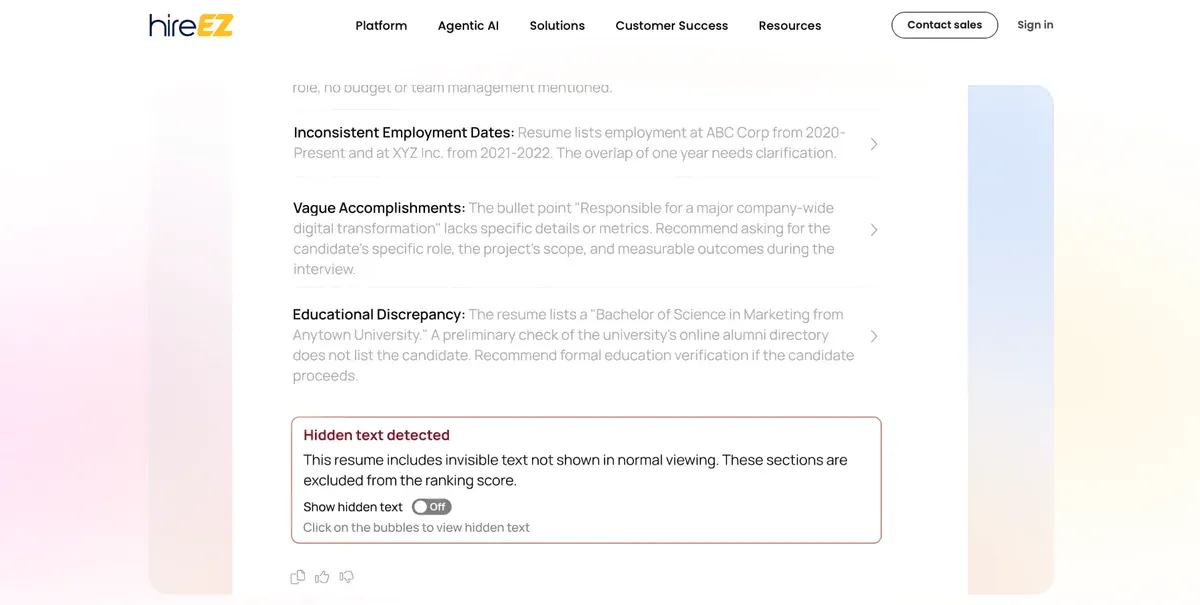
hireEZ is an AI outbound sourcing tool designed to sit on top of an existing recruiting stack. It connects to your ATS and CRM and adds AI-assisted passive candidate discovery with automated multi-channel outreach sequences across email and social channels.
-
AI-powered outbound sourcing across multiple candidate data sources
-
Automated outreach sequences for passive candidate engagement
-
CRM functionality for managing candidate relationships over time
-
Integration layer designed to work alongside an existing ATS
The positioning is clear: hireEZ is an add-on, not a standalone system. It excludes candidate screening, applicant scoring, a free tier, and recruiter services. Teams without an existing ATS need to buy one separately before hireEZ becomes useful. $169 to $199 per recruiter per month, which adds up quickly across even a small team. For mid-sized in-house recruiting teams that already have infrastructure in place and want stronger outbound sourcing layered in, it’s a defensible addition.
Humanly
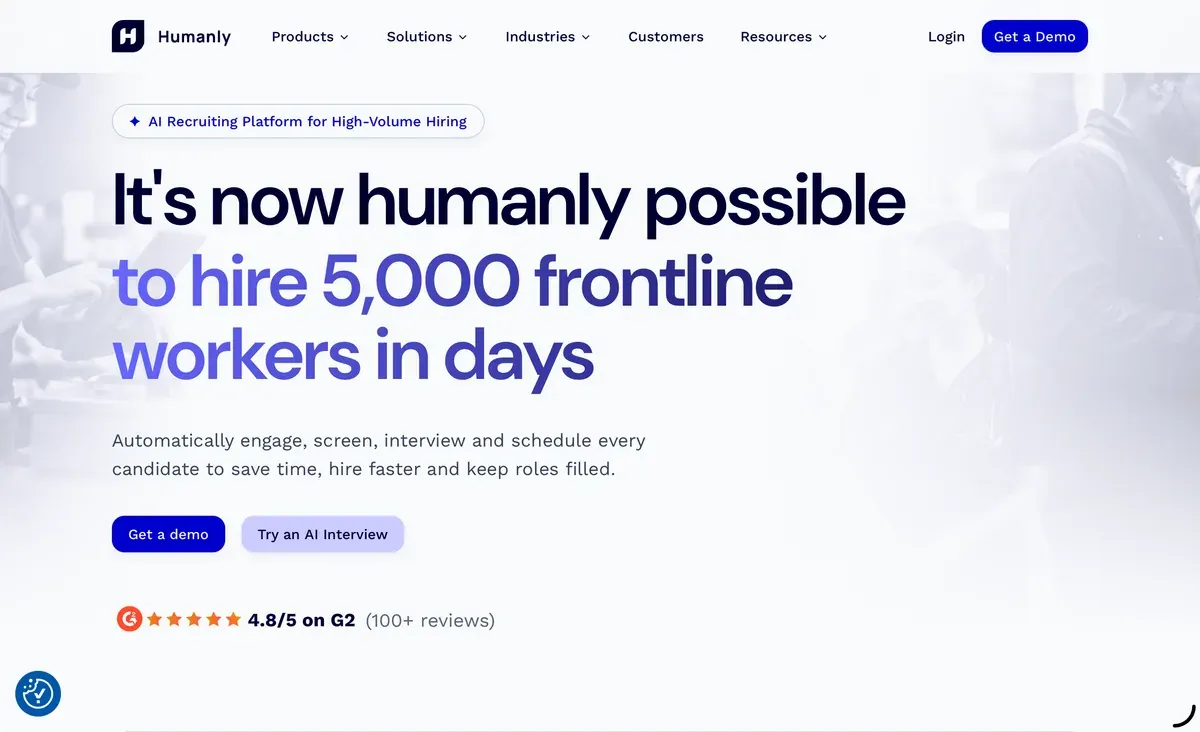
Humanly automates the early stages of inbound recruiting through conversational AI, handling applicant screening via chat, interview scheduling, and candidate communications through early pipeline stages. Teams assessing their full stack may also want to review the best ATS for startups.
-
AI chat-based screening and pre-qualification of inbound applicants
-
Automated interview scheduling integrated with calendar tools
-
Candidate communication and follow-up automation
-
ATS integrations to pass screened candidates into existing pipelines
It fits mid-to-large teams running high inbound volume who want to reduce manual screening load without replacing their existing ATS. Pricing is not listed publicly.
Why Dover Works Differently From the Other AI-Powered Recruitment Platforms
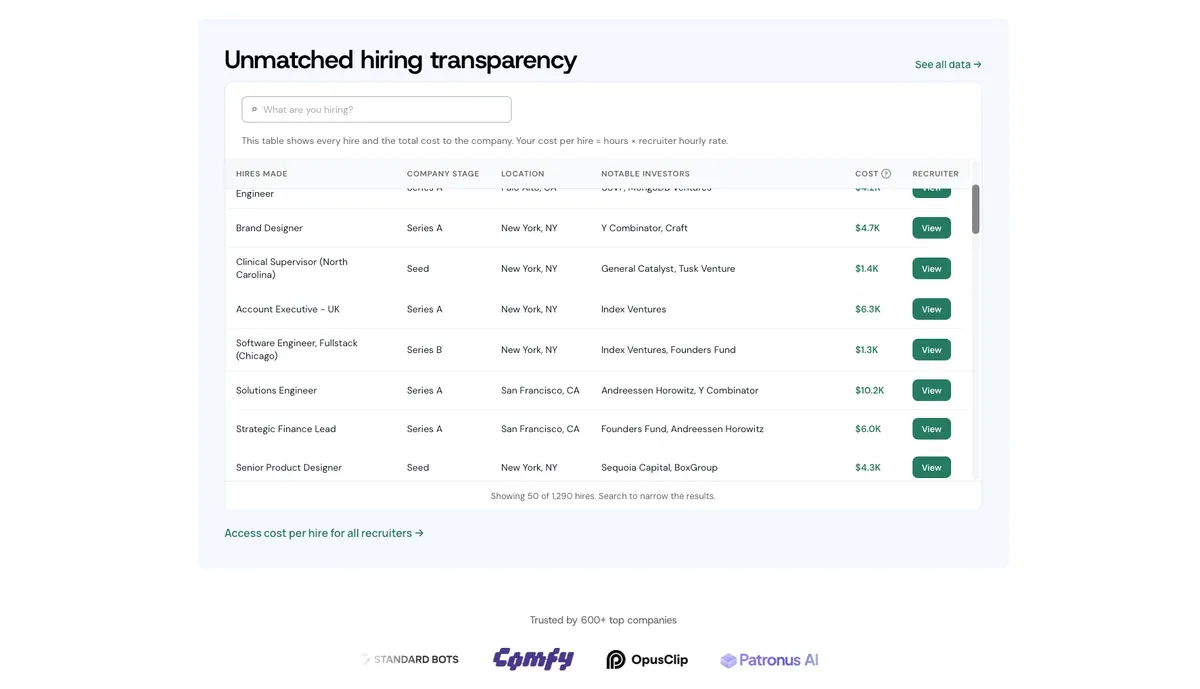
An ATS alone handles pipeline, job distribution, and scheduling. It doesn’t source passive candidates, run outreach, or bring recruiting judgment to a senior search. SeekOut, hireEZ, Sapia.ai, and Humanly cover some of those gaps, but each is an add-on layer that requires an existing ATS before it delivers value. Phenom bundles more of the stack but requires a minimum contract around $100,000 annually. None start at free, and none include human recruiting support.
Dover treats the ATS as a foundation that scales into full-cycle support without adding vendors. The free ATS covers pipeline management, job distribution across 50+ boards, and interview scheduling, with AI applicant scoring on the Premium plan. When a search requires active sourcing or recruiting judgment, fractional recruiters plug into the same pipeline at an average cost per hire of $4.8k, below the SHRM 2025 average cost per hire of $5,475 for non-executive roles, and no long-term contract is required. Fractional recruiters and internal teams work from one shared system, so there’s no duplicate outreach and no candidate history lost across handoffs.
FAQs
When does it make sense to use a specialized sourcing tool like SeekOut or hireEZ instead of an all-in-one recruiting platform?
Specialized sourcing tools make sense when your team already has a full recruiting stack (an ATS, screening workflows, and scheduling infrastructure in place) and the remaining constraint is finding and engaging passive candidates at scale. SeekOut and hireEZ are add-on layers, not standalone systems. For teams still assembling their recruiting infrastructure, both tools require several other purchases before they deliver meaningful value.
What is the structural difference between a contingency recruiter marketplace and a fractional recruiting model?
In a contingency marketplace, recruiters are paid only on placement, which creates pressure to focus on faster-to-fill roles and can result in multiple recruiters contacting the same candidates simultaneously. A fractional model typically bills hourly or on retainer and assigns one dedicated recruiter who works inside your pipeline, owns the full search, and has no financial incentive tied to candidate salary level. The distinction matters most for specialized technical roles or senior searches where speed-over-quality tradeoffs are costly.
Can AI-powered recruitment tools fully replace human recruiting judgment, or do they work best as a filtering layer?
None of the tools reviewed here operate without human oversight at some stage of the process. Sapia.ai and Humanly handle early-stage inbound screening through chat and scoring, but both require a recruiter or hiring manager to assess final candidates. AI applicant scoring (such as Dover’s premium ATS feature) ranks candidates against defined criteria, but the criteria still require human input to set and the output works best as a ranking signal for human review, not a final hiring decision.
Final Thoughts on Finding AI Recruitment Software That Works for Your Hiring Stage
Your budget, your current stack, and how many roles you’re trying to fill will do more to narrow the decision than any feature comparison. The right AI-powered recruitment platform looks different depending on whether you’re assembling your first stack or layering onto one that already exists. Dover is one place to start: a free ATS paired with on-demand fractional recruiters, no long-term contract required.