
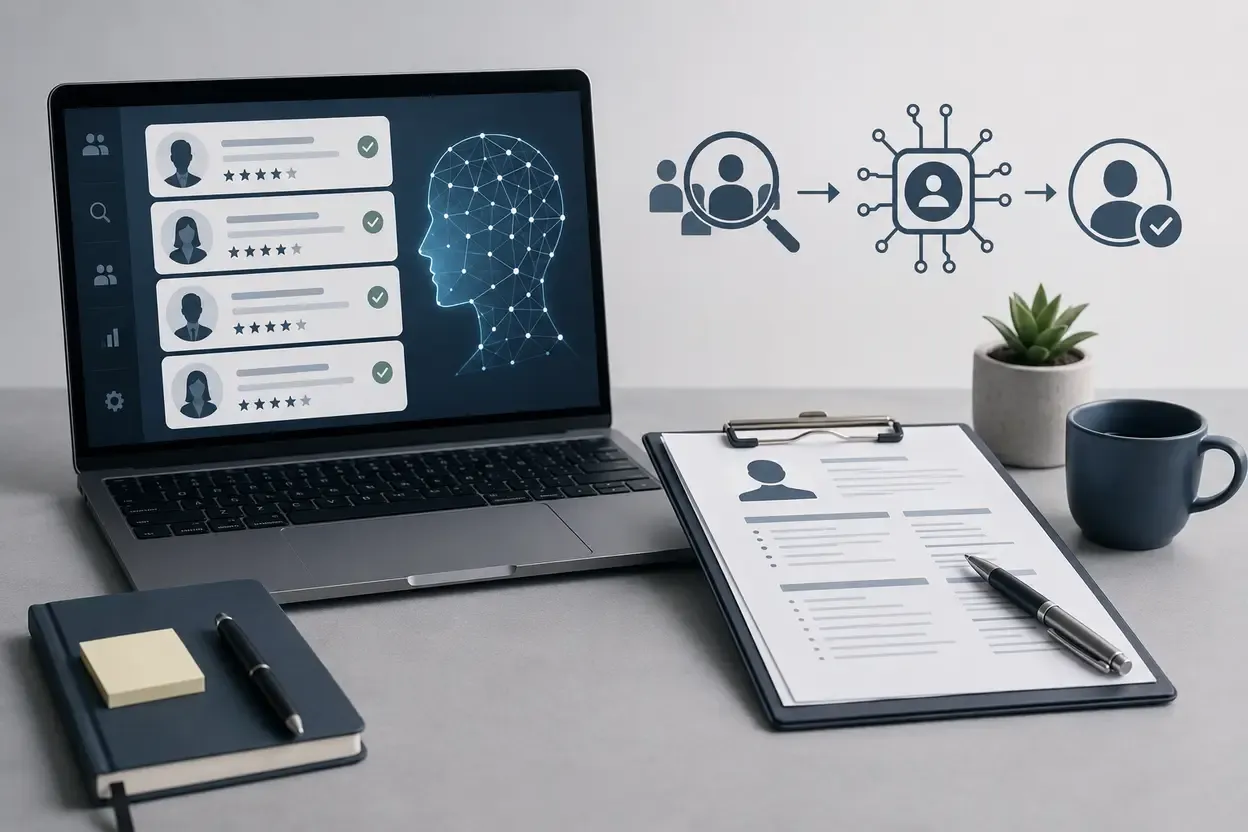
Today’s AI-driven sourcing tools can scan millions of profiles, understand skills contextually (going beyond simple keyword matching), and surface qualified candidates in hours instead of weeks. The result is faster hiring cycles, stronger matches, and measurable ROI across every stage of the talent pipeline. For high-volume roles with clear criteria, AI handles the heavy lifting automatically. For senior or specialized searches, the best teams pair AI-driven sourcing with experienced recruiters who own candidate conversations and closing. The ATS keeps everything in one pipeline, and the recruiter layer adds the relationship depth that converts strong candidates into accepted offers.
TLDR:
-
AI candidate sourcing finds qualified candidates faster than manual methods, reducing time-to-fill.
-
Modern AI analyzes millions of profiles across platforms, understanding the context beyond simple keyword matching.
-
Companies see recruiting speed gains and higher outreach response rates compared to traditional methods.
-
Best results combine AI screening with human recruiters for relationship building and closing top talent.
-
AI-powered ATS tools can score candidates and post to 100+ job boards in one click; some pair this with on-demand recruiting support for senior or specialized searches that need a more hands-on approach.
What Is AI Candidate Sourcing?
AI candidate sourcing is the process of using machine learning algorithms to automatically identify, assess, and rank potential job candidates from multiple sources. Unlike traditional keyword-based searches that look for exact matches, AI sourcing understands context, analyzes skills alignment, and predicts candidate success based on multiple data points.
It’s like having an intelligent sourcing system that continuously refines your candidate search. While traditional sourcing might find candidates who mention “Python” in their resume, AI sourcing understands that someone with “machine learning engineering” experience likely has Python skills, even if they don’t explicitly list it.
What makes this particularly powerful is the ability to learn from your hiring decisions. When you mark certain candidates as good fits, the AI learns your preferences and gets better at finding similar profiles. This creates a feedback loop that continuously improves sourcing quality.
The Current State of AI Candidate Sourcing in 2026
The numbers tell a compelling story about AI adoption in recruiting. According to recent industry data, 87% of companies now use AI somewhere in their recruitment process, and 93% of recruiters plan to increase their AI use in 2026, with sourcing remaining the top use case according to LinkedIn’s 2026 Talent Report.
The market has grown quickly. Dedicated AI recruiting software was valued at around $596 million in 2025 and is projected to reach $921 million by 2031, according to Mordor Intelligence. The broader AI in HR market is growing even faster, with Grand View Research projecting it will hit $15.24 billion by 2030. That growth reflects a real shift in how companies approach talent acquisition.
What’s driving this rapid adoption? Simple economics. Many companies using AI sourcing report measurable time-savings and faster candidate identification compared with manual methods. When you consider that SHRM’s 2025 benchmark puts the average cost-per-hire at $5,475 for non-executive roles, and AI can reduce time-to-fill, the ROI becomes clear.

Key Benefits of AI Candidate Sourcing
The most immediate benefit is time savings, and the numbers are staggering. Talent acquisition professionals typically spend around 13 hours per week sourcing candidates for a single role. AI automation can free up multiple hours per day, translating to an increase in recruiting speed.
| Dimension | AI Candidate Sourcing | Traditional Sourcing |
|---|---|---|
| Time to source | Hours to days for qualified candidates | Days to weeks per role |
| Matching method | Contextual, semantic understanding of skills and experience | Exact keyword matching only |
| Candidate pool | Scans millions of profiles automatically | Limited by recruiter bandwidth |
| Scalability | Handles high-volume hiring without added headcount | Requires proportional staff growth |
| Bias exposure | Focuses on qualifications and defined criteria | More exposed to unconscious bias |
| Learning over time | Improves with hiring feedback and decisions | Starts fresh with each new search |
| Cost impact | Reduces time-to-fill and overall recruiting costs | High manual hours per role, higher cost-per-hire |
Cost reduction follows naturally from these improvements. When you can fill positions faster with better-matched candidates, the financial impact compounds quickly. Lower cost-per-hire, reduced turnover, and improved productivity from better hires all contribute to major ROI.
Here’s what makes this particularly valuable for startups:
-
Level playing field: Small teams can compete with enterprise recruiting departments
-
Reduced bias: AI focuses on qualifications and fit instead of unconscious human biases. See Dover’s guide on how to reduce bias in hiring
-
Scalability: Handle high-volume hiring without proportionally increasing recruiting staff
-
Data-driven decisions: Make hiring choices based on predictive analytics rather than intuition
How AI Candidate Sourcing Actually Works
Under the hood, AI candidate sourcing relies on several sophisticated technologies working together. The process starts with semantic analysis, where AI models parse job descriptions to understand the explicit requirements and the implied skills and experience needed for success.
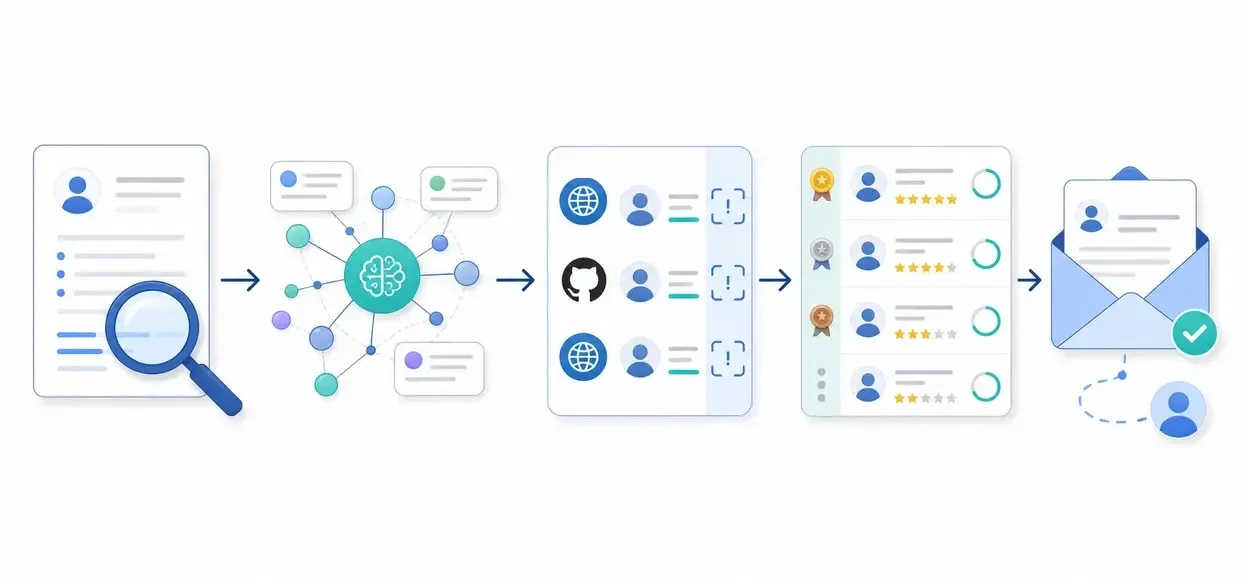
Instead of simple keyword matching, these systems understand relationships between concepts. When you’re looking for a “full-stack developer,” the AI knows to look for candidates with experience in both frontend frameworks like React and backend technologies like Node.js, even if those specific terms aren’t in the job posting.
The real magic happens in profile analysis. AI systems can access and analyze profiles from LinkedIn, GitHub, Stack Overflow, and other professional databases containing millions of public records. They’re looking at career progression patterns, skill combinations, project complexity, and even communication styles in public posts.
The automated outreach component uses AI text analysis to craft personalized recruiting emails based on candidate backgrounds and interests. Instead of generic “we have an opportunity” messages, AI can reference specific projects, career goals, or mutual connections to increase response rates.
Implementation Best Practices
Successful AI candidate sourcing implementation starts before you even choose a tool. The most important step is defining your ideal candidate profile with specificity that goes beyond basic job requirements. Include soft skills, cultural fit indicators, career progression patterns, and success metrics from your best current employees.
Start with clear data hygiene. AI systems are only as good as the data they’re trained on, so make sure your existing candidate database is clean, properly tagged, and includes outcome data (hired/not hired, performance ratings, retention). This historical data becomes the foundation for training your AI models.
Measurement and iteration separate successful implementations from failed ones. Track metrics like:
-
Time-to-source qualified candidates
-
Response rates to AI-generated outreach
-
Interview-to-hire conversion rates
-
Quality of hire scores for AI-sourced candidates
-
Recruiter satisfaction and adoption rates
Don’t try to automate everything at once. Start with high-volume, standardized roles where AI can have the biggest impact, then gradually expand to more complex positions as your team becomes comfortable with the technology.
AI sourcing performs best on roles with clear, repeatable criteria. For senior, specialized, or relationship-sensitive searches, AI can surface strong candidates but closing often requires someone with direct market relationships and the judgment to handle an offer conversation well. That’s where fractional recruiting agency support fits in: a recruiter who works inside the same ATS pipeline, owns candidate conversations and closing, and steps back when the search wraps up. The ATS handles the volume; the agency-level expertise handles the depth.
Dover’s Approach to AI-Enhanced Recruiting
Dover combines AI-powered technology with human expertise to create a complete recruiting ecosystem designed for startups. Our approach recognizes that while AI excels at candidate identification and initial screening, human insight remains important for relationship building and final hiring decisions.
Our ATS offers AI applicant scoring on its premium tier, letting you rank applicants based on criteria that you set. Instead of manually reviewing hundreds of resumes, you can focus on the top-ranked candidates while still having access to the complete applicant pool.
What sets Dover apart is its position as the infrastructure layer that fractional recruiting agencies are built on. Our network of experienced recruiters, each with verified reviews from real prior engagements, can take over relationship building, interview coordination, and closing when AI handles initial screening, all working inside the same ATS pipeline so nothing gets fragmented. When a role is senior, the candidate pool is narrow, or your team lacks bandwidth to run a full search, the recruiter layer pays off most: you get AI-driven sourcing speed paired with the human judgment that converts strong candidates into accepted offers.
Our one-click job posting reaches over 100 job boards simultaneously, then consolidates all applicants into a single dashboard with AI-powered ranking. This means you can cast a wide net without drowning in unqualified applications.
For companies working with multiple recruiting agencies, Dover’s Agency Portal provides a single hub to manage all submissions with AI-powered duplicate detection and quality scoring. You can see which recruiters consistently deliver the best candidates and focus your relationships accordingly.
Over 1,500 companies now use Dover’s recruiting solutions to attract top talent through our combination of free AI-powered tools and expert recruiter services. The approach is flexible: use just the free ATS, upgrade to the $199/month premium tier for the AI layer, or engage our fractional recruiters for hands-off hiring.
FAQs
What’s the main difference between AI sourcing and traditional keyword searches?
Traditional searches look for exact keyword matches, while AI sourcing understands context and relationships between skills. For instance, AI knows that a “machine learning engineer” likely has Python experience even without explicitly listing it, whereas keyword searches would miss this connection.
When should I add a fractional recruiter to my AI sourcing workflow?
AI sourcing handles volume well, quickly surfacing qualified candidates for roles with clear criteria. The tool shows its limits on senior or highly specialized roles where the best candidates are passive, skeptical of automated outreach, and more likely to respond to a warm introduction. If your AI pipeline is generating matches but response rates or offer-acceptance rates are lagging on a critical role, adding a fractional recruiter on top of your ATS is often the right move. The recruiter works inside the same pipeline, owns candidate conversations and closing, and steps back when the search wraps up. That combination covers both the speed of AI-driven sourcing and the relationship depth that complex searches need.
Can AI candidate sourcing reduce bias in hiring?
AI sourcing can reduce certain types of bias by focusing on qualifications, skills, and career patterns instead of subjective impressions during early screening. Because the system applies consistent criteria to every profile it reviews, it removes some of the inconsistency that comes from manual resume reviews. That said, AI is only as fair as the data it is trained on. If past hiring decisions reflected bias, the model can replicate those patterns. The best approach combines AI-driven screening with clear, defined criteria and periodic review of who is and isn’t surfacing in results.
Which types of roles does AI candidate sourcing work best for?
AI sourcing tends to perform best on roles with well-defined, repeatable criteria: software engineers, sales reps, customer success managers, and similar positions where skill sets and career trajectories follow recognizable patterns. For these roles, AI can quickly surface a strong candidate pool across multiple platforms. For senior leadership, highly specialized technical research roles, or positions where culture fit and interpersonal judgment are the dominant hiring criteria, AI sourcing is still useful for building an initial pool, but the screening and closing process typically benefits from a more hands-on approach.
Final Thoughts on AI Candidate Sourcing
AI candidate sourcing has become the baseline for competitive hiring. The teams still relying on manual screening are already losing top talent to those using intelligent, automated systems that work around the clock. By combining contextual AI matching with human expertise, teams can fill roles faster, reduce hiring costs, and meaningfully improve candidate quality. Dover is one place to start: a free ATS that serves as the infrastructure layer for fractional recruiting agency support, with on-demand access to reviewed, experienced recruiters when a search needs more hands-on work, at an average of $2,000 to $7,000 per hire with no long-term contracts.