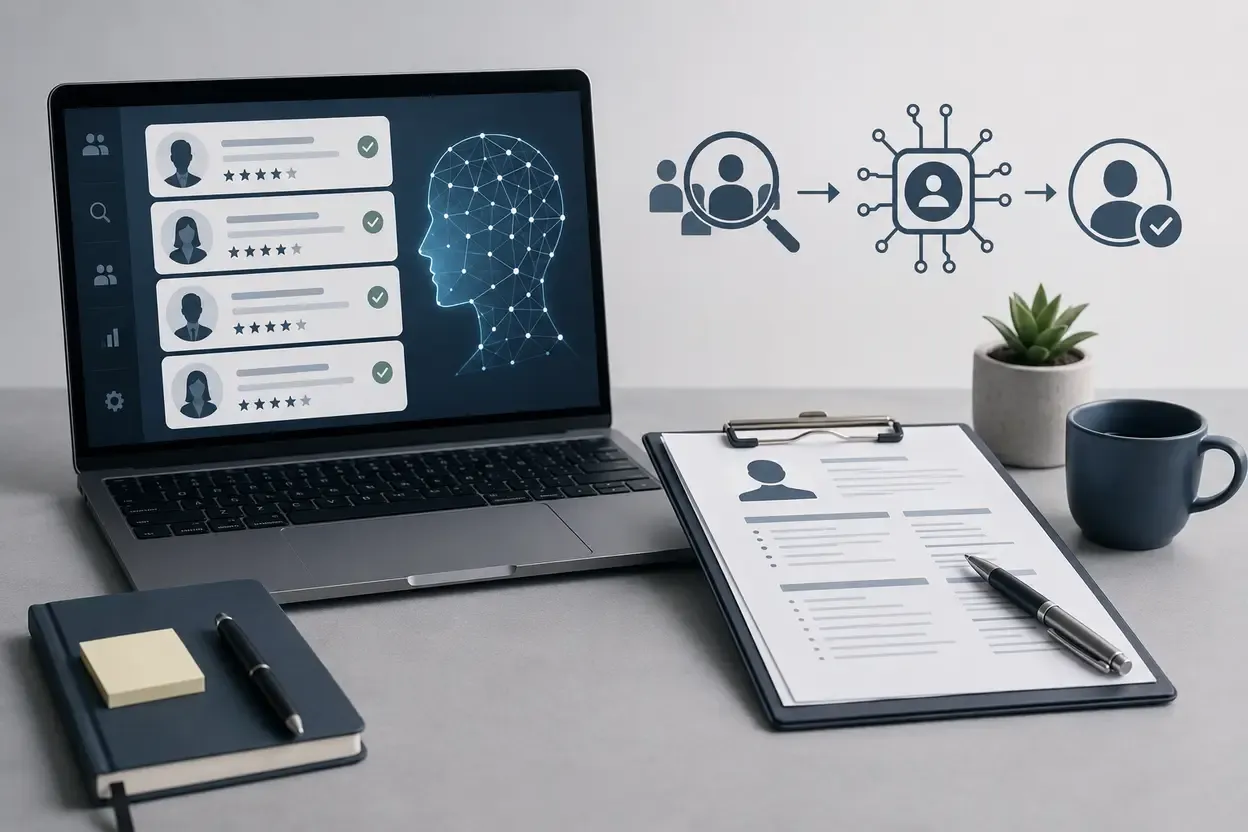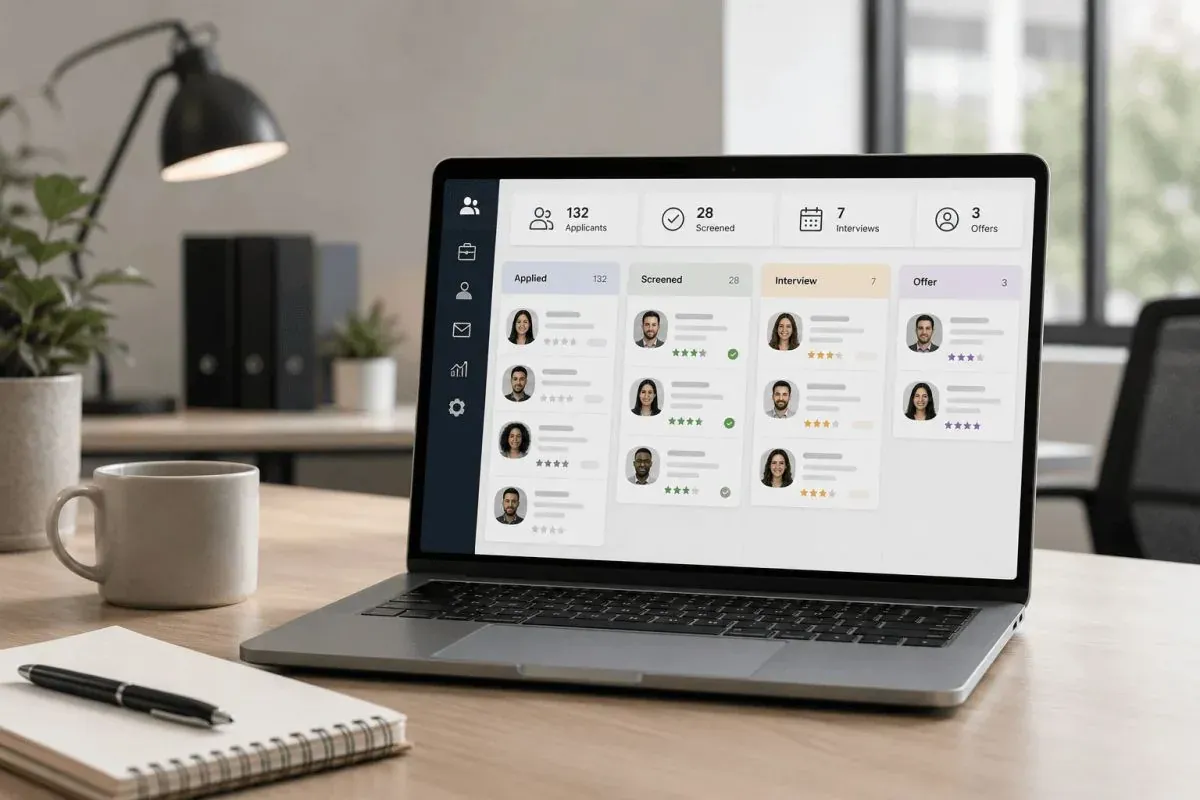

The conversation around AI and recruiting has been going on for years, but what’s actually changed is how much of the hiring funnel startups can now run without a full recruiting team behind it. The tools work, with some real caveats around bias, compliance, and configuration. Here’s what’s worth knowing before you start plugging them in.
TLDR:
-
Some estimates suggest AI scoring tools can reduce time-to-hire by up to 50% and cut cost per hire by 20-40%, but only with well-configured criteria and human review at each stage.
-
AI filters, scores, and schedules; it cannot persuade a candidate with two offers to choose yours, so recruiter roles are shifting toward higher-impact work.
-
Bias enters AI hiring tools at three points: training data, criteria configuration, and how outputs get interpreted, making explainability a requirement.
-
Employers remain liable for discriminatory outcomes from automated hiring tools even when a vendor built the system; vet for audit trails before deploying.
-
Some tools pair a free ATS with on-demand recruiting support averaging $4.8k per hire, covering volume with AI and specialized searches with human recruiters.
What AI Actually Does in the Recruiting Process
AI shows up at nearly every stage of the hiring funnel, though what it actually does varies considerably depending on where in the process you look.
AI candidate sourcing tools surface matching candidates before a recruiter sends an outreach message, scoring tools rank inbound resumes against customizable criteria, scheduling assistants handle interview coordination, and transcription tools capture interview notes for feedback forms. Across all of it, recruiters and hiring managers remain responsible for the final calls.
AI for Candidate Sourcing
AI sourcing tools scan professional networks and resume databases for passive candidates whose profile signals match a role’s requirements, even when those candidates haven’t applied anywhere. The signals these systems use go beyond job titles: years of experience, career progression patterns, skills adjacency, and tenure at comparable companies all factor into how candidates get ranked. A recruiter running a manual search might miss a strong candidate because of a title mismatch; a predictive model looks past that.
The clearest gain is coverage. Manual sourcing caps out at how many profiles a recruiter can review in a day. AI recruiting tools expand that ceiling considerably, surfacing a broader pool faster and letting recruiters focus on outreach and assessment instead of discovery. Human judgment still determines who actually gets contacted.
AI-Powered Resume Screening and Applicant Scoring
AI scoring tools rank inbound applicants against defined role criteria, letting teams weight experience, skills, and location while flagging who cleared the bar. Output accuracy depends almost entirely on how carefully criteria are set: too narrow a filter removes strong candidates; too broad a filter still needs manual review. Advanced candidate sourcing techniques help teams define what strong looks like first.
Benefits of AI-Driven Recruiting
Speed, cost, and capacity are where AI’s impact on recruiting shows up most clearly. Some estimates suggest AI tools can reduce time-to-hire by up to 50%, while other estimates point to 20-40% lower cost per hire for organizations that have adopted AI screening and sourcing.

One caveat worth stating plainly: these outcomes reflect thoughtful implementation, well-configured criteria, and human review at each decision point.
Risks and Limitations of AI in Recruiting
Four failure modes show up repeatedly when teams scale AI use in recruiting without adequate oversight.
-
Garbage-in, garbage-out scoring: AI applicant scoring replicates whatever biases exist in the historical hiring data it’s trained on.
-
Opaque logic: Many scoring systems can’t explain why a candidate ranked low, so a recruiter has no way to catch errors before they affect real candidates.
-
Candidate experience degradation: Fully automated pipelines where candidates never hear from a human until late stages produce worse offer-acceptance rates, particularly for senior roles.
-
Over-reliance at the screening stage: Treating AI scores as final decisions instead of filtering tools removes the human check that catches configuration errors and strong candidates who don’t fit the model’s pattern.
Bias, Fairness, and Ethical Considerations in AI Hiring
Bias in AI hiring tools enters at three distinct points: the training data the model learns from, the criteria teams define when configuring the tool, and how outputs get interpreted downstream.

Training data is the most common entry point: a model trained on hiring decisions that favored certain schools or backgrounds will rank similar candidates higher, not because they’re better qualified, but because they resemble past hires. Criteria definition compounds the issue when teams set AI employment bias and legal compliance factors without scrutiny, and interpretation of outputs adds a third layer, since a ranked list can look objective while still carrying forward those patterns. Bias audits and diverse training data help, but explainability remains the baseline requirement: a scoring system that can’t say why a candidate ranked low leaves a recruiter with no way to catch a configuration error before it reaches other applicants.
Compliance and Legal Requirements for AI in Hiring
Using AI tools to screen candidates is no longer a compliance-free zone. Regulators on both sides of the Atlantic have moved quickly, and the obligations are real.
In the U.S., EEOC Title VII employer liability guidance makes clear that employers remain liable for discriminatory outcomes, even when a vendor built the system. NYC Local Law 144 requires independent bias audits before a tool is used on candidates, and the Illinois Artificial Intelligence Video Interview Act now requires explicit candidate notice before AI analyzes interview footage.
In the EU, EU AI Act rules for talent management impose strict transparency, documentation, and human-oversight requirements on any AI used in recruitment. Vet any vendor for audit trails and bias-testing documentation before deploying, since liability follows the employer, not the vendor.
Will AI Replace Human Recruiters?
The short answer is no. AI handles volume well: screening applications, flagging scheduling conflicts, and transcribing interview notes are genuinely automatable, so recruiters spending most of their week on those tasks will see that work shrink.
What AI cannot do is persuade a candidate with two offers, read subtext that doesn’t show up on paper, or build the hiring-manager relationship where candid feedback flows. Understanding AI recruiting tools inside an ATS clarifies where that division of labor lives.
How to Get Started with AI in Recruiting
Start by naming the actual bottleneck. Inbound volume calls for screening and scoring tools, coordination drag calls for scheduling automation, and a thin passive pipeline calls for AI discovery tools. Once the gap is clear, pilot on one role before scaling: run AI screening alongside the existing process for a single search and check whether top-ranked candidates match the hiring team’s judgment. Build human review in from the start, not as an afterthought, so AI outputs stay filtered starting points rather than final verdicts.
Treat the ATS as the base layer and a fractional recruiting agency as the capacity added on top when a search is senior, specialized, or the brief keeps shifting, since those problems don’t yield to automation alone.
How Dover Integrates AI into Its Recruiting Workflow
How does fractional recruiting work with an ATS? In practice, the recruiter and the internal hiring team work inside the same pipeline. Sourcing activity, candidate flow, and scoring all live in one place, so the recruiter sees exactly what the hiring team sees in real time, with no handoff friction and no duplicate outreach. Dover’s free ATS handles that pipeline infrastructure: unlimited jobs, unlimited users, and one-click posting to 50+ boards. The Premium plan at $199/month adds AI applicant scoring that ranks inbound candidates against the criteria you set for each role, with no API key required for up to 2,000 scores per month (or connect your own OpenAI, Anthropic, or Gemini key). The AI interview notetaker, also part of Premium, transcribes video interviews and can pre-fill feedback forms, reducing the manual documentation time that typically follows each call.
That same infrastructure is also what fractional recruiting agencies on Dover’s marketplace run their operations on, using the identical ATS and pipeline tools rather than a separate internal system. For a client, that means visibility into exactly what an agency is doing on a search as it happens, rather than waiting on periodic updates. Dover’s marketplace also publishes reviews for its vetted fractional recruiters, giving clients a way to assess fit before engaging one.
| Feature | Free Plan | Premium Plan ($199/month) |
|---|---|---|
| Job postings | Unlimited | Unlimited |
| Users | Unlimited | Unlimited |
| Job board distribution | One-click posting to 50+ boards | One-click posting to 50+ boards |
| AI applicant scoring | Not included | Up to 2,000 scores/month, or use your own API key |
| Customizable scoring criteria | Not included | Included, no API key required |
| AI Interview Notetaker | Not included | Transcribes video interviews, populates feedback forms |
| On-demand human recruiters | Available as add-on | Available as add-on |
| Cost per hire (human recruiter) | Avg. $4.8k per hire, no long-term contract | Avg. $4.8k per hire, no long-term contract |
Teams that hit the limits of what AI can handle can bring in fractional recruiters through the same system, averaging $4.8k per hire with no long-term contract required. For a broader look at options, see the best ATS for startups compared across the current market. AI manages the volume problem; human recruiters handle specialized searches, senior roles, and high-stakes positions where relationship-level judgment matters. Both operate within a shared pipeline, so nothing gets lost between the tools and the people using them.
FAQs
What’s the best free ATS for startups just beginning to hire?
For teams at the earliest hiring stages, the right free ATS should handle job posting, application tracking, and basic pipeline management without requiring setup time or per-seat fees. Dover’s free ATS covers all of that: unlimited jobs and users, one-click posting to 50+ boards, a no-code careers page, and built-in referral tracking, with AI-powered applicant scoring available on the $199/month premium plan for teams that need ranked screening at volume. The free tier is purpose-built for founders managing their first hires, not a stripped-down version of an enterprise product.
Should I use AI screening tools before defining what a strong candidate looks like for my role?
Not exactly. Deploying AI screening before you have written, specific criteria is the most common configuration mistake. AI scoring works as a force multiplier on whatever criteria sit beneath it: a well-defined role profile produces a useful ranked list, while a generic or vague one produces a faster version of a poorly structured process. Before running any AI screening, document what a strong candidate actually looks like for the specific role, including skills, background patterns you want to include and exclude, and any hard knockout requirements.
When does it make sense to layer in a human recruiter on top of AI recruiting tools?
AI handles volume well, covering tasks like screening hundreds of inbound applications, coordinating scheduling, and transcribing interview notes, but it can’t persuade a candidate with competing offers, read misalignment that doesn’t show up on paper, or build the kind of recruiter-hiring manager relationship where candid feedback actually flows. For high-stakes roles, senior positions, or specialized searches where candidate relationship management determines whether an offer gets accepted, human recruiters remain the more reliable option.
Final Thoughts on AI and Recruiting
Getting real value from AI and recruiting comes down to one thing: knowing what you’re solving for before you deploy anything. AI handles volume well, but your judgment still governs the decisions that matter. Start with one bottleneck, configure your criteria carefully, and keep a human in the loop at each stage. Dover’s model is one version of that pattern: a free ATS handling pipeline infrastructure and AI scoring, paired with a marketplace of vetted recruiters who carry published reviews and fractional recruiting agencies run their end-to-end work on the same infrastructure, with recruiters available in that system when a search needs more hands-on support, averaging $4.8k per hire, no long-term contract required.