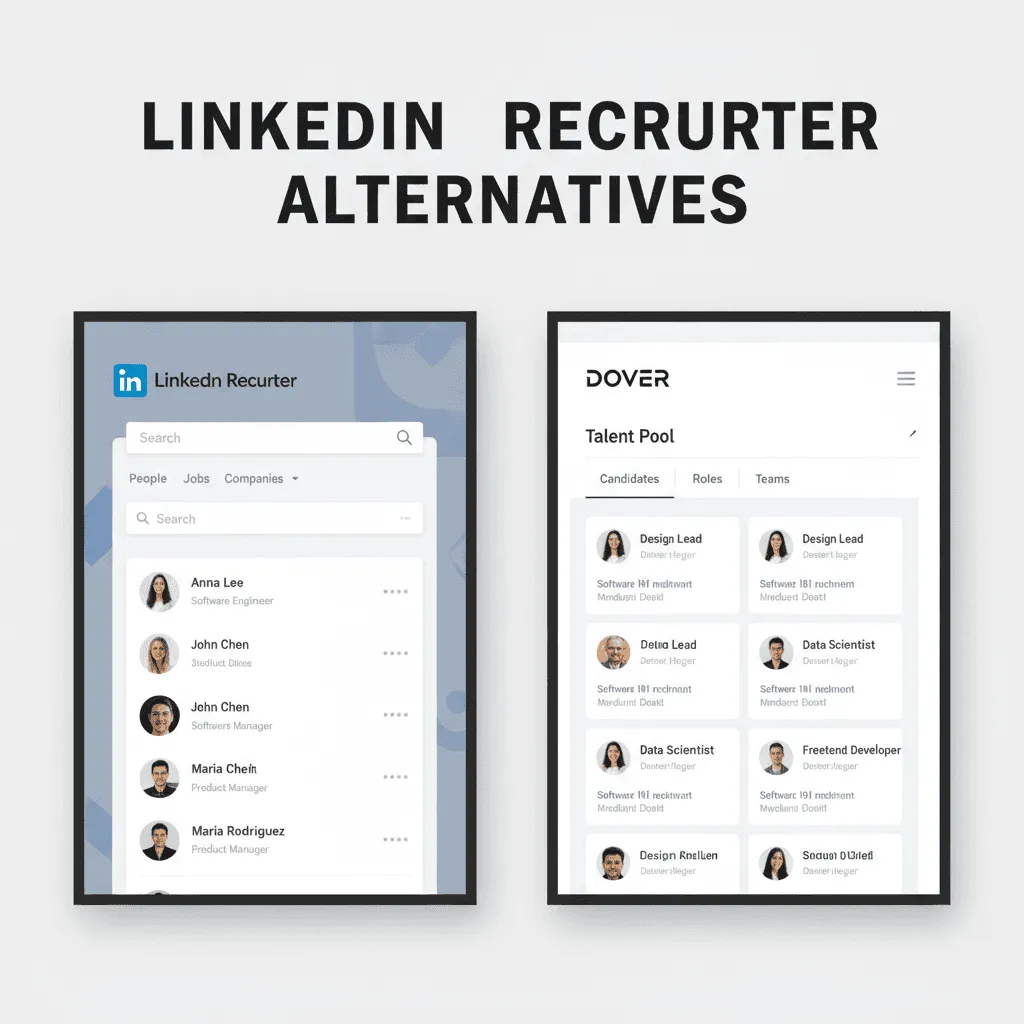
LinkedIn Recruiter has dominated the recruiting space for years, but the LinkedIn Recruiter cost, which third-party estimates commonly place at roughly $9,000-$12,000 or more per seat annually, combined with its limited monthly InMail allowances, is pushing startups toward more flexible solutions. New tools offer everything from free ATS systems to fractional recruiting services that fit startup budgets, and many LinkedIn Recruiter alternatives can deliver better results at a fraction of that cost. In this guide, we break down LinkedIn Recruiter’s true costs and major limitations, then show you the best alternatives that can save your startup thousands while improving hiring outcomes.
TLDR:
-
Full LinkedIn Recruiter commonly costs thousands of dollars per seat annually and includes a limited monthly allocation of InMail credits.
-
Some tools pair a free ATS with on-demand fractional recruiters, offering meaningful cost savings compared to LinkedIn.
-
LinkedIn’s search limitations, InMail allowances, and potential usage restrictions can create workflow bottlenecks for high-volume recruiting teams.
-
Fractional recruiting aligns costs with hiring needs, so you only pay when actively recruiting.
-
Some solutions provide both recruiting software and expert services for less than LinkedIn’s tool alone.
What is LinkedIn Recruiter and How Does it Work?
LinkedIn Recruiter is a premium talent search and engagement solution designed for professional recruiters and organizations with substantial hiring needs. The tool provides access to LinkedIn’s global network of more than one billion members, offering:
-
Advanced search features
-
InMail messaging
-
Collaboration features
The service operates through multiple tiers including Recruiter Lite for smaller teams and Recruiter Corporate for enterprise-level organizations. Features vary widely by plan. Recruiter Lite generally includes 30 monthly InMail credits and a more limited set of search and collaboration features, while full Recruiter plans may include 100-150 monthly InMail credits, broader network visibility, advanced search tools, analytics, team collaboration, and ATS integrations.
The system uses Boolean search functionality, allowing recruiters to combine keywords and filters to narrow down candidate pools based on specific criteria like location, industry experience, and skill sets.
LinkedIn positions this as important for filling specialized or senior-level roles where traditional job postings often fall short. However, as we’ll see below, the reality often doesn’t match the marketing promises for budget-conscious startups.
LinkedIn Recruiter Pricing Breakdown
LinkedIn does not publish standardized pricing for its full Recruiter plans, so organizations generally need to contact its sales team for a customized quote. The true costs are only revealed by their sales team after they assess your company and needs.
That’s already a red flag for startups who need transparent pricing to plan their budgets.
Based on LinkedIn Recruiter cost analysis from multiple sources, current pricing estimates for 2025 include:
| Plan | Monthly Cost | Annual Cost | Key Features |
| Recruiter Lite | $170-$270/month | $2,040-$3,240/year | Single license, basic features |
| Recruiter Corporate | $895-$1,080/month | $9,600-$12,960/year | Advanced features, team collaboration |
| Additional InMails | $10-$15 per message | N/A | Extra outreach capacity |
The pricing varies greatly based on factors including company size, industry, geographic location, and number of licenses needed. Larger companies and those in competitive industries typically pay more, while some organizations may receive different per-seat pricing based on license volume and contract terms.
Additional InMails cost a staggering $10-$15 per piece. If you want an additional 100 InMail messages, which typically generate 18-25 responses, it’ll cost you $1,000.
For startups already watching every dollar, these costs can quickly spiral out of control. A full LinkedIn Recruiter subscription can represent a sizable annual expense before accounting for recruiter labor, job postings, or other hiring costs.
LinkedIn Recruiter Key Limitations and Gaps
Despite its market position, LinkedIn Recruiter faces major constraints that impact user experience and ROI. The high cost represents the primary barrier for most organizations, particularly startups and small businesses. Many reviewers feel that LinkedIn Recruiter is prohibitively expensive, especially for small businesses and startups.
The InMail system presents another major limitation. Users frequently exhaust their monthly allowances and face expensive per-message charges for additional outreach capacity. As reported by a few users and reviews from Capterra, InMails are very limited monthly, and it’s expensive.
While LinkedIn supports advanced Boolean search, recruiters often spend time fine-tuning queries to filter out irrelevant profiles. This single design flaw creates lots of irrelevant results that require extensive manual filtering to identify truly relevant candidates.
Technical limitations also limit daily usage. LinkedIn may restrict profile viewing or searching when usage reaches certain limits or appears unusually high. These restrictions can disrupt high-volume sourcing workflows, although the thresholds may vary by account and usage pattern, as documented in LinkedIn’s help center.
The competitive environment on LinkedIn has intensified. There are simply too many recruiters vying for the same candidates, making it increasingly difficult to stand out.
For startups looking for startup recruiting competition data to better understand the hiring environment, these limitations compound quickly. You’re paying premium prices for a tool with defined outreach and usage limits while competing for attention in a crowded marketplace.
LinkedIn Recruiter Alternatives for Startups
The recruiting world has expanded far beyond LinkedIn’s ecosystem, offering organizations multiple ways to identify and engage top talent. Modern alternatives often provide superior value propositions through lower costs, broader data sources, and more flexible engagement models.
Dover: Best LinkedIn Recruiter Alternative for Startups
Unlike traditional agencies, Dover combines a free ATS with on-demand recruiting services along with a range of features such as:
-
Free Multi-channel sourcing extension
-
A marketplace of talented fractional recruiters
-
Access dozens of job boards, just a click away
-
Agency portal to track submissions
-
Track and monitor employee referrals
These fractional recruiters step in and out based on your hiring needs. Compared to LinkedIn Recruiter costs that add up to $1,000+ monthly, you can hire a fractional recruiter at an hourly rate.
AI-powered talent search engines
AI-powered talent search engines like SeekOut, HireEZ, and Findem aggregate profiles from multiple sources beyond LinkedIn. Their database sizes and source coverage vary by provider, with each platform combining publicly available and licensed professional data from different sources.
Contact enrichment tools
These tools focus on finding accurate email contacts and phone numbers for candidates identified through other channels. Companies like SignalHire, Swordfish, and Nymeria specialize in this functionality without requiring expensive monthly subscriptions.
X-ray search techniques
X-ray search allows recruiters to use search engines to find some publicly indexed LinkedIn profile pages without a Recruiter subscription. However, it does not provide access to private or unindexed profiles, premium search filters, full profile visibility, or InMail messaging.
Public communities such as GitHub, Stack Overflow, and Kaggle can provide additional evidence of a candidate’s technical work or subject-matter expertise, although they do not all provide dedicated recruiting tools or reliable indications that a user is open to employment.
With these many options, instead of being locked into LinkedIn’s expensive ecosystem, you can mix and match tools based on your specific hiring needs and budget.
How Dover Stands Out as a Startup Recruiting Solution
Dover operates as the infrastructure layer that fractional recruiting agencies are built on, giving startups agency-grade recruiting capacity without the cost structure that comes with it. Traditional agencies charge 20-30% of a candidate’s first-year salary per hire. Dover’s fractional service runs on a transparent hourly model where per-hire costs land well below the $15,000-$30,000 range charged by typical agency fees. Instead of paying thousands monthly for LinkedIn Recruiter licenses, startups get both software and professional recruiting services for a fraction of that cost.
Dover’s recruiter selection process is built around transparency. Every recruiter in the marketplace carries real, vetted reviews from companies they have previously worked with, so startups choose based on track record and proven fit, not a profile alone. The fractional recruiting model also aligns costs with actual hiring activity: you pay when recruiting is active, not when it’s quiet. LinkedIn Recruiter’s fixed subscription doesn’t flex that way, and for startups with variable hiring pipelines, that difference adds up across the year.
Combining software with expert support closes the expertise gap many startups face. LinkedIn Recruiter requires someone who knows how to use it well, and for most startups that know-how is in short supply. Dover pairs recruiting software with hands-on recruiter access, so teams get results instead of just paying for platform access. Because Dover is the layer fractional recruiting agencies are built on, those recruiters work within the same ATS and pipeline the client already uses, so no context gets lost between the tool and the person running the search. For startups looking to reduce their recruiting budget while improving outcomes, Dover’s model is a more direct path than an expensive tool with a steep learning curve and no built-in support.
Frequently Asked Questions
How much does LinkedIn Recruiter actually cost per year?
LinkedIn Recruiter Corporate runs $9,600 to $12,960 per license annually, though LinkedIn does not publish pricing publicly and only reveals the final number after a sales conversation. Beyond the base fee, each additional InMail costs $10 to $15, and active teams can burn through their monthly allocation quickly. That’s before factoring in recruiter time spent filtering irrelevant results and working around daily profile view caps.
When should startups consider alternatives to LinkedIn Recruiter?
If your team is hitting InMail limits, filtering irrelevant candidates, or paying close to $1,000 a month without proportional results, LinkedIn Recruiter is likely not the right fit. Its fixed subscription model is a poor match for startups that hire in bursts or focus on a handful of roles per quarter, since you keep paying even during quiet periods. If recruiters are spending more time wording Boolean queries and filtering noise than engaging candidates, the tool is creating work instead of reducing it. Look at alternatives before costs compound across multiple renewals, not after locking into another annual contract.
How do Dover’s costs compare to LinkedIn Recruiter for startups?
Dover’s ATS is free, with no license or subscription fee. Fractional recruiting services run $75 to $125 per hour, with per-hire costs generally landing between $2,000 and $7,000 depending on the role, and you only pay when actively hiring. Compare that to LinkedIn Recruiter Corporate at $9,600 to $12,960 per seat annually, locked in whether your pipeline is active or quiet, with no recruiting expertise built in. Dover ties costs to actual hiring activity; LinkedIn Recruiter charges a flat fee regardless of how many hires you make.
Final Thoughts on LinkedIn Recruiter Costs and Alternatives for Startups
The LinkedIn Recruiter cost alone, which can top $12,000 a year before a single hire, makes it a tough fit for startups that need flexible, budget-conscious hiring. Dover offers a smarter path, combining a free ATS with on-demand fractional recruiters who step in exactly when you need them. You pay only for the recruiting support you actually use, and you get real results to show for it. Dover’s fractional model means you’re backed by experienced recruiters who know how to source, screen, and close candidates fast, without the overhead of a full-time hire or the steep fees of a traditional agency. For startups serious about building great teams without burning through budget, Dover is worth a close look.
Table of contents