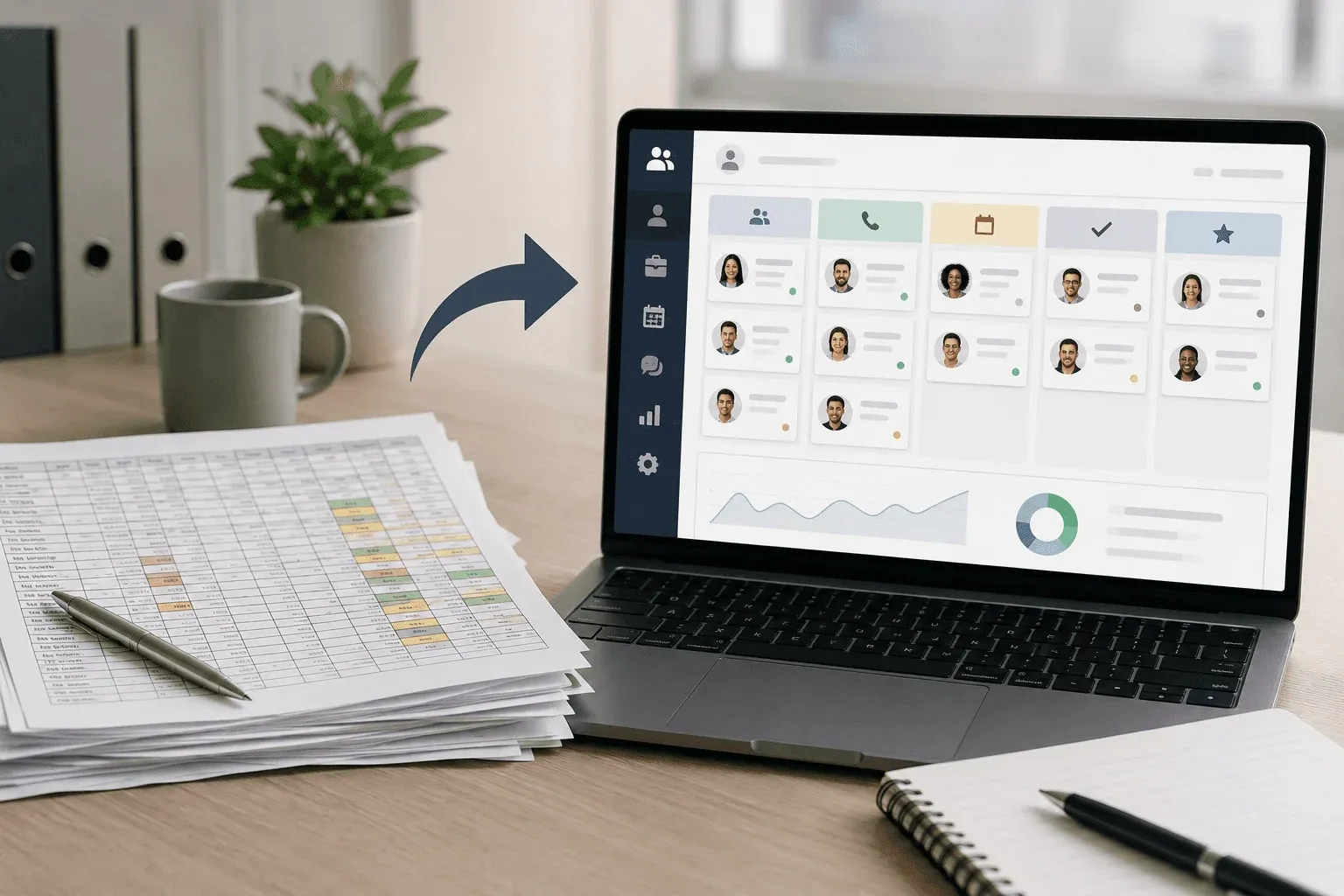
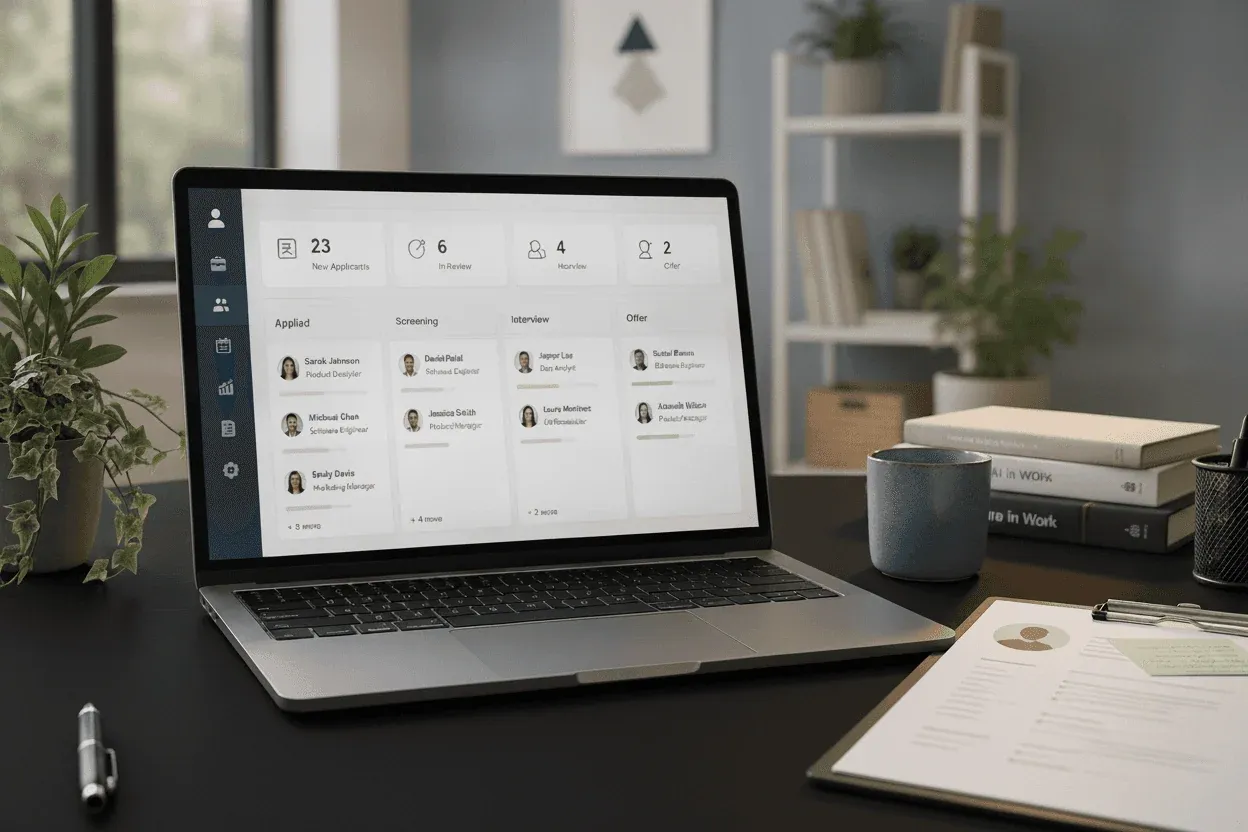
When you’re hiring for several roles at once, tracking candidates across email threads and spreadsheets starts to break down. Talent acquisition software replaces that chaos with structured workflows that track applications, distribute job postings, automate interview scheduling, and show where searches slow down. The category covers applicant tracking systems, sourcing tools, AI screening, and analytics dashboards, but most startups hiring a few people a year don’t need the full stack. The right tool handles your current hiring volume without requiring someone to manage it full-time.
TLDR:
-
Talent acquisition software replaces spreadsheets with structured workflows for tracking applicants, posting jobs, and managing interviews across multiple roles.
-
Core features include applicant tracking, job distribution, interview scheduling, and AI screening that filters high-volume pipelines when paired with clear criteria.
-
Entry-level tools often start around $15 to $75 per user per month; mid-market solutions commonly run about $200 to $500 monthly; enterprise contracts can reach five figures annually or more.
-
Free tiers cover basic needs at low volume but gate key features behind paid plans as hiring scales.
-
Some tools combine free ATS software with on-demand recruiting support, keeping costs tied to actual hiring activity instead of retainer commitments.
What Is Talent Acquisition Software?
Talent acquisition software helps organizations find, attract, and hire candidates. It spans applicant tracking systems (ATS), sourcing tools, interview scheduling software, AI-powered screening, and analytics dashboards. The talent acquisition software market is projected to grow from $10.95 billion in 2026 to $14.4 billion by 2031.
At the basic level, these tools replace spreadsheets and email threads with structured workflows. At the advanced end, they connect sourcing, outreach, screening, and offer management into one system that gives hiring teams visibility across every open role. Demand remains steady: the outlook for HR specialists projects 6% growth from 2024 to 2034.
A few common categories:
-
Applicant tracking systems manage inbound applications, track candidates through stages, and store hiring activity in a searchable database.
-
Sourcing tools help recruiters find passive candidates through job boards, LinkedIn integrations, or talent databases.
-
AI screening tools filter and score applicants against defined criteria, cutting the manual work of reviewing high application volumes.
-
Analytics and reporting tools track metrics like time-to-fill, source quality, and conversion rates so teams can spot where hiring slows down.
The right starting point depends on where the biggest bottleneck is.
Core Features of Talent Acquisition Software
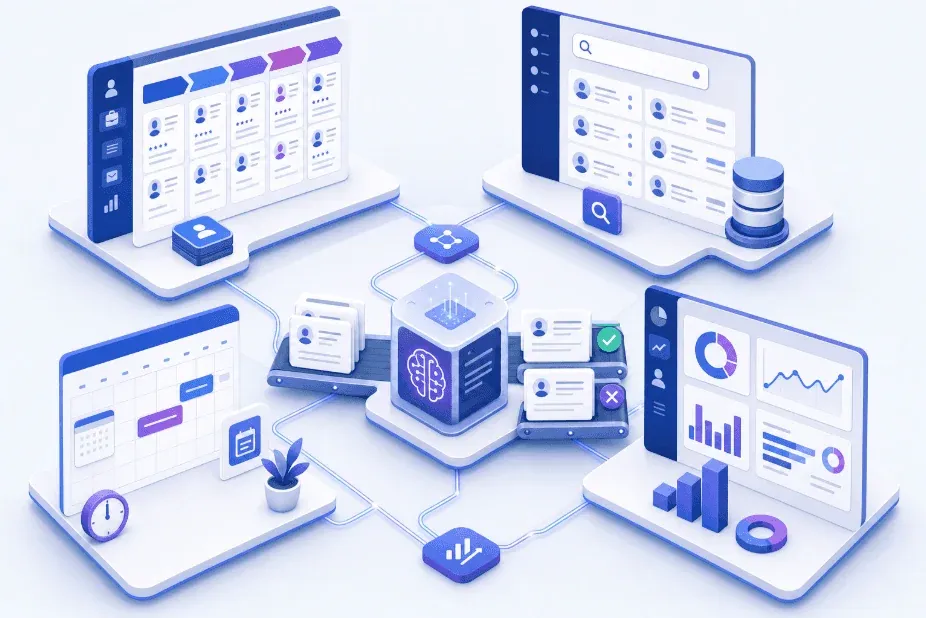
Most talent acquisition tools share a common set of capabilities, even when pricing and depth vary. Knowing what each feature does helps teams figure out which ones matter for their hiring volume.
Core capabilities to look for:
-
Applicant tracking manages candidates across pipeline stages. Without it, status lives in spreadsheets and things slip when multiple people are involved.
-
Job distribution pushes open roles to multiple job boards at once, widening reach without separate logins to each site.
-
Candidate sourcing tools help recruiters find passive candidates who haven’t applied.
-
Interview scheduling automates coordination between candidates and interviewers, often cutting time-to-schedule from days to hours.
-
AI screening filters and scores applicants against defined criteria, reducing resumes that require manual review.
-
Reporting and analytics surface funnel data like source quality, time-to-fill, and conversion rates, so teams can spot where searches stall.
Early-stage teams hiring two or three roles per year often get more value from clean pipeline tracking and job distribution than from sourcing automation or advanced analytics.
When inbound applications dry up or a role needs passive candidates, sourcing becomes a constraint software alone can’t solve. Some teams add fractional recruiters at that point, keeping the ATS as the shared system for both internal and external recruiters. That adds sourcing capacity for specific roles without handing searches off entirely.
Types of Talent Acquisition Software
Talent acquisition software spans several categories, each built for a different part of the hiring process.
Here are the main types you’ll encounter:
-
Applicant tracking systems (ATS) manage inbound applications, track candidates through stages, and store communication history. They’re the backbone of most recruiting workflows and the starting point for any repeatable hiring process.
-
Sourcing and outreach tools help recruiters find candidates who aren’t actively applying. They typically pull from professional networks or resume databases and automate initial outreach sequences.
-
Interview scheduling software reduces back-and-forth by syncing calendars and sending automated confirmations and reminders.
-
AI screening tools score or filter applicants based on resume criteria or job fit signals, helping teams triage high-volume pipelines without reading every application manually.
-
Recruiting analytics software tracks metrics like time-to-fill, source quality, and pipeline conversion rates, giving teams visibility into where hiring slows down.
-
All-in-one suites combine several functions into one product, reducing context-switching but sometimes trading depth for breadth.
Many early-stage teams start with just an ATS and add tools as volume grows. The right combination depends less on what’s available and more on where the process creates the most friction.
Benefits of Talent Acquisition Software
Talent acquisition software cuts time-to-hire, reduces recruiter workload, and shows small teams where candidates drop off. For startups without dedicated HR, those benefits show up quickly once a basic workflow is in place.
Here are some of the concrete advantages teams see:
-
Centralized candidate tracking means you stop losing applicants to scattered email threads or spreadsheet confusion. Everyone involved in hiring sees the same pipeline, which reduces duplicate outreach and missed follow-ups.
-
Automated screening and scheduling removes the back-and-forth that eats recruiter time early in a search, freeing capacity for conversations that require judgment.
-
Structured interview workflows keep feedback consistent across candidates, making final decisions easier to defend and surfacing patterns when a hire goes wrong.
-
Reporting and analytics show where candidates stall, which sources produce qualified applicants, and how long each stage takes, so you can adjust before a search drags on.
-
Compliance documentation is easier to maintain when applications, communications, and decisions are logged in one place, not scattered across inboxes.
The gains are clearest for teams running multiple searches at once or hiring repeatedly for the same roles. With SHRM’s average cost per hire near $5,475 for nonexecutive roles, the setup time pays off quickly for any team hiring more than a few people per year, even if a one-off hire may not warrant it.
How Talent Acquisition Software Automates Recruitment Workflows
Recruiting workflows break at the same points: applications pile up, follow-ups get missed, interviewers double-book, and offers sit in drafts. Talent acquisition software handles the coordination that otherwise slips.
Most tools cover a few areas:
-
Job posting distribution pushes open roles to multiple boards from one submission.
-
Resume parsing pulls structured data from applications so teams can filter and sort without reading every submission.
-
Interview scheduling syncs with calendars so candidates self-select times, cutting days of back-and-forth.
-
Candidate communication triggers templated messages at defined stages, keeping applicants informed.
-
Pipeline tracking logs where every candidate stands, so nothing relies on memory.
AI-assisted features now appear across most major tools. Screening filters score applications against defined criteria, and some flag matches from passive candidate databases. Research on AI recruiting tools shows they can outperform manual screening when paired with clear criteria.
For small teams, that means less oversight: a hiring manager reviews a curated shortlist instead of an unfiltered inbox, and recruiters spend more time on calls than on scheduling and data entry.
Pricing Models for Talent Acquisition Software
Pricing varies considerably by scope and team size. Knowing the ranges before vendor conversations helps set realistic budget expectations.
| Tier | Typical Structure | Cost Range | Notes |
|---|---|---|---|
| Entry-level | Per user/month | $15 to $75/user/month | Basic ATS and job posting; some free tiers available |
| Mid-market | Monthly or annual subscription | $200 to $500/month or $5,000 to $12,000/year | Broader feature sets; per-seat or flat-rate billing |
| Enterprise | Custom annual contract | $50,000 to $100,000+/year | Multi-month implementation; often requires dedicated IT involvement |
Per-job-posting pricing is less common but suits teams with sporadic, low-volume hiring. At the enterprise tier, implementation costs are a separate line item and can extend onboarding by months before the tool is ready.
Considerations When Choosing Talent Acquisition Software
Picking the right talent acquisition software comes down to a few questions that vary by team size, hiring volume, and process overhead.
Factors worth weighing:
-
Team size and hiring volume matter more than feature lists. A solo founder hiring one engineer needs something lightweight; a team running five concurrent searches needs pipeline visibility and coordination across roles.
-
Free tiers are real, but they come with ceilings. Many work well at low volume, then gate key features behind paid tiers as you scale. Check what’s included before assuming the free version covers your workflow.
-
AI screening reduces early-stage review time, but works best with clear, role-specific criteria. Without that, automated filtering can quietly exclude strong candidates on surface-level signals.
-
Integration with your existing tools affects adoption. If your team lives in Slack or Google Workspace, a tool that connects to neither adds friction across hundreds of candidate touchpoints.
-
Reporting and analytics determine whether you can improve over time. Basic tools show who applied; better ones show where candidates dropped off, which sources convert, and how long each stage takes.
The right starting point is usually the simplest tool that handles your current hiring load without requiring a dedicated person to manage it.
Dover’s Integrated Approach to Talent Acquisition
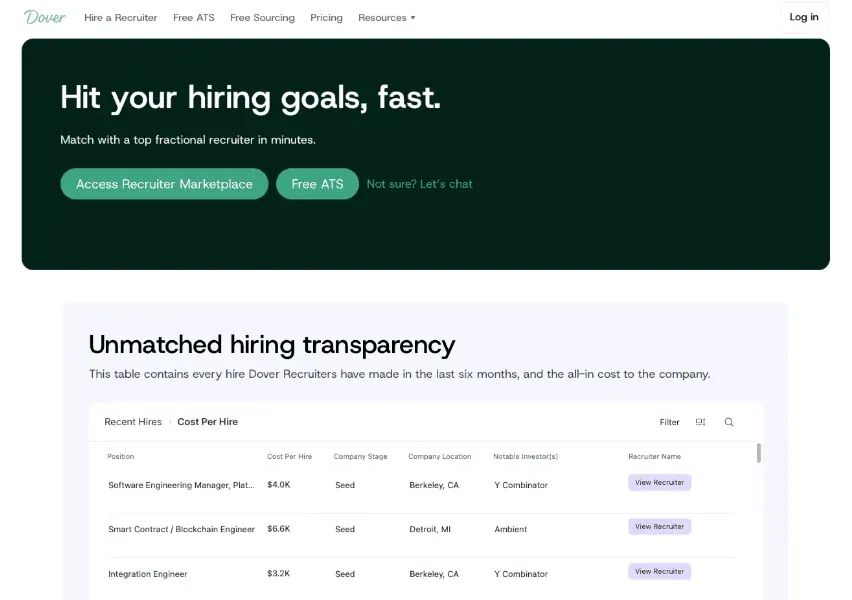
Dover sits outside the typical binary most recruiting tools force on you: either manage everything yourself with software, or hand searches off to an agency.
Dover’s ATS distributes jobs to 50+ boards, tracks candidates, and supports core recruiting workflows. AI applicant scoring and AI note-taking are also available as part of Dover’s ATS. Setup runs under five minutes, with no seat or job limits.
When a search needs more hands, fractional recruiters from Dover’s marketplace step in, with marketplace hires averaging about $4,000 per hire. An $800 refundable deposit starts the engagement, keeping costs tied to actual hiring activity instead of retainer commitments. For startups that want to stay involved in recruiting without managing every piece of it, that structure tends to fit better than fully outsourced search or a DIY approach with no support behind it.
Frequently Asked Questions
Best talent acquisition software for startups hiring their first 5-10 people?
For seed-stage teams, the simplest tool that handles your current hiring load wins: free applicant tracking, job distribution to multiple boards, and minimal setup. Clean candidate tracking matters more at this stage than advanced sourcing automation or analytics.
Can you use talent acquisition software without a full-time recruiter?
Yes. Many tools are built for founder-led hiring, automating job posting, resume parsing, interview scheduling, and candidate communication. Some pair free ATS software with on-demand recruiting support when searches need more hands, so you’re not stuck choosing between doing it all yourself or hiring full-time.
How long does it take to set up an applicant tracking system?
Most startup-focused ATS platforms set up in under an hour, with some live in as little as five minutes. Enterprise systems can take weeks or months with dedicated IT involvement, making them a poor fit for teams that need to start hiring now.
Final Thoughts on Choosing Talent Acquisition Software That Grows With You
The best talent acquisition software is the one that matches how you hire today while leaving room to add capacity as volume grows. Dover fits that pattern by pairing a free ATS that handles job distribution and pipeline tracking with AI features and access to fractional recruiters when a search needs more hands, so your tooling and your support scale with actual hiring activity instead of locking you into a system you outgrow or a retainer you don’t need.