

Search for “recruiter marketplace jobs” or “recruiting hub reviews” and most results point you toward where recruiters themselves find work, not where companies hire recruiters. The actual category worth understanding is the recruiter marketplace for employers: platforms that let you browse, hire, and manage independent recruiters who source candidates for your open roles. If you’re hiring 5 to 50 roles a year without an in-house recruiter, this structure can move faster and cost less than either posting jobs yourself or committing to a retained agency relationship.
TLDR:
-
A recruiter marketplace connects companies with independent recruiters on demand, without the upfront contracts that traditional agencies require.
-
Traditional agencies charge 15% to 30% of first-year salary per hire, while marketplaces offer flat fees or hourly rates with more visibility into the process.
-
Fractional recruiters bill for time worked instead of placement fees, which changes the incentive structure away from speed-focused fills.
-
Companies hiring 5 to 50 roles per year typically see the most value from marketplace models compared to in-house or agency alternatives.
-
Some tools pair free ATS software with on-demand recruiter access, letting early-stage teams scale hiring without committing to retained search contracts.
What Is a Recruiter Marketplace?
A recruiter marketplace is a digital service that lets companies browse and hire external recruiters on demand, without the contracts and upfront commitments that traditional agencies typically require.
Instead of relying on a single firm, you gain access to a network of independent recruiters and small recruiting firms. The marketplace handles matching, and you keep control over who actually works on your search.
This model differs from a job board, where candidates apply directly to posted roles, and from a staffing agency, where the vendor runs the process with limited client input. A recruiter marketplace gives you the human expertise of agency recruiting while preserving more visibility and flexibility over how the work gets done.
How a Recruiter Marketplace Works
You describe the role, compensation, and requirements. The marketplace matches you with a recruiter, who then sources and screens candidates through a shared dashboard. You review, give feedback, and the recruiter adjusts their approach until you have a shortlist worth interviewing. Because marketplace recruiters typically focus on a limited set of searches simultaneously, outreach tends to be more targeted than agency recruiters juggling dozens of open roles.

Types of Recruiter Marketplaces
Recruiter marketplaces vary considerably in structure, and choosing between them usually depends on how much control you want over the hiring process versus how quickly you need results.
-
Contingency-Based Marketplaces: These connect companies with independent recruiters who only get paid when a candidate is successfully placed.
-
Retained Recruiting Networks: Here, companies pay a portion of the fee upfront to secure a recruiter’s focused attention on a role.
-
Freelance and Independent Recruiter Marketplaces: Platforms connecting companies directly with independent recruiters on project terms.
-
Staffing Agency Networks: These operate more like traditional staffing firms, but with a marketplace layer that lets companies request recruiters with particular industry expertise.
-
Hybrid Marketplaces: Some services combine recruiter access with built-in applicant tracking or sourcing tools, so hiring teams can manage the full search in one place.
Benefits of Using a Recruiter Marketplace
Recruiter marketplaces offer a few concrete advantages over posting jobs directly or working with a single retained firm.
Access to a wider recruiter network is the most immediate one. Instead of relying on one agency’s relationships, you’re drawing from dozens or hundreds of independent recruiters who have built pipelines in specific industries, functions, or geographies. That’s particularly useful for hard-to-fill roles where your internal network runs thin.
The pay-for-performance structure also changes the risk profile. Most recruiter marketplaces charge only when a hire is made, which means you’re not paying retainers on searches that stall. For early-stage companies managing runway carefully, that distinction matters.
Speed is another factor. When multiple recruiters are sourcing for the same role simultaneously, candidate flow tends to increase faster than a single-agency search. That said, quality can vary across recruiters on the same search, so having a clear screening process on your end remains important. SHRM’s 2025 talent trends research indicates that time-to-fill remains a top concern for companies, particularly in competitive talent markets where delays translate directly to lost candidates.
Recruiter Marketplace vs. Traditional Recruitment Agency
Recruiter marketplaces and traditional recruitment agencies both help companies fill open roles, but they operate on fundamentally different models with very different cost structures and control dynamics.
A traditional recruitment agency typically works on contingency or retained fees, charging anywhere from 15% to 30% of a candidate’s first-year salary. The agency owns the search process, and the hiring company often has limited visibility into who is being contacted or how the role is being positioned to candidates. For a single $120,000 hire, that fee structure can mean $18,000 to $36,000 out the door.
A recruiter marketplace flips that arrangement. Instead of routing work through an agency that abstracts away the process, companies connect directly with individual recruiters or small recruiting firms. Pricing tends to be more transparent, often structured as a flat fee or hourly rate, and hiring teams retain much more control over candidate evaluation and communication.
|
| Recruiter Marketplace | Traditional Agency |
| — | — | — |
| Fee structure | Flat fee, hourly, or per-hire | 15%-30% of first-year salary |
| Upfront commitment | None required | Retainer often required |
| Process visibility | High - shared dashboard | Low - agency manages search |
| Candidate control | Hiring team reviews and directs | Agency screens and presents |
| Best fit | 5-50 hires/year, startups | One-off or executive searches |
Fractional Recruiter Marketplaces Explained
Fractional recruiter marketplaces occupy a specific slice of the broader hiring marketplace: instead of posting a job and waiting for candidates to apply, you get access to a recruiter who works part-time on your search. The independent contractor model behind this structure has grown considerably: BLS data from the July 2023 Contingent Worker Supplement found that independent contractors represented approximately 7.4% of U.S. workers.
The appeal for early-stage teams is structural. Hiring a full-time in-house recruiter can cost well over $100,000 per year in salary alone, before factoring in benefits or the ramp time to get them productive on your roles. A fractional recruiter, sourced through a marketplace, lets you pay for recruiting capacity when you actually need it. LinkedIn’s 2025 recruiting trends data shows companies increasingly adopting flexible recruiting models as hiring becomes more variable and budget-conscious.
What to Look for in a Fractional Recruiter Marketplace
Quality varies considerably across these marketplaces. A few factors worth assessing before committing:
-
Vetting depth: how the marketplace screens its recruiter network, and whether recruiters have proven experience with the types of roles you’re hiring for.
-
Pricing structure: whether you pay hourly, by milestone, or per hire, and how that maps to your expected hiring volume and timeline.
-
Startup fit: some fractional marketplaces are built for enterprise procurement processes and can feel mismatched for a five-person team trying to hire its first engineer quickly.
Common Pricing Models in Recruiter Marketplaces
Recruiter marketplaces use a few distinct pricing structures, and the one that fits your situation depends heavily on how many roles you’re filling and how much risk you want to carry upfront.

Per-Hire or Contingency Fees
The most common structure charges a percentage of the placed candidate’s first-year salary, typically ranging from 15% to 25%. You pay nothing until a hire is made, which limits financial exposure on searches that don’t close. The tradeoff is that recruiters working on contingency are often juggling multiple clients, which can affect how much attention any single search receives.
Subscription or Retainer Access
Some marketplaces charge a flat monthly or annual fee for access to a pool of recruiters or sourcing tools. This model works better for companies with ongoing, high-volume hiring needs where a per-hire fee would add up quickly. Costs vary widely depending on the scope of access and the seniority of recruiters included.
Hourly or Fractional Billing
Fractional recruiting arrangements bill by the hour or by a scoped project, giving teams more control over spend. Rates generally fall between $75 and $125 per hour depending on recruiter experience and role complexity. This structure suits startups that need recruiting support for a defined period without committing to a long-term retainer.
Hybrid Models
Some services combine elements, such as a reduced monthly fee paired with a smaller placement percentage. These can offer a middle ground, though the total cost of a successful hire warrants careful comparison against a straight contingency arrangement before committing.
When to Use a Recruiter Marketplace
A few situations point clearly toward a recruiter marketplace as the right fit, and recognizing them early can save you from over-engineering your hiring stack.
The clearest signal is headcount: companies hiring somewhere between 5 and 50 roles per year tend to get the most out of a marketplace model. Too few hires and the overhead of onboarding an external recruiter outweighs the return. Too many, and a full-time in-house recruiter often makes more economic sense.
Beyond volume, these situations tend to indicate a good match:
-
You’re a startup without a dedicated recruiter on staff, and recruiting is currently sitting on a founder’s plate alongside everything else.
-
You’ve just closed a funding round and need to scale hiring quickly, but don’t want to lock into agency contracts before you know what the next six months of hiring looks like.
-
You’re filling a role that requires specialized domain knowledge, such as a specific technical skill set or an industry vertical, that your internal network doesn’t cover well.
-
You want to try external recruiting support without a long-term retainer commitment, treating it as a scoped engagement instead of an ongoing relationship.
Dover’s Approach to Recruiter Marketplaces
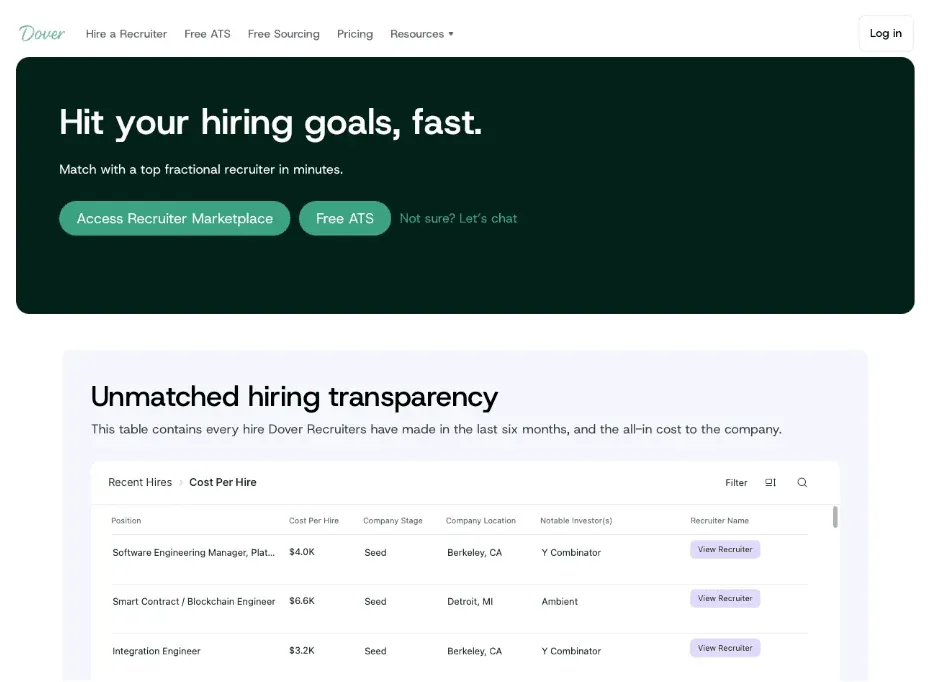
Dover’s recruiter marketplace pairs free ATS software with on-demand access to vetted recruiters, so early-stage teams can run a full hiring process without committing to a retained search or building an internal recruiting function from scratch.
The setup takes under five minutes, and the software syncs job postings across 100+ job boards automatically. From there, founders can manage inbound applications directly or bring in a Dover recruiter to source candidates, run outreach, and handle screening. Recruiter fees run $2,000 to $7,000 per hire, with an $800 refundable deposit to get started.
Frequently Asked Questions
Can I use a recruiter marketplace without paying upfront retainers?
Yes. Most recruiter marketplaces operate on contingency (pay only on hire) or hourly billing models, eliminating traditional retainer commitments. Fractional recruiting services typically charge $75-$125/hour with no contract requirement, while contingency marketplaces charge 15-25% of salary only when a placement is made.
What’s the best recruiter marketplace for startups hiring 5-20 roles per year?
Fractional recruiter marketplaces built for startup hiring tend to work better than contingency platforms in this range. Look for services that pair recruiter access with ATS functionality so your internal team and external recruiter work from the same system, and verify that recruiters have direct startup experience instead of generalist agency backgrounds.
When does fractional recruiting make more sense than hiring a full-time recruiter?
The fit guideline is 5-50 roles per year. Below that range, a full-time recruiter sits idle too often; above it, dedicated headcount usually delivers better economics. Fractional recruiting works particularly well when hiring is real but inconsistent, such as after a funding round when you need to scale quickly without locking into long-term overhead.
Final Thoughts on Using a Recruiter Marketplace
Most founders figure out whether a recruiter marketplace works for them after running one or two searches. The model gives you more flexibility than a traditional agency and more expertise than going it alone, but it still requires someone on your team to manage the relationship and give fast feedback when targeting needs adjustment. If you’re hiring steadily but don’t have a full-time recruiter yet, it’s worth testing. Dover is one place to start: free ATS software paired with on-demand recruiters, no retainer required.