
The real question behind LinkedIn Recruiter Professional isn’t whether it includes more features than Lite; it’s whether those extras are worth the jump from $170 per month to roughly $900 per month when hiring happens only a few times per quarter. For solo recruiters and small teams, that price gap adds up quickly, especially when Professional is sold through an annual contract and access is tied to fixed InMail limits and paid seats. Before committing, it helps to compare what each tier actually supports at different hiring volumes, and whether managed recruiting services offer a more practical way to get qualified candidates without paying year-round for tools that sit idle. This distinction matters most for teams balancing hiring alongside product, sales, and operations work.
TLDR:
-
Recruiter Lite costs $170/month with 30 InMails; Professional runs $900/month with 150 InMails and team features.
-
Lite lacks ATS integration and advanced intent signals, forcing manual data transfers between systems.
-
Professional is typically sold through annual contracts, while Recruiter Lite may be available monthly or annually depending on checkout terms; extra InMails can add roughly $10 per credit when you exceed plan limits.
-
Certain platforms offer fractional recruiters at $2,000-$7,000 per hire with no subscriptions or unused credits.
-
Early-stage teams with intermittent hiring may underuse annual Recruiter subscriptions if they only need sourcing tools during a few months of the year.
LinkedIn Recruiter Lite: Features and Best-Fit Users
LinkedIn Recruiter Lite is a subscription service for individual recruiters and small hiring teams who need occasional access to LinkedIn’s candidate database. At $170 per month for a single license, it sits between a standard LinkedIn Premium account and the full Corporate Recruiter package.
The service provides more than 20 recruiting search filters for criteria such as location, job title, skills, and company history. It extends candidate discovery beyond immediate connections, although its network visibility is more limited than Recruiter Corporate. Users can also organize candidates into project folders for different roles.
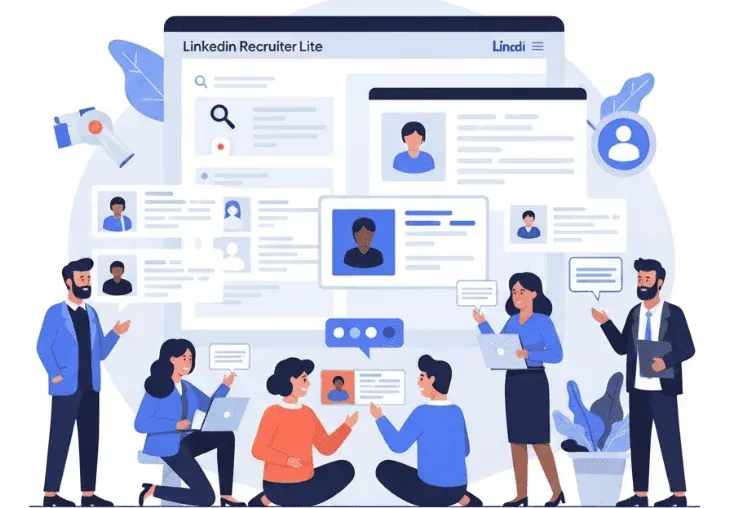
The key feature is the 30 InMail credits per month, which let you message candidates outside your network. These 30 InMail credits refresh each month, and unused credits may roll over for a limited time subject to LinkedIn’s plan caps and current terms.
Recruiter Lite works best for hiring managers or solo recruiters filling one or two roles per quarter.
LinkedIn Recruiter Corporate: Features and Best-Fit Users
LinkedIn Recruiter Corporate targets larger in-house recruiting teams that need advanced sourcing, collaboration, reporting, and integration features. Third-party estimates commonly place annual Recruiter Corporate pricing around $10,800 to $12,960 per seat, or approximately $900 to $1,080 per month, although final pricing is customized.
Corporate adds over 40 search filters unavailable in Lite, including expanded candidate insights and job-seeking intent signals for identifying more relevant prospects.
You get 150 InMail credits monthly, five times Lite’s allocation for higher-volume outreach.
The key difference is team functionality: shared candidate pools, pipeline visibility across recruiters, and project collaboration tools show who contacted each candidate and track collective progress.
The subscription integrates with many major applicant tracking systems for pushing candidate data into existing workflows. This tier fits companies filling five or more roles simultaneously with dedicated recruiting teams.
| Factor | Recruiter Lite | Recruiter Professional (Corporate) |
|---|---|---|
| Price | $170/month ($2,040/year) | Around $900-$1,080/month (approximately $10,800-$12,960/year per seat) |
| InMail credits | 30 per month (360/year) | 150 per month (1,800/year) |
| Search filters | 20+ basic filters | 40+ filters, including job-seeking intent signals |
| Saved searches | Limited | Far more extensive storage |
| ATS integration | Not available | Integrates with major ATS platforms |
| Team collaboration | Single-user license, no shared workspace | Shared pipelines, collaborative notes (paid seat each) |
| Standout strength | Low entry cost for occasional hiring | Higher outreach volume and team visibility |
| Core drawback | No ATS sync, capped outreach, no sharing | High annual cost; features go unused at low volume |
| Best fit | Solo recruiters filling 1-2 roles per quarter | Teams filling 5+ roles at once |
Pricing Breakdown: Cost Per Hire at Each Tier
Costs escalate when you exceed InMail limits.
Recruiter Lite costs $2,040 annually for one user with 360 InMails (30 per month). Professional requires an annual contract at roughly $10,800 per seat, delivering 1,800 InMails total. Professional is generally sold on annual contracts, while Recruiter Lite may offer monthly billing depending on the plan and checkout terms.
LinkedIn charges approximately $10 for each additional InMail credit beyond your allocation. If you need 100 extra messages, that’s another $1,000 on top of your subscription.
The per-contact cost on Recruiter Lite is $5.67 if you use all 30 monthly InMails. Professional works out to roughly $6 per contact with 150 InMails. For companies filling only two roles per year, that’s $1,020 per hire in subscription costs alone with Lite, before accounting for time spent. For context, SHRM’s 2025 cost-per-hire benchmark puts the average nonexecutive cost per hire at $5,475, so subscription fees are only one slice of the total spend.
Search Filter Gaps in Recruiter Lite
Lite provides basic filters for job title, location, company, and experience. The constraints surface when searches require more nuance.
The subscription offers more limited job-seeking intent signals, making it harder to identify candidates most actively open to new roles. You’ll message without knowing who’s most likely to engage.
Lite limits the number of saved searches, while Professional supports far more extensive search storage. This becomes problematic when managing multiple requisitions or building talent pools.
Language skills and relocation preferences aren’t available as dedicated structured filters and often require manual review, making it harder to identify bilingual candidates or workers open to relocation.
The core functional gap is missing ATS integration. You’ll manually transfer candidate data between systems, which is why many early-stage teams pair outreach with one of the best applicant tracking systems for startups. Team collaboration is limited too. Colleagues can’t access your outreach history or notes, forcing duplicative work when adding team members mid-search.
InMail Caps and the Real Cost of Outreach
InMail credits refresh each month, but unused credits may roll over for a limited time subject to LinkedIn’s plan caps and current terms. This still creates pressure to use credits before rollover limits are reached, which doesn’t always match hiring timelines.
The monthly reset doesn’t sync with recruiting cycles. If you launch searches in week three of your billing period, you’ll burn through your allocation before interviews even start. Waiting until next month’s reset adds two weeks to your time-to-hire.
Companies hiring for three roles simultaneously face immediate capacity problems. Reaching 50 qualified candidates per role requires 150 InMails (the entire Professional monthly allocation for a single recruiter). Lite subscribers hit their limit after contacting 30 people across all searches, forcing premature filtering that increases the risk of missing strong candidates.
Team Collaboration: Where Individual Licenses Run Into Trouble
Recruiter Lite operates as a single-user license with no shared workspace. If three hiring managers need visibility into the same candidate pipeline, each requires their own $170/month subscription ($6,120 annually for basic team access).
Professional includes shared projects and collaborative note-taking, but every team member who needs access requires a paid seat. A five-person recruiting team pays $54,000 annually.

Without shared access, teams export candidate data to spreadsheets, forward InMail threads via email, and schedule meetings to sync on pipeline status. This creates coordination problems when multiple stakeholders interview the same candidates and increases the risk someone contacts a candidate twice.
For startups where founders, department heads, and fractional recruiters all participate in hiring decisions, the per-seat licensing model makes the subscription cost prohibitive or forces manual coordination workflows that eliminate the time savings you’re paying for.
How Dover Offers a Different Approach to Hiring
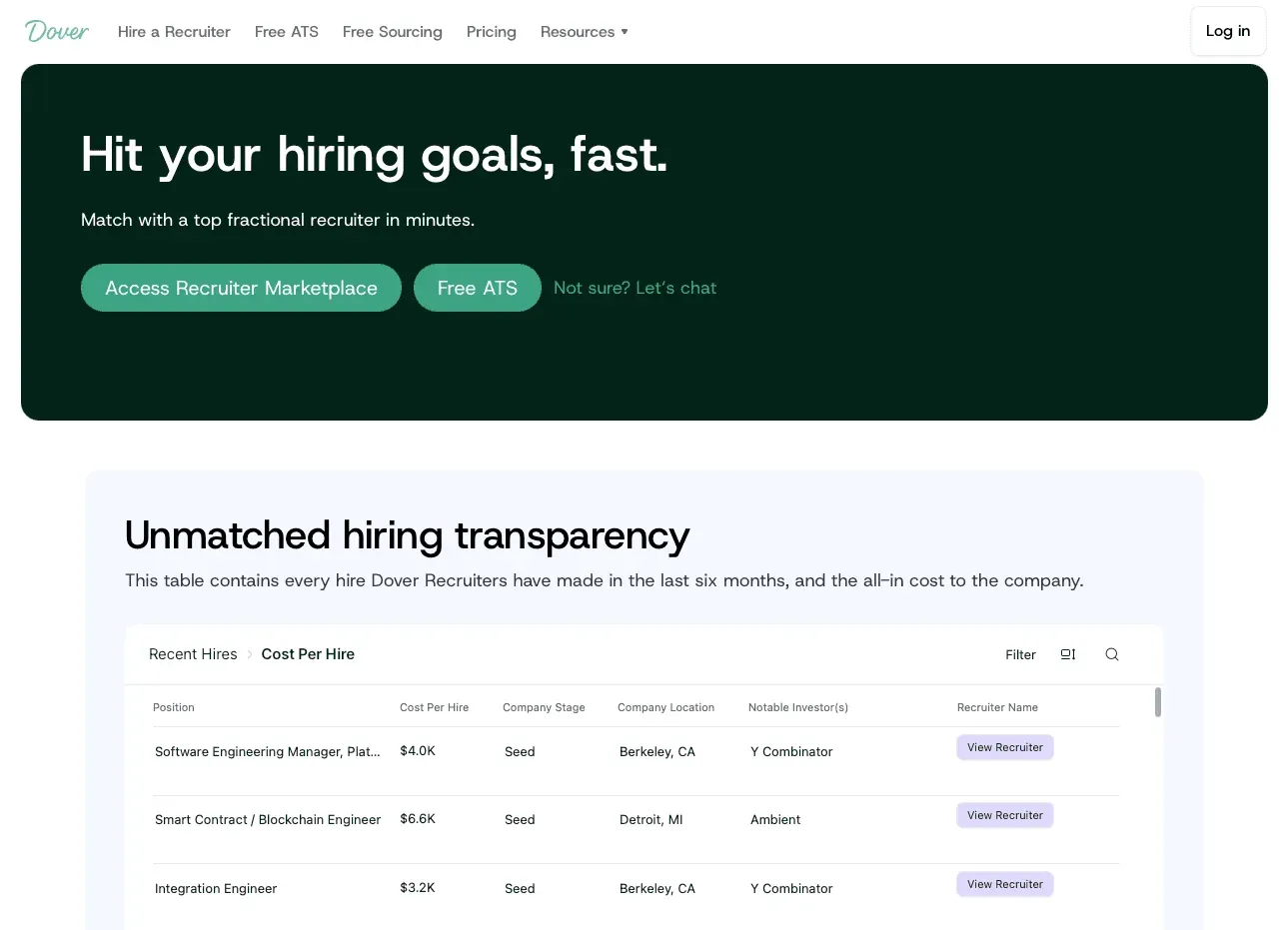
Dover’s Recruiter Marketplace connects you with fractional recruiters who handle end-to-end sourcing for $2,000 to $7,000 per hire. You pay for candidates in your pipeline, not monthly database access. The hourly recruiting model scales with hiring demand, and because Dover pairs its free ATS with on-demand recruiters in one shared system, both you and the recruiter see the same pipeline in real time.
What separates Dover from a typical recruiter directory is that fractional recruiting agencies build their delivery workflows on top of Dover’s infrastructure. The pipeline visibility, shared ATS, and recruiter coordination tools that agencies rely on internally are the same ones you access directly as a Dover client. That means you get the structured process of an agency engagement without paying the agency’s management margin or losing ownership of your candidate data when the search closes. Dover operates as the underlying layer those agencies run on, so working through the marketplace puts you closer to that infrastructure than going through an agency that adds its own overhead on top of it.
Choosing a recruiter also carries less guesswork than a traditional agency arrangement. Dover’s marketplace surfaces real, verified reviews from companies that have worked with each recruiter, covering the types of roles they’ve filled, the stage of company they’ve worked with, and what clients say about sourcing quality and communication. Before a search starts, you can read actual client accounts of how a recruiter performs on searches like yours. That level of transparency is not common in traditional agency relationships, where recruiter performance data typically stays internal and clients have little visibility into how a specific person has performed before the engagement begins.
The decision comes down to hiring volume and role complexity. LinkedIn Recruiter can be enough for familiar roles at low volume. When a search is senior, specialized, or competing for time against product and sales work, a fractional recruiter can take sourcing off your plate. If you’re still unsure, this guide on what type of recruiter is best can help you decide.
FAQs
What’s the main difference between LinkedIn Recruiter Lite and Professional?
Lite gives you 30 InMails monthly and basic search filters for $170/month. Professional provides 150 InMails, 40+ advanced filters, ATS integration, and team collaboration tools for around $900/month on an annual contract. Once you need shared pipelines or higher outreach volume, Lite’s constraints become harder to work around.
Which tool is better for startups filling 1-2 roles per quarter?
Recruiter Lite covers the basics if you can stay within 30 InMails per month. It gets harder when searches run past a billing cycle or founders are splitting time between hiring and other work. For lean teams, paying per hire through a fractional recruiter often costs less than carrying a year-round subscription with credits sitting idle between searches.
Can I share LinkedIn Recruiter Lite access with my hiring team?
No, Lite operates as a single-user license with no shared workspace. Each team member needs their own $170/month subscription, and you’ll still need to manually coordinate through spreadsheets and forwarded emails.
Final Thoughts on LinkedIn Recruiter Lite vs. Professional
Choosing between LinkedIn Recruiter Lite and LinkedIn Recruiter Professional comes down to how often you hire and how much hands-on sourcing you want to own. LinkedIn Recruiter Lite can work for solo operators filling infrequent roles, while LinkedIn Recruiter Professional tends to make sense only for teams running several searches at once and actively using shared pipelines and ATS sync. For startups without full-time recruiters, Dover offers a different path. Instead of paying year-round for a LinkedIn Recruiter seat you operate yourself, Dover’s fractional recruiting marketplace connects you with experienced recruiters who run sourcing end to end, with no annual software contracts or InMail limits to manage. The focus changes from managing tools to closing roles, with Dover tying cost directly to hires instead of unused licenses and aligning recruiting effort with real hiring demand instead of fixed monthly commitments.