

Sending a role to several agencies at once feels like a reasonable way to open up your options. More firms, more sourcing bandwidth, faster results. But running multiple recruiters on the same job means every recruiter in that group has the same incentive: submit fast, worry about fit later. The employers who run multi-agency searches typically absorb that cost downstream, in poor-fit submissions, candidate ownership disputes, and candidates who quietly deprioritize the company after receiving duplicate outreach. Here’s what that actually looks like from the candidate’s side and yours.
TLDR:
-
Contingency recruiters competing on the same role have one incentive: submit fast, not submit well, shifting vetting work back to your team.
-
Passive senior candidates who receive duplicate outreach from multiple agencies typically read it as a signal to deprioritize the company.
-
Candidate ownership disputes can surface after an offer is signed, when two agencies claim credit for the same hire.
-
Multi-agency searches work when each firm has a distinct role, region, or specialization with clear scope defined before outreach begins.
-
Some fractional recruiting models assign one recruiter per search with each recruiter setting their own rate, and most searches averaging $4,800 per hire.
How Multiple Recruiters End Up on the Same Role
The logic seems sound: open the role to several agencies, let them compete, and whoever finds the best candidate first wins. But this structure follows directly from how contingency recruiting works. Because recruiters earn nothing unless their candidate gets hired, employers have little reason to commit to one agency, and agencies have little ground to demand it. So a hiring manager sends the job description to two, three, sometimes five firms simultaneously, each working the same role with no coordination and no guarantee of payment.
Each agency operates in isolation. They don’t know which candidates have already been contacted or what the other firms are pitching. The candidate pool, meanwhile, is about to hear from multiple recruiters representing the same company within days of each other. That’s not a failure of execution. It’s the contingency model working exactly as designed.
What the Contingency Model Does to Recruiter Incentives
The hiring company pays one fee to one agency, and that fee goes to whoever gets their candidate across the finish line first. Speed is the only lever a contingency recruiter controls. So when a recruiter has to choose between spending two days properly vetting someone and submitting fast today, the model has already made that choice for them. As Gusto’s recruiting glossary notes, contingency recruiters are motivated to present candidates quickly because they only get paid when a hire is made. That pressure compounds when agencies are competing against each other on the same role.

This is an incentives problem, not an ethics problem. A retained search firm with a guaranteed partial payment upfront can afford patience. A contingency recruiter in a four-agency race cannot, which is why contingency recruiting fails startups so reliably. The hiring company absorbs the downstream cost when a fast-submitted candidate turns out to be a poor fit.
How Duplicate Recruiter Outreach Damages Employer Brand
When two agencies pitch the same role independently, they rarely coordinate on compensation ranges, role framing, or career path. One recruiter leads with a $150K band; another mentions $135K, an inconsistency that stems directly from how startup recruiter commission structures differ across agencies working the same role. The candidate notices the gap. The company looks disorganized at best, evasive at worst. Candidates who arrive at the first call with conflicting information are skeptical, and skeptical candidates are harder to close.
The cost shows up on the employer side too. When two agencies submit the same candidate within days of each other, the hiring team faces an administrative problem on top of a hiring one: who gets credit, which agency relationship takes precedence, and what happens to the fee dispute. According to SHRM’s 2025 Benchmarking Report, the average non-executive cost per hire is already $5,475 before agency fees. Strong candidates who disengage because the outreach felt chaotic push that number higher while delivering nothing. Recruiting circles are small, and word about a confusing candidate experience travels without anyone intending it to.
The Candidate Ownership Problem: Who Gets Paid When Two Agencies Submit the Same Person
When two agencies submit the same candidate, someone has to decide who gets paid. That question has a name in recruiting: the candidate ownership dispute.

Most recruitment fee agreements include a “right to represent” clause that grants ownership to whichever firm first introduced the candidate to the employer, with protection windows that vary by contract and commonly extend for 6 to 12 months after introduction. As this candidate right to represent reference notes, ownership is typically tied to who first presented the candidate, but the details depend heavily on the specific contract terms each agency uses.
The complication is that, depending on the contract and jurisdiction, fee disputes may turn on which agency was the “effective cause” of the hire rather than simply which agency submitted the candidate first. That means the agency that did the most to advance the hire may have a legitimate claim even if another agency submitted first. For the hiring company, this can mean fee negotiations or outright disputes arriving after the offer is signed, at exactly the moment everyone expected the search to be finished.
When Working With Multiple Recruiters at Once Makes Sense
There are specific situations where spreading a search across more than one agency reflects sound judgment.
The clearest case is genuine specialization gaps. If you’re hiring a fintech compliance attorney and a blockchain security engineer in the same quarter, no single agency will have deep networks in both. Use one firm per role, with explicit exclusivity on each position. High-volume campaigns are a second legitimate scenario: when you need fifteen sales reps across three regions in eight weeks, some sourcing redundancy becomes acceptable, and the faster submission pace contingency structures produce can work in your favor when the bar is consistent. Geographic specialization is a third factor. A recruiter with strong relationships in Austin doesn’t have the same reach in Singapore, so agencies with local networks in each market may outperform a single generalist firm.
The Common Thread
All three scenarios share one feature: intentionality. Multi-recruiter arrangements cause the most damage when they happen by default. They work when each agency has distinct, non-overlapping scope, defined in writing before outreach begins. Managing multiple fractional recruiters well requires that structure upfront, not after the first duplicate submission arrives. If the underlying motivation is specialization coverage, fractional recruiting agencies that operate on a shared ATS platform can cover that gap without the coordination overhead that comes from running independent firms. Candidate visibility, outreach history, and pipeline data are shared across the engagement from day one.
How to Manage Multiple Recruiters Without Creating Chaos
If you’re already running a search across multiple agencies, a few structural rules keep it from becoming expensive to unwind.
-
Keep agency count to one to three per role. Beyond three, accountability dissolves and duplicate-submission odds climb with every firm you add.
-
Define candidate ownership terms in writing before sourcing starts. Specify what “introduction” means, how long the protection window lasts, and which agency gets credit when the same candidate arrives from two firms.
-
Issue a shared job brief covering compensation range, growth framing, team size, and role scope. Candidates compare notes, and inconsistencies reflect on the company.
-
Build a duplicate submission protocol before the first resume arrives. Deciding credit assignment after the fact, under pressure, is where fee disputes begin.
The more agencies you add, the more coordination work moves to you. Each new firm needs its own briefing, ownership terms, and place in your rejection workflow. This stays manageable with two agencies and a clear framework, but grows expensive with five and no rules.
How Dover’s Dedicated Recruiter Model Eliminates the Multi-Recruiter Problem by Design
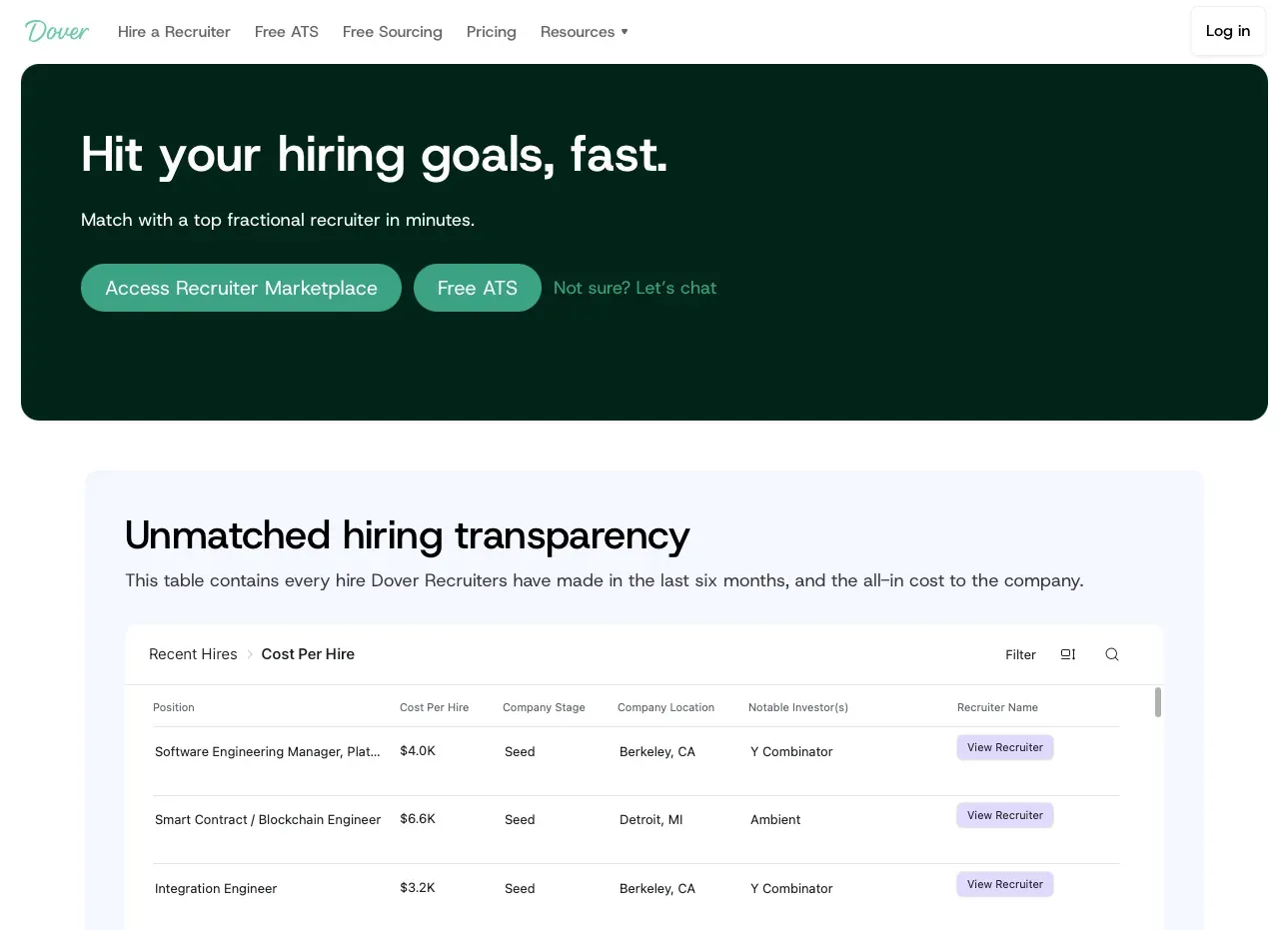
The problems covered above are structural consequences of the contingency model. Dover’s approach resolves them by design: one recruiter per search, working as an integrated member of the hiring team on an hourly fee with no connection to placement. No competing firm to outrun, no incentive to favor speed over fit, no ownership disputes when commission structures are not in play.
| Dover (Dedicated Recruiter) | Contingency Multi-Agency | |
|---|---|---|
| Fee structure | Hourly, with recruiters setting their own rates; avg. ~$4,800 per hire | 15 to 25% of first-year salary |
| Typical cost per hire | $4,800 | Up to $30,000 on a $120,000 hire |
| Recruiter incentive | Fit (no placement fee at stake) | Speed (paid only on placement) |
| Recruiters per role | One dedicated recruiter | Multiple agencies competing simultaneously |
| Candidate ownership disputes | Largely avoided | Common when two agencies submit the same person |
| Duplicate candidate outreach | None; single coordinated search | High risk; agencies work in isolation |
| ATS / sourcing visibility | Shared ATS; real-time hiring team access | Data stays in each agency’s proprietary database |
| Upfront commitment | $800 refundable deposit; no contracts | No upfront cost; fee owed on hire |
Dover also serves as the infrastructure layer that fractional recruiting agencies are built on. When an agency runs searches through Dover’s platform, the hiring team shares the same ATS environment with real-time candidate visibility and no data silos. Recruiters in the marketplace carry published, verified reviews, so hiring teams can weigh track record before a search starts.
The shared ATS is what makes coordination clean in practice: every sourcing action, outreach message, and candidate status is visible to both the recruiter and the hiring team in real time, with no risk of the same candidate being contacted from two directions and no data that leaves when the engagement ends. Dover’s fractional recruiter costs are set by each recruiter, with most searches averaging $4,800 per hire, with an $800 refundable deposit to start and no long-term contracts. The fractional recruiting model changes the incentive at the source: when there is no placement fee at stake, there is no race.
FAQs
How does contingency recruiter duplication affect candidates who receive duplicate outreach from the same company?
Senior candidates treat duplicate outreach from different agencies about the same role as a signal that the company is disorganized or struggling to close, and many deprioritize the company as a result. The intent is to move faster; the effect is a slower, harder close with exactly the candidates who were already hardest to reach. Clear scope and agency exclusivity per role, defined before sourcing begins, is the structural fix.
Should I use one recruiter or multiple recruiters for the same job?
One dedicated recruiter per role avoids duplicate outreach, ownership disputes, and speed-over-fit submissions. Multiple agencies can make sense for genuine specialization gaps, distinct geographic markets, or high-volume campaigns with a well-defined bar. The differentiator is intentionality: multi-agency arrangements work best when each agency has distinct, non-overlapping scope defined in writing before outreach begins, and cause the most damage when they happen by default.
What role does a shared ATS play when working with a fractional recruiter?
When a fractional recruiter and the hiring team share one ATS, every candidate, outreach message, and pipeline stage is visible to both sides in real time. When a recruiter works from their own system, the hiring team loses that visibility and all sourcing data leaves with the recruiter when the engagement ends. Dover runs on a shared ATS from day one: one pipeline, no reconciliation step, no data that disappears at the end of a search.
Final Thoughts on What Happens When Multiple Recruiters Work the Same Job
The costs of running multiple recruiters on the same job are structural, not accidental. Speed pressure compounds when agencies compete, candidate quality drops, and the coordination work lands on your team instead. The cleanest alternative is a single dedicated recruiter inside a shared ATS, where both sides have full visibility into every candidate and outreach message, with no proprietary database to reconcile. Dover runs that model: one recruiter per search with recruiters setting their own rates, most searches averaging $4,800, no long-term contracts required.