Recruitment fee agreements are rarely written for founders. They’re designed to lock you into exclusivity, limit your options if a hire fails, and pull cash from your account long before you know whether the person will work out. What makes this costly isn’t just the 15–25% fee; it’s the assumption that these terms are fixed when, in reality, every clause is negotiable if you know where to push. And if you don’t want to negotiate at all, many teams now bypass traditional agency contracts by working through a more flexible recruiting partner that removes placement fees and long-term commitments entirely.
TLDR:
-
Traditional agency fees run 15-25% of salary ($22,500-$37,500 per engineer hire), but are negotiable.
-
Negotiate exclusivity to 30 days max with performance benchmarks and early exit rights.
-
Push for 90-day full refund guarantees instead of replacement-only clauses.
-
Limit candidate ownership windows to 6 months and exclude direct applicants after rejection.
-
Modern fractional recruiting models run $2,000–$7,000 per hire with no contracts and no placement fees attached.
Understanding Recruitment Agency Fee Structures and Why They Matter
Most tech employment agencies charge 15-25% of first-year salary as their placement fee. For executive roles, fees reach 20-30%. When you’re hiring a software engineer at $150,000, that’s $22,500 to $37,500 per hire.
For early-stage companies, these costs add up fast. Hire three senior engineers and two product managers in a quarter, and you’re looking at $150,000+ in agency fees. That’s runway you could spend on product development or an additional headcount.

Here’s what many founders miss: these fees are negotiable. Agencies build markup into their standard rates, expecting pushback. The percentage you pay is a starting point for discussion, not a fixed cost.
Agencies charging the highest fees aren’t necessarily delivering better candidates, and choosing the right type of recruiter matters more than price alone. They’re just better at pricing. When you walk into contract negotiations knowing these baseline numbers, you’re already ahead.
Clause 1: Exclusivity Terms and Timeframes
Exclusivity clauses give agencies sole rights to fill a role for a set period. During this window, you can’t work with other recruiters or post the job publicly, even if the agency isn’t delivering candidates.
Typical exclusive agreements last 30 days, but some agencies push for 60 or 90. If your recruiter isn’t performing, you’re stuck waiting while your hiring timeline slips.
When reviewing exclusivity terms, look for:
-
Duration (30 days is reasonable, anything beyond 45 needs justification)
-
Performance benchmarks tied to exclusivity, like minimum qualified candidates per week
-
Early termination rights if the agency doesn’t meet deliverables
-
Clear definition of what breaks exclusivity (can you accept inbound applications?)
The best approach: negotiate a trial period first. Give an agency 15 days exclusive to prove they can deliver, or consider alternatives to contingency recruiting. If they send quality candidates, extend it. If not, you haven’t burned a month of hiring time.
Clause 2: Guarantee Periods and Refund Policies
Guarantee periods protect you if a hire doesn’t work out. The most common guarantee period is 90 days, accounting for roughly half of recruitment agency guarantees. But what happens during that window varies wildly between contracts.
Three types of guarantees exist:
-
Full refund returns 100% of the fee back if the candidate leaves or is terminated within the guarantee period
-
Prorated refund returns a percentage based on how long the candidate stayed (60% if they leave at day 60)
-
Replacement-only means the agency finds another candidate instead of returning money
Replacement-only guarantees lock you into continuing with the same agency after an unsuccessful hire, which is why vetting external recruiters before signing is critical. Push for full money-back guarantees. If an agency resists, negotiate a hybrid: full refund in the first 30 days, prorated after.
Clause 3: Payment Terms and Fee Negotiation Points
Payment schedules matter as much as the percentage. Agency contracts request payment within 30 days of the candidate’s start date, though terms vary by firm. Many agencies will consider net 60 or net 90 terms if you ask, particularly for repeat clients or multiple roles. This gives your new hire time to onboard before the bill comes due and aligns payment timing with your guarantee period.

The fee percentage itself is where you have real room to move. Start by asking for a volume discount if you’re filling multiple roles, and understand different commission structures to negotiate better. Hiring three positions at once? Request 18% instead of 25%. Role difficulty should affect pricing too. A generic marketing coordinator isn’t worth the same fee as a VP of Engineering requiring niche technical skills. Propose tiered pricing: 20% for senior roles, 15% for mid-level, 12% for junior positions. Market conditions give you influence as well. Hiring for remote roles with national candidate pools is easier than location-restricted searches, or you could work with fractional recruiters who offer more flexibility.
Clause 4: Candidate Ownership and Recruitment Period Windows
Candidate ownership clauses define how long an agency can claim a fee after introducing you to a candidate. Standard protection windows run 12 months, but some contracts push for longer.
Here’s the scenario: you interview someone through Agency A in March. They’re not the right fit. In November, that same person applies directly through your careers page. Agency A still claims the full fee because they “introduced” the candidate within their protection window.
Negotiate these specific terms:
-
Protection window of 6 months maximum instead of 12
-
Carve-outs for candidates who apply directly or through referrals after initial rejection
-
Clear definition of “introduction” requiring formal submission, on top of LinkedIn outreach
-
No fee if the candidate is hired for a different role than originally discussed
If an agency introduced someone for a sales role but you hire them 8 months later as a customer success manager, that’s a different search. Learn when your startup needs recruiting help.
Clause 5: Termination Rights and Notice Periods
Termination clauses control your exit if the agency isn’t delivering. Many contracts demand 30-90 days written notice with penalties for early termination, meaning you’re stuck paying for months of inactivity.
Push for “termination for convenience” language that allows you to exit with 14 days notice instead of 90. If the agency hasn’t placed anyone, you shouldn’t owe fees.
Watch for clauses requiring payment for “work in progress” after termination. Some agencies claim fees for any candidate interviewed within 30 days of ending the agreement, regardless of when they’re hired. Strike these provisions or limit the window to 7 days maximum for candidates already in final rounds.
How Dover’s No Contracts Model Eliminates Traditional Fee Agreement Friction
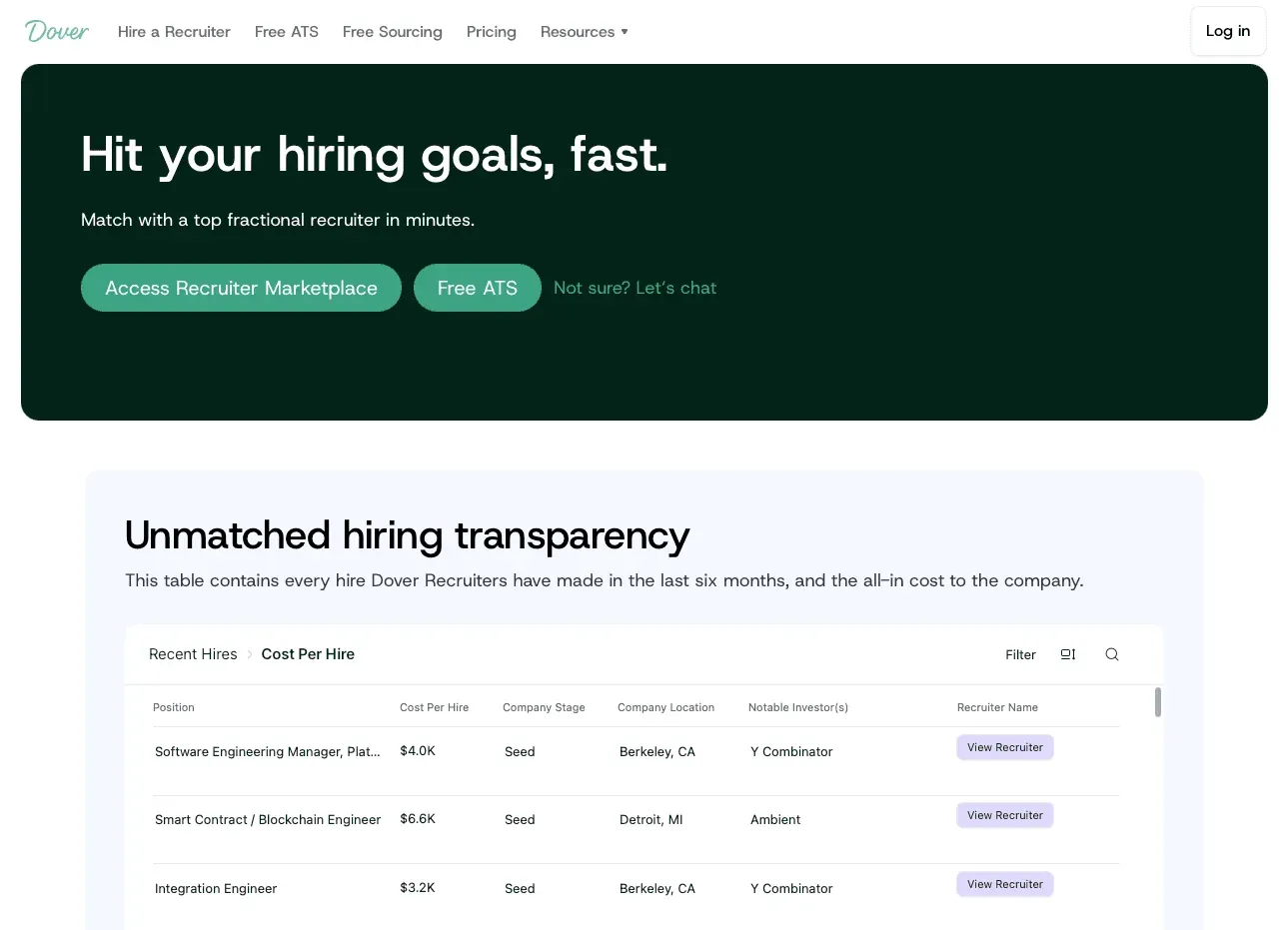
Dover’s recruiter marketplace replaces traditional agency contracts with fractional recruiters who work hourly. No placement fees, no retainers, and no long-term commitments.
Most startups pay $2,000-$7,000 per hire through Dover versus $20,000+ from traditional agencies. You pay for hours worked and scale up or down each month.
This model eliminates every clause negotiation. No exclusivity because you’re never locked in. No traditional guarantee period, since there’s no placement fee to refund. Termination means stopping scheduled hours. Candidate ownership disputes are largely avoided without commission structures.
You also get Dover’s free ATS, eliminating separate software costs while managing recruiter relationships. Everything stays in one place with full visibility into recruiter activity and complete hiring process control.
Frequently Asked Questions
How much can I actually negotiate off standard recruitment agency fees?
Many agencies price their standard rates with room for negotiation, so you can typically negotiate down from 25% to 18-20% for single placements, or 15-18% if you’re hiring multiple roles at once.
What’s a reasonable guarantee period to ask for in a recruitment contract?
90 days is the industry standard, but push for a full money-back guarantee during that window instead of replacement-only terms, which lock you into continuing with the same agency after an unsuccessful hire.
Can an agency still charge me if I hire someone who applied directly months after they introduced them?
Yes, if your contract has a candidate ownership clause. Most run 12 months, but you should negotiate this down to 6 months maximum and add carve-outs for direct applications or referrals after initial rejection.
How long should I agree to exclusivity with a recruitment agency?
30 days is reasonable for exclusivity, but negotiate performance benchmarks like minimum qualified candidates per week and early termination rights if they’re not delivering. Anything beyond 45 days needs strong justification.
What’s the difference between Dover’s model and traditional agency fees?
Dover charges $2,000-$7,000 per hire through fractional recruiters who work hourly with no placement fees or contracts, versus traditional agencies that charge $20,000+ (20-25% of salary) per placement with long-term commitments.
Final Thoughts on Recruitment Fee Agreements
Recruitment fee agreements only become expensive when founders accept them at face value. Once you understand how fee percentages, guarantees, exclusivity, and ownership clauses actually work, you gain influence in every hiring conversation and keep more capital inside the business. You can negotiate better terms with agencies, or avoid those contracts entirely by working with Dover, where fractional recruiters are engaged hourly with no placement fees and no long-term obligations. Either way, the goal is the same: hire great people without locking your company into agreements that cost more than the hire itself.