
Placement fees sound simple: the agency finds someone, you hire them, you pay a percentage of their salary. But that contingency recruiting incentive problem runs deeper than most people realize until they’re restarting a search six months later. The recruiter’s payday is locked in at offer acceptance, before anyone knows whether the hire will work out, and your exposure compounds from there. Here’s how the placement fee misaligned incentives built into this model affect the candidates you see, the offers you make, and the searches that quietly stall.
TLDR:
-
Contingency recruiting fees of 15% to 25% of salary create built-in pressure to close fast, not hire well.
-
Fee size scales with salary, giving recruiters a financial reason to steer toward higher offers regardless of fit.
-
Hard-to-fill roles get deprioritized under contingency models because failed searches cost the agency, not you.
-
When a contingency search ends, all candidate data and sourcing intelligence stays with the agency, not your team.
-
Some fractional recruiting models bill only for time worked with no placement fee, putting total cost at $4,800 per hire instead of $18,000 to $30,000.
How the Placement Fee Model Works
Contingency recruiting is the dominant model at traditional staffing agencies. Under this arrangement, a company lists a role with an agency and pays nothing upfront. The agency searches for candidates, and a fee is triggered only when a hire is made. That fee is typically 15% to 25% of the new hire’s first-year base salary, so a $120,000 engineering hire generates an invoice somewhere between $18,000 and $30,000, which is a key reason contingency recruiting costs vs. hourly models matter so much for startups.
The agency carries all search costs until a placement closes. If no hire happens, the agency absorbs that loss. This creates a structure where agencies are paid exclusively on outcomes, not effort, and where the fee scales directly with the salary of the person placed. The larger the offer, the larger the check.
The Incentive Misalignment Built Into Contingency Recruiting
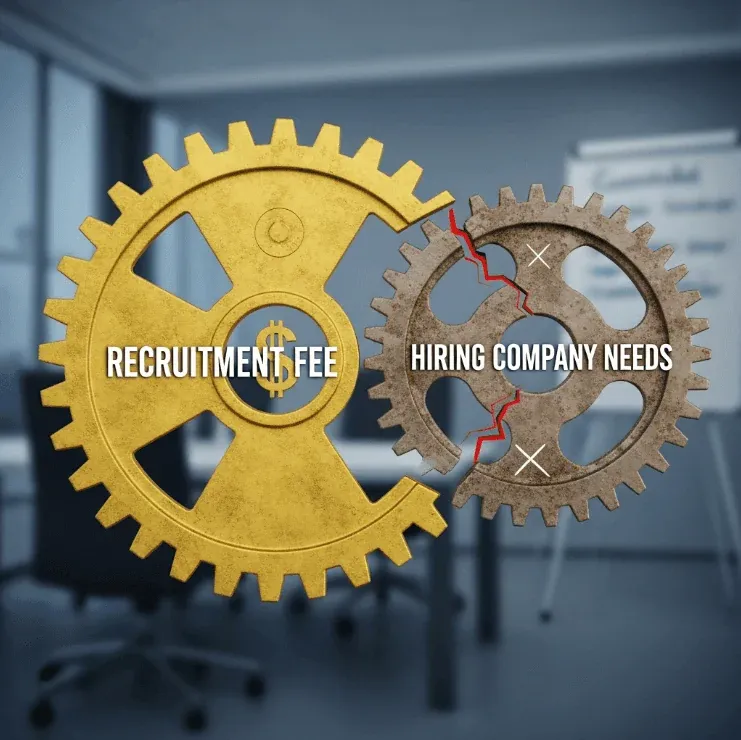
That fee structure sounds reasonable on the surface, but it quietly pulls recruiter behavior away from what hiring companies actually need. It is one of several startup recruiter commission structures worth understanding before signing with an agency.
Speed Over Fit: How Placement Fees Pressure Recruiters to Close Fast
Placement fees create a structural pressure that’s easy to miss until you’re on the receiving end of it. When a recruiter earns nothing until an offer is accepted, every day a role stays open is a day they go unpaid. That economic reality quietly shapes which candidates get surfaced, how thoroughly references get checked, and how directly a recruiter will flag concerns about fit.
Some estimates suggest bad hires cost anywhere from 30% to 150% of annual salary when you account for lost productivity, rehiring costs, and team disruption, factors that surface clearly when comparing agency fees vs. in-house vs. embedded recruiting. Research on bad hire costs shows mid-level failures can reach 100% to 150% of salary once productivity loss and rehiring are included.
The Salary Inflation Effect
A recruiter presenting two finalists of comparable quality has a financial reason to advocate for the candidate who will command a higher salary. The difference between a $120,000 offer and a $140,000 offer can mean an additional $3,000 to $5,000 in placement fees. From the hiring company’s side, this looks like a recruiter doing their job. From the recruiter’s side, every salary negotiation carries a personal upside.
How This Plays Out in Practice
The inflation effect rarely shows up as explicit dishonesty. It tends to operate through framing choices:
-
Candidates get coached to hold firm on compensation, since a higher accepted offer benefits the recruiter as much as the candidate, a pattern founders can counter through recruitment fee agreement clauses that create better alignment.
-
Market rate ranges get presented at the top of their band, making premium offers appear like the only competitive option.
-
Counteroffers from the candidate get relayed with urgency, pressuring hiring managers to close quickly at higher numbers instead of stepping back to reassess fit.
None of these behaviors require bad faith. They are the predictable output of a fee structure where recruiter income scales with candidate salary.
Hard-to-Fill Roles and the Deprioritization Problem
When a recruiter absorbs the cost of every failed search, specialized or high-bar roles become expensive bets. A staff-level infrastructure engineer with a narrow skill set and a demanding hiring bar could consume thirty hours of sourcing before a single viable candidate surfaces. A growth marketing manager in a well-defined comp band might close in two weeks. The recruiter’s time flows accordingly, and the startup with the harder search gets less of it. Hourly vs. contingency recruiting comparisons document this pattern directly: contingency recruiters can drop hard-to-fill roles or push misaligned candidates when the search stops looking like a quick win.
For early-stage companies, this is where the structural problem becomes most costly. The niche technical hire, the first sales leader, the specialized compliance role: these searches carry the highest stakes and the lowest probability of fast closure. That combination is precisely what contingency economics penalizes, which is part of why recruiting suits a fractional model so well.
Pipeline Ownership and Candidate Data After the Engagement
When a contingency search ends, whether a placement was made or not, the candidate data, sourcing notes, and pipeline intelligence the recruiter built typically stay with the agency. The hiring company gets a hire (or doesn’t), but it retains none of the underlying work product. Every outreach log, every screened candidate who didn’t quite fit, every sourcing strategy that revealed where talent actually lives in that market, all of it walks out the door.
A startup that pays a placement fee has effectively funded research it will never own, which is one reason many founders look into what a fractional recruiter is as a structural alternative.
What Gets Lost at the End of an Engagement
The gap between what a company pays for and what it keeps tends to show up clearly in three areas:
-
Candidate pipeline visibility: Screened candidates who weren’t placed but might be right for a future role are invisible to the hiring company. Those profiles live in the agency’s ATS, not the client’s.
-
Sourcing intelligence: Agencies learn which communities, job boards, and referral paths surface the right candidates for a given role type. That knowledge doesn’t transfer with the invoice.
-
Employer brand signals: Recruiter outreach shapes how candidates perceive a company before they ever speak to a hiring manager. Without visibility into those conversations, companies can’t assess or correct the impression being made on their behalf.
The Real Cost When the Hire Does Not Work Out
When a placement does not work out, the recruiting agency has already been paid. The financial consequence falls entirely on the hiring company.
Some estimates suggest bad hire costs, accounting for lost productivity, management time, and the cost of restarting the search. For a $120,000 role, that range runs from roughly $36,000 to $180,000, on top of the original placement fee.
|
| Contingency Recruiting | Dover Fractional Recruiting |
| — | — | — |
| Fee structure | 15%-25% of first-year salary, paid at offer acceptance | Recruiters set their rates, billed for time worked |
| Typical cost (for a $120K hire) | $18,000-$30,000 | $4,800 |
| Salary incentive | Fee scales with salary; recruiter benefits from higher offers | No link between fee and candidate salary |
| Speed pressure | Recruiter earns nothing until placement; urgency is built in | Hourly billing removes pressure to close fast |
| Hard-to-fill roles | Deprioritized, failed searches cost the agency | Billed by the hour regardless of search difficulty |
| Pipeline ownership | Sourcing data and candidate profiles stay with the agency | Pipeline and search intelligence belong to the client |
| Risk on failed hire | Agency already paid; hiring company absorbs full cost | No placement fee to re-pay if the hire doesn’t hold |
Who Absorbs the Risk
Most contingency agreements include a 30 to 90-day guarantee period. If the candidate leaves within that window, the agency may offer a replacement search, a structure quite different from arrangements where recruiter deposits are refundable. Outside that window, the hiring company bears the full cost.
When Contingency Recruiting Still Makes Sense
Contingency recruiting fits best for mid-level roles with clear requirements and a predictable candidate pool. When the path from first screen to offer letter is short, the speed incentive becomes an asset, particularly for teams with a rigorous internal assessment process that won’t be pressured by competing offers.
Where contingency tends to break down is specialized roles, long assessment cycles, or multi-function hiring where you need a recruiter invested in the outcome beyond the placement, a trade-off covered in depth when comparing a fractional recruiter vs. full-time recruiter for your startup.
How Dover Handles the Placement Fee Incentive Problem
Dover’s fractional recruiters set their own rates and bill for time worked, with no placement fee tied to the outcome, consistent with broader benchmarks for fractional recruiter costs in 2026. Because there is no connection between the fee and the candidate’s salary, there is no financial reason to steer toward a higher offer or manufacture urgency around competing compensation.
Cost also works differently in practice. Many engagements run 20 to 30 hours per hire, putting total cost at $4,800, compared to $18,000 to $30,000 on a contingency placement for a $120,000 role.
Pipeline ownership is the other meaningful difference. Candidate data, sourcing notes, and outreach history from every search stay in your ATS, not the recruiter’s. Each new search builds on the last instead of starting from zero.
Frequently Asked Questions
What’s the real cost of a bad hire made through a contingency agency?
The placement fee is already paid at offer acceptance, so the full cost of a failed hire falls on the hiring company. Some estimates put bad hire costs at 30% to 150% of annual salary, covering lost productivity, management time, and restarting the search, on top of the original fee. If the failure surfaces after the 30-to-90-day guarantee window, a replacement search can generate a second placement fee on the same role.
How does placement fee misalignment affect salary negotiations between recruiters and candidates?
Because the placement fee scales with the candidate’s accepted salary, recruiters have a financial reason to advocate for higher offers. The inflation effect shows up through framing: candidates get coached to hold firm on compensation, market rate ranges get presented at the top of their band, and competing offers get relayed with urgency that pressures hiring managers to close at higher numbers.
What happens to candidate pipeline data after a contingency search ends?
When a contingency engagement closes, the sourcing notes, screened profiles, and outreach intelligence stay with the agency. The hiring company retains none of the underlying work product, and each new search restarts from zero while the agency carries forward knowledge it can redeploy across other clients.
Final Thoughts on the Contingency Recruiting Incentive Problem
The contingency recruiting incentive problem rarely announces itself. It shows up in the slate of candidates you receive, the salary numbers you feel pressured to accept, and the specialized search that quietly stalls. The right model depends on the role, your internal process, and how much risk you can absorb if the placement does not hold. For teams that want recruiter incentives and pipeline ownership aligned from the start, Dover is one concrete option: a free ATS paired with on-demand fractional recruiters who set their own rates and bill for time worked, no placement fee attached.