

You can post jobs and wait for applicants who rarely convert, pay an agency 20% per hire, or lock in a full-time recruiter before your hiring volume supports it. Fractional recruiting gives you another path: an experienced recruiter on a part-time or project basis, working inside your workflow on an hourly or retainer model, without permanent headcount or per-placement fees. This guide covers when fractional hiring makes sense for startups that need to fill roles without building a full recruiting function.
TLDR:
-
Fractional recruiters charge $75-$150/hr, sitting between full-time salaries and agency fees of 15-25% per placement.
-
You pay only for hours worked, which fits teams with steady but not high-volume hiring.
-
Fractional recruiters bring specialized expertise, though company-specific knowledge builds more slowly than with an in-house hire.
-
Independent and freelance work represents a substantial portion of the U.S. workforce, with fractional recruiting coming up as a growing segment.
-
Some tools pair free recruiting software with fractional recruiters, covering 50+ job boards and on-demand sourcing at $4,800 per hire.
What Is Fractional Recruiting?
Fractional recruiting means bringing in an experienced recruiter on a part-time or project basis: by the hour, through a hiring sprint, or across a specific search. You get someone who learns your process and candidate bar without the overhead of a full-time hire, making it a strong fit for startups hiring steadily but not yet at the volume that supports a dedicated recruiting head.
How Fractional Recruiting Works
A fractional recruiter works a set number of hours per week or per search cycle, owning sourcing, screening, and interview coordination without the overhead of a full-time hire.

Here is how the process generally unfolds:
-
The company and recruiter agree on scope upfront, including the roles to fill, hours per week, and expected timeline. This scoping step matters because fractional arrangements live or die on clarity about what the recruiter is responsible for and what falls to internal stakeholders.
-
The recruiter gets access to the company’s hiring tools, job descriptions, and interview process, then begins sourcing candidates through job boards, outbound outreach, or referrals depending on the role.
-
Candidates who clear an initial screen get passed to the hiring manager with context, so the internal team is reviewing warmed prospects instead of raw applicants.
-
The recruiter stays involved through offer and close, handling coordination and keeping the process moving between stages.
The engagement can be structured by the hour, by retainer, or by milestone. Some companies run fractional recruiting continuously across multiple open roles; others bring a recruiter in for a single critical search and wind down once the role is filled.
Fractional Recruiting vs Traditional Recruitment Models
In-house recruiting carries a fixed salary and overhead regardless of volume; contingency agencies charge nothing upfront but take 15-25% per placement. Fractional sits between: you pay for active recruiting capacity without the fixed cost or per-placement fees.
Here is how the three models compare across the dimensions that matter most to early-stage teams:
| Factor | In-House Recruiter | Contingency Agency | Fractional Recruiter |
|---|---|---|---|
| Cost structure | Fixed annual salary + benefits | 15-25% fee per placement | Hourly or retainer-based |
| Upfront commitment | High (full-time headcount) | None until placement | Low to moderate |
| Scalability | Low | High, but expensive | High and cost-controlled |
| Process ownership | Full internal control | Agency controls sourcing | Shared with your team |
| Best fit | High-volume, stable hiring | Urgent, one-off roles | Variable hiring needs |
A few tradeoffs worth weighing before choosing a model:
-
Contingency recruiting works for a single urgent hire, but placement fees create a speed-over-fit incentive that can hurt quality on harder-to-fill roles.
-
Full-time in-house recruiters build institutional knowledge over time, but that pays off only if hiring volume stays high enough to support the fixed cost.
-
Fractional recruiters work best when hiring needs are real but uneven, providing senior expertise without permanent headcount.
The right model often becomes clearer once founders feel the downstream cost of the wrong one firsthand.
Fractional Recruiter Pricing and Cost Structure
Fractional recruiters generally charge $75-$150/hr, $3,000-$10,000/month on retainer, or $4,800 per placement. Rate drivers include role seniority, market, and recruiter experience. Industry benchmarks suggest total recruiting costs can become substantial for hard-to-fill or highly specialized positions. When a team is consistently filling five or more roles per quarter, the economics often favor building internal capacity instead.
Benefits of Fractional Recruiting for Growing Companies
You pay for recruiting capacity only when you need it, keeping burn low during slower periods without leaving you understaffed when a role opens.
-
Fractional recruiters bring deep specialization in a function or industry, so you get someone who already knows the candidate pool.
-
Engagements scoped by project or retainer let you match recruiting bandwidth to actual pipeline volume instead of carrying fixed overhead year-round.
-
Working across multiple clients, fractional recruiters often bring cross-industry pattern recognition a single in-house hire rarely develops.
The tradeoff: time split across clients means institutional knowledge about your culture builds more slowly than with a dedicated hire.
When Companies Should Hire Fractional Recruiters
The clearest signal is a gap between hiring volume and internal capacity: roles to fill, no recruiter on staff, and not ready to commit to a full-time hire.
-
You’re a startup ramping hiring ahead of a funding milestone or launch and need experienced help for a defined window.
-
Recruiting has become reactive. Roles stay open longer than they should because no one owns the process.
-
You’re filling a specialized role outside your network and need a recruiter with domain expertise to open sourcing channels.
-
Job postings alone aren’t producing qualified candidates, but hiring volume doesn’t support a full internal function yet.
Very high continuous volume tips the economics toward a full-time hire. One or two roles per year is better covered by a contingency recruiter. Cadence matters more than company size. Early-stage teams with 10 to 50 employees often fit the model well.
Common Roles and Functions for Fractional Hiring
Fractional hiring covers a wide range of functions, and the right fit depends on where your team has gaps. Some of the most common roles companies bring in on a fractional basis include:
-
Fractional recruiter: manages sourcing, screening, and coordination for active hiring cycles without being on payroll full-time.
-
Fractional talent acquisition lead: goes beyond individual requisitions to own the hiring strategy, build out processes, and sometimes manage a recruiting coordinator or sourcer. Better suited to teams preparing for a larger hiring push than filling a single open role.
Challenges of Fractional Recruiting and How to Manage Them
Fractional recruiting has real coordination overhead, but most of it is manageable with clear upfront agreements.
| Challenge | How to Manage It |
|---|---|
| Availability split across clients | Set weekly hour commitments in writing; agree on response windows before the engagement starts |
| Culture fit with limited exposure | Front-load onboarding with team intros, hiring values, and a calibration hire early in the engagement |
| Process gaps when switching recruiters | Keep role briefs, interview notes, and pipeline data in a shared ATS accessible to internal stakeholders |
| Time zone coordination on remote arrangements | Agree on async communication norms upfront; define what decisions need synchronous input versus what can move without it |
| Measuring performance and ROI | Track time-to-fill, cost-per-hire, and candidate-to-offer conversion rate by role to catch drift before it compounds |
The Growth of Fractional Work and Market Trends
Fractional work has grown well beyond a niche workaround for budget-limited startups. Upwork’s 2025 Future Workforce Index found more than 1 in 4 U.S. knowledge workers now work independently, and the BLS Contingent Work Survey shows independent contractor employment rose from 6.9% to 7.4% of total employment between 2017 and 2023. Within that broader shift, fractional roles in recruiting, HR, and talent acquisition have seen some of the steepest growth.
A few factors are driving this. Remote work normalized the idea that skilled professionals can contribute meaningfully without being on-site or on payroll full time. AI tools have reduced the administrative overhead that once made part-time hiring work impractical to coordinate. And as hiring cycles became more unpredictable post-2020, many companies found that locking in a full-time recruiter for a role that might close in two months created more problems than it solved.
How Dover Combines Free Recruiting Software with Fractional Recruiters
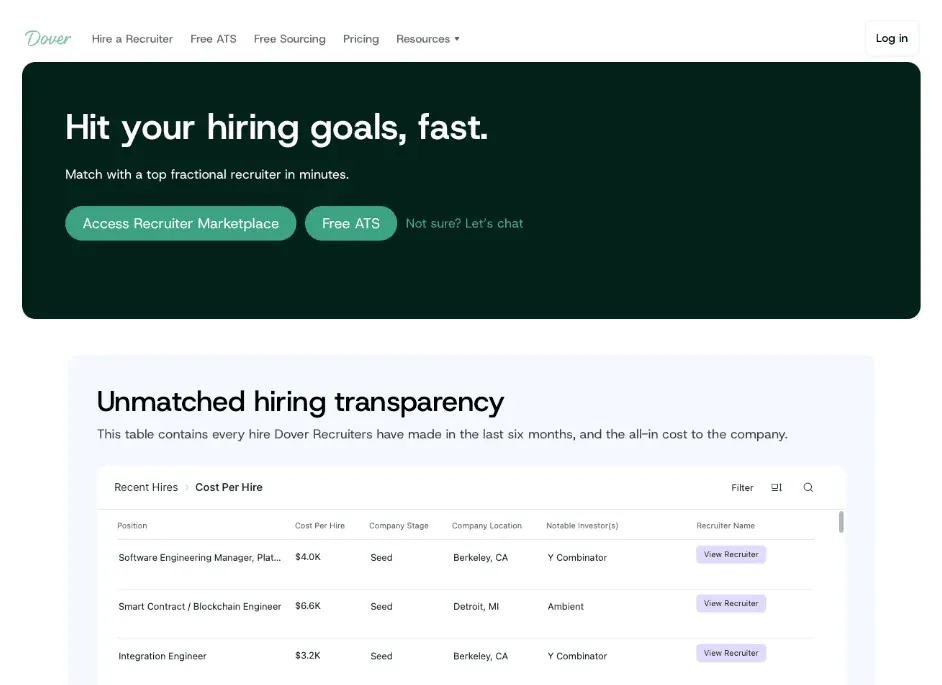
Dover’s fractional recruiting model is built for early-stage teams that need real recruiting capacity without committing to a full-time hire. The setup takes under five minutes, and the cost per hire runs about $4,800, which sits well below typical agency fees.
The way it works: Dover pairs its free ATS with a network of experienced recruiters who have deep startup hiring backgrounds. You get sourcing, screening, and coordination handled by someone who knows early-stage hiring, without carrying a full-time salary on your books.
A few things that shape how Dover fits into a fractional recruiting setup:
-
The free ATS syndicates your job posts across 50+ job boards automatically, so your fractional recruiter spends less time on distribution and more time on qualified candidates.
-
Recruiters set their own rates and bill only for time worked, which gives you costs tied to actual hours instead of a placement percentage.
-
An $800 refundable deposit is collected upfront, which screens for teams that are genuinely ready to hire and helps match you with a recruiter who fits the role.
-
AI screening can score and filter applicants before a recruiter reviews them, reducing the manual triage work that tends to slow down lean teams.
Where Dover fits best is companies hiring without a dedicated recruiting function, where a fractional recruiter needs both support infrastructure and a hiring workflow they can step into immediately. The combination of free software and on-demand recruiting means you can scale up for an active search and pull back when hiring slows, without retaining a full agency or carrying headcount.
Frequently Asked Questions
Fractional recruiter vs full-time hire for a Series A startup?
Fractional makes sense when you’re hiring 5-15 roles per year with uneven timing. You get senior-level expertise without carrying $85,000-$170,000 in fixed annual cost. Consider your first full-time recruiter around 15-20 annual hires when volume stays consistently high enough to support permanent headcount.
Can fractional recruiting work for technical roles like blockchain engineers?
Yes, if you match with a fractional recruiter who has domain expertise in your technical area. Many fractional recruiters specialize in crypto, blockchain development, or other technical verticals and bring warm networks in those talent communities instead of generic sourcing approaches.
How do I find fractional recruiter jobs or start working as a fractional recruiter?
Experienced recruiters build fractional practices by serving two or three clients simultaneously through dedicated marketplaces, fractional job boards, or direct client relationships. The model has become a viable full career path instead of gap-fill work, with rates running $75-$150 per hour depending on specialization and experience level.
When should companies stop using fractional recruiters and hire in-house?
The economics shift when you’re consistently filling five or more roles per quarter. At that volume, the per-hire cost of fractional support often approaches the annual cost of a full-time recruiter who builds deeper institutional knowledge of your culture and candidate bar over time.
Final Thoughts on Fractional Recruiting
Fractional recruiting solves a specific problem for growing companies: you need real recruiting capacity, but your hiring volume doesn’t support a full-time hire and agency fees add up fast. Dover’s fractional model, for instance, pairs a free ATS with on-demand recruiters who handle sourcing and coordination without permanent headcount on your books. The economics and fit become clear once you look at your actual hiring cadence against what each model costs.