
Most early-stage teams hit the same wall: too much hiring to manage internally, but not enough volume to support a dedicated recruiter. A contingency agency fills the gap on paper, but the fee structure creates pressure to close quickly, which isn’t always the same as closing well. Fractional recruiting for employers works differently, and the structure is worth understanding before you default to one of the usual options.
TLDR:
-
Fractional recruiting means hiring a recruiter part-time or per-project, billing hourly or per-hire ($2,000-$7,000), with no placement fee pressure.
-
Contingency agencies charge 15%-25% of first-year salary; a full-time recruiter runs $70K-$100K+ annually before benefits.
-
The model fits early-stage teams with 1-5 open roles best; high-volume, repeatable hiring needs tend to get better economics elsewhere.
-
Fractional recruiters bring sourcing playbooks and interview frameworks your team would otherwise spend months building from scratch.
-
Some tools pair free ATS software with on-demand fractional recruiting support, letting you scale up or pull back as hiring volume changes.
What Is Fractional Recruiting?
Fractional recruiting means hiring a recruiter on a part-time or project basis. A fractional recruiter works as an extension of your team for a defined period, learning your company and what good looks like, then steps back when the work is done. The model sits between full in-house recruiting and handing searches off to a contingency agency, without the salary overhead of a full-time hire.
Engagements are usually structured in one of a few ways:
-
Hourly, billing for time spent sourcing, screening, and coordinating.
-
Monthly retainer, covering a fixed scope of work each month.
-
Per-hire flat fee, paid when a role closes regardless of time spent.
What separates fractional recruiting from other outsourced models is the orientation. A contingency agency fills roles at volume and moves on. A fractional recruiter is accountable to your hiring goals over an extended period, runs your actual process, and typically works within your applicant tracking system instead of operating from a separate workflow.
Fractional Recruiting vs. Other Hiring Approaches
Fractional recruiting sits in a middle ground that most hiring frameworks skip over. To see where it fits, it helps to map it against the three options most early-stage teams actually reach for.
Traditional Staffing Agencies
Staffing agencies typically charge a contingency fee, collecting 15% to 25% of a new hire’s first-year salary only after a placement is made. That fee structure creates pressure to fill seats quickly, which can work against a careful cultural or functional fit. For a startup hiring an engineer at $150,000, that means $22,500 to $37,500 per placement, with limited transparency into how candidates were sourced or screened.
In-House Full-Time Recruiters
Hiring a full-time recruiter makes sense once a company is running enough searches to warrant the headcount. Until then, the fixed cost sits on the books regardless of hiring volume. A full-time recruiter salary often falls between $70,000 and $100,000 annually, consistent with BLS wage data for HR specialists, before benefits and equity, and the ramp time to build institutional knowledge of the business adds another variable that founders absorb directly.
| Approach | Typical Cost Structure | Recruiter Alignment | Flexibility |
|---|---|---|---|
| Staffing agency | 15%-25% of first-year salary | Incentivized to close quickly | Low; engagement ends at placement |
| Full-time recruiter | $70K-$100K+ salary plus benefits | Fully aligned, but expensive to maintain | Low; fixed cost regardless of volume |
| DIY (founder/manager) | Time cost only | Fully aligned but limited in capacity | High; no external dependency |
| Fractional recruiter | Hourly or project-based rate | Aligned to quality; no placement fee pressure | High; scope adjusts to hiring needs |
How the Fractional Recruiting Process Works
Most fractional recruiting engagements follow a recognizable pattern, even when the specific scope varies by company.
The process typically starts with a scoping conversation where the recruiter gets grounded in the role, the team, and what a strong hire looks like in practice. From there, they build or refine the job description, set up sourcing channels, and begin working the candidate pipeline. Depending on the engagement, they may run initial screens, coordinate interviews, and manage candidate communication through to offer.
What separates this from simply handing off a job req is the ongoing feedback loop. A fractional recruiter checks in regularly, adjusts sourcing strategy when early results are thin, and flags when a role is scoped in a way that’s making it harder to fill. That kind of iterative involvement is what makes the model closer to an embedded hire than a one-time service.

The recruiter typically works inside whatever tools the company already uses, whether that’s an ATS, a shared doc, or a structured spreadsheet. Setup friction is low by design.
That said, shared infrastructure matters more than most teams expect. An ATS is what separates a clean fractional engagement from a messy one: when both the recruiter and the hiring manager see the same candidate pipeline in real time, there is no coordination overhead and no status updates bouncing through email. Some tools pair free ATS software with on-demand recruiting support in a single system, so the infrastructure and recruiting capacity arrive together.
Key Benefits of Fractional Recruiting for Employers
Fractional recruiting gives employers access to senior recruiting talent without the cost structure of a full-time hire. Hiring a full-time senior recruiter often means $120,000 or more in annual compensation before benefits, while fractional arrangements run at hourly or project rates that are a fraction of that cost, particularly for companies hiring fewer than ten people per year.

There are a few areas where this model tends to deliver the most value:
-
Speed without the ramp-up period: Fractional recruiters are usually experienced operators who have run searches before. They do not need weeks of onboarding to become productive, which matters when a role has been open for two months and the team is stretched thin.
-
Unbiased sourcing strategy: A fractional recruiter working on an hourly basis has no incentive to push a candidate through quickly at the expense of fit. Their compensation is not tied to placement fees, so the advice they give tends to be more aligned with what the role actually needs.
-
Flexibility across hiring cycles: Startups rarely hire at a steady pace. Fractional arrangements let teams scale recruiting support up during a growth push and pull back when the pipeline is quiet, without carrying fixed headcount in the meantime.
The model works best for teams that have clear role definitions but limited internal bandwidth to run searches end to end.
When Fractional Recruiting Makes the Most Sense
Fractional recruiting tends to work best in a few specific situations. Early-stage startups with one to five open roles, limited runway, and no dedicated HR function are the most natural fit. When hiring needs are real but not yet consistent enough to support a full-time recruiter’s salary, fractional support covers the gap without locking you into headcount you may not need in six months.
It also works well for companies going through a sudden growth phase. If a seed round closes and you suddenly need to hire four engineers and a head of sales, a fractional recruiter can step in quickly without the two-to-three month ramp that a new internal hire would require.
A few other scenarios where this model tends to fit:
-
You need role-specific expertise your team lacks. Some roles, like a VP of Finance or a senior ML engineer, require sourcing and interviewing skills that go well beyond your team’s experience. A fractional recruiter with relevant background in that function can screen candidates more accurately than a generalist.
-
Your internal team is stretched thin. If your head of people is already managing onboarding, compliance, and culture, offloading active searches to a fractional recruiter keeps the process moving without burning out existing staff.
-
You want a structured process without building one from scratch. Fractional recruiters typically bring their own sourcing workflows, interview frameworks, and candidate communication cadences. For teams hiring for the first time, that structure alone can reduce the time it takes to get to an offer.
How Much Does Fractional Recruiting Cost?
Fractional recruiting typically runs on one of two pricing structures: hourly rates or per-hire fees. Fractional recruiter costs for hourly engagements depend on the rate each recruiter sets, while per-hire arrangements can range from $2,000 to $7,000 depending on role seniority and search complexity.
For context, SHRM’s 2025 benchmarking data puts the average non-executive cost per hire at $5,475 before any agency fees. Contingency recruiting firms generally charge contingency placement fees of 15% to 25% of a candidate’s first-year salary, which on a $120,000 role can reach $30,000 or more.
How Dover Supports Fractional Recruiting for Employers
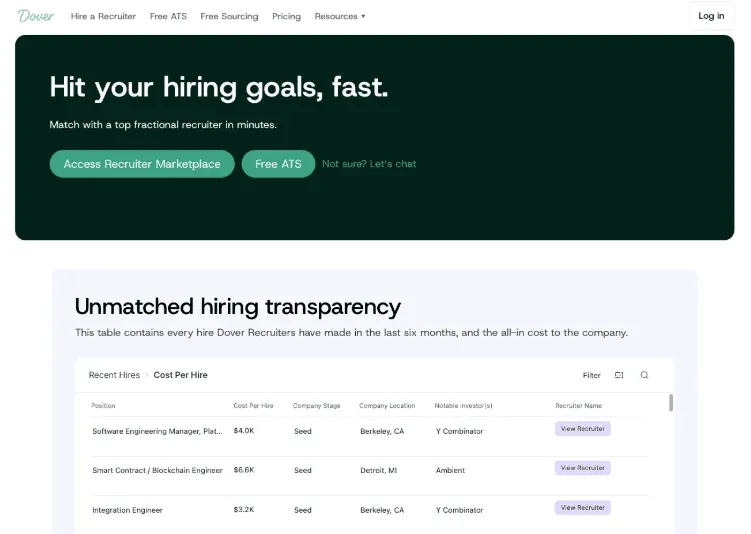
Most teams hit the same infrastructure problem before a first fractional engagement: without a shared system, candidate status lives in the recruiter’s notes, interview feedback travels by email, and the hiring manager has no real-time view of the pipeline.
Dover bridges that gap. The ATS with fractional recruiter model pairs free pipeline software with on-demand recruiting support in a single shared system. With Dover, employers can post to 50+ job boards in under five minutes and track candidates through structured stages at no added cost.
When a search needs more hands-on work, employers can bring in a fractional recruiter at $2,000 to $7,000 per hire, with no upfront retainer and a refundable $800 deposit. Dover’s recruiters have startup hiring backgrounds and work within the employer’s pipeline, keeping candidate progress visible at every stage.
Frequently Asked Questions
What’s the difference between fractional recruiting and a contingency staffing agency?
A fractional recruiter bills hourly or on a project basis and works as an extension of your team over a defined period, while a contingency agency collects 15-25% of a new hire’s first-year salary only after placement. That fee structure pushes agencies toward speed-to-fill, whereas a fractional recruiter’s compensation has no connection to how quickly a candidate gets an offer.
How do I know if my company is ready for fractional recruiting or should just hire a full-time recruiter?
Fractional recruiting tends to fit companies hiring fewer than 15-20 roles per year, where a full-time recruiter’s $70,000-$100,000+ annual salary would sit mostly unused. Once hiring volume reaches that threshold consistently, the economics of a full-time hire start to make more practical sense.
What does fractional recruiting typically cost per hire?
Most engagements run between $2,000 and $7,000 per hire, depending on role seniority and how actively the recruiter needs to source. For context, cost-per-hire benchmarks put the average non-executive cost per hire at $5,475 before any agency fees, and contingency firms typically charge $18,000-$30,000 on a $120,000 role.
Final Thoughts on Fractional Recruiting for Employers
Fractional recruiting fits best when hiring is real but not yet consistent enough to support a full-time recruiter on payroll. The model works when the engagement is clearly defined from the start: what a good hire looks like, how candidates move through stages, and how documentation gets captured before the engagement ends. Dover offers one concrete implementation, a free ATS paired with on-demand fractional recruiters at $2,000 to $7,000 per hire, with no upfront retainer.