

Startup hiring in Nashville doesn’t fit the traditional staffing agency mold, and that friction is real the moment you try to use one. Most recruitment agencies in Nashville, TN, are built for general industry placements like temp workers, admin roles, and light industrial, not early-stage tech companies filling engineering or GTM seats. A recruiter who can’t talk through a cliff-and-vest schedule or explain why a $140K offer at a Series A might be worth more than $165K at a mature company will lose your best candidates before the second interview. This post cuts through that noise for founders who need a recruiting partner that actually fits.
TLDR:
-
Contingency agencies charge 15-25% of salary per hire, often five times the average cost per hire across all methods
-
A bad hire at a 10-person startup can cost around $14,900 and pulls founders into compensatory work with no buffer
-
Fractional recruiters have an average cost per hire of $4.8k, compared to $18,000-$30,000 with a contingency agency
-
Your recruiting partner should source nationally, work inside your ATS, and price transparently with no long-term contract
-
Some tools pair a free ATS with on-demand fractional recruiting support at an average cost per hire of $4.8k, with no long-term contract
Nashville’s Startup Hiring Scene
Nashville’s startup scene has grown well beyond its music industry roots. The Nashville startup ecosystem now tracks 475 funded startups with over $1B in VC invested, 12 unicorns, and healthcare tech accounting for 75% of the city’s largest funding rounds, spanning health tech, fintech, music tech, and logistics. Jumpstart Foundry and the Nashville Entrepreneur Center anchor early-stage support, and Vanderbilt University feeds a steady pipeline of technical talent. A healthcare tech startup looking for its first product manager and a fintech building out its engineering team need recruiters who understand equity compensation, startup culture, and the difference between a candidate who can thrive in ambiguity versus one who needs process in place, context most generalist staffing firms lack.
Why Traditional Staffing Agencies Are a Poor Fit for Startups
The contingency model is the core issue. Agencies charge 15 to 25% of a candidate’s first-year salary; on a $120,000 engineering hire, that fee runs $18,000 to $30,000. SHRM’s 2025 benchmarking data puts the average non-executive cost per hire at $5,475 across all hiring methods. The agency fee alone can run five times that figure.

Beyond cost, the model creates structural problems:
-
Roles get shopped to multiple recruiters, so candidates receive duplicate outreach and no single recruiter builds real context about the company.
-
Sourcing intelligence stays with the agency when the engagement ends.
-
The fee tied to salary creates a built-in incentive to push candidates toward higher compensation, a problem most acute when hiring the first five engineers on a tight runway.
The Roles Nashville Startups Actually Hire For
Seed-to-Series C Nashville startups cluster hiring around a few role types that require more than a generalist recruiter can offer.
-
Full-stack and backend engineers who set architecture decisions early
-
Data engineers and ML practitioners, especially in healthcare tech
-
Product managers who own roadmaps without a dedicated design team above them
-
First AEs, SDRs, and a VP of Sales before the GTM motion is proven
-
Operations leads building process from scratch across finance, legal, and people ops
Each search has quirks a generalist misses. An early engineering hire requires a recruiter who can explain why a $140,000 base at a Series A compares favorably to a $165,000 offer at a mature company, run a tight interview loop, and read culture fit for a five-person team that cannot absorb someone who needs structured onboarding.
What Startup Founders Should Expect From a Recruiting Partner
Choosing the wrong recruiting partner costs time you do not have. Before committing to any external search support, founders should hold potential partners to a short set of criteria that separate genuinely startup-savvy recruiters from generalist shops repackaging themselves as startup-friendly.
-
Startup hiring experience: your recruiter should know how to talk about equity, early-stage role scope, and the tradeoffs between a funded startup and a larger company. If they cannot explain a cliff and vest schedule, they will lose candidates in the first conversation.
-
Dedicated engagement: one recruiter who builds context on your team, not a role shopped to whoever picks it up first.
-
Fee transparency: clear, upfront costs, not a percentage revealed after the candidate accepts.
-
Visibility into recruiter activity: you should see sourcing volume, outreach, and pipeline movement, not wait for a weekly update call.
-
Integration with your own hiring workflow: a good partner works inside your ATS and processes, not a black box that hands you a shortlist.
-
No long-term contracts: early-stage hiring needs shift fast. The ability to pause or stop without penalty is a basic structural requirement, not a perk.
Any agency that cannot satisfy these criteria upfront is almost certainly built for a client profile that is not you.
The True Cost of a Bad Hire for an Early-Stage Team
A bad hire at a 10-person startup has no buffer. The mis-hire interacts with nearly every teammate, slows decisions, and occupies a seat that could have gone to someone who actually fits. CareerBuilder’s bad hire cost survey puts the average cost of a bad hire around $14,900, a figure that understates the damage for senior roles where the replacement search can outlast the original. A new hire who cannot perform independently pulls founders into compensatory work, and a cultural mismatch that festers can fracture team trust in ways that outlast the departure itself.
Contingency agencies are incentivized to fill roles quickly. Speed-to-fill determines their economics; fit determines yours. When those priorities conflict, the agency’s interest wins by default.
How the Fractional Recruiting Model Works
Fractional recruiting is structurally different from contingency placement, and that difference shapes everything from cost to candidate experience.
A fractional recruiter embeds with your team and runs the full hiring cycle: sourcing, outreach, screening, coordinating interviews, and closing. They work with no percentage of salary. For a standard role, total cost averages $4.8k per hire, not $18,000 to $30,000.

| Contingency Agency | Fractional Recruiter | |
|---|---|---|
| Pricing model | 15-25% of first-year salary | Set with your recruiter: hourly, retainer, or pay-per-hire |
| Cost per hire (typical) | $18,000-$30,000 | Avg. $4.8k |
| Incentive alignment | Speed-to-fill drives economics | Fit drives the engagement |
| Sourcing data ownership | Stays with the agency | Stays with your team |
| ATS integration | Parallel system, limited visibility | Works inside your ATS |
| Contract structure | Exclusivity clauses common | No long-term contract |
| Recruiter assignment | Role shopped to multiple recruiters | One dedicated recruiter |
The three-way distinction matters here. Freelancers complete discrete tasks. Contractors are scoped to a defined deliverable and exit when done. Fractional recruiters fill an ongoing strategic role, building knowledge of your culture, comp philosophy, and candidate pipeline over time. Each search builds on the last instead of starting cold.
Because they work inside your ATS and processes, all sourcing history stays with you when the engagement ends.
A fractional recruiter running a parallel process outside your system produces a shortlist; a fractional recruiter working inside your ATS builds a hiring function. That distinction matters most during the searches that take longest: senior technical roles and first GTM hires, where pipeline visibility affects decisions in real time.
When a Fractional Recruiter Beats a Traditional Agency
Fractional recruiting fits most early-stage scenarios, but knowing when to use it versus a retained search firm keeps costs and expectations aligned.
Fractional wins clearly when:
-
You are hiring across multiple functions simultaneously, so one recruiter builds context across all open roles from the same pipeline, avoiding fragmented process and duplicate outreach.
-
You are seed-stage with no internal recruiting capacity and need the recruiter to become your hiring function, not a vendor running a parallel process.
-
Hiring is bursty, so you can ramp hours up during a growth sprint and pull back when headcount plans shift, without penalty.
A retained executive search firm can make sense for a single C-suite hire where the shortlist is genuinely thin and budget is not a constraint. For most Nashville startups filling technical, product, or GTM roles, that scenario rarely applies.
What to Look for in a Nashville Tech Recruiting Partner
Nashville’s talent pool spans local and distributed hires, and healthcare tech is the city’s dominant vertical. Ask any prospective partner whether they source nationally, and whether they can distinguish a clinical data engineer from a health informatics analyst without prompting. Beyond domain fit, the practical questions are straightforward:
-
Do they work inside your ATS or run a separate process you cannot see?
-
Is pricing clear upfront, not a percentage disclosed after the hire?
-
Can they show you sourcing and outreach activity in real time?
-
Have they filled roles at companies with fewer than 50 employees?
A firm that checks all four is worth a conversation. One that hedges on any of them is built for a different client.
How Dover Fits Into Startup Recruiting
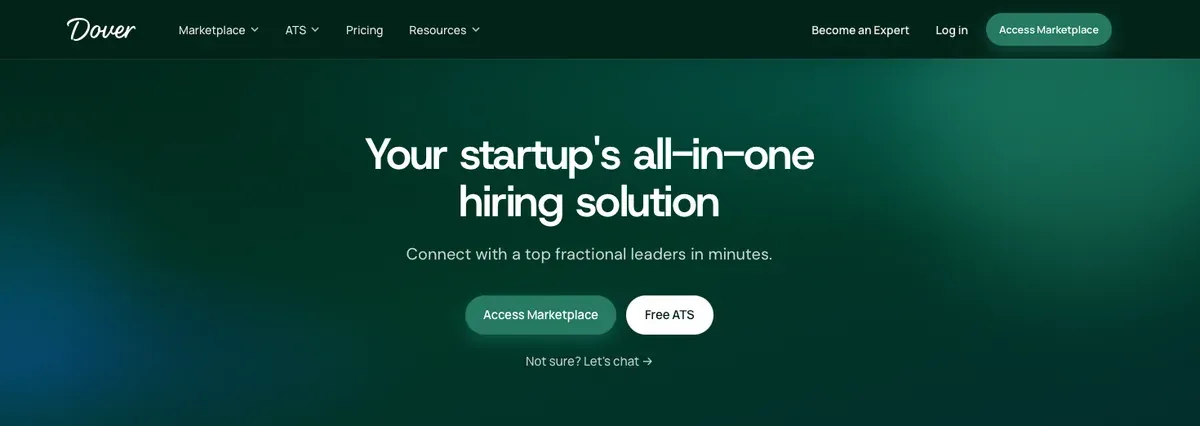
Sure, we may be biased here, but Dover is a concrete implementation of the fractional model this post has been describing.
The setup is straightforward: a free ATS paired with on-demand fractional recruiters who work inside it alongside your team. The ATS posts to 50+ job boards in one click, supports native referral tracking, and gives both you and your recruiter a shared real-time view of the pipeline. No separate recruiter system running a process you cannot see.
On the recruiter side, Dover’s marketplace matches you with one dedicated recruiter, not a contingency shop that shops your role to whoever picks it up. For a broader look at fractional recruiting services for startups, the options vary by engagement model and pricing structure. Total cost averages $4.8k per hire. You set the pricing model with your recruiter (hourly, retainer, or pay-per-hire), and there is no long-term contract. Getting started requires an $800 refundable deposit. If hiring plans shift, you stop without penalty.
For Nashville startups hiring across engineering, product, or GTM, that structure (a shared ATS and a dedicated fractional recruiter operating inside it) tends to fit better than a contingency agency whose economics reward speed over fit.
FAQs
What’s the difference between a fractional recruiter and a traditional Nashville staffing agency for startup hiring?
A fractional recruiter embeds with your team, sets pricing with you (hourly, retainer, or pay-per-hire), and runs the full hiring cycle inside your own ATS, so all sourcing history stays with you when the engagement ends. Traditional staffing agencies charge 15 to 25% of a candidate’s first-year salary on placement, keep sourcing intelligence in their own systems, and are structurally incentivized to put speed-to-fill ahead of fit.
When does a fractional recruiter make more sense than a contingency agency for an early-stage engineering hire?
A fractional recruiter tends to fit better when you are hiring across multiple functions simultaneously or need real-time visibility into sourcing activity, since one dedicated recruiter builds context across all open roles from a shared pipeline at an average cost per hire of $4.8k. A contingency agency can make sense for a single urgent, low-complexity role where fit criteria are minimal and your budget can absorb a fee of $18,000-$30,000 on a $120,000 hire.
Do I need an ATS before bringing in a fractional recruiter?
Not necessarily, but having one changes the quality of the engagement. An ATS gives both the recruiter and the hiring team a shared real-time view of sourcing activity, outreach, and pipeline movement. Without that shared layer, coordination happens in email threads and weekly calls, sourcing data lives in the recruiter’s system rather than yours, and there is no durable record of what was tried when the engagement ends. With a shared ATS, the recruiter works as an extension of your team rather than a vendor handing off a shortlist. Some tools pair a free ATS with fractional recruiter access in one system, so both layers are available from the start without additional tooling to configure.
Final Thoughts on Choosing a Recruiting Model for Nashville Startups
Nashville’s startup hiring scene has real depth now, but most recruitment agencies in Nashville, TN, are still built for a different client. Your stage, your runway, and the specific roles you’re filling should drive the model you choose, not the familiarity of a traditional staffing agency name. For early-stage teams that need a dedicated recruiter without a percentage-of-salary placement fee, Dover pairs a free ATS with on-demand fractional recruiters, averaging $4.8k per hire with no long-term contract. The best searches start with a recruiter who actually understands what you’re building.