

Most startups frame the agency vs recruiter marketplace decision as a cost question, but it’s really an incentives question. A contingency fee that closes fast rewards the recruiter for speed, not fit. An hourly or per-hire model changes that calculus entirely. Getting clear on which structure fits your hiring volume and your runway is the decision that actually matters here.
TLDR:
-
Recruiting agencies charge 15% to 25% of first-year salary; on-demand marketplaces bill hourly or per hire, decoupling cost from compensation levels.
-
Contingency agency fees reward speed and placement volume, which can deprioritize your search when a larger client’s role offers a bigger fee.
-
Agencies hold a genuine edge for niche technical searches, C-suite hires, and markets where you have no existing candidate network.
-
Marketplaces fit teams running multiple concurrent searches, with variable hiring volume, or founders who want direct pipeline visibility throughout a search.
-
Some tools pair a free ATS with on-demand recruiting support at $75 to $125 per hour instead of fixed retainers, covering the middle ground between full agency outsourcing and self-serve job posting.
What Agency Recruiting and Recruiter Marketplaces Actually Are
Agency recruiting and recruiter marketplaces are two structurally different ways to bring external recruiting capacity into a startup, and the cost model behind each shapes nearly every practical tradeoff between them.
A recruiting agency operates on a contingency or retained basis. In the contingency model, the agency collects a fee only when a hire is made, typically ranging from 15% to 25% of the new hire’s first-year salary. Retained search works differently: the client pays an upfront fee to secure the agency’s exclusive focus on a role, with the remainder due at placement. Either way, the agency owns the search process end-to-end. Sourcing, screening, and candidate presentation happen inside the agency, largely out of the hiring team’s view.
An on-demand recruiter marketplace connects companies directly with independent recruiters who work on a fractional or hourly basis. Instead of a percentage-of-salary fee, the cost is typically tied to hours worked or a flat per-hire fee. The hiring team retains more control over the process, and the recruiter operates as an extension of the internal team instead of a separate vendor running a parallel search.
| Recruiting Agency | On-Demand Marketplace | |
|---|---|---|
| Fee structure | 15% to 25% of first-year salary (contingency) or upfront retainer | Hourly ($75 to $200/hr) or flat per-hire fee |
| Cost predictability | Tied to compensation level; scales with salary | Decoupled from salary; forecastable per role |
| Incentive alignment | Rewarded for speed and placement volume | Compensated for work performed, not outcome alone |
| Transparency | Agency owns the search; shortlists shared, not sourcing activity | Recruiter works inside your workflow with real-time pipeline visibility |
| Flexibility | Retainers or exclusivity clauses; harder to pause or adjust | No long-term contract; scale up or down as hiring volume changes |
| Best for | Niche technical searches, C-suite hires, passive candidate access | Multiple concurrent searches, variable volume, founder-led hiring |
How the Pricing Models Break Down
Recruiting agencies operating on contingency typically charge 15% to 25% of a placed candidate’s first-year salary. For a $120,000 engineering hire, that’s $18,000 to $30,000 in fees, paid only on a successful placement. For context, SHRM’s recruiting cost data puts the average non-executive cost per hire at $5,475 before agency fees, making contingency placements on mid-to-senior roles a meaningful multiple above that baseline. Retained search firms require an upfront payment, often 10% to 15% of the total fee, with the remainder due at defined milestones regardless of whether the search closes.
On-demand recruiter marketplaces work differently. Instead of a percentage tied to compensation, you pay an hourly rate or a flat per-hire fee. Rates across the category tend to fall between $75 and $200 per hour depending on the recruiter’s seniority and the role’s complexity, with some services offering fixed per-hire pricing that caps your total exposure on any given search. Contingency recruiting for startups typically transfers timeline risk to the agency, but that risk transfer comes with the incentive tradeoffs described below.
The structural difference matters more than the numbers themselves. Contingency vs hourly recruiting costs matter here: a startup hiring senior engineers or executives will pay considerably more than one filling coordinator-level roles, even if the actual work involved is similar. Per-hire or hourly models let you forecast spend more precisely because the fee is decoupled from compensation inflation.
Incentive Alignment: Where the Two Models Structurally Diverge
A contingency agency earns its fee only when a candidate accepts an offer. That structure rewards speed and placement volume. When a recruiter is working five open searches simultaneously, the incentive is to move fast and present candidates who are likely to close, not necessarily candidates who are the best fit for your specific team. The pressure isn’t malicious; it’s built into the economics.

An on-demand marketplace operates differently. Recruiters typically bill hourly or per milestone, meaning they’re compensated for the work itself, not solely the outcome. That removes the race-to-close pressure and gives the recruiter more room to be selective about sourcing, spend time on calibration calls, and present fewer but better-fit candidates.
For startups, this difference usually comes down to visibility and prioritization. Agency recruiters may juggle competing searches, while marketplace recruiters typically work as an extension of your team, giving you more insight into progress and more opportunities to adjust the search.
Speed, Transparency, and Hiring Manager Control
These three factors often shape the day-to-day hiring experience more than pricing.
-
Speed. Agencies can move quickly when they already have relevant candidates, but searches may slow if they need to build a pipeline from scratch. On-demand marketplaces often launch faster because recruiters are engaged as needed, though timelines still depend on role complexity.
-
Transparency. Traditional agencies typically share candidate shortlists instead of the sourcing process itself. Marketplace recruiters often work directly inside the hiring team’s workflow, providing real-time visibility into outreach, pipeline activity, and candidate progress.
-
Control. Agencies generally own the candidate relationship throughout the search, while marketplace recruiters operate as an extension of the hiring team. This gives founders and hiring managers more direct involvement in sourcing decisions and feedback.
Where Agency Recruiting Has a Genuine Edge
Agency recruiters carry real advantages in specific situations, and those advantages are worth naming clearly before any comparison gets underway.
The most defensible case for agencies is niche technical searches. When a startup needs a principal ML researcher or a semiconductor architect with a very specific background, the relevant talent pool may be small enough that a specialized agency’s pre-built relationships with passive candidates genuinely matter. Recruiting agencies for startups vary widely in how deep those networks actually run. Building that network from scratch takes time most startups don’t have.
Senior Leadership Searches
Executive roles introduce a layer of discretion and market intelligence that pure job postings rarely surface. Agencies running VP and C-suite searches typically maintain confidential candidate relationships and can approach people who aren’t actively looking. For a seed-stage company trying to hire a CFO quietly, that access has real value.
Agencies may also be useful for urgent hires or markets where specialized local expertise is important.
Where Recruiter Marketplaces Have a Genuine Edge
Recruiter marketplaces tend to perform best in specific conditions, and understanding those conditions is more useful than a general comparison.
Marketplace recruiters are often more cost-effective for startups because they can be engaged on demand, without retainers or salary-based fees. Some research on the fractional employee business model finds these arrangements can reduce hiring costs compared to fixed-fee or percentage-based engagements. They also provide flexibility for companies with uneven hiring volume.
A Decision Framework for Startups
The choice between a recruiting agency and an on-demand marketplace rarely comes down to one factor. It comes down to a combination of where your startup is in its growth, how much capital you can reasonably deploy per hire, and how much visibility you want into the process.
A few diagnostic questions can help frame the decision:

-
How many roles are you trying to fill in the next 90 days? If the answer is three or more, the per-hire economics of an on-demand marketplace tend to hold up better than agency retainers priced for one-off searches.
-
Is the role highly specialized or sensitive enough that a misfire carries outsized risk? Senior leadership hires and roles requiring rare technical depth may warrant the dedicated search capacity a retained agency provides. The fractional recruiter vs full-time recruiter question often surfaces at this same decision point.
-
Do you have internal bandwidth to stay involved in the process? Marketplaces typically work best when a founder or hiring manager can give structured feedback and stay in the loop. Agencies absorb more of that coordination work, which has value when your team has no slack.
-
What does your runway support? A contingency fee at 20% to 25% of first-year salary on a $180,000 hire is a $36,000 to $45,000 spend. That math compounds quickly across multiple roles.
How Dover Fits Into the Decision
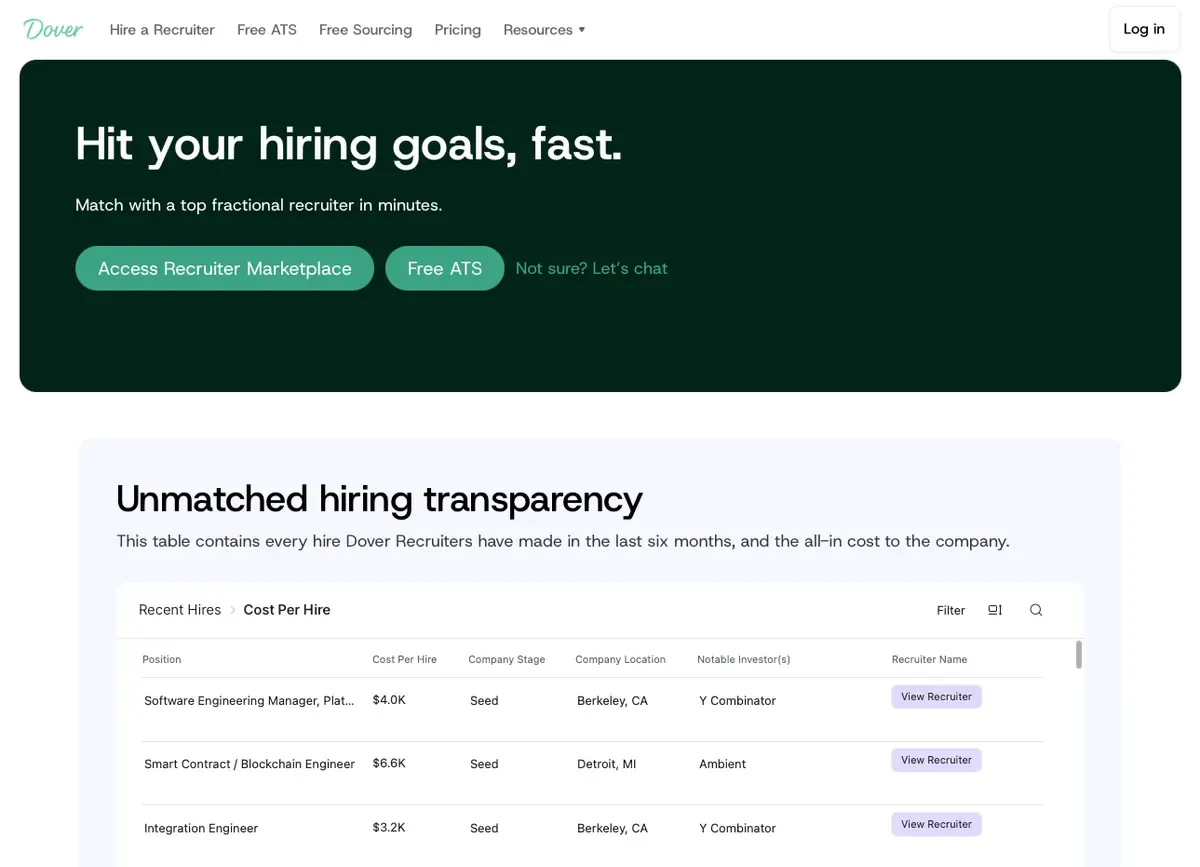
Dover pairs a free ATS with on-demand fractional recruiters, which means it sits at an interesting point in the agency vs. recruiter marketplace decision. You get the pipeline visibility and candidate tracking of a self-serve tool without giving up access to experienced recruiting support when a search gets complex.
The cost structure reflects that positioning. Fractional recruiter costs run $75 to $125 per hour, with per-hire costs typically ranging from $2,000 to $7,000, no retainer required. For a startup that needs to run three searches this quarter and nothing next quarter, that variability matters more than it might look on paper.
Where Dover tends to fit well is the middle ground that most frameworks ignore: teams that want more than a job board distribution tool but less than a fully outsourced agency engagement. The ATS handles inbound pipeline and keeps hiring managers in the loop; fractional recruiters can step in for sourcing, outreach, or interview coordination on searches that need the extra effort.
Recruiter activity, candidate stages, and outreach all log in real time inside the same pipeline the hiring team already sees, instead of a parallel search delivering summaries on completion. For teams comparing fractional recruiting services for startups, that shared visibility is the clearest structural difference from a traditional agency arrangement.
FAQs
When does agency recruiting vs. a recruiter marketplace make more financial sense for a startup hiring multiple roles?
For three or more concurrent searches, recruiter marketplace models tend to hold up better on cost: contingency fees at 15% to 25% of first-year salary compound fast across parallel hires, while hourly or per-hire marketplace pricing lets you forecast spend per role without salary-linked exposure. Agency fees make the most sense on one-off, high-stakes searches where passive candidate access and discretion carry real weight.
Should I use a contingency agency or on-demand fractional recruiter for an engineering hire?
For a standard engineering role where the talent pool is reasonably accessible, an on-demand fractional model usually delivers better cost control and pipeline visibility than contingency. Reserve agency fees for roles requiring a very specific background or pre-built passive candidate relationships that would take months to replicate from scratch.
Can I run multiple searches with a fractional recruiter without signing a long-term contract?
Yes. On-demand marketplace models, including fractional recruiter engagements, are structured on a per-hour or per-hire basis with no retainer or long-term commitment required. That pay-as-you-go structure is one of the primary reasons teams with variable or bursty hiring volume tend to favor them over agency retainers priced around single placements.
Final Thoughts on the Agency vs. Recruiter Marketplace Decision
The agency vs recruiter marketplace decision mostly comes down to two things: how many searches you are running at once, and how much runway you can put toward recruiting fees per hire. Agencies earn their cost in specific, narrow conditions. On-demand marketplaces tend to fit the broader range of startup hiring contexts where cost predictability and pipeline visibility matter more than exclusive candidate relationships. Dover is one place to start: a free ATS paired with on-demand fractional recruiters at $75 to $125 per hour, no retainer required.