
There’s a number most early-stage teams never calculate: total recruiting spend across a full year of hiring. They approve each agency agreement individually, and the percentage fees compound in the background. When you compare hourly recruiter cost vs. agency fees on a $140,000 engineering hire, the gap between a fractional recruiter hire, averaging about $4,000 through Dover’s marketplace, and a 20% contingency fee is roughly $24,000 on a single placement. Multiply that across your hiring plan and it tells you something worth knowing before you sign the next one.
TLDR:
-
Contingency agencies charge 15% to 25% of first-year salary; a $120K hire costs $18,000 to $30,000 regardless of search length.
-
Hourly fractional recruiters bill $75 to $150/hour, keeping total cost per hire well below agency fees on the same role.
-
Agency fees scale automatically with salary, so three senior hires can run $75,000+ in fees even when every placement lands well.
-
Contingency incentives favor speed of placement over fit; hourly billing creates incentive alignment around finding the right candidate.
-
Some tools pair free ATS software with on-demand recruiting support averaging about $4,000 per hire instead of fixed retainers or percentage-of-salary fees.
The Real Price Gap Between Hourly and Agency Recruiting
The math that separates hourly recruiting from agency recruiting comes down to one structural difference: one charges for time spent, the other charges a percentage of whatever salary the candidate accepts.

A contingency agency vs hourly recruiting comparison starts here: contingency typically bills 15% to 25% of first-year compensation. On a $120,000 engineering hire, that’s $18,000 to $30,000 in fees, whether the search took two weeks or two months. A fractional recruiter billing at $100 to $150 per hour, working 80 to 120 hours on the same search, lands somewhere between $8,000 and $18,000 total, with every hour visible and accountable.
Here is how those two models compare across a typical early-stage hiring scenario:
| Factor | Contingency Agency | Hourly Fractional Recruiter |
|---|---|---|
| Fee structure | 15% to 25% of first-year salary | $75 to $150/hour |
| Cost on a $120K hire | $18,000 to $30,000 | $8,000 to $18,000 (80 to 120 hrs) |
| Cost on a $180K hire | $27,000 to $45,000 | $9,000 to $21,000 (80 to 140 hrs) |
| Fee visibility | Single invoice after placement | Itemized by hours worked |
| Incentive alignment | Speed of placement | Quality of process |
| Scales with salary? | Yes, automatically | No |
The gap widens as roles get more senior. A $180,000 VP of Engineering search through a contingency agency can run $27,000 to $45,000. The same search with an hourly recruiter, even one running a longer, more careful process, stays well below that ceiling in most cases.
The Hidden Costs That Don’t Appear in the Contract
When comparing hourly recruiting to agency fees, the sticker price is rarely where the real difference shows up.
Replacement Guarantees and Their Limits
Most contingency agreements include a guarantee period, typically 60 to 90 days, during which the agency will replace a failed hire at no additional charge. What those clauses rarely cover is the internal cost of the failed hire itself: onboarding time, manager attention, delayed projects, and the productivity gap while the role sits open again. Some estimates suggest a bad hire at the manager level can cost between 30% and 150% of that person’s annual salary when downstream effects are included, though figures vary widely depending on role seniority and company context.
Why Contingency Incentives Don’t Always Align With Hiring Goals
Contingency recruiters earn their fee only when a candidate accepts an offer, typically 15% to 25% of first-year salary. On a $120,000 engineering hire, that’s $18,000 to $30,000 paid in a single transaction the moment a candidate signs, whereas a fractional recruiter bills hourly for time worked.
That fee structure creates a pull toward speed and availability over fit. A recruiter working five open searches simultaneously has financial incentive to present candidates who are ready to move quickly, not necessarily candidates who are the best match for your team’s specific needs. The pressure to close is baked into how they get paid.

How Hourly Recruiting Engagements Are Scoped and Billed
Fractional recruiting covers the actual work: sourcing candidates, writing outreach, screening applicants, coordinating interviews, running debriefs, and supporting offer negotiation. Percentage-based agency fees bundle all of that into a single output-based charge; hourly billing makes each input visible and attributable.
A standard search typically runs 20 to 30 hours across three to four weeks, covering an initial sourcing sprint, outreach, screening calls, and pipeline handoffs to your hiring manager. Senior or specialized roles may require more hours, but the pacing stays within your control because you approve hours as they accrue, not after a lump-sum invoice lands following placement.
That control cuts both ways. You can pause a search if a role’s priority changes, redirect the recruiter toward a different opening, or cap hours at a weekly ceiling without contractual friction. The tradeoff is that hourly engagements require active involvement on your end: reviewing progress, approving sourcing lists, and checking that billed hours map to real outputs. The “hands off until someone signs” experience of a contingency agency is not what this model offers.
The coordination load that comes with that active involvement drops considerably when the recruiter and hiring team share a common pipeline tool. With a shared ATS, sourcing activity, candidate status, and outreach history are visible to both sides in real time. That shared visibility separates a well-run hourly engagement from one where both parties work in parallel without a common record.
Recruiting Cost Per Hire for Startups: What the Math Looks Like in Practice
The arithmetic is sharpest for startups hiring engineering and product roles in the $100,000 to $160,000 salary range, where agency fees compound fastest.
Three representative roles show how fast that gap compounds: a mid-level engineer at $110,000 runs $22,000 in agency fees versus $2,500 at 25 hourly hours; a senior engineer at $140,000 costs $28,000 in fees versus the same $2,500; and a head of product at $160,000 lands at $32,000 in fees versus $2,500 hourly. The hourly figure holds flat while the agency fee climbs with every salary negotiation. A startup filling three senior roles in a year could spend $75,000 or more in agency fees alone, even if every hire lands well. Understanding fractional recruiter costs helps clarify why filling those same three roles with a fractional recruiter who puts in 25 hours per search runs closer to $7,500 total.
When Agency Fees Are Worth the Cost
Contingency recruiting agencies aren’t always the wrong call. For certain hiring situations, the fee structure that looks expensive on a spreadsheet actually reflects real value being delivered.
Speed with No Internal Capacity
If you have no recruiting function at all and need a qualified candidate in the next four to six weeks, an agency can run the entire search without any setup time on your end. You’re paying for the speed and the execution lift together.
The clearest tradeoff is this: agency fees are hardest to defend when you’re hiring more than one or two roles, when the positions are mid-level instead of senior, or when you have some internal capacity that could be directed toward sourcing. In those situations, the percentage-of-salary model stops functioning as risk transfer and starts functioning as an expensive convenience.
When Hourly Recruiting Delivers a Better Return
The clearest case is when hiring volume is low but role complexity is high. A single senior engineering or product hire where you need deep sourcing, careful screening, and calibrated compensation guidance benefits from an experienced recruiter’s judgment, not a scaled process. Forty to 60 hours of focused fractional work on that hire typically lands in the mid-four figures, a fraction of what a contingency agency charges on a $180,000 salary.
How Dover’s Fractional Recruiting Model Fits This Decision
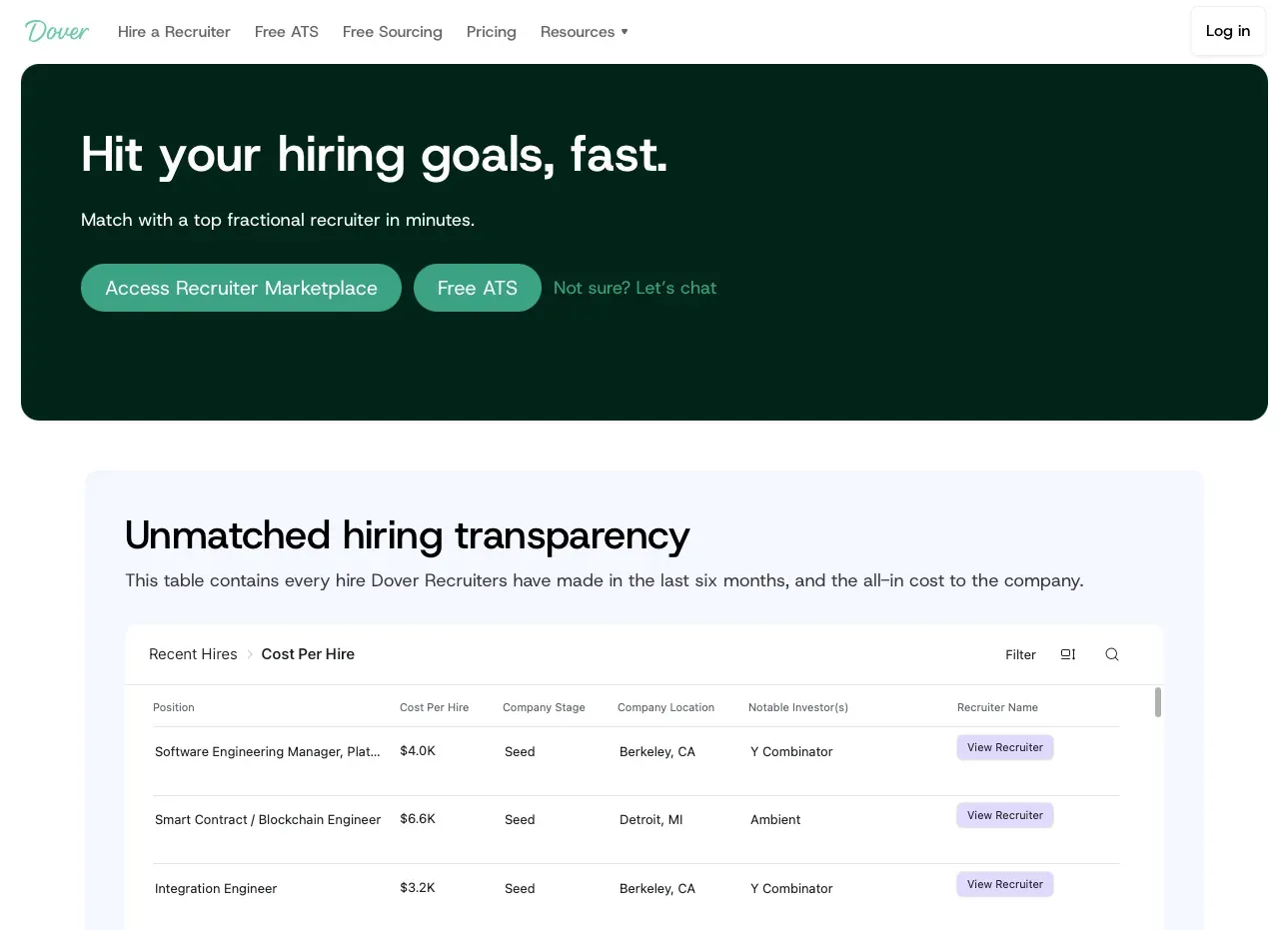
Sure, we may be biased, but here is what Dover actually does and why it fits the math this post has been walking through.
Dover’s model pairs a free ATS with on-demand fractional recruiters who set their own rates, with total cost per hire typically falling between $2,000 and $7,000 (about $4,000 on average). There is no retainer, no percentage of first-year salary, and no minimum commitment. You pay for the hours worked on your search, nothing more.
For a seed or Series A team running one or two searches at a time, that structure matters. You get recruiter access when a search is active and stop paying when it closes. The ATS handles your pipeline continuously at no cost, so you are not paying for infrastructure during quiet periods either.
Dover’s fractional recruiters work within that hourly structure inside a shared ATS, so the recruiter’s sourcing, outreach, and candidate notes are visible to your hiring team in real time, no handoff overhead, no pipeline gaps, and no knowledge that disappears when the engagement ends. The recruiter and the hiring team are operating in the same system from the first sourced candidate to the accepted offer.
FAQs
What’s the real difference between hourly recruiter cost vs agency fees for a $120K engineering hire?
The structural gap is considerable: a contingency agency charges 15% to 25% of first-year salary, putting a $120,000 engineering hire at $18,000 to $30,000 regardless of how long the search took. An hourly fractional recruiter billing $100 to $150/hour across 80 to 120 hours on the same search lands between $8,000 and $18,000, with every hour visible and attributable. The fee is the same whether the role closed in two weeks or two months under the agency model; the hourly model doesn’t work that way.
What’s a reasonable recruiting cost per hire for a startup filling multiple senior roles in a year?
SHRM’s 2025 benchmarking data puts the average non-executive cost per hire at $5,475 across all hiring methods, but a 20% agency fee alone on a mid-level hire doubles or triples that figure before any internal time is counted. A startup filling three senior roles at $140,000 to $160,000 could spend $75,000 or more in agency fees alone; fractional recruiters billing $100/hour across 25 hours per search run closer to $7,500 total for the same three hires. The gap widens as roles get more senior because contingency fees scale automatically with salary while hourly costs don’t.
Should I use a contingency agency or a fractional recruiter with an hourly rate for a VP of Engineering search?
For a VP of Engineering search at $180,000, a contingency agency runs $27,000 to $45,000 at standard rates; an hourly recruiter working 80 to 140 hours at $100 to $150/hour stays well below that ceiling even on a longer, more careful search. The more useful question is what drives the recruiter’s behavior: a contingency model creates financial incentive to close quickly, while an hourly model creates incentive to find the right person. For a senior role where team fit and retention matter, that difference in incentive structure tends to produce different candidate pools and different levels of transparency throughout the search.
Final Thoughts on Comparing Hourly and Agency Recruiting Costs
Neither model is universally right. Agency fees can be worth paying when the search is genuinely specialized, the hire is one-of-a-kind, or you have no internal capacity to support a search at all. Outside of those situations, the math tends to favor the fractional recruiter hourly rate model, especially once you account for replacement searches, salary scaling, and the attention your role actually gets. Dover’s hourly fractional recruiters give early-stage teams that cost structure with a shared ATS included, so you get full pipeline visibility from the first sourced candidate to the accepted offer without paying a percentage of salary to get there.