

Your runway math changed, or your roadmap shifted, or the market just made growth bets harder to defend. Whatever triggered your hiring freeze, the response looks the same: you need a clear way to communicate it, a plan for keeping your pipeline warm, and a sense of which roles to move on first when the pause lifts.
TLDR:
-
A hiring freeze pauses headcount growth without touching existing staff, so your team and candidate pipeline stay intact.
-
Rank roles by blocking impact, not complaints: revenue-tied and single-point-of-failure gaps compound the longest.
-
Industry benchmarks consistently put the average cost per hire in the thousands, making warm pipeline maintenance worth the effort during a pause.
-
Use the freeze to audit job descriptions, build evaluation scorecards, and configure an ATS before searches reopen simultaneously.
-
Some tools pair free ATS software with on-demand recruiting support billed for time worked instead of fixed retainers, which fits the unpredictable volume that follows a pause.
What a Hiring Freeze Actually Means for a Startup
A hiring freeze is a deliberate pause on filling open roles. No new offers, no active searches, and in many cases, no backfilling positions that open up while the freeze is in place. It is temporary by design, and it leaves your existing team intact.
That distinction matters. A freeze is not a layoff. Nobody loses their job. What changes is your ability to grow headcount.
For a startup founder, that difference shapes everything about how you respond. Layoffs require severance conversations, morale management, and often public communication. A freeze is quieter, but it carries its own practical weight: roles stay open, work gets redistributed, and candidates you were close to hiring end up in limbo.
Why Startups Hit a Hiring Freeze in 2026
Hiring freezes at startups tend to come from a handful of distinct places, and identifying yours changes how you manage through it.
The most common trigger is runway math. A funding round closes smaller than expected, or takes longer than it should, and the board wants 18 months of runway instead of 12. Recruiting capacity planning between fundraising rounds becomes the fastest lever. The second trigger is strategic reprioritization: the product direction changes, a key market doesn’t materialize, and roles that made sense six months ago no longer fit the plan.
The third trigger is macro. Business Insider and others have described the current labor market as a “Great Freeze,” marked by cautious hiring, lower workforce mobility, and growing economic uncertainty across industries. Many companies aren’t pausing because their own numbers are bad. They’re pausing because hiring during a market downturn makes growth bets harder to support.
None of these are failures. A freeze is a risk management call, and recognizing which trigger applies tells you how to frame it internally, how long to hold the pause, and which roles to move on first when conditions change.
How to Communicate a Hiring Freeze Internally and to Candidates
Two audiences, two different messages, both requiring honesty without false precision on timelines.
Talking to Your Team
Your existing employees will notice when roles stop getting filled. A short, direct message from leadership works better than waiting for questions to surface organically.
Cover three things: why the freeze happened, roughly how long you expect it to last, and what it means for workload. If you don’t know the timeline, say so. “We’re targeting a reassessment at the end of Q3” is more credible than a confident prediction that turns out wrong. Avoid framing the freeze as “an opportunity to be thoughtful about hiring.” Your team knows the roles were open for a reason.
Talking to Candidates Mid-Pipeline
Going quiet on a candidate you’ve spent three rounds with burns a relationship that took weeks to build. A short, direct note goes a long way:
-
Acknowledge where they are in the process so they know you haven’t lost track of them.
-
Explain that a hiring pause is in effect, not that the role was cancelled, so the door stays open.
-
Give a rough re-engagement window if you have one, even a quarter-level estimate.
-
Ask if they’re open to staying in touch, which costs nothing and keeps the relationship intact.
Candidates who feel respected during a pause often re-engage when hiring resumes. The ones who hear nothing usually had other offers move faster while you were silent.
How to Rank Which Roles to Fill First When the Freeze Ends
When headcount opens back up, the instinct is to hire for whoever complained loudest during the freeze. That produces a team that’s slightly less frustrated but still structurally weak.

A more useful frame is blocking. Ask which open role, if unfilled another 90 days, blocks something else from moving. A sales hire that can’t close without an SDR to hand off pipeline. A backend engineer who is the only person who understands the auth system. These are the roles that compound in cost the longer they stay open.
Run each open role through three questions:
-
Is this role directly tied to revenue generation or retention? Sales, post-sales, and any product work tied to a renewal cycle belong at the top of the list.
-
Is there a single point of failure behind this gap? If one person leaving would create a crisis in this function, filling around that risk comes first.
-
How long does this role typically take to fill? 2025 time-to-fill data show mid-senior roles averaging 60 to 75 days, with 17% stretching past 90 days; check for updated 2026 benchmarks as market conditions have continued shifting. Senior engineers and specialized product leaders sit at the longer end of that range, so start those searches early, before the freeze fully lifts, so you’re not restarting from zero.
The sequence matters more than the speed.
Keeping Your Candidate Pipeline Warm During the Pause
SHRM’s 2025 benchmarking data puts the average cost per hire in the thousands of dollars. Every candidate who drops off mid-freeze represents sourcing hours, screening time, and recruiter effort that won’t carry forward.
A brief check-in every four to six weeks is enough to keep the relationship real. Using an ATS to build a talent pipeline makes it easier to share a product update, a press mention, or a note about team progress without implying an offer is coming. That same infrastructure also makes it straightforward to bring in a fractional recruiter or fractional recruiting agency when hiring resumes, since they plug into the existing pipeline rather than starting from scratch.
Focus on candidates who made it past a second or third round. They’ve already invested time and signaled genuine interest, and a short, straightforward note acknowledging that matters more to them than silence.
Using Downtime to Audit and Strengthen Recruiting Infrastructure
When recruiting is active, nobody has time to rebuild the templates everyone is already using. A freeze changes that. Start with job descriptions: pull every template you’ve posted in the last 12 months and check three things: whether the requirements still reflect what the role needs, whether compensation ranges are current given how the market has moved, and whether the language would attract the type of candidate you actually want to hire. Descriptions written in a growth sprint often overspecify credentials and underspecify the actual work.
From there, build evaluation scorecards for your highest-priority roles. A scorecard forces you to agree, before a candidate is in front of you, on what “good” looks like for each function. Understanding what a fractional recruiter can own versus what your team owns clarifies who runs that process. Without one, hiring decisions drift toward whoever impressed in the room. With one, you’re comparing candidates against consistent criteria and making faster calls when searches reopen.
How to Set Up an ATS Before You Need It
Spreadsheets break down fast when multiple searches open at once. Setting up a free ATS for startups during a freeze takes far less time than migrating mid-search. At minimum, get three things in place:
-
A careers page that reflects your current brand, so candidates who find you during the freeze see something credible.
-
Knockout questions on application forms that filter obvious mismatches before anyone reviews a resume.
-
Stage-level email templates for scheduling and rejections, so nothing sits unanswered when searches reopen.
For senior or specialized searches, a fractional recruiter can plug into the same system, giving both sides real-time pipeline visibility without coordination overhead. It needs to exist before you need it.
Dover’s free ATS is also the infrastructure layer that fractional recruiting support runs on. When a founder brings in fractional recruiting help after the freeze lifts, both sides are already operating inside the same system, with no handoff overhead or duplicate pipeline setup required. The shared foundation means a fractional recruiter can pick up where your team left off, not start from scratch.
Assessing Your Recruiting Model Before the Next Hiring Sprint
Three variables determine which recruiting model fits your next hiring sprint.
| Model | Typical Cost | Contract Required? | Best Fit |
|---|---|---|---|
| Full-time recruiter | $85,000 to $170,000 loaded annual cost | Yes (employee) | 15+ roles per year, stable roadmap |
| Fractional recruiter | ~$2,000 to $7,000 per hire (avg. ~$4,000) | No | Fewer than 15 roles/year, variable or bursty hiring volume |
| Agency / contingency | Percentage of placed salary; cancellation risk on long-term contracts | Often yes | Urgent, one-off hires where speed outweighs cost |
If your answers point toward low volume, budget sensitivity, and some specialized roles, the fractional recruiter vs full-time recruiter comparison tends to favor the fractional model over either extreme. You get dedicated sourcing expertise without the fixed overhead of a full-time hire, and you can scale effort up or down as searches open and close. Dover’s recruiter marketplace lists vetted fractional recruiters with published reviews and per-hire data visible before you commit, which is a meaningful contrast to traditional agencies where performance data is typically opaque until after a placement. Assessing this during a freeze, when no open search is forcing a rushed decision, produces cleaner thinking than vetting vendors the same week hiring resumes.
How Dover Fits Into a Startup’s Post-Freeze Hiring Plan
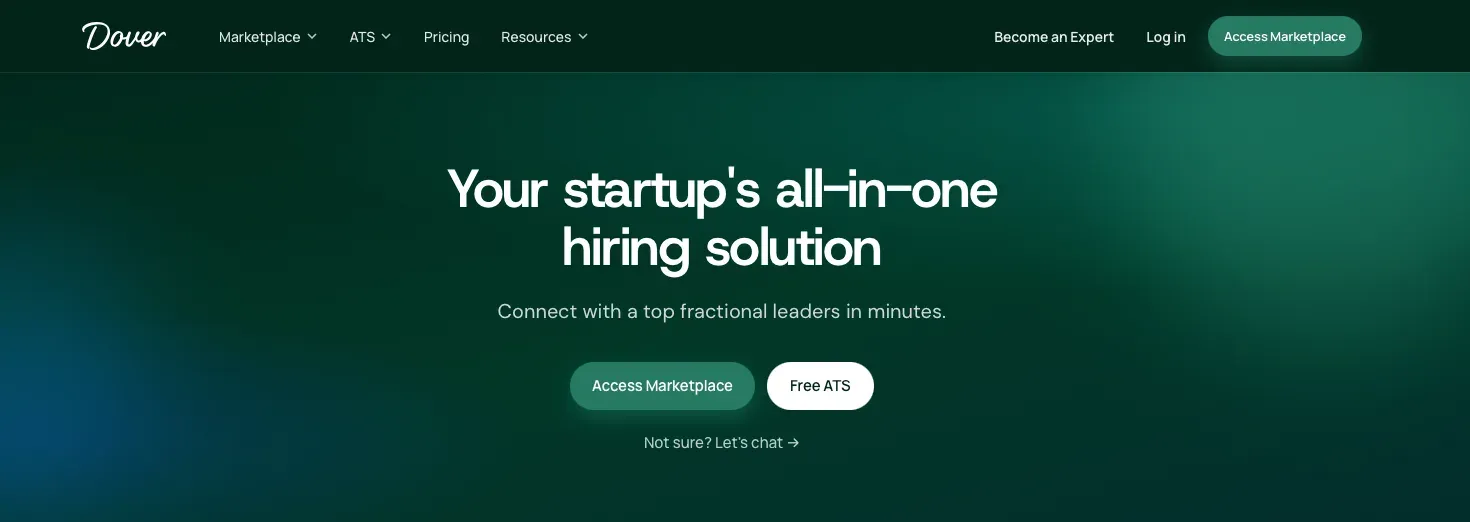
Dover’s free ATS supports unlimited jobs and users, takes under five minutes to configure, and operates as a shared system, so a fractional recruiter from Dover’s marketplace works inside the same pipeline your hiring team already sees, with no handoff overhead or duplicate outreach. That shared visibility is what makes the combined model functional rather than just convenient.
When the freeze lifts, founders can pair the ATS with a fractional recruiter from Dover’s marketplace without signing a contract or committing to a retainer. Getting started takes an $800 refundable deposit, and a typical per-hire cost runs $2,000 to $7,000, varying by role seniority and complexity. One recruiter builds role and culture context over time instead of running a parallel search alongside other recruiters working the same opening, a structural difference that matters more after a freeze, when the first few hires need to land well and stick. The start-or-stop model fits the unpredictable volume that comes out of a pause: run one search, close it, and re-engage when the next role opens without penalty.
FAQs
What should a startup founder do during a hiring freeze to be ready when it ends?
Use the pause to build the recruiting infrastructure you never have time to set up during an active search: update job descriptions, create evaluation scorecards for priority roles, configure a careers page, and get an ATS running with stage definitions and email templates. Founders who do this work during the freeze restart hiring with a functioning system instead of scrambling to build one while searches are already open.
How do I keep candidates warm during a hiring freeze without implying an offer is coming?
Send a brief, direct check-in every four to six weeks: share a product update, a press mention, or a note on team progress, but do not signal that an offer is imminent. Focus on candidates who reached a second or third round, since they have already invested time and are more likely to re-engage when hiring resumes. Candidates who feel respected during a pause often stay available; those who hear nothing typically move on to other offers while you are silent.
Do I need a recruiter if I’m already using an ATS?
An ATS organizes your pipeline: tracking candidates, staging interviews, and keeping your team aligned. What it doesn’t do is source candidates or bring outreach expertise to senior and specialized roles. When inbound volume is strong and your team has bandwidth, the ATS alone covers the workflow. When the role is senior, the search is specialized, or multiple searches are open at once, a fractional recruiter plugs in as the sourcing layer on top of that infrastructure. The two address different parts of the hiring problem.
Final Thoughts on Surviving and Preparing During a Hiring Freeze
The companies that come out of a hiring freeze in good shape are not the ones that simply waited. They kept candidate relationships alive, fixed the recruiting infrastructure that nobody had time to touch during active searches, and thought carefully about which roles to fill first. That preparation compounds quickly once hiring resumes, and the model that fits depends on your hiring volume, how predictable your roadmap is, and whether you need just pipeline tracking or dedicated recruiting support built in. Dover is one place to start: a free ATS paired with on-demand fractional recruiters, no retainer required.