

Choosing between RPO recruiting and fractional recruiting sounds like a vendor decision, but it’s really a question about where your company is right now. The two models look similar on the surface, but they’re priced and structured for completely different hiring realities, and picking the wrong one creates friction that compounds over time.
TLDR:
-
RPO outsources your full hiring function to an embedded provider; it typically requires 50+ hires/year (a general industry threshold) to support retainer fees of $10,000 to $50,000/month.
-
Fractional recruiting bills for time worked, averaging about $4,000 per hire, with no contract required and a minimum viable volume of 5 to 15 hires/year.
-
Both models own the full hiring cycle and operate inside your systems; the difference is commitment structure and cost at lower volumes.
-
RPO makes economic sense post-Series B when hiring is continuous and role types are repeatable across departments.
-
Some tools pair free ATS software with on-demand recruiting support billed for time worked instead of fixed retainers, averaging $2,000 to $7,000 per hire.
What Is RPO Recruiting?
RPO stands for Recruitment Process Outsourcing: an arrangement where a company hands off part or all of its hiring function to an external provider, who operates as an embedded extension of the internal team instead of a vendor working at arm’s length.
The distinction from a staffing agency matters. A staffing agency finds candidates and places them, then moves on. An RPO provider takes ownership of the recruiting process itself: job scoping, sourcing, screening, scheduling, and often offer management. They work inside your systems, under your employer brand, and are accountable for outcomes across the full hiring cycle. Temp firms, by contrast, supply workers for defined periods without transferring process ownership.
The Four Main RPO Models
RPO engagements aren’t one-size-fits-all. The model you choose shapes how deeply the provider embeds, how long the engagement runs, and how much process control you hand over.

RPO Pricing Models and What They Actually Cost
RPO providers rarely publish pricing. Three structures cover most engagements: a fixed monthly management fee (common in enterprise contracts where hiring is continuous), cost-per-hire (charged only when a role fills), and a hybrid of both. The hybrid is the most common structure according to some industry analysts, splitting volume risk between client and provider.
In practice, RPO providers price based on volume, role complexity, and engagement length. Per-hire fees range from a few thousand dollars for high-volume entry-level roles to $15,000 or more for senior positions, with enterprise management fees running $10,000 to $50,000 per month.
Who RPO Is Right For
RPO is built for organizations that hire consistently at high volume. The typical fit is a mid-market or enterprise company running 50 or more hires per year as a general rule, where the cost of maintaining internal recruiting infrastructure starts to exceed the cost of outsourcing it. Healthcare systems, financial services firms, and manufacturers with distributed locations are recurring RPO buyers for this reason.
Companies undergoing rapid geographic expansion also benefit. When headcount targets jump considerably over 12 to 18 months, an RPO provider can deploy sourcing infrastructure faster than an internal team can be assembled. The global RPO market, according to Grand View Research, is projected to grow from $14.2 billion in 2026 to $31.5 billion by 2033 (though figures vary by methodology and source), partly driven by organizations scaling faster than their HR functions can keep up.
RPO fits poorly for smaller teams. A startup hiring 5 to 15 roles per year will rarely offset the management fees, long contracts, and ramp time that most RPO engagements require. The per-hire economics only improve at scale, and early-stage companies typically need flexibility that RPO contract structures don’t accommodate well.
What Is Fractional Recruiting?
Fractional recruiting puts an experienced recruiter inside your team on a part-time basis. They work under your employer brand, inside your systems, and own the full hiring cycle: sourcing, screening, scheduling, and closing. The engagement is ongoing, and the recruiter builds context about your team, culture, and hiring bar over time.
The structural difference from a staffing agency is straightforward. An agency gets paid on placement and moves to the next client. A fractional recruiter is accountable for the process and the outcome, with no financial incentive to rush a hire or push a candidate who isn’t the right fit.
The difference from RPO is subtler but consequential. RPO is built for organizations running hiring at continuous volume, with corresponding contract commitments and ramp periods. A fractional recruiter operates on an hourly, on-demand basis with no long-term contract required. You engage them when hiring is active and step back when it isn’t.
Fractional recruiters also tend to work across a small number of clients at once, which creates a practical advantage: real-time exposure to what sourcing approaches, compensation structures, and candidate messaging are working across companies right now.
RPO vs. Fractional Recruiting: Head-to-Head Comparison
The two models share more than they differ on paper. Both embed an external recruiter inside your process, both operate under your employer brand, and both own the hiring cycle end-to-end. The divergence is in commitment and economics.

| Dimension | RPO | Fractional Recruiting |
|---|---|---|
| Contract structure | Long-term retainer or fixed engagement | No contract; engage by the hour |
| Minimum viable volume | 50+ hires/year to support fees | 5 to 15 hires/year |
| Cost structure | Management fee + per-hire, or hybrid | Billed for time worked; avg. ~$4,000 per hire |
| Speed to productivity | Weeks to months to ramp | Days; recruiter integrates immediately |
| Process ownership | Full cycle, embedded in your systems | Full cycle, embedded in your systems |
| Pipeline data ownership | Stays in your ATS if scoped correctly | Stays in your ATS |
| Flexibility | Limited; contract terms govern scope changes | High; scale up or stop anytime |
RPO is priced for volume; the fee structures only make sense when hiring is continuous enough to amortize a retainer. Fractional recruiting charges by the hour, so a company hiring eight engineers this quarter pays for exactly the hours that search requires. Most RPO engagements require months-long commitments with defined minimums, and changing scope mid-engagement typically involves renegotiation. Fractional arrangements carry no such inertia: if a search closes fast, you stop, and if priorities shift, you redirect.
One structural requirement makes both models work cleanly: a shared ATS where the recruiter and the internal team operate in the same system. Without it, pipeline visibility breaks down. Hiring managers lose sight of where candidates are, duplicate outreach happens, and the recruiter’s sourcing notes stay locked in a separate tool when the engagement ends. Both RPO and fractional recruiters typically work inside the client’s own ATS for this reason; the question is whether that infrastructure exists before the engagement starts.
The Cost Comparison: What Each Model Charges
Per SHRM’s 2025 benchmarking data, the average non-executive cost per hire is $5,475 across all hiring methods, a figure widely cited across recruiting industry sources. Both RPO and fractional recruiting can land well above or below that figure depending on volume and engagement structure.
RPO management fees for enterprise engagements typically run $10,000 to $50,000 per month before any per-hire component. At 20 hires annually, a $15,000/month retainer works out to $9,000 per hire in overhead before a single placement fee is added. Traditional contingency agencies charge 15 to 25% of first-year salary, meaning an $18,000 to $30,000 agency fee vs. in-house recruiting cost on a $120,000 role regardless of search length.
Fractional recruiting bills for time worked, with many searches closing in 20 to 30 hours of recruiter time, though complexity and role type affect that range. Hires through Dover’s marketplace average about $4,000 all-in, with no retainer attached. For a startup filling several roles per quarter, that difference compounds quickly against either the agency or enterprise RPO model.
When Fractional Recruiting Makes More Sense
Fractional recruiting fits best when the conditions that make RPO viable aren’t present. Three signals point that way.
Volume is low or uneven. If you’re filling 5 to 15 roles per year, a management fee built for 50-plus annual hires becomes an expensive fixed cost. Fractional recruiters charge by the hour, so you pay only for active search time.
You need continuity, not team capacity. A fractional recruiter embeds directly, learns your hiring bar, and carries that knowledge search to search. With a shared ATS, pipeline data and candidate history stay in a system the company owns. When the engagement ends, the institutional knowledge stays too.
Your headcount plan could shift. RPO contracts are built around predictability. A fractional arrangement lets you pause or redirect without renegotiating scope. For startups between founder-led hiring and a full-time recruiting hire, typically fewer than 15 to 20 roles per year, where RPO recruiting is out of reach on volume, fractional support is the practical choice.
How Dover Fits Into Fractional Recruiting
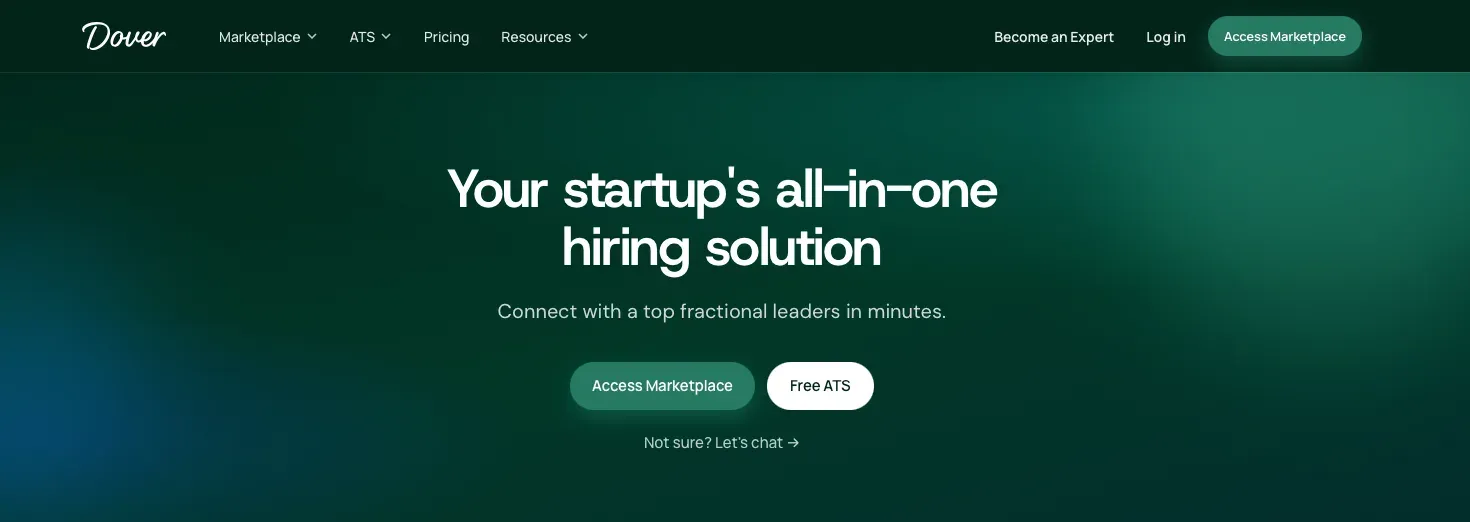
For startups filling fewer than 50 roles per year, the gap between a self-serve ATS and a full RPO commitment is where most providers aren’t built to help. Dover is the infrastructure layer fractional recruiting agencies are built on: a free ATS combined with a vetted recruiter network, giving companies full-cycle recruiting support without the retainer structure that makes RPO impractical at lower volumes.
Dover pairs a free ATS for startups with a network of experienced fractional recruiters who bill for time worked, typically $2,000 to $7,000 per hire with no retainer or long-term contract required. Recruiters in the network carry verified reviews, including published cost-per-hire data and client feedback for each recruiter, so companies can assess fit before committing. That pricing and transparency structure makes full-cycle recruiting support accessible without the commitment model that makes RPO impractical at smaller scale.
The ATS is the foundation that makes this work cleanly: all sourcing activity, pipeline data, and candidate history accumulate in the client’s own system, not the recruiter’s. When a search closes, that intelligence stays with the company rather than disappearing with the vendor. Because fractional recruiting agencies using Dover work inside this same shared ATS, hiring managers get real-time visibility into recruiter activity as it happens, with no status-update emails and no coordination overhead from external systems running in parallel.
Getting started requires an $800 fully refundable deposit. The free ATS sets up in under five minutes, distributes job postings to over 50 boards, and gives the recruiter and your internal team a shared system from day one.
FAQs
What’s the difference between RPO and fractional recruiting for a startup hiring fewer than 20 roles per year?
Fractional recruiting is almost always the better fit at that volume. RPO pricing structures, which typically involve monthly management fees of $10,000 to $50,000 plus per-hire components, only make economic sense when hiring runs continuously at 50 or more roles per year. Fractional recruiters bill for time worked, so a startup filling 10 to 15 roles annually pays only for active search time instead of carrying a fixed retainer through slower months.
Should I use an RPO provider or a fractional recruiter if my headcount plan could shift with a funding round?
A fractional recruiter is the more practical choice when your hiring plan is subject to change. RPO contracts are structured around predictability, and adjusting scope mid-engagement typically requires renegotiation. Fractional arrangements carry no such inertia: if a search closes early or priorities shift, you can pause or redirect without contractual friction, which is why most seed and Series A startups are better served by fractional support until hiring volume stabilizes at the post-Series B level where RPO economics begin to work.
Do I need a fractional recruiter if I’m already using an ATS?
An ATS manages your pipeline, candidate data, and scheduling logistics, but it doesn’t source, screen, or close candidates. For companies filling a handful of straightforward roles per year, the ATS alone may be enough. Once a role requires active sourcing into passive candidate pools, or recruiting is consuming 10-plus hours per week, the ATS is the infrastructure layer, not the recruiting function. A fractional recruiter plugs in on top of it: they work inside your existing ATS, bring the sourcing and relationship work software doesn’t do, and leave no candidate history behind when the engagement ends.
Final Thoughts on RPO Recruiting, Fractional Hiring, and Finding the Right Fit
Both RPO recruiting and fractional recruiting solve the same core problem: getting experienced recruiting support without building a full in-house function. The difference is in the commitment level each model requires. Your hiring volume, contract flexibility needs, and stage will point you toward one or the other more clearly than any feature comparison will. For startups and early-stage teams where RPO volume thresholds aren’t met, Dover offers full-cycle fractional recruiting support with no retainer: an ATS, a recruiter marketplace, and a per-hire cost that scales with your actual hiring activity.