
Most founders know hiring is critical, but when growth picks up, the question becomes how to scale it without losing speed or control. Should you hire an in-house recruiter, pay agency fees for every placement, or try recruitment process outsourcing? The options sound similar on the surface, yet the cost structures, incentives, and long-term impact on your team are very different. In this guide, we break down what recruitment process outsourcing actually means, how it compares to traditional staffing agencies, and when flexible solutions make sense for your startup.
TLDR:
-
RPO hands off part or all of your recruiting to an external provider who acts as your team.
-
Companies can save 30-40% on hiring costs versus agencies, typically $2K-$7K per hire versus $20K-$30K.
-
RPO works best when scaling fast, filling 10+ roles, or hiring specialized talent your team can’t source.
-
RPO recruiters work as embedded team members, aligning with your hiring managers and representing your brand like in-house recruiters.
-
Some solutions offer RPO benefits with vetted fractional recruiters at $2K-$7K per hire plus a free ATS.
What Is RPO (Recruitment Process Outsourcing) Recruiting?
Recruitment process outsourcing is a hiring model where you hand off part or all of your recruiting function to an external provider. Instead of building an in-house recruitment team or calling up an agency for a single role, you partner with an RPO provider who acts as an extension of your company.
The RPO provider takes ownership of your recruitment process from start to finish. They handle sourcing candidates, screening resumes, conducting initial interviews, managing your applicant pipeline, and sometimes even onboarding new hires. They work under your employer brand, follow your hiring criteria, and integrate with your team.
How RPO Works and Common Service Models
RPO providers work with companies in different ways based on how much help you need and which recruiting tasks you want to hand off. RPO can cover full-cycle recruiting, specific tasks like sourcing, or on-demand support during hiring sprints.
RPO vs. Traditional Staffing Agencies: Understanding the Difference
The split comes down to how recruiters work with your company. Staffing agencies operate on placement fees, submitting candidates from their network and billing 20-30% of first-year salary when someone gets hired. They juggle multiple clients at once, which pushes them toward quick closes and high volume.
RPO recruiters join your team instead. They typically focus on your roles during the engagement, learning your culture and building candidate pipelines over time. You pay through retainer or hourly fees instead of per placement. This model means they attend your team meetings, use your hiring tools, and represent your company like an in-house recruiter would.
The cost difference matters most when scaling. Agencies charge per hire regardless of time spent. RPO can spread costs across a longer engagement, which may lower your average cost per hire when filling multiple positions. Pick agencies for one-off senior searches. Pick RPO when you need consistent recruiting support over months.
| Feature | Traditional Staffing Agency | RPO Provider | Dover Recruiter Marketplace |
|---|---|---|---|
| Cost Per Hire | $20,000-$30,000 (20-30% of first-year salary) | $2,000-$7,000 per hire through retainer or project fees | $2,000-$7,000 per hire with hourly fractional recruiters |
| Engagement Model | Per-placement fee, transactional relationship | Long-term contract, embedded team member | Flexible hourly model, no long-term contracts required |
| Recruiter Focus | Works with multiple clients simultaneously, focuses on quick placements | Dedicated to your company during engagement, learns your culture | Vetted fractional recruiters work as an extension of your team |
| Technology Included | Uses their own systems, limited integration with your tools | Often includes ATS, sourcing tools, and reporting dashboards | Free ATS with sourcing tools included in one platform |
| Best Use Case | One-off senior searches or urgent single role fills | High-volume hiring, scaling teams, 10+ roles over time | Variable hiring needs, startups with fluctuating volume |
| Scalability | Limited, requires engaging multiple agencies for volume | Scales with your hiring needs through dedicated team | Scales up or down by the hour based on current needs |
| Brand Representation | Represents their own agency brand to candidates | Represents your employer brand, attends team meetings | Works as your team, represents your company to candidates |
Key Benefits of Recruitment Process Outsourcing for Growing Companies
RPO tackles the hiring pressures that hit growing companies hardest. You get recruiting capacity that scales when building a new team and flexes down during quieter periods, without hiring or laying off internal recruiters.
The financial difference shows up quickly. Companies report 30-40% cost savings by outsourcing recruitment versus using agencies or staffing full in-house teams. You pay for hours worked instead of placement fees or full-time salaries with benefits.
Speed counts when competing for talent against larger companies. RPO recruiters fill roles faster through their sourcing networks and dedicated focus. They’ve spent years building talent pipelines and know where to find candidates in your space.
You also get recruiting tech you might not buy on your own. Many RPO providers include ATS software, assessment tools, and reporting, depending on the engagement model. This translates to better candidate tracking, visibility into what’s working, and a smoother experience that improves your employer brand.
The RPO Market Growth and Adoption Trends
The global RPO market reached $7.33 billion in 2022 and projections show it hitting $24.32 billion by 2030. That’s a 16.1% annual growth rate over the next several years.
Several forces are pushing companies toward RPO. Ongoing labor shortages make it harder to fill roles without dedicated recruiting resources. The competition for specialized skills in tech, healthcare, and other fields means you need recruiters who know these markets. Companies also want to focus internal resources on their core business instead of building recruiting infrastructure.
Tech integration plays a role too. RPO providers bring recruiting software and data analytics that smaller companies wouldn’t buy separately. Both small businesses and large enterprises are adopting RPO to compete for talent without expanding headcount.
When Should Your Company Consider RPO?
RPO works best when you face specific recruiting challenges that your current setup can’t solve.
If you just closed a funding round and need to double headcount within 12 months, your existing team probably can’t keep up. Bringing on recruiters takes time, and you’ll lose months to hiring and training. RPO gives you recruiting capacity that scales with your growth immediately.
High-volume hiring across multiple roles or geographies also calls for RPO. Filling 10+ positions at once requires dedicated sourcing and pipeline work. A small internal team gets overwhelmed. RPO providers staff up to match your volume.

Specialized roles like your first data scientist or head of sales need market knowledge your team may lack. RPO recruiters who’ve filled similar positions know where to source candidates, what comp looks like, and how to close them.
When slow time-to-fill costs you offers or delays product launches, RPO can speed things up through focused attention and proven sourcing channels.
Finally, if your hiring fluctuates by quarter, paying for full-time recruiters year-round makes little sense. On-demand RPO lets you pay only when you’re actually hiring.
RPO Pricing Models and Cost Structure
RPO pricing varies by provider and the scope of recruiting support you need. Monthly retainers charge a flat fee covering agreed-upon roles or hiring volume. Cost-per-hire models bill for each completed placement, similar to agencies but at lower rates. Hourly arrangements let you pay for time spent on recruiting activities, scaling costs with actual work done.
Most companies spend $2,000-$7,000 per hire through RPO providers versus $20,000-$30,000 in traditional agency fees. Pricing depends on role complexity, hiring volume, and service scope. Executive searches cost more than high-volume entry-level recruiting. For startups looking to control costs while accessing expert recruiting help, hourly fractional recruiters offer flexibility without long-term commitments.
How to Choose the Right RPO Provider for Your Organization
Look for providers who’ve worked with companies at your stage and in your industry. An RPO partner who’s filled technical roles at Series A startups faces different challenges than one recruiting for Fortune 500 enterprises. Ask for case studies and references from similar companies.
Check their tech stack. You want a provider with an ATS that integrates with your tools, sourcing software that reaches passive candidates, and reporting dashboards that show real-time metrics. Ask to see their recruiting tools during initial calls.
Cultural fit matters more than most companies realize. Your RPO recruiters will represent your employer brand to candidates. Talk through their communication style, values around candidate experience, and how they handle feedback. Get a sense of whether they’ll mesh with your team.
Transparency separates strong providers from weak ones. Ask to see their average time-to-fill by role type, candidate-to-interview ratios, and offer acceptance rates. Good providers share performance data upfront. Watch out for vague promises without numbers backing them up.
Match the pricing model to your hiring patterns. Retainers work when you have consistent volume. Hourly rates make sense when hiring fluctuates month to month.
Dover’s Recruiter Marketplace: A Flexible Alternative to Traditional RPO
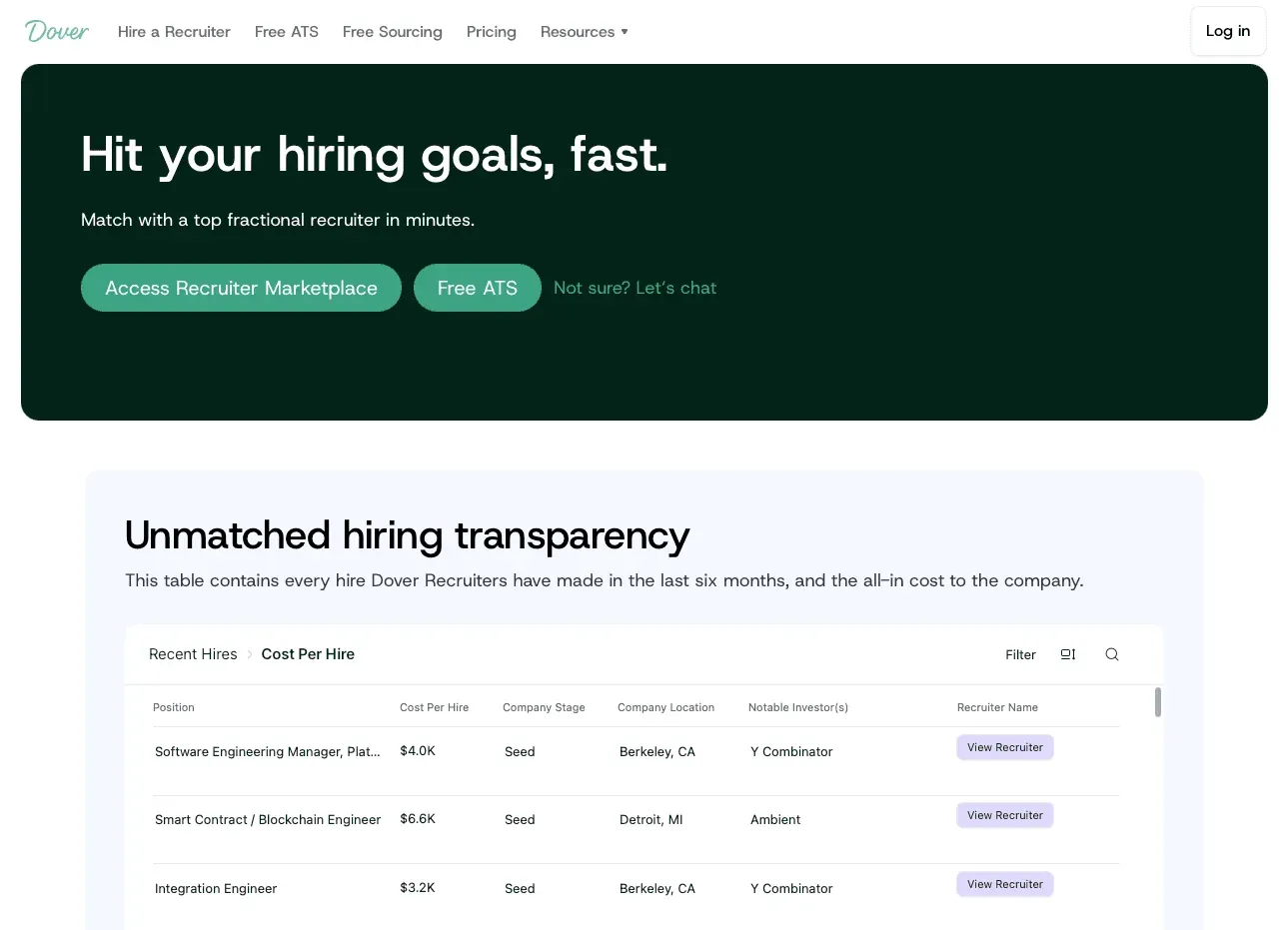
Dover’s Recruiter Marketplace gives startups RPO benefits without the long-term contracts or enterprise pricing. You get vetted fractional recruiters who work by the hour, scaling up when you’re hiring and down when you’re not.
Cost-per-hire through Dover typically runs $2,000-$7,000 compared to $30,000+ agency fees. You choose which recruiters match your needs from our marketplace, and they work as an extension of your team on sourcing, screening, and closing candidates.
The difference from RPO? We pair recruiting expertise with our free ATS and sourcing tools, so you get both the human help and software in one place. You get RPO scalability and cost savings in a model that fits startup budgets and hiring patterns.
Dover vs. RPO: A Buyer’s Guide for Startups
If you are actively comparing an RPO contract against a fractional recruiting marketplace, the decision usually comes down to how predictable your hiring is over the next two quarters. RPO rewards volume and consistency. Fractional support rewards teams whose headcount plans shift.
| Traditional RPO | Dover’s Recruiter Marketplace | |
|---|---|---|
| Commitment | Multi-month or annual contract | No contract; engage per role |
| Pricing | Monthly retainer or per-hire fee | Hourly, $75-$125 per hour |
| Typical cost per hire | $2,000-$7,000 | $2,000-$7,000 |
| Scaling down | Renegotiate or wait out the term | Pause when you stop hiring |
| Recruiter selection | Assigned by the provider | You pick from vetted recruiters |
| Software included | Varies; often your own ATS | Free ATS and sourcing tools |
| Best fit | Steady, high-volume hiring | Bursty, early-stage hiring |
Questions to ask before you sign
Whichever model you choose, the diligence is the same. Ask these before committing:
-
What happens if we pause hiring? Get the exit terms in writing. This is where annual RPO contracts hurt startups whose plans change mid-term.
-
Who is actually doing the work? Ask to meet the recruiter on your roles, not just the account lead. Confirm their experience at your stage and in your function.
-
What does the per-hire number include? Clarify whether sourcing tools, job board spend, and assessment software are billed separately.
-
Who owns the candidate data? Confirm you keep your pipeline and can export it if the engagement ends.
-
What performance data will we see? Ask for time-to-fill by role type, candidate-to-interview ratios, and offer acceptance rates, reported on a set cadence.
For most startups hiring fewer than ten roles a year, the flexibility of hourly fractional support outweighs the volume discounts an RPO retainer can offer. Once hiring becomes steady and predictable, running the numbers again is worth it.
Frequently Asked Questions
When should startups consider using RPO instead of hiring an in-house recruiter?
You should consider RPO when you need to hire quickly after funding, fill 10+ positions at once, or have fluctuating hiring needs that don’t support full-time recruiter salaries year-round. It’s also smart for specialized roles your team hasn’t recruited for before.
What’s the main difference between full-cycle RPO and on-demand RPO?
Full-cycle RPO covers your entire recruiting process (job descriptions through offers) and works best for high-volume hiring, while on-demand RPO gives you recruiting help only when needed with no long-term contract, popular with startups that have variable hiring patterns.
How is Dover’s Recruiter Marketplace different from traditional RPO?
Dover matches you with vetted fractional recruiters who work hourly ($2,000-$7,000 per hire) without long-term contracts, and includes a free ATS with sourcing tools in one place, giving you RPO benefits at startup-friendly pricing.
Final Thoughts on Building Your Recruiting Strategy
Recruitment process outsourcing makes the most sense when hiring starts to outpace your internal capacity or when you need expertise your team does not yet have. If you are scaling after a fundraise, building out a new function, or hiring for specialized roles, bringing in external recruiting support can help you move faster without committing to full-time headcount too early. The key is choosing a model that fits your volume, budget, and growth plans. If you are weighing your options, take a look at how Dover approaches recruitment process outsourcing and flexible recruiting support here to see what makes sense for your next stage of hiring.
-recruiting-hero-ba99639a.zcrlfqTR_Z1g1uIg.webp)