

RPO (Recruitment Process Outsourcing) providers take on part or all of your recruiting function, working inside your process instead of sending over candidates like a staffing agency would. The model fits specific hiring situations, like scaling quickly without a full-time recruiter or managing unpredictable hiring volume, but it isn’t the right fit for every company. Here’s what RPO is, how the models and pricing structures work, and when it makes sense to outsource your recruiting.
TLDR:
- RPO (Recruitment Process Outsourcing) means handing some or all hiring tasks to an outside provider who works as part of your team.
- RPO can shorten time-to-hire and lower recruiting costs compared with traditional agencies, mainly because pricing ties to scope or hours instead of per-placement fees.
- RPO works best for companies making 20+ hires annually with unpredictable hiring needs or lacking internal recruiters.
- Some modern solutions offer fractional recruiters with no contracts, averaging about $4,800 per hire (costs vary by role and recruiter) versus $18,000 to $30,000 in agency fees on a $120,000 role (15% to 25% of first-year salary).
- RPO providers embed inside your hiring process and often work directly in your ATS alongside your internal team.
What Is RPO (Recruitment Process Outsourcing)?
RPO stands for Recruitment Process Outsourcing, a hiring model where a company hands over some or all of its recruiting function to an external provider that acts as an extension of its internal talent team.
The scope goes beyond filling open roles. An RPO provider can manage candidate sourcing, resume screening, interview coordination, offer management and negotiation, and sometimes onboarding.
What separates RPO from other recruiting services is the partnership structure. RPO providers embed themselves in your hiring process. They learn your company culture, understand your long-term talent needs, and often use your employer brand in their outreach.
This integrated approach means RPO providers are accountable for your hiring success over months or years, instead of individual placements. The global RPO market is projected to grow from about $9.7 billion in 2024 to $22.9 billion by 2030, a 15.4% compound annual growth rate, according to Research and Markets RPO projections. The U.S. market alone sits at roughly $3.5 billion in 2024.
How RPO Works
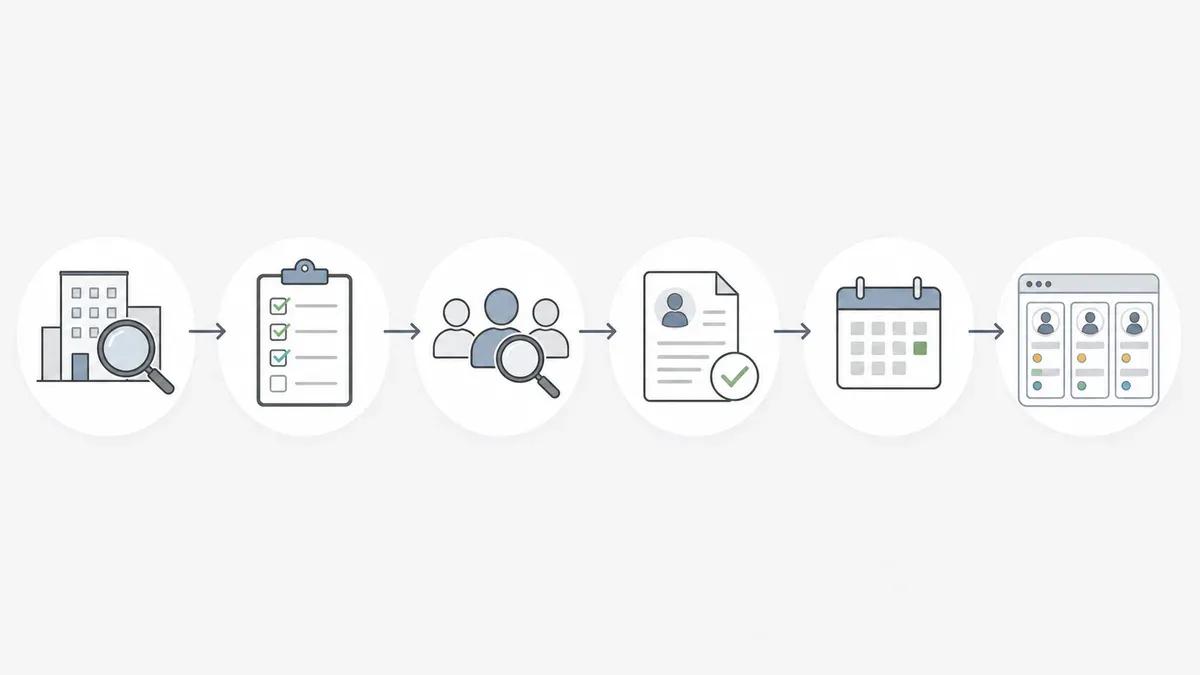
An RPO engagement starts with discovery, which usually runs a few weeks, where the provider learns your business, hiring goals, and current recruiting challenges. This includes reviewing hiring data, understanding how teams are structured, and spotting bottlenecks in your process. Sourcing typically begins once role scorecards, interview steps, and hiring manager expectations are agreed on.
Once live, the RPO team handles day-to-day recruiting tasks like sourcing candidates, conducting screenings, scheduling interviews, and updating hiring managers on pipeline progress. Most work directly in your ATS so internal stakeholders have full visibility.
How RPO Differs from Staffing Agencies
The terms get used interchangeably, but RPO and staffing agencies solve different hiring problems.
Staffing agencies work on a placement basis. You pay them a fee (usually 15 to 25 percent of the candidate’s first-year salary) for each successful hire. The placement is typically complete once the candidate starts, although many agencies offer a replacement guarantee period.
RPO providers take responsibility for managing parts or all of your hiring process over time. Because RPO pricing ties to project scope or retained hours instead of individual placements, it can cost less than per-placement agency fees for teams that hire steadily.
Types of RPO Models
Full-cycle RPO means outsourcing your entire recruiting operation. The provider handles everything from creating job descriptions and sourcing candidates to screening applicants, coordinating interviews, extending offers, and sometimes onboarding. This model works for companies that want to completely replace an internal recruiting function or don’t have one yet.
Project-based engagements focus on specific hiring initiatives with clear start and end dates. Think rapid headcount expansion, opening a new office, or launching a product team from scratch. The RPO provider steps in for the duration of the project, then steps back when hiring volume returns to normal.
On-demand models give you flexible recruiting support that scales with your needs. You can dial support up during busy hiring periods and down when things slow. This works well for companies with unpredictable hiring cycles or seasonal volume swings.
Hybrid models let you outsource specific recruiting functions while keeping others in-house. You might hand off sourcing and candidate screening but keep final interviews and offers internal. This gives you control over candidate experience while offloading time-intensive tasks.
| RPO Model | Best For | Typical Duration | Cost Structure |
|---|---|---|---|
| Full-cycle RPO | Companies replacing entire recruiting function or scaling rapidly without internal recruiters | 12+ months | Monthly retainer based on hiring volume |
| Project-based RPO | New office openings, product launches, or one-time expansion initiatives | 3-6 months | Fixed project fee or milestone-based payments |
| On-demand RPO | Unpredictable hiring patterns or seasonal volume fluctuations | Flexible | Variable monthly fees tied to active recruiting hours |
| Hybrid RPO | Companies wanting to keep candidate evaluation internal while outsourcing sourcing and screening | 6-12 months | Blended retainer plus per-function fees |
Key Benefits of RPO
RPO can deliver measurable improvements in hiring speed and quality. RPO can help teams hire faster and improve hire quality, since these gains typically come from providers who specialize in recruiting full-time, not hiring managers juggling it alongside their other work.
The cost structure differs from traditional agency models. Instead of paying percentage-based fees per placement, RPO pricing ties to scope and hours. This shift removes the incentive to rush placements and creates alignment around hiring the right people instead of filling seats quickly.
RPO providers that stay current on employment law can build compliance checks into sourcing, screening, and offer stages. This can reduce legal risk for companies hiring at volume or expanding into new states.
Many startups wait to hire a full-time recruiter until they expect to make roughly 15 to 20 hires annually. RPO gives smaller teams access to recruiters with years of experience sourcing for specific roles and industries without the overhead of a full-time hire.
RPO Pricing Models Explained
RPO pricing varies based on engagement scope and the provider’s business model. Understanding these structures helps you predict recruiting costs and compare options.
Management fee models charge a fixed monthly retainer to cover a defined scope of work, like managing all engineering hires or supporting 10 roles per quarter. The fee stays consistent regardless of how many candidates you actually hire that month. This creates predictable budgeting but requires accurate forecasting of your hiring needs upfront.
Cost-per-hire pricing ties fees to completed placements. You pay when someone accepts an offer and starts. This reduces upfront risk since you only pay for results, though it can create misaligned incentives around hiring speed versus fit.
Cost-per-slate models charge for delivering qualified candidate shortlists instead of completed hires. You pay the provider to present vetted candidates per role, then your team handles final interviews and offers. This works when you want to keep candidate evaluation in-house while outsourcing time-intensive sourcing work.
Hybrid structures combine elements from different models, like a base retainer plus per-hire bonuses.
When Companies Should Consider RPO
RPO makes the most sense when you’re hiring at scale but don’t have the internal recruiting muscle to keep up. If you’re planning to make 20+ hires in the next year but don’t have a dedicated recruiter, RPO can fill that gap without the overhead of a full-time hire.
Companies with unpredictable hiring patterns also benefit. If you need to hire five engineers this quarter and zero next quarter, maintaining full-time recruiting capacity wastes money. RPO lets you match recruiting spend to actual hiring activity.
Another trigger is poor hiring outcomes. If your time-to-fill keeps stretching past 60 days or hiring managers complain about candidate quality, bringing in specialized recruiting expertise can fix broken processes faster than trying to solve it internally.
When RPO Might Not Be the Right Fit
- Low hiring volume: companies making fewer than 15 to 20 hires a year often pay more for RPO than the model returns in value.
- Highly specialized or executive searches that need deep niche expertise an RPO team may not have built up.
- Teams that want full control over every candidate touchpoint, from first outreach to final offer.
- One-off hires that a single contingency recruiter can fill without the setup an RPO engagement requires.
How to Select the Right RPO Provider
Start by asking whether the provider understands companies at your stage. RPO firms that specialize in enterprise hiring often struggle with startup pace and ambiguity. Look for providers with a track record hiring similar roles in similar environments.
Request performance data from past engagements. Ask about average time-to-fill for roles like yours, candidate-to-interview ratios, and offer acceptance rates. Providers should share metrics freely if they’re confident in their results.
Cultural alignment matters more than most founders expect. The RPO team will represent your employer brand to candidates. If their communication style or values don’t match yours, that disconnect shows up in candidate experience and hiring outcomes.
Tech integration determines workflow friction. Confirm the provider can work directly in your ATS or recruiting tools instead of forcing you to adopt theirs. Switching systems mid-process creates data silos and coordination headaches.
The same logic applies to fractional recruiters. Outside recruiters typically work best when they and your hiring team share one ATS, so everyone sees the same pipeline in real time, feedback lands in one place, and two people don’t contact the same candidate. If you don’t have an ATS yet, setting one up before bringing in outside recruiting help can cut coordination overhead later.
Contract terms reveal how providers think about risk-sharing. Watch for long commitment periods, restrictive exclusivity clauses, or opaque fee structures.
Ask how they vet and train recruiters, and how they handle workforce planning, employer branding, and job advertising. Strong providers use your growth plans and market trends to anticipate hiring needs so roles get staffed before they turn urgent. Also ask about employer branding and job advertising, since job ads and campaigns that reflect your values can improve applicant volume and quality.
How Dover’s Recruiter Marketplace Works
Dover approaches fractional recruiting differently. Instead of long contracts or monthly management fees, we connect you with experienced recruiters who work hourly as an extension of your team.
On average, companies spend about $4,800 per hire working with Dover recruiters, though costs vary by role and recruiter since each sets their own rates. Because cost per hire is hours worked times the recruiter’s hourly rate, you pay for actual time invested, compared with agency per-hire fees or RPO retainers that lock in costs upfront.
You choose which recruiter to work with based on their background and track record. They work directly in Dover’s free ATS alongside your internal team, giving everyone real-time visibility into sourcing activity and candidate pipeline. The model gives you RPO-style outcomes, including cost savings and the ability to scale hiring up or down, with no contracts, minimum commitments, or system migrations. You can start with a 100% refundable deposit that goes toward your recruiter’s work and stop whenever your hiring needs change.
FAQs
How is RPO different from working with a recruiting agency?
RPO providers embed in your recruiting process and take ownership of hiring outcomes over time, working inside your systems and reporting to your leadership like an internal team. Recruiting agencies work transactionally, submitting candidates from outside your process and collecting a per-hire fee (usually 15 to 25 percent of salary) when someone gets hired.
Do I need a recruiter if I already use an ATS?
It depends on hiring volume and role difficulty. An ATS organizes applicants, interview stages, and feedback, but it does not source candidates or run outreach for you. Teams hiring a few roles a year with steady inbound applicants can often manage with the ATS alone, while hard-to-source, senior, or specialized roles, or a team with no recruiting bandwidth, usually call for a fractional recruiter or RPO provider working on top of the ATS.
Do I need an ATS before bringing in an RPO provider or fractional recruiter?
It often helps. Most RPO providers and fractional recruiters can work inside your existing ATS, and a shared system gives hiring managers and outside recruiters the same view of every candidate, stage, and note. Teams without one may end up tracking candidates across spreadsheets and email threads, which can slow handoffs. Some providers, including Dover, pair a free ATS with on-demand recruiters so the software and the recruiting capacity live in one system from the start.
Final Thoughts on RPO for Startups
RPO (Recruitment Process Outsourcing) works well for teams that need recruiting support at scale, though long retainers and fixed fees can be too rigid for early-stage companies with unpredictable hiring volume. Dover’s fractional model offers a comparable level of support (a free ATS paired with hourly recruiters and no long-term commitments) for teams that want flexibility alongside the outcomes.