

Finding a recruiter who can fill administrative and executive-support roles is only half the problem for most startup founders. The other half is figuring out whether a boutique specialist can handle the full range of functions a growing company needs at the same time. Most seed-stage and Series A teams are hiring across engineering, sales, and operations simultaneously, and a single-function agency rarely covers that range. This guide breaks down what The Hire Standard does well, where it falls short, and what alternatives exist for startups with broader hiring needs.
TLDR:
-
The Hire Standard specializes in administrative and day-to-day roles but lacks the complete approach startups need.
-
Traditional recruiting agencies are becoming less effective, with 42% more interviews per hire and 24% longer time-to-hire since 2021 (per 2024 benchmarks).
-
Some modern recruiting platforms serve as the infrastructure layer for fractional recruiting, pairing a free ATS with on-demand recruiter access across all hiring functions.
-
Fractional recruiting typically averages $2,000-$7,000 per hire versus $30,000+ for traditional agencies.
-
Modern startups need flexible, technology-integrated recruiting solutions that scale with their growth.
What is The Hire Standard?
The Hire Standard is a San Francisco-based recruiting agency that specializes in HR, executive, and administrative roles. They brand themselves as “matchmakers for modern business” and target companies that are redefining success. Drawing from over five decades of experience from their team, they focus on what they call “white-glove service” for support roles. They’ve built a reputation around executive assistant placements, with clients praising their ability to find candidates with direct experience.
While they’ve carved out a niche in administrative hiring, this narrow focus creates real challenges for startup founders. Most growing companies don’t have the luxury of working with different recruiters for different functions. You need engineers, salespeople, marketers, product managers, and administrative support, often all at the same time. Managing multiple recruiting relationships becomes a headache when you’re trying to scale quickly.
The History of The Hire Standard
Founded by Jaimie Lynn Feliz, The Hire Standard began as a boutique recruiting firm focused on creating connections and matching people with opportunities. The company proudly operates as a women-owned business in the San Francisco market.
Jaimie built the firm around her 20+ years of recruiting experience and network within the San Francisco tech ecosystem. Instead of trying to be generalists, they chose to specialize in administrative and operations roles, developing what they describe as sophisticated sourcing methods for these positions.
The Hire Standard: Features, Functions, and User Reviews
Core Services and Features
The Hire Standard has several key service offerings:
Service Portfolio:
-
Direct permanent and contract hires within leadership operations, people operations, executive support, administrative support, customer support and sales support.
-
Direct hire placement, contract/temporary recruiting, payrolling, and other sourcing support.
-
Geographic coverage spanning the US and on-site/remote/hybrid hiring within PST, CST, EST, and HST time zones
User Reviews and Feedback
Client Testimonials: The feedback from hiring managers is positive, particularly around executive assistant placements. “Jaimie Lynn did a great job meeting our need for a C-suite Executive Assistant. Jaimie sourced candidates with direct experience serving very demanding CEO type executives.”
Professional Network Feedback: LinkedIn reviews from industry professionals praise The Hire Standard’s retention rates and quality of matches. One client mentioned: “This high retention rate speaks volumes about the quality of candidates they provide. Another aspect I deeply appreciate is the lack of pressure from Jaimie in decision-making.”
Limitations Based on User Feedback
While reviews are positive, the feedback reveals some inherent limitations:
Narrow Specialization: Reviews focus on administrative and support roles, confirming their limited scope compared to startups’ broader hiring needs.
Scale Constraints: The personal, boutique approach that clients praise also means they can’t handle high-volume or rapid-scaling hiring needs that growing startups often face.
Geographic Focus: Despite claiming broader coverage, most success stories and testimonials center around San Francisco Bay Area placements, suggesting their network strength is geographically concentrated.
The Hire Standard excels within their niche, but leaves startups needing additional recruiting partners for technical, sales, and other critical roles.
Why Startups Are Moving Beyond Traditional Recruiting Agencies
The data tells a compelling story about why traditional recruiting is failing startups. Hiring teams now conduct 42% more interviews per hire than in 2021 (20 vs. 14), contributing to a 24% increase in average time-to-hire (41 vs. 33 days), per 2024 hiring benchmarks.
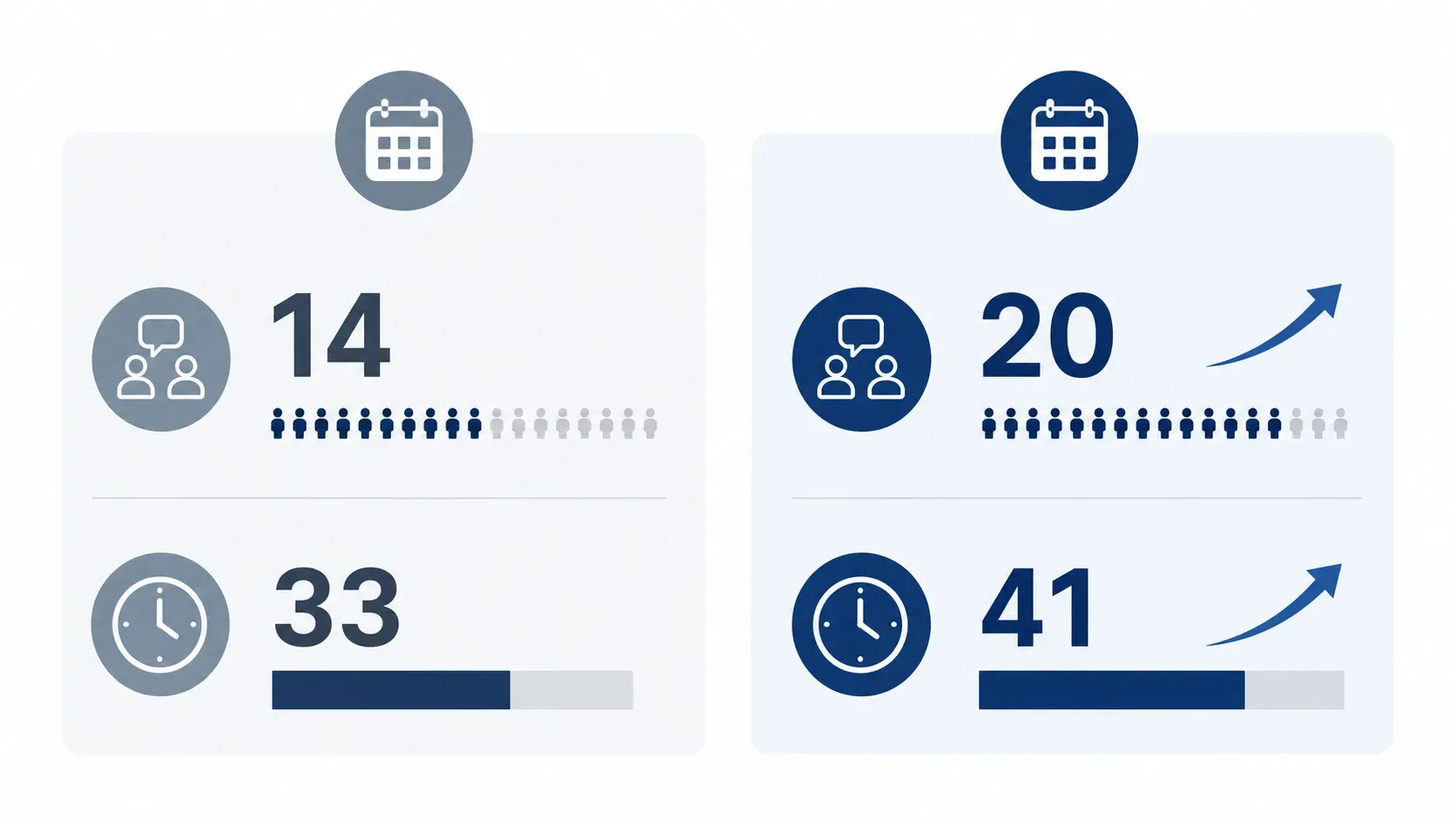
This shows a fundamental breakdown of the traditional model. According to recent industry data, the average recruiter manages 56% more open job reqs (14) and 2.7× more applications (2,500+) than three years ago. For startups that need to hire quickly to take advantage of opportunities, this creates a perfect storm.
According to Gem research, a sourced (outbound) applicant is 5× more likely to be hired than an inbound applicant, showing that proactive sourcing is one of the most efficient strategies for hiring top-tier talent.
Most traditional agencies work on contingency, meaning they only get paid when you hire someone. The pressure is to focus on speed over quality fit. You either don’t make a hire and waste time, or you make a hire and pay $30,000+ per placement.
The fractional recruiting model solves these problems by aligning incentives around quality work instead of placements alone.
Startup Recruiting in September 2026
Crunchbase Q1 2026 data showed roughly $300 billion flowing into about 6,000 startups, a sharp rebound after two quieter funding years. That surge created a new wave of competitive hiring almost overnight. Founders who waited out the slowdown now need to hire fast across engineering, go-to-market, and operations at the same time, which puts serious pressure on any recruiting process that was not already built for speed.
Fractional recruiting has moved from a workaround to the default approach for seed and Series A teams. LinkedIn data shows profiles identifying as fractional professionals jumped from roughly 2,000 to over 110,000 in a few years, a signal of how mainstream the model has become. The question for most founders in 2026 is no longer whether to use a fractional recruiter, but which one and at how many hours per week.
AI screening tools are now table stakes, with roughly 88% of companies using some form of AI for initial candidate evaluation. The practical difference is no longer whether you use AI, but whether your recruiting setup pairs those tools with experienced human judgment. Without that human layer, AI filters can miss context, screen out strong candidates on thin signals, and leave hiring managers with a shortlist that looks clean on paper but falls apart in interviews.
Best Alternative to The Hire Standard
Dover: The Complete Startup Recruiting Solution
Dover stands out as a strong alternative because it combines recruiting software with on-demand recruiting services. Unlike The Hire Standard’s narrow focus on administrative roles, Dover offers a complete platform for hiring across all functions.
Since 2019, Dover has helped 1,500+ companies like Stripe, Scale AI, OpenSea, Benchling, and Vanta attract and hire top talent. Here’s what makes Dover superior:
| Feature | The Hire Standard | Dover |
|---|---|---|
| Role Coverage | Admin/Operations only | All functions |
| Pricing Model | High placement fees | Hourly fractional rates |
| Technology | Basic agency tools | Free ATS + AI sourcing |
| Flexibility | Fixed agency model | Scalable fractional model |
| Average Cost | $30,000+ per hire | Avg. $2,000-$7,000 per hire |
Free ATS and Tools: Dover’s ATS is lightweight, but powerful, built for busy founders and hiring managers. It’s as easy to use as a spreadsheet, but includes everything needed to manage your first 100 hires without the pain of traditional platforms.
Fractional Recruiting Agency Infrastructure: Dover is the infrastructure layer that fractional recruiting agencies are built on, giving startups direct access to recruiters with deep startup hiring backgrounds and real, verified reviews visible on Dover rather than anonymous ratings. Each fractional recruiter in the network works as an extension of your team, so you get specialized expertise without full-time overhead.
AI-Powered Speed: The platform uses AI to score candidates, support sourcing with AI-assisted outreach that recruiters review and direct, and simplify the entire hiring process. You spend time on qualified candidates instead of sifting through hundreds of applications.
The key advantage is flexibility. Use Dover’s free tools for basic hiring needs and scale up with fractional recruiters when you need specialized help. This approach perfectly matches the hiring needs of growing startups.
Other Notable Alternatives
Riviera Partners: Focuses on executive searches for technical leadership roles. While excellent for senior hires, they’re expensive (25-30% of salary) and take 3-6 months per search. This makes them unsuitable for most startup hiring needs.
Korn Ferry: Global executive search firm with detailed assessment tools. However, they’re even more expensive than Riviera and primarily serve large enterprises instead of startups.
Traditional recruiting agencies still operate on the contingency model with high placement fees. Many founders find them limited in technology integration and startup-specific depth. For a closer look at how these models compare, check out our agency vs. marketplace comparison.
How Dover Changes Startup Recruiting
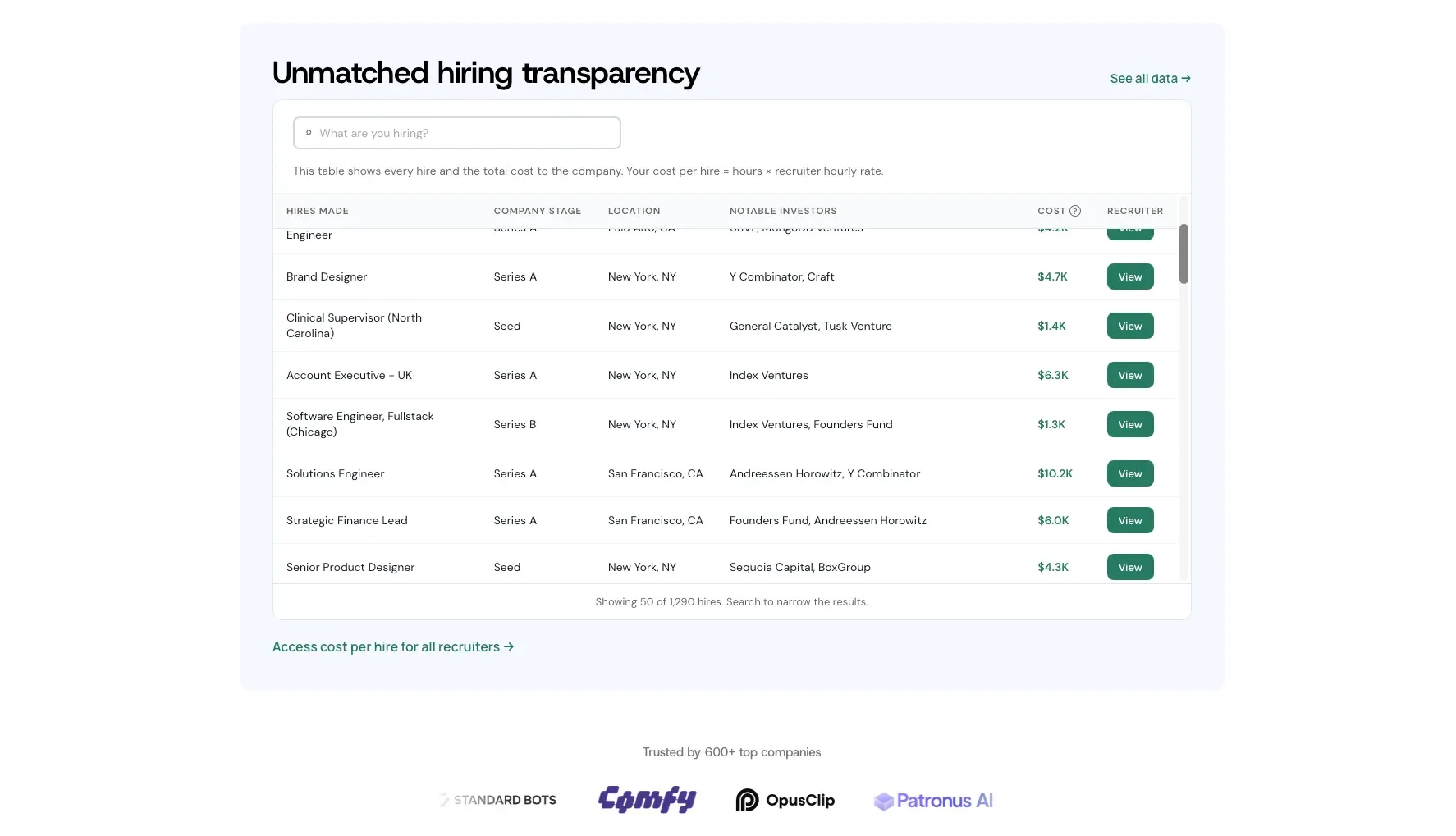
Dover replaces high placement fees with a free ATS paired with a vetted network of fractional recruiting services that work as an extension of your team. Dover acts as the infrastructure layer that fractional recruiting agencies are built on, and every recruiter in the network carries real, verified reviews so founders can assess fit before committing. Instead of paying $30,000+ per hire, the model gives you full hiring infrastructure at zero software cost and on-demand recruiter access when a search needs more depth:
-
Free ATS and job board integrations - manage your full hiring pipeline across 50+ boards, a no-code careers page, and a built-in referral tracker at zero software cost.
-
On-demand recruiters - each with 10-15 years of experience, matched to your role and industry, available by the hour with no retainer required.
-
Unified platform - fractional recruiters work inside Dover, so all candidate data, communications, and pipeline management stays in one place.
-
Transparent pricing - pay hourly rates set by each recruiter, with no placement fee risk.
The free ATS tier is built for capital-efficient hiring at seed-stage and post-YC companies, with no seat limits and no per-user fees. Over 100 Y Combinator startups have used Dover, and setup takes under five minutes. For a closer look at how the fractional model works day-to-day, see Dover’s complete fractional recruiting guide.
FAQs
What makes a fractional recruiter different from a traditional agency?
Fractional recruiters work hourly as extensions of your team instead of on contingency for placements. This aligns incentives around quality work and gives you more control over the process and costs. Dover’s network of fractional recruiters includes verified reviews, so hiring teams can assess recruiter fit before a search begins.
How much does Dover cost compared to The Hire Standard?
Dover’s fractional recruiting typically averages $2,000-$7,000 per hire, while traditional agencies like The Hire Standard charge 15-30% of the candidate’s salary, often $30,000+ per placement. Actual cost varies with the recruiter’s hourly rate and the type of role.
Can Dover help with roles beyond administrative positions?
Yes, Dover’s network includes recruiters specializing in engineering, sales, marketing, product, operations, and executive roles. Unlike The Hire Standard’s narrow focus, Dover covers all startup hiring needs.
Do I need both an ATS and a fractional recruiter, or does one replace the other?
They serve different functions and work best together. An ATS handles the infrastructure layer: job posting distribution, inbound application tracking, candidate pipeline visibility, scheduling, and communications. A fractional recruiter handles the judgment layer: sourcing passive candidates, running outreach, screening, and closing. When a fractional recruiter works inside the same ATS as your internal team, both sides have real-time pipeline visibility, with no coordination overhead, no duplicate outreach, and no sourcing intelligence lost when the search ends. For early-stage teams, starting with a free ATS and layering in a fractional recruiter on harder or higher-volume searches is a common pattern that keeps costs predictable without sacrificing hiring quality.
Final Thoughts on The Hire Standard vs. Dover for Startup Recruiting
The Hire Standard reviews confirm a legitimate boutique agency for administrative and executive-support roles, but most seed-stage and Series A teams need a recruiting partner that covers every function without the $30,000+ agency price tag per hire. For founders weighing their options, Dover offers a free ATS paired with on-demand fractional recruiters averaging $2,000 to $7,000 per hire, a cost structure that makes competitive hiring realistic for early-stage teams whether they are hiring across engineering, sales, or operations at the same time.