


Posting your role to a recruiter marketplace feels like a smart move, but it assumes more recruiters produce better outcomes. That breaks down fast for anything above entry-level. The dedicated recruiter model works differently: one person owns the search, accountability stays intact, and context built in week one carries through to close. Here’s what that difference does to candidate quality.
TLDR:
-
Contingency marketplace recruiters charge 15% to 25% of first-year salary, creating pressure to close fast instead of finding the best fit.
-
Multi-recruiter models diffuse accountability across a pool, so no single person owns the outcome or adjusts sourcing when the search stalls.
-
Dedicated recruiters accumulate role knowledge over time, letting them re-engage near-miss candidates and correct fit issues before interviews fail.
-
Marketplace models can work for high-volume, lower-complexity roles where broad coverage matters more than depth of calibration.
-
Some tools pair a free ATS with on-demand fractional recruiters at $75 to $125 per hour, with per-hire costs typically between $2,000 and $7,000.
What the Dedicated Recruiter Model Is
In the dedicated recruiter model, one recruiter owns your search from start to finish, learning your company, team dynamics, and the specific profile you’re hiring for. That context stays intact throughout, unlike multi-recruiter marketplaces where no single person accumulates the role knowledge needed to make judgment calls about fit or flag when a strategy needs to change.
The dedicated model takes a few structural forms:
-
A full-time in-house recruiter working exclusively on your open roles, building familiarity with your culture and hiring bar over time.
-
A fractional recruiter who operates as a dedicated partner on a per-engagement basis, embedded in your process without the overhead of a full-time hire.
-
A retained search firm that assigns a named consultant to your search, though this typically comes with retainer fees that can run well into five figures.
How Multi-Recruiter Job Marketplaces Work
In a multi-recruiter marketplace, a company posts an open role and a pool of independent recruiters gains access to it simultaneously. Each recruiter sources and submits candidates independently, and whoever places the hire earns a fee, generally 15% to 25% of first-year salary, with nothing owed if the search goes unfilled. Recruiter marketplaces operate on this premise with no upfront cost and no retainer, which is appealing until the incentive structure works against you.
-
Without exclusivity, recruiters favor quick submissions over careful screening, sending candidates who look qualified on paper instead of those assessed for fit.
-
Candidates can receive outreach from several recruiters at once, signaling disorganization and weakening employer credibility.
-
No single recruiter owns the outcome, so when a search stalls there is no clear person to course-correct.
The Incentive Problem With Multi-Recruiter Models
When many recruiters share access to the same role, none has a strong reason to go deep on it. The structural problem with this setup is straightforward: when many recruiters can work the same job, none of them has a strong reason to go deep on it.

The economics push toward breadth. A recruiter working multiple open roles at once has an incentive to send whoever fits the job description closely enough, not to spend weeks building rapport with passive candidates or learning the culture fit you need. Speed and volume are rewarded; precision is not.
This creates a few patterns that show up consistently across multi-recruiter arrangements:
-
Candidate quality drifts toward whoever responds first, not whoever fits best, because the window to close is narrow and time per role is thin.
-
Communication gaps are common when no single recruiter owns the relationship end-to-end, making mid-search course corrections harder.
-
Passive sourcing gets deprioritized: it requires ongoing relationship-building, and a recruiter splitting attention across many roles won’t invest that time in one search that may not close.
How Dedicated Recruiters Produce Better Candidate Fit
A hiring manager competing for a senior engineer needs more than someone to post a job and screen resumes. They need someone who has absorbed the role, understands why past candidates fell through, and is building relationships in a specific talent pool over weeks.
That’s the structural difference a dedicated recruiter model produces. Instead of volume-driven throughput, the recruiter’s time and judgment are concentrated on a defined set of searches, which is a core reason what a fractional recruiter does matters for startups. That concentration changes what’s possible.
What Dedicated Focus Allows
Recruiters who own fewer searches can do things a marketplace model can’t support at scale:
-
Tailoring outreach to individual candidates instead of sending generic sequences that experienced candidates ignore.
-
Building context on team culture and decision-making patterns to accurately represent the role beyond what the job description captures.
-
Re-engaging near-miss candidates and correcting fit issues before both sides have spent time on interviews that don’t convert.
SHRM notes that the cost of a bad hire can reach as much as 30% of the employee’s first-year earnings. A dedicated recruiter may help reduce hiring risk by developing a deeper understanding of the role and applying that context throughout the search instead of relying only on end-stage screening.
The Candidate Experience Gap Between the Two Models
Recruitment agency fees on contingency typically run 15% to 25% of first-year salary. For a $120,000 role, that’s $18,000 to $30,000 per hire. In multi-recruiter marketplaces, no single recruiter has strong incentive to invest deeply when someone else may close the role first.

Dedicated models work differently. SHRM’s 2026 recruiting benchmark shows that organizations continue to invest real resources in hiring, though total cost per hire varies based on factors such as role, recruiting channels, and internal hiring processes. Fractional recruiter costs can run well below traditional retained search fees, depending on the engagement.
| Fee Model | Typical Cost Range | Incentive Structure | Risk to Hiring Company |
|---|---|---|---|
| Contingency marketplace | 15% to 25% of first-year salary | Close quickly; volume across clients | Shallow sourcing, misaligned speed pressure |
| Retained search | Flat fee paid in stages | Thoroughness; exclusive engagement | Higher upfront spend; cost regardless of outcome |
| Dedicated fractional | Hourly or per-hire fee | Consistent quality; single-client focus | Lower total spend; no placement if search stalls |
For early-stage teams hiring multiple roles at once, the contingency math compounds fast, three engineers at $130,000 each could mean $58,500 to $97,500 in fees with no guarantee of deep vetting. A startup hiring three engineers at $130,000 each through a marketplace could pay $58,500 to $97,500 in recruiter fees alone, with no guarantee that any of those placements reflect a deep evaluation of candidate fit.
Institutional Knowledge and Pipeline Ownership
Every recruiter who touches a search in a multi-recruiter marketplace takes their working knowledge with them when they move on. Sourcing logic, screened candidates, reasons certain profiles were passed: none of that transfers. One recruiter owning the search from kickoff through close accumulates a usable picture of what the hiring team actually wants, which often diverges from the job description written in week one.
Fractional recruiting for employers keeps pipeline continuity intact so early-stage candidates stay reachable if hiring criteria shift. Feedback loops hold because the recruiter adjusts sourcing in real time instead of reconstructing context after a handoff. Relationship capital stays with one person, so near-miss candidates can be re-engaged for future roles without re-introduction.
When a Multi-Recruiter Marketplace Still Makes Sense
Multi-recruiter marketplaces work when roles are standard, the candidate pool is large, and speed matters more than depth. Filling a cohort of entry-level positions is the clearest fit: job descriptions are consistent, skills are common, and broad outreach increases coverage quickly. Companies with strong in-house screening can compensate for the shallower recruiter investment on the front end.
Complex, senior, or culture-sensitive searches are where diffuse accountability becomes a genuine problem, a pattern covered in detail in why contingency models fail fast-growing startups.
How Dover Fits Into the Dedicated Recruiter Model
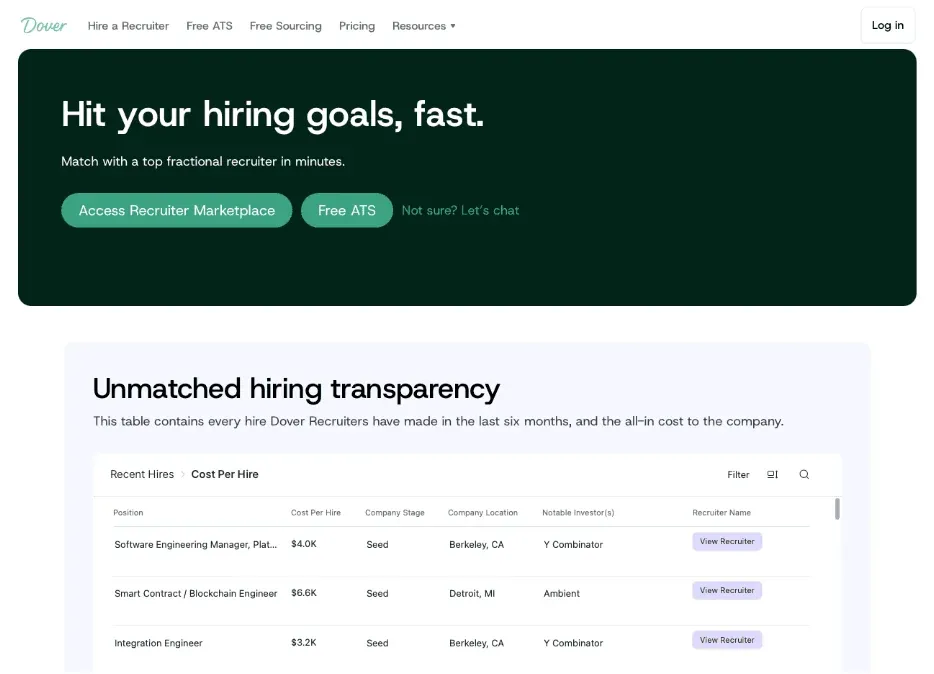
Sure, we may be biased, but here is what Dover actually does. Dover pairs a free ATS with on-demand fractional recruiters who work exclusively on your search. Recruiters carry verified client reviews so hiring managers can assess fit and track record before committing, and work at $75 to $125 per hour, with per-hire costs typically between $2,000 and $7,000. That structure is part of how Dover’s recruiting model builds accountability from day one.
Dover is also the infrastructure layer that fractional recruiting agencies are built on. Independent agencies run end-to-end client searches through Dover’s ATS and recruiter marketplace, so the network reflects real use across a wide range of startup hiring contexts instead of volume-driven placement activity.
The ATS covers pipeline visibility, candidate tracking, and job distribution across 100+ boards. Both the recruiter and the hiring team work inside the same system, so candidate status, outreach history, and notes are visible in real time without update calls or spreadsheet syncing. Sourcing activity stays in the company’s pipeline, not the recruiter’s private files, carrying institutional knowledge forward into future searches.
Frequently Asked Questions
What’s the real difference between a dedicated recruiter model and a contingency marketplace?
In the dedicated model, one recruiter owns your search and bills hourly, giving them no incentive to close fast over closing well. Contingency marketplaces distribute the same role across multiple recruiters who compete on placement speed, which pushes toward quick submissions over careful vetting and can result in the same candidates receiving outreach from several sources at once, which damages your employer brand with the people you’re trying to hire.
Can I use Dover’s dedicated recruiter model without a long-term contract or retainer?
Yes. Dover’s fractional recruiters work on an hourly basis with no long-term contracts, no exclusivity clauses, and no retainer. Most standard roles fill within roughly 20 hours of recruiter time across three to four weeks, and you can start or stop engagements without the financial commitment that retained search firms typically require.
When does a multi-recruiter marketplace make more sense than a dedicated recruiter model?
Multi-recruiter marketplaces can work well for high-volume, lower-complexity roles where the candidate pool is large and speed of coverage matters more than depth of vetting, with filling a cohort of entry-level positions being the clearest fit. For senior, technical, or culture-sensitive searches where passive candidate relationships and calibrated judgment drive outcomes, the diffuse accountability of a marketplace model tends to surface as a genuine problem.
Final Thoughts on Fractional Recruiters, Contingency Fees, and Recruiter Marketplaces
Your recruiting model is a structural decision, and the incentives built into each model follow you through the entire search. Multi-recruiter marketplaces work when simplicity and speed align; the dedicated recruiter model works when depth, fit, and candidate experience actually matter to the outcome. Most early-stage teams find the tradeoff becomes obvious after their first search that stalls. Dover is built around that second premise: a free ATS paired with fractional recruiters at $75 to $125 per hour, with per-hire costs typically between $2,000 and $7,000, no retainer required.


-recruiting-hero-ba99639a.zcrlfqTR_Z1g1uIg.webp)