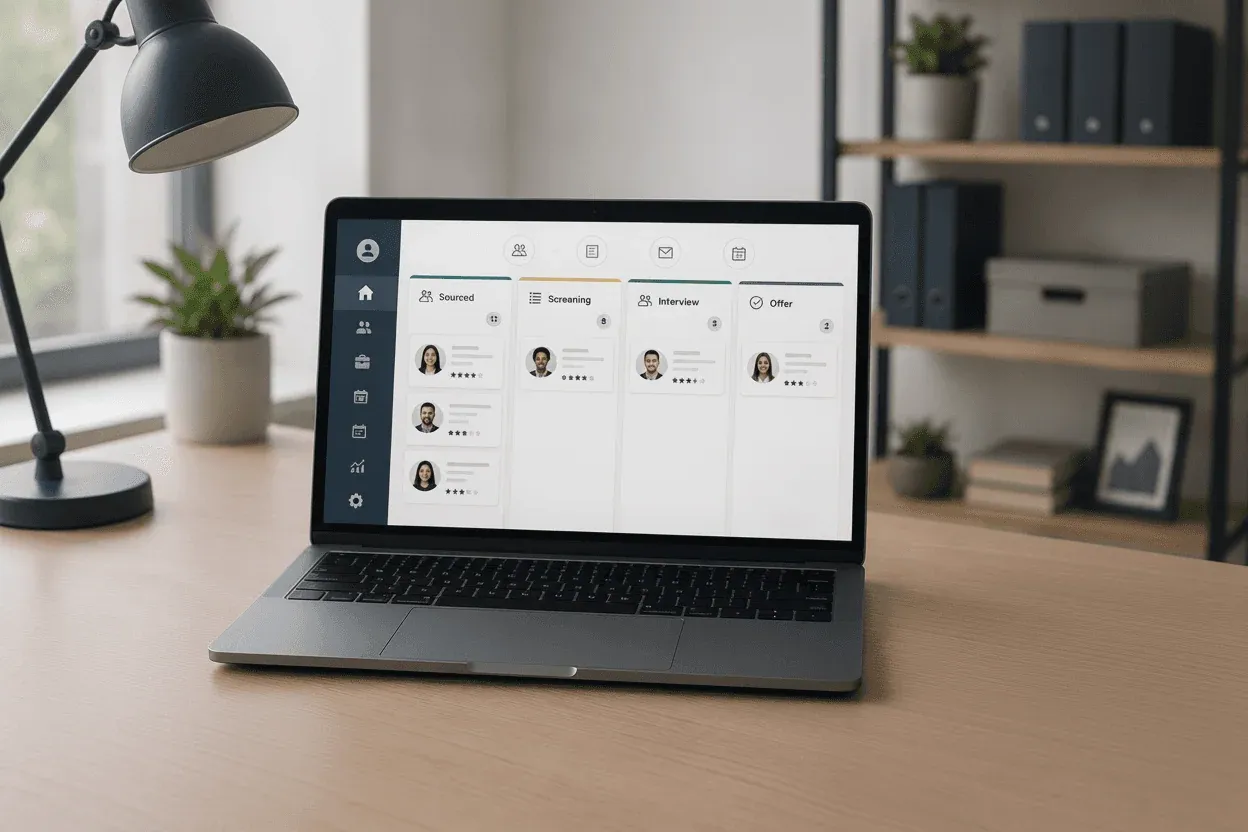

When your recruiting stack is a mess of disconnected tools, job postings go out manually, applications scatter across inboxes, candidate data gets copied into your ATS by hand, and new hires get re-entered into your HRIS because nothing syncs. ATS integration fixes this by connecting your applicant tracking system to job boards, communication tools, background check vendors, and HRIS platforms through APIs, so a candidate can apply via LinkedIn Apply Connect, sync to your ATS, trigger a Slack notification, and get an interview link without manual data transfer. The sections below cover how ATS integration APIs work, which integrations matter most for LinkedIn and other core recruiting tools, and how to build a connected hiring stack without adding complexity.
TLDR:
-
HR teams waste nearly 20% of their workweek on app-switching and manual data transfer between recruiting tools
-
ATS integrations connect your applicant tracking system to job boards, scheduling tools, and HRIS systems through APIs
-
LinkedIn offers three integration paths: Apply Connect for easy applications, Recruiter System Connect for bidirectional syncing, and API access for custom builds
-
You can build integrations directly against vendor APIs, use iPaaS tools like Zapier, or use unified API providers like Merge
-
Some tools combine free ATS software with on-demand recruiting support, keeping pipeline management and recruiter access in one system
When your recruiting stack is a mess of disconnected tools, job postings go out manually, applications scatter across inboxes, candidate data gets copied into your ATS by hand, and new hires get re-entered into your HRIS because nothing syncs. ATS integration fixes this by connecting your applicant tracking system to job boards, communication tools, background check vendors, and HRIS platforms through APIs, so a candidate can apply via LinkedIn Apply Connect, sync to your ATS, trigger a Slack notification, and get an interview link without manual data transfer. The sections below cover how ATS integration APIs work, which integrations matter most for LinkedIn and other core recruiting tools, and how to build a connected hiring stack without adding complexity.
What ATS Integrations Are and Why They Matter
Your ATS doesn’t work in a vacuum. Recruiting spans job boards, LinkedIn, HRIS systems, scheduling tools, and background check vendors. When those tools don’t communicate, someone moves the data between them by hand.
An ATS integration connects your applicant tracking system to other recruiting tools through APIs, keeping candidate data in sync and automating handoffs. HR teams waste nearly 20% of their workweek on app-switching and manual tasks.
Core ATS Integration Types Every Recruiting Team Needs
Recruiting teams typically rely on four categories of ATS integrations.
Job Distribution Integrations
These connect your ATS to job boards like Indeed, LinkedIn, ZipRecruiter, and CareerBuilder, pushing listings automatically without manual re-posting. A role posted once reaches dozens of boards at once, and applications flow back into a single pipeline instead of scattered inboxes.
Communication and Scheduling Integrations
Calendar and email tools sync with your ATS so interview scheduling, confirmation emails, and follow-up sequences run without coordinators copying between tabs.
Background Check and Assessment Integrations
Vendors like Checkr or HireRight connect directly to the candidate record, triggering checks at the right stage without exporting data manually.
HRIS and Payroll Integrations
Once a candidate accepts, the data should move to your HRIS or payroll system without being re-entered. Connections to Workday, BambooHR, and Paycom cover the gap between offer acceptance and day-one setup.
How ATS API Integrations Actually Work
At the core of any ATS integration is an API, a set of rules that lets two software systems exchange data in a structured way. When a candidate applies through LinkedIn, the API pulls that data directly into your ATS.
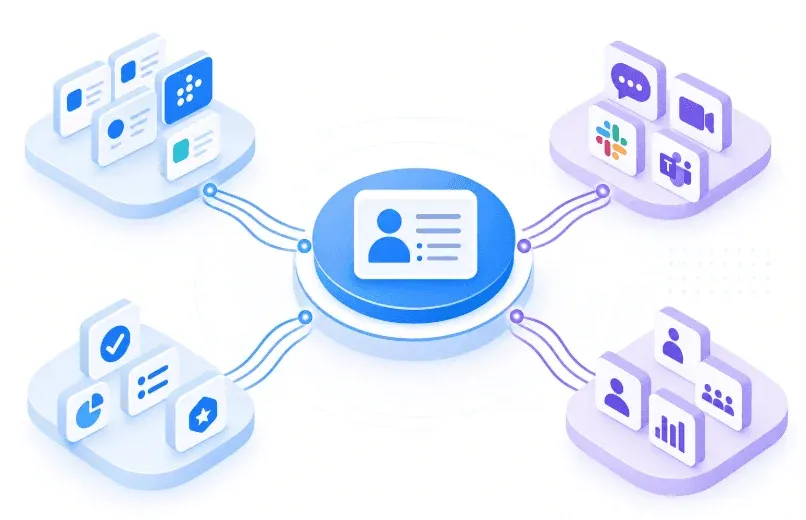
Most ATS APIs follow a request-and-response model: your ATS sends a request, the other system returns structured data, and your ATS records it.
There are a few common patterns worth knowing:
-
One-way syncs push data in a single direction, such as publishing jobs from an ATS to external job boards without synchronizing status updates back to the originating system.
-
Two-way syncs keep records current on both sides, so a status change in LinkedIn Recruiter reflects in your ATS and vice versa. LinkedIn’s Recruiter System Connect works this way.
-
Middleware layers like Merge ATS sit between your ATS and other tools, offering a single normalized API that connects to dozens of providers at once.
Integration depth depends on what each vendor’s API exposes. LinkedIn’s API offers endpoints for job postings, applications, and candidate profiles, but certain endpoints require joining LinkedIn’s partner program.
LinkedIn ATS Integrations: Apply Connect, Recruiter System Connect, and API Access
LinkedIn sits at the center of most recruiting stacks, and how you connect it shapes how much manual work your team carries. There are three ways to build that connection.
Apply Connect
LinkedIn Apply Connect lets candidates apply using their LinkedIn profile instead of a form, routing structured candidate data directly into your ATS with no separate import step, as outlined in LinkedIn’s Apply Connect documentation. Many leading ATS providers support this natively.
Recruiter System Connect
Recruiter System Connect (RSC) is LinkedIn’s deeper layer for teams using LinkedIn Recruiter. It syncs candidate activity bidirectionally, so InMail history, notes, and pipeline stages stay consistent across both tools. Workday, Greenhouse, and Lever are among the providers with certified RSC support.
LinkedIn API Access
The LinkedIn API gives engineering teams direct programmatic access to LinkedIn data. LinkedIn provides APIs and partner integrations for job posting, applications, recruiter workflows, profiles, and content publishing, though access tiers and pricing vary by use case. Recruiter-grade data access requires a partnership agreement, not a standard API key.
For unified access across multiple ATS providers without separate builds, tools like Merge ATS offer a single API layer connecting to Greenhouse, Lever, Workday, and others at once.
The Business Case: Measurable Benefits of ATS Integrations
Teams that track integration performance report gains in time-to-fill, cost-per-hire, and candidate drop-off, since real-time data leaves recruiters less manual data entry and more time on candidates. The ROI is clearest in a few areas:
-
Reduced time-to-fill: Automated distribution to boards like LinkedIn and ZipRecruiter posts roles faster, with status updates flowing back automatically.
-
Lower cost-per-hire: Fewer manual touchpoints mean less overhead per requisition.
-
Better candidate experience: Automatic status notifications speed up responses and reduce offer-stage drop-off.
-
Cleaner reporting: With sourcing data, interview outcomes, and offers in one record, you can see which boards produce hires and adjust spend accordingly.
Common Integration Challenges and How to Solve Them
Connecting your ATS to other tools rarely goes as smoothly as vendor documentation suggests.
Data sync delays and duplicate records
As data moves between your ATS, CRM, and job boards, timing mismatches create duplicate profiles or stale status fields. Designate one system as the source of truth and have the rest read from it. Webhook-based updates, supported by many modern platforms, push changes in real time to reduce that lag.
Field mapping mismatches
Systems use different schemas, so what your ATS calls “application stage” may not match your CRM or HRIS. Audit fields on both sides and map them before going live. Middleware tools like Merge handle much of this automatically.
Permission and authentication errors
Expired OAuth 2.0 tokens, rotated API keys, and changed admin permissions are the most common reasons integrations break silently. Add monitoring so auth failures surface immediately instead of going undetected for days.
LinkedIn-specific restrictions
LinkedIn’s API access is more limited than most job board APIs. Features like Recruiter System Connect require LinkedIn approval and are generally reserved for enterprise ATS partners, so smaller tools may find certain sync features unavailable without a partnership.
Three Approaches to Building ATS Integrations: In-House, iPaaS, and Unified APIs
How you build an integration shapes maintenance burden as much as which systems you connect. Three approaches dominate.
Building directly against each vendor’s API gives you the most control, but every API needs its own authentication, error handling, and upkeep whenever vendors push breaking changes.
iPaaS tools like Zapier or Workato sit in the middle: prebuilt connectors cut code but add a third dependency that gets expensive as workflow volume grows.
Unified API providers like Merge let you build once against a single normalized API, with the provider translating to each underlying system. For teams integrating multiple ATSs across a customer base, that cuts the long-tail work of supporting Greenhouse, Workday, BullHorn, and others as separate endpoints.
Key ATS Platforms and Their Integration Ecosystems
Each major ATS has built its own integration ecosystem.
Greenhouse
Greenhouse has one of the more mature integration libraries, spanning background check providers, assessment tools, HRIS systems, and job boards. Its LinkedIn Recruiter System Connect partnership syncs candidate activity both ways, and the well-documented REST API keeps custom builds accessible for teams with engineering resources.
Workday
Workday is more complex. Its LinkedIn Recruiter System Connect runs at enterprise scale, syncing InMail activity, candidate stages, and application data, but heavy configuration makes integrations harder to set up and maintain, and smaller teams struggle to absorb the overhead.
Lever and Workable
Both sit in a middle tier with solid pre-built connectors for Indeed, LinkedIn, and background check vendors. Workable’s API is accessible enough that many teams build lightweight automations with little engineering.
BambooHR and Zoho
These serve smaller organizations with ecosystems to match. BambooHR connects well with payroll and onboarding tools, while Zoho’s LinkedIn integration covers job posting and basic applicant syncing, though teams expecting deep bidirectional sync often find it limited.
| ATS | LinkedIn Integration | API Accessibility | Best Fit |
|---|---|---|---|
| Greenhouse | Recruiter System Connect | Well-documented REST API | Mid-market to enterprise |
| Workday | Recruiter System Connect | Complex, heavy config | Enterprise |
| Lever | Standard LinkedIn apply | Moderate | Growth-stage teams |
| Workable | Job posting + apply | Developer-friendly | SMBs and startups |
| BambooHR | Basic apply | Limited | Small businesses |
| Zoho Recruit | Job posting + sync | Moderate | SMBs |
Dover’s Integrated Recruiting System: Free ATS Plus On-Demand Recruiters
Most recruiting stacks end up as a collection of tools that barely talk to each other. Your ATS holds candidate data, your sourcing tool runs separately, and any recruiter you bring in operates outside the system entirely. Dover is built to close that gap.
Dover’s free ATS connects your pipeline management, job distribution, and recruiter access in one place. Setup takes under five minutes, and the system posts to 50+ job boards automatically. Candidates flow into a single tracked pipeline instead of scattering across inboxes and spreadsheets.
On-Demand Recruiters With Direct System Access
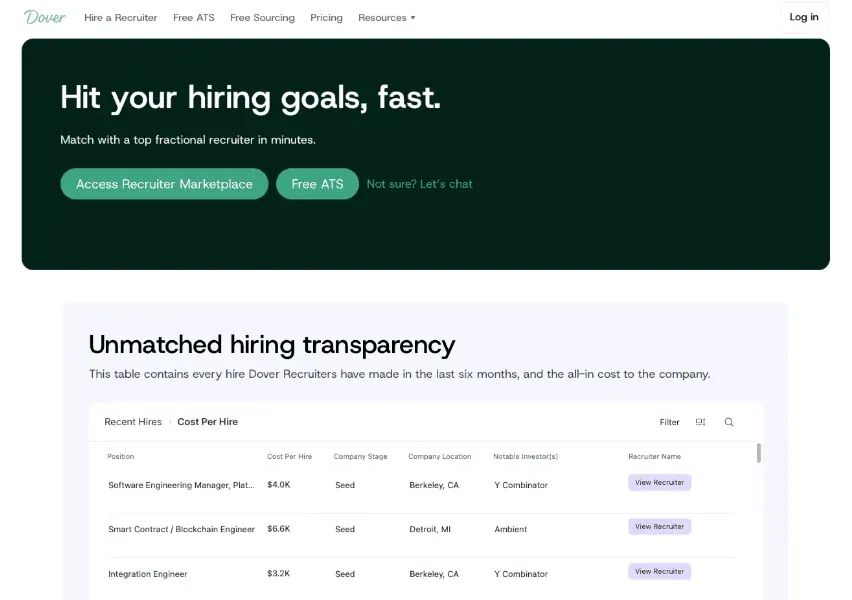
Where Dover separates from a standalone ATS is the recruiter layer. For hands-on searches, experienced recruiters with startup hiring backgrounds can be brought in at $2,000 to $7,000 per hire, working inside the pipeline you already manage.
For ongoing sourcing support, hourly recruiter access averages about $4,000 per hire with a refundable $800 deposit, suiting early-stage teams that need expertise without a retained search or full-time hire.
The result: your ATS integration and recruiter access share one data layer, so candidate history, stage tracking, and outreach records stay in one place whether you run the search yourself or alongside a recruiter.
Frequently Asked Questions
What’s the difference between ATS integration API and middleware tools like Merge?
An ATS integration API connects two systems directly through structured requests and responses, while middleware tools like Merge provide a single normalized API that translates across dozens of ATS providers at once. Direct API builds give you more control but require separate authentication and maintenance for each vendor; middleware reduces that overhead by handling the translation layer for you.
Can I integrate my ATS with LinkedIn without a Recruiter license?
Yes. LinkedIn Apply Connect lets candidates apply using their LinkedIn profile and routes applications directly into your ATS without requiring a Recruiter license. Deeper integrations like Recruiter System Connect that sync InMail activity and candidate stages require LinkedIn Recruiter and ATS provider certification.
How long does it take to set up ATS integrations with job boards and HRIS systems?
Many native integrations with job boards like Indeed or LinkedIn can be configured in less than an hour, while HRIS integrations to systems like Workday or BambooHR often require several hours of field mapping, testing, and validation before going live.
Final Thoughts on Building a Connected ATS Integration Stack
An ATS integration only matters if it cuts manual work, so start with the handoffs that cost your team the most time before adding connections just because they exist. A well-integrated ATS handles pipeline management and candidate tracking, but when sourcing gets hard for senior or competitive roles, some teams add fractional recruiting support into the same system. Dover’s free ATS, paired with on-demand recruiters working inside that pipeline, is one example of both layers sharing a single source of truth.