
Early-stage founders live with a constant bind: every open role feels urgent enough to fill alone, yet the hires that matter most are exactly the ones where a single person’s judgment is the weakest filter. Collaborative hiring, which means structuring the process so multiple team members share input, evaluation, and accountability, is the practical fix, but most startups never get around to building it. Move too fast and you risk a mismatch that costs months to unwind. Bring in the team without a clear process and you risk losing the candidate while everyone waits on each other. This guide covers how to set up a collaborative hiring process that actually holds together as your startup grows.
TLDR:
-
Involving team members early in hiring can cut time-to-hire and improve cultural fit for startups.
-
High inbound volume makes structured, team-based evaluation a coordination requirement, not a preference.
-
Defining clear roles, shared rubrics, and debrief processes reduces inconsistent candidate assessments.
-
AI can help filter and score applicants, but team judgment on fit and tradeoffs remains the deciding layer.
-
Some tools pair free ATS software with on-demand recruiting support to keep collaborative hiring manageable.
Why a Collaborative Hiring Process Matters for Startups
Startup hiring can be hectic and hyper-competitive. Processes constantly change as you grow, and each hire has a major impact on your company.
Unlike larger organizations, startup founders have smaller teams, limited resources and unique mission-focused cultures that require employees to have the necessary skills while aligning with your vision.
With a collaborative hiring process, you can avoid some of the pitfalls early-stage startups make when choosing those key initial hires. Some of the main benefits of a collaborative hiring process include:

-
Diverse perspectives: Involving multiple team members gives you varied viewpoints.
-
Cultural fit: Collaboration helps you learn what a new hire needs to align with company values and work dynamics.
-
Employee Buy-In: When your team is involved, they feel more accountable for the success of new hires.
-
Higher retention rates: Candidates hired through collaboration fit in better since the team was involved in choosing them. This can lead to longer tenures and reduced turnover, consistent with onboarding and retention research.
-
Improved candidate experience: Candidates have the chance to engage with multiple team members and gain a broader view of the company culture. This leaves them with a positive impression of the company, improving your employer’s brand in the process, a pattern reflected in candidate experience and retention data.
-
Better outcomes: Of course, collaboration leads to better hires. Better hires mean you have a better team to drive the company forward.
| Benefit | What It Delivers |
|---|---|
| Diverse perspectives | Varied viewpoints from multiple team members improve candidate assessment. |
| Cultural fit | Team input surfaces what a new hire needs to align with company values and work dynamics. |
| Employee buy-in | Involved team members feel more accountable for the success of new hires. |
| Higher retention rates | Candidates hired through collaboration fit in better, leading to longer tenures and reduced turnover. |
| Improved candidate experience | Engaging with multiple team members gives candidates a broader view of culture, strengthening employer brand. |
| Better outcomes | Better hires mean a stronger team to drive the company forward. |
How to Build a Collaborative Hiring Process
Building a collaborative recruitment approach doesn’t necessarily involve adding a bunch of steps. It’s about making some adjustments to make recruitment more inclusive, transparent and effective. Here’s how:
1. Involve Key Team Members Early in the Hiring Process
First, identify the team members who will work closely with the new hire. These individuals should participate in the process from the beginning. They can help you define the role requirements and the job description. Their input helps you align the role with actual team needs.
To involve these team members, you can schedule a brainstorming session to outline role expectations. This has the dual benefit of clarifying your hiring objectives and getting the team invested in the new hire.
2. Set Clear Roles and Responsibilities for Everyone Involved
Ambiguity in the hiring process leads to miscommunication and inefficiencies. Clearly define who will be doing what. Decide who is sourcing candidates, who is conducting interviews, etc.
Since your company is in its early stages, hiring can feel like the Wild West. Giving the process a sense of structure can help make things easier for everyone, including the candidates. Ironing out roles may take some time, but it’s well worth it in the long run.
3. Use Collaborative Tools to Simplify Communication and Feedback
Modern recruitment tools can support collaborative communication and feedback during the hiring process. Tools like applicant tracking systems (ATS), shared documents and messaging platforms can keep you organized. See how teams use an ATS for startup team collaboration to coordinate across interviewers.
Here’s a quick rundown of some common tools to use:
-
Slack or Microsoft Teams: For instant communication.
-
Google Sheets or Notion: A centralized place for hiring processes, interview questions, etc.
-
Dover’s free ATS: A free tool to help startups track applicants, communicate and manage the hiring process.
4. Encourage Open and Transparent Discussions About Candidates
Open discussions during the hiring process can help you spot potential red flags or standout qualities in candidates. Try to create an environment where team members feel comfortable sharing their opinions.
You can encourage transparent discussions by holding debrief meetings after interview rounds to gather insights. Structured feedback forms can also help keep debriefs organized and consistent.
5. Create a Structured, Bias-Free Evaluation Process
Unstructured hiring processes may cause unconscious biases. You want your hiring process to be as fair and accurate as possible. Of course, objective assessments are easier said than done, but there are some ways you can reduce bias.
Start by developing a standardized evaluation rubric for interviews, a practice backed by structured interview research. For a practical framework, see our guide on startup hiring rubrics. You can also use skill-based assessments to gauge candidates’ experience and abilities objectively. You should also provide bias training for anyone involved in the hiring process so they can recognize and mitigate it.
6. Build a Sense of Ownership in the Hiring Decision
When team members feel that their input matters, they’re more likely to support and welcome new hires. Make the hiring process a shared responsibility to encourage active participation.
You can promote ownership by using some of the steps we discussed earlier about involving team members early in the hiring process. Have the team help you craft interview questions and let them rank or vote on candidates they’ll work with after hiring. Instilling this sense of ownership in the hiring process increases team morale and encourages accountability.
7. Offer Training to Improve Interview and Evaluation Skills
Even hiring experts can benefit from training. Provide team members with resources and knowledge to make the interview and evaluation process more consistent and effective, a point supported by the SHRM skills-based hiring study. Our step-by-step interview scorecard guide gives teams a ready-made framework to put that training into practice.
Some training topics to cover include:
-
Crafting impactful interview questions
-
Identifying behavioral and technical skills
-
Avoiding bias in evaluations
-
Filling out a hiring rubric
-
Giving effective feedback
Continuous learning leads to better hiring outcomes and gives the team the confidence to improve the hiring process.
8. Maintain Regular Check-Ins and Adjust the Process as Needed
Your company is going to grow rapidly, and your hiring processes need to evolve with you. Regularly review what’s working and what isn’t, and make adjustments based on hiring outcomes, feedback from your team and feedback from candidates.
You can implement hiring process audits regularly to confirm you’re continuously improving. It’s also a good idea to schedule post-hiring reviews to get feedback from the team and the new hire. If possible, get feedback from all candidates who went through the hiring process.
Of course, all of this feedback doesn’t do you much good if you don’t use it. Make sure you implement improvements for future recruitment cycles so your hiring process stays effective and consistent.
How Dover Supports Collaborative Hiring
Team-based hiring breaks down quickly without shared infrastructure. When interviewers, hiring managers and founders work from separate notes, scattered emails or disconnected spreadsheets, feedback gets lost, scheduling turns into a back-and-forth and candidates slip through the cracks. The coordination problem grows with inbound volume: a handful of team members can informally compare notes, but once a startup is fielding dozens or hundreds of applicants, informal coordination stops working.
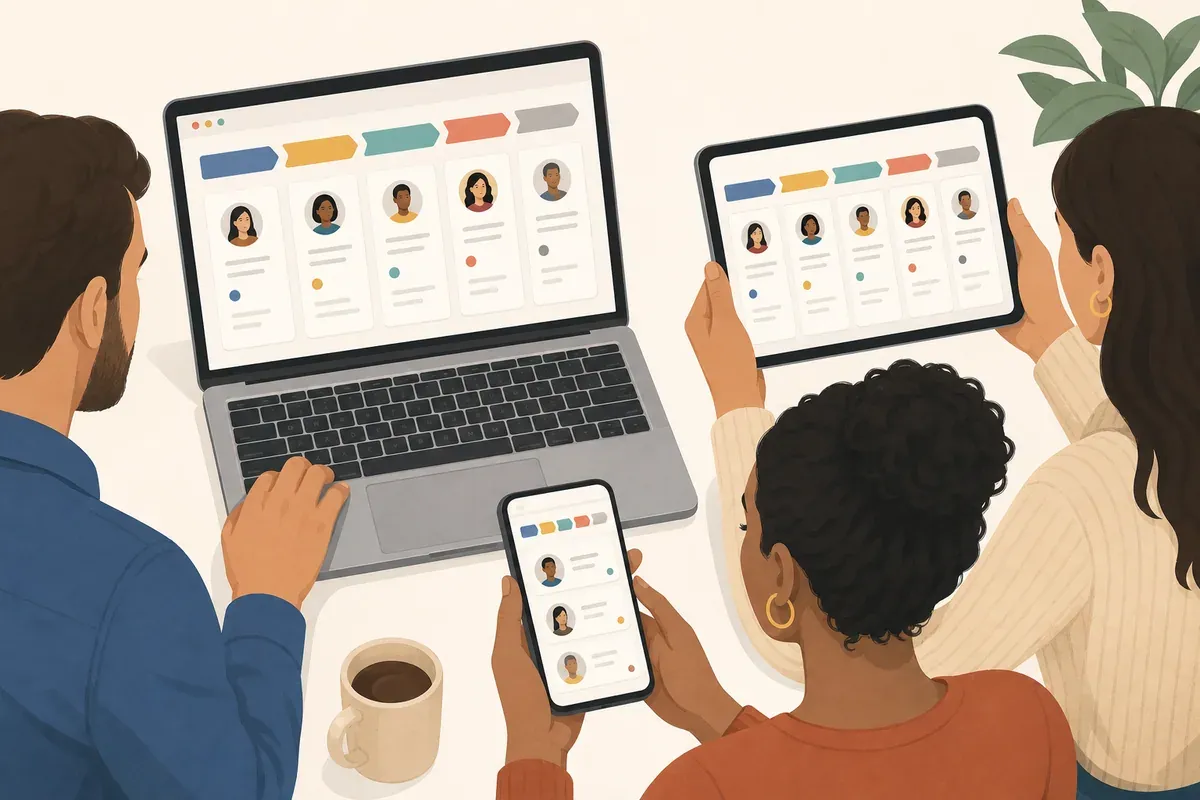
Dover’s free applicant tracking system gives teams a shared pipeline where everyone sees the same candidate data at the same time. Interviewers can log feedback directly against each candidate, hiring managers can view status at a glance and AI applicant scoring (Premium) can help rank applicants against the role criteria before a human reviews them. Interview scheduling removes the manual back-and-forth of coordinating calendars across multiple interviewers, which matters once more than one or two people are involved in a hiring decision.
For roles that need more hands-on search support, Dover’s Recruiting Partners marketplace connects startups with fractional recruiters who work inside that same shared ATS rather than a separate system. Because sourcing, interview notes and candidate status all live in one pipeline, the hiring team and the fractional recruiter can see the same information in real time, which keeps collaborative evaluation intact even when outside recruiting help is added to the process.
Hire Fast with Dover’s Free ATS and On-demand Recruiting Partners
Creating a collaborative hiring process doesn’t have to be overwhelming. Dover’s free ATS tier gives startups unlimited jobs and users, distribution to 50+ job boards, and setup that typically takes minutes. Teams that want AI-assisted resume scoring can move to the premium plan, which supports up to 2,000 AI candidate scores per month.
For teams that need more hands-on support, Dover’s Recruiting Partners marketplace connects startups with experienced fractional recruiters on flexible terms, with no long-term contracts required. Dover’s average cost per hire is $4.8k, with an $800 refundable deposit to start a search.
Both halves run on the same shared platform, so whether a team is managing applicants directly or working with a recruiting partner, everyone sees the same pipeline in real time. That shared visibility keeps collaborative evaluation grounded in one source of truth instead of scattered spreadsheets and email threads.
FAQs
What does a collaborative hiring process actually look like for an early-stage startup?
A collaborative hiring process means involving the people who will work alongside a new hire from the start, having them help define the role, contribute to interview questions, and share structured feedback after each round. The key mechanics are a shared evaluation rubric, clear ownership of each stage, and a single place where everyone’s notes and candidate status are visible without manual reconciliation.
How do I reduce bias in startup interviews without slowing down the hiring process?
Develop a standardized evaluation rubric before interviews begin so every candidate is assessed against the same criteria, and use skill-based assessments to measure capabilities independently of interviewer impressions. Structured interviews consistently outperform unstructured ones on both accuracy and fairness, and they don’t require more calendar time, just more preparation upfront.
Should I use Dover’s free ATS or a tool like Ashby for collaborative startup hiring?
Dover’s free ATS is the better fit for early-stage teams without dedicated recruiting operations. It requires no per-seat contracts, sets up in minutes, and gives every interviewer shared pipeline visibility from day one. Ashby is built for scaling teams with recruiting headcount who need advanced workflow configuration; its setup complexity and per-seat pricing create friction for founders hiring their first ten people.
Final Thoughts on Building a Collaborative Hiring Process
Collaborative hiring works when two things are true at once: everyone involved has a clear role, and everyone can see the same information. The structural and process steps in this guide handle the first half. The second half depends on having shared infrastructure, a single place where sourcing activity, interview notes, and candidate status are visible to the whole team without requiring a coordinator to manually reconcile separate systems. For early-stage teams, that infrastructure is often what separates a hiring process that scales from one that quietly falls apart as volume grows. Whether a startup manages hiring entirely in-house or brings in outside recruiting support, the coordination overhead stays manageable when there is one pipeline everyone works from instead of many.