
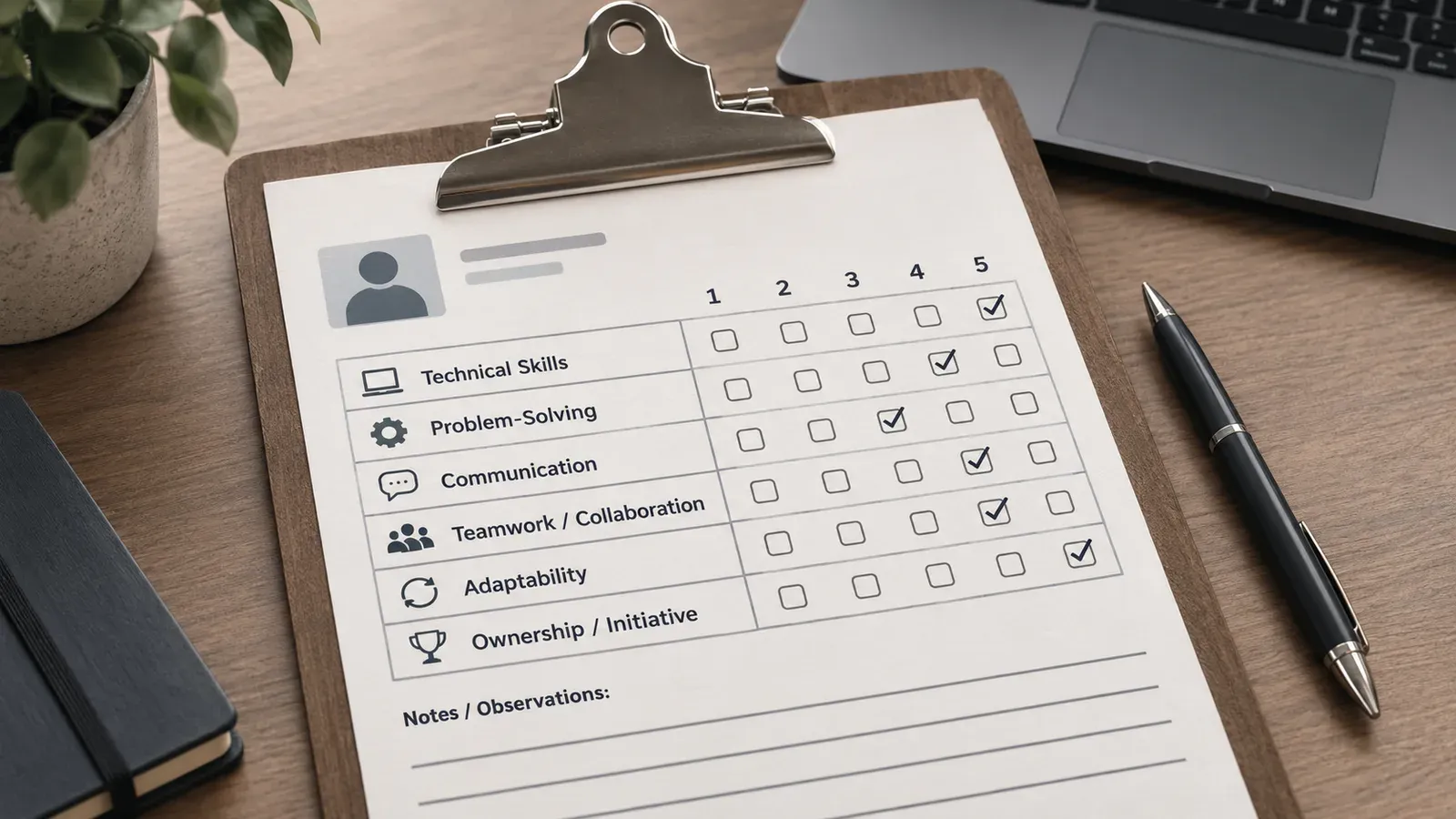
When interviews run without a clear structure, each person approaches the conversation differently. One zeroes in on technical skills, another leans heavily on culture fit, and someone else pulls questions from whatever list they found online. An interview scorecard brings order to the process by spelling out the specific qualities you’re assessing and the criteria for judging them. With a shared framework, your team can compare candidates on the same terms, reduce bias, and focus discussions on real evidence instead of clashing opinions.
TLDR:
-
Interview scorecards standardize candidate evaluation with predefined criteria and 1-5 rating scales.
-
About two-thirds of organizations use structured interviews, which help reduce bias and bring clarity to decisions through documented ratings.
-
Define 6-12 job-specific competencies, weight them by importance, and train interviewers to use the scale.
-
Complete scorecards during or immediately after the interview to prevent memory decay and recency bias.
-
Some free hiring tools include built-in scorecards and AI notetaking, and serve as the foundational layer fractional recruiting agencies use to manage client pipelines.
What Is an Interview Scorecard?
An interview scorecard is a structured evaluation form that hiring teams use to assess candidates consistently across interviews. Instead of relying on gut feelings, you rate each candidate on predefined job-relevant criteria using a standardized scale.
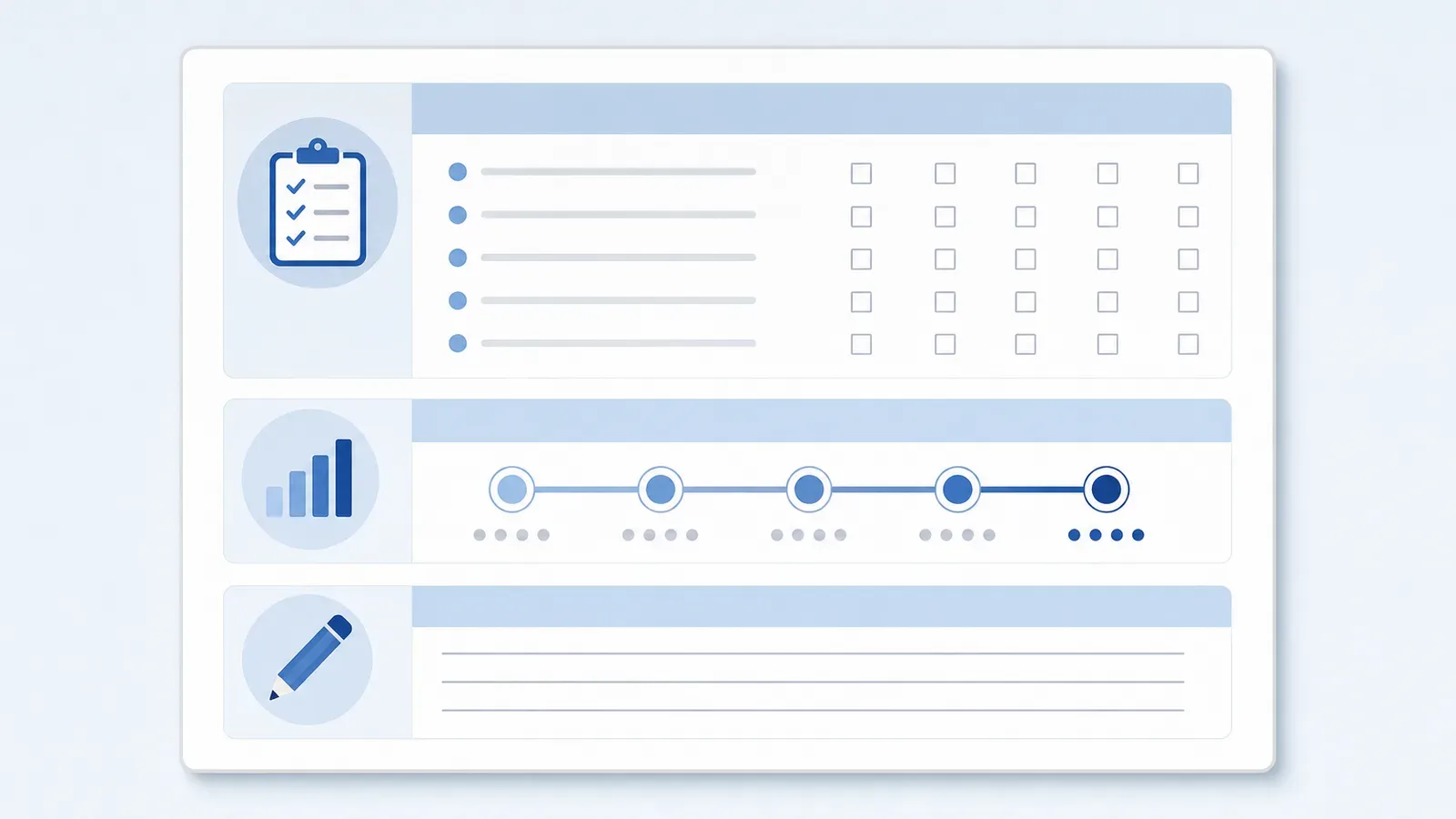
Every scorecard contains three core components:
-
Evaluation criteria that reflect the skills, competencies, and attributes required for the role, such as technical expertise, problem-solving ability, or cultural fit
-
A scoring scale (typically 1-5 or 1-10) with clear definitions for each rating level that remove ambiguity about what constitutes strong or weak performance
-
Space for notes and observations that capture specific examples from the interview, which provide context for your ratings and help you recall details during deliberations
The scorecard turns interviewing from subjective judgment into a repeatable process. Each interviewer assesses the same competencies using the same standards, allowing you to directly compare candidates and make hiring decisions based on evidence.
Benefits and Limitations of Interview Scorecards
Interview scorecards deliver measurable improvements to your hiring process. Talent Board’s 2024 Candidate Experience Benchmark Research found that about two-thirds of organizations use structured interviews to reduce hiring bias.
The most immediate benefit is consistency. When every interviewer assesses candidates using the same criteria and scale, you eliminate scenarios where different team members focus on completely different qualities. This standardization makes candidate comparisons straightforward and defensible.
Finally, scorecards create an evidence trail. When you need to explain a hiring decision to stakeholders or defend against claims of unfair treatment, you have documented, job-relevant reasons for every choice.
Limitations to Be Aware Of
-
Scorecards can create false precision. A numerical score implies objectivity even when criteria definitions are vague, giving the appearance of rigor without it.
-
Designing and calibrating a scorecard takes real upfront effort. Poorly defined criteria or skipped calibration sessions undermine the consistency scorecards are meant to create.
-
Poorly designed scorecards can encode existing biases if competency criteria reflect cultural preferences instead of actual job requirements.
-
Over-reliance on numerical scores can cause interviewers to discount valid qualitative signals that numbers alone cannot capture.
Step 1: Conduct a Job Analysis and Define Key Competencies
Start by analyzing what the role actually requires day-to-day. Review the job description, talk to the hiring manager, and interview team members who do similar work. Ask what activities consume most of the day and which skills separate high performers from average ones.
Select 6-12 core competencies that genuinely predict success in this role. More than 12 makes evaluation unwieldy and dilutes focus. Fewer than 6 risks oversimplifying the role. Each competency should directly connect to job responsibilities and performance outcomes you expect within the first 90 days.
When selecting competencies, organize them into four categories for balanced coverage:
-
Must-have qualifications: Non-negotiable skills or credentials required to perform the role at a baseline level.
-
Technical skills: Role-specific knowledge and hard skills such as coding languages, tools, or domain expertise.
-
Interpersonal and behavioral skills: How the candidate communicates, collaborates, and handles adversity.
-
Nice-to-have attributes: Qualities that add value but are not disqualifying if absent, such as industry-specific experience or a second language.
Step 2: Develop Job-Specific Interview Questions
Write 2-4 questions per competency from your job analysis. Each question should pull out specific evidence of that skill through past behavior or scenario-based thinking.
Step 3: Create Your Scoring Scale and Define Rating Criteria
A 1-5 scale works for most roles: 1 (Poor), 2 (Below Expectations), 3 (Meets Expectations), 4 (Exceeds Expectations), 5 (Outstanding). Many teams prefer 1-5 scales because they’re easier to calibrate and use consistently, though some organizations successfully use larger scales.
Use Behavioral Anchors
Define each rating level with observable performance indicators. Instead of “3 = Good communication,” write “3 = Explained technical concepts clearly but needed follow-up questions to handle edge cases.” These anchors prevent one interviewer’s 4 from meaning another’s 3.
Train Interviewers on Common Rating Errors
Central tendency bias pushes all scores toward 3, eliminating differentiation between candidates. Leniency bias inflates scores across the board. Train interviewers to use the full scale and anchor ratings to your written definitions instead of personal impressions.
Step 4: Build in Space for Notes and Observations
Numerical ratings show what you assessed but not the reasoning behind each score. Include 3-5 lines of blank space under each competency for written observations.
Step 5: Complete Scorecards during or Immediately after Interviews
Fill out your scorecard during or immediately after the interview. Rating responses right away prevents memory decay and recency bias, where only the last few answers stick in your mind.
Score each competency after you ask its corresponding questions. This captures fresh observations while the candidate’s explanation, body language, and specific examples remain clear.
In panel interviews, each interviewer completes their scorecard independently before any group discussion. Sharing opinions beforehand creates groupthink where junior interviewers defer to senior voices or everyone anchors to the first person who speaks. Independent ratings preserve diverse perspectives and catch signals that individual interviewers might notice differently.
Interview Scorecard Best Practices
Use the same scorecard version for every candidate interviewing for a given role. Switching formats mid-hiring-process makes comparisons invalid. Apply any improvements only to future requisitions.
Document why you assigned each rating in your notes section. “Gave 3 on communication because candidate clearly explained technical approach but struggled to simplify concepts for non-technical audience” provides context the number alone cannot. These justifications matter during hiring deliberations and create accountability for scoring decisions.
How Interview Scorecards Reduce Hiring Bias
Interview scorecards force evaluations through job-relevant criteria instead of gut reactions.
Standardized questions and rating scales reduce the chance that interviewers apply different standards to different candidates. When every applicant answers identical questions and gets scored on the same competencies, factors like race, gender, and age carry less weight in hiring decisions. If the organization tracks ratings over time, patterns of inconsistent scoring can surface and be corrected through calibration.
Analyzing and Comparing Scorecard Results
Gather all completed scorecards before your debrief meeting. Calculate each candidate’s total score by multiplying individual competency ratings by their assigned weights, then adding the results together. For example, a rating of 4 on a competency weighted at 25% contributes 1.0 points to the final score.
| Competency | Weight | Raw Score (1-5) | Weighted Score | Interviewer Notes |
|---|---|---|---|---|
| Problem-Solving | 30% | 4 | 1.2 | Walked through a structured approach unprompted; identified edge case |
| Communication | 25% | 3 | 0.75 | Clear explanation but struggled to adapt language for non-technical audience |
| Technical Expertise | 45% | 5 | 2.25 | Showed deep familiarity with stack; gave specific production examples |
| Total | 100% | – | 4.2 | – |
A total weighted score of 4.2 out of 5 indicates a strong candidate worth advancing.
Look for patterns across interviewers. When ratings differ substantially (one interviewer assigns 5s while another assigns 2s on the same competencies), review the notes sections to understand what each person observed. These gaps often show that interviewers focused on different aspects of responses or applied rating criteria inconsistently.
Flag outlier scores that contradict the overall pattern. A candidate who receives mostly 4s and 5s but scores a 2 on a critical competency needs discussion, particularly if that low rating came from the interviewer best positioned to assess that skill.
During debrief meetings, start with data, not opinions. Display scores side by side and have each interviewer share specific examples from their notes that explained their ratings. This evidence-based approach prevents the loudest voice from dominating the conversation.
Common Interview Scorecard Mistakes to Avoid
Rushing implementation without defined criteria creates scorecards that can’t deliver consistent evaluations. Generic terms like “good culture fit” or “strong work ethic” mean different things to different interviewers. Define what each rating level looks like in practice with specific behavioral examples for your role.
Treating scorecards as post-decision paperwork undermines their value. When interviewers complete forms after making gut calls, scores simply reinforce conclusions already reached. Rate candidates based on what you observed, not the outcome you want.
Skipping calibration sessions leads to scoring inconsistencies across your team. Without shared standards, one interviewer’s 4 becomes another’s 3 for identical performance. Practice sessions help teams apply rating scales uniformly.
Leaving the notes section blank removes critical context from numerical ratings. Scores without supporting examples offer no useful information during hiring discussions or potential legal reviews.
How Dover Helps You Implement Interview Scorecards Smoothly
If you want structured interviews without extra admin work, Dover makes scorecards easy to adopt and hard to forget. Dover’s free ATS includes built-in interview scorecards, weighted competencies, standardized rating scales, and automatic collection of interviewer feedback, all in one place. The platform’s AI Interview Notetaker also transcribes video interviews and pre-fills scorecards with structured observations so teams capture evidence, not guesses.
Dover is also the system fractional recruiting agencies are built on. When you need help filling the pipeline for senior or hard-to-source roles, the agencies in Dover’s marketplace operate directly inside the same ATS, with vetted reviews from real clients so you can pick with confidence.
For startups without a full recruiting team, Dover adds broader support: automated scheduling, email templates, centralized candidate tracking, and access to experienced fractional recruiters who can handle sourcing, screening, and full-cycle work when a role demands it. Scorecards give you the evaluation framework, but for senior, specialized, or high-urgency searches, getting qualified candidates into the pipeline is often the harder problem. A fractional recruiter from Dover’s marketplace works directly inside the same ATS, starting from your scorecard criteria and giving both sides real-time visibility into the pipeline, with no coordination overhead or duplicate outreach. Because the ATS is free and scalable, you can roll out structured interviewing across your team without onboarding friction or software costs.
Dover keeps your hiring consistent, data-driven, and bias-resistant, so every interview leads to a clearer, faster decision.
FAQs
How many competencies should I include on my interview scorecard?
Focus on 6-12 core competencies that directly predict success in the role. Fewer than 6 oversimplifies the position, while more than 12 makes evaluation unwieldy and dilutes your focus on what truly matters for performance.
When should I fill out the interview scorecard?
Complete your scorecard during or immediately after the interview. Rating responses immediately prevents memory decay and recency bias, capturing fresh observations while the candidate’s specific examples and explanations remain clear in your mind.
Do I need a recruiter if I’m already using an ATS?
An ATS and a structured scorecard give you consistent criteria, documented ratings, and a shared framework for comparing candidates. For many roles, that’s enough. But for senior, specialized, or hard-to-source roles, the bottleneck is filling the pipeline, not rating candidates once they arrive. Dover is the system fractional recruiting agencies are built on. Those agencies work directly inside your ATS, handing screened candidates into your scorecard process with no coordination overhead.
Final Thoughts on Structured Interview Evaluation
Building a candidate interview scorecard takes time upfront but saves weeks of debate later. You’ll compare candidates more fairly, spot your own biases, and make hiring decisions you can explain to anyone who asks. If you need to fill the pipeline fast, Dover is the system fractional recruiting agencies are built on, so the same ATS that runs your scorecards connects directly to vetted agency partners when you need them. Keep refining your competencies and rating definitions based on which criteria actually separate your best hires from the rest.