

Free job posting platforms can work well, but they don’t all work the same way. LinkedIn caps applicants, ZipRecruiter’s free option is a short trial with a credit card attached, and Indeed limits free-post visibility and gives sponsored listings greater visibility. Those are the visible constraints. Less obvious are the structural ones: some boards cap applicant volume quietly, others throttle unsponsored reach after the first 48 hours, and none of them coordinate with each other when you’re running more than one search. Knowing those differences before you post saves time and billing surprises.
TLDR:
-
“Free” job posting means different things across sites: LinkedIn caps you at 1 active post, ZipRecruiter’s trial lasts 2-4 days, and Indeed throttles visibility without sponsorship.
-
Google for Jobs reaches an estimated 70% of job seekers who search there first, but employers access it through schema markup or an ATS, not a direct account.
-
Glassdoor directs employers to Indeed for job posting, and paid Indeed listings can also appear on Glassdoor.
-
Listings with salary ranges, searchable job titles, and work arrangement details tend to get more applicants on free boards where you can’t pay for visibility.
-
Some free ATS tools pair multi-board distribution across 100+ job boards with centralized applicant tracking, removing the manual overhead of posting to each site separately.
What “Free” Actually Means on Job Posting Sites in 2026
“Free” means different things depending on where you post. On some sites it is genuinely free: no credit card, no expiration. On others it means a 4-day trial before billing starts, a posting that quietly limits how many candidates can apply, or a listing that gets buried without a sponsorship budget. LinkedIn’s free posting cap, ZipRecruiter’s trial window, and Indeed’s visibility throttling all carry different constraints, and none advertise them clearly. If you’re still building out your process, understanding what an ATS is in recruiting can help clarify what infrastructure you actually need.
The Major Free Job Posting Sites: An At-a-Glance Comparison
The table below gives a quick read on where each major free posting option fits before the detailed breakdowns.
| Platform | Free Tier | Free Post Limit | Registration Required | Best For |
|---|---|---|---|---|
| Indeed | Yes | Up to 3 free jobs per month in the U.S. and certain other markets | Yes | High-volume, broad applicant reach |
| Yes | 1 active free job post per month | Yes | Professional and technical roles | |
| ZipRecruiter | Trial only | 1 job, 4 days | Yes | Testing paid distribution before committing |
| Google for Jobs | Yes (aggregator) | Unlimited via structured data | No direct account | Organic search visibility via your own site |
| Glassdoor | Yes | No standalone posting; jobs are handled through Indeed | Yes | Company brand-conscious hiring |
| Handshake | Yes | Unlimited (for employers) | Yes | Entry-level and early-career candidates |
| Craigslist | Usually paid for U.S. job postings | Varies by city | No | Local, hourly, and trade roles |
Two entries here deserve a quick flag before the deeper breakdowns. Google for Jobs is an aggregator, meaning your job never lives on Google directly. It surfaces through structured markup on your own careers page or through boards that syndicate to it. Craigslist pricing varies by market, but job postings in the U.S. and parts of Canada generally cost $10-$75, so it should not be treated as a universally free job board.
LinkedIn Free Job Posting: Limits, Rules, and What to Expect
LinkedIn’s free job posting is genuinely free, but it carries enough structural constraints that it functions more like a limited trial for high-volume hiring.
Here are the rules as of August 2026:
-
One active free job post at a time per account
-
Posts auto-pause after 14 days of inactivity (you can reopen them, but not immediately after closing)
-
There is a 7-day restriction on reposting the same role
-
Once you hit roughly 10 to 30 applicants, LinkedIn stops surfacing the post in search results by default, which effectively caps your reach without a promotion budget
ZipRecruiter Free Job Posting: What the Trial Actually Covers
ZipRecruiter does not have a permanent free tier for employers. What gets marketed as a “free trial” is a 2-to-4 day window that requires a credit card upfront, covers one job posting, and converts automatically to a paid subscription if you do not cancel before it ends. ZipRecruiter’s trial structure is closer to a short product demo than a usable free option. Paid plans run several hundred dollars per month, so set a calendar reminder before the trial ends or you will be charged.
Glassdoor Free Job Posting: What Changed in 2026
Glassdoor no longer handles employer job posting as a separate channel. Employers are directed to Indeed to post roles, and paid jobs posted on Indeed can also appear on Glassdoor. If you were relying on Glassdoor as a separate free channel, that option is gone.
What remains free is the employer profile: review responses, company information, and basic analytics. Candidates researching companies before applying still check Glassdoor reviews, so a maintained profile paired with a solid startup ATS workflow still earns its place for employer branding, even without direct posting.
Google for Jobs: The Free Aggregator Most Employers Underuse
Google for Jobs is a search feature built into Google Search results, not a standalone job board. Employers do not create accounts or post listings directly to it. When someone searches for a role on Google, a dedicated jobs carousel pulls relevant listings from across the web and surfaces them at the top of the results page.
There are two ways to get your listings into that carousel. The first is adding JobPosting schema markup to your own careers page, which tells Google’s crawlers to index your roles and display them directly. The second is posting through a job board or ATS that already feeds Google, which most major boards do automatically. Either way, the feature itself costs nothing.
The reach argument here is straightforward. An estimated 70% of job seekers use Google as their first search step before visiting any job board. Employers who rely only on LinkedIn or Indeed are invisible to a portion of that traffic unless those boards syndicate to Google on their behalf.

The technical setup requires schema markup, which can feel like a dev task, but most ATS products handle it automatically. If your careers page runs through an ATS that syndicates to Google, your roles are likely already appearing there without any additional configuration.
Free Job Posting Sites Without Registration
True registration-free job posting is rarer than the search volume suggests. Most sites that rank for this topic still require an account. The genuine exceptions: Google for Jobs surfaces your listing through schema markup or a syndicating board, no account needed; Craigslist may require only an email to create a listing, but U.S. job postings generally carry a $10-$75 fee depending on the market; some niche and local boards accept email-only submissions with no tracking. Indeed, LinkedIn, and ZipRecruiter all require accounts, but that comes with a centralized inbox and the ability to manage listings without re-submitting from scratch.
How to Post Jobs to Multiple Boards at Once Without Paying Per Listing
Manually posting to every free board costs nothing in dollars but compounds fast in time. Each board has its own submission flow, its own account, and its own process for editing or closing a listing.
The cleaner approach is a free all-in-one ATS for startups with built-in multi-board syndication. Write the job once, and the tool distributes it across 100+ boards simultaneously, with all applications landing in one place. Google for Jobs gets covered automatically if the ATS handles schema markup, which most do. Dover’s free ATS does exactly that: one-click distribution to 100+ boards, including LinkedIn and Indeed, with every applicant collected centrally.
For roles that fill well from inbound applicants, that’s often enough. The decision point comes when a role is senior, specialized, or not generating strong applicants from boards alone. At that point, job board distribution has done its job, and layering a fractional recruiter into the same pipeline covers active sourcing without splitting candidate data across tools.
How to Write a Job Posting That Performs on Free Platforms
On free boards, algorithmic deprioritization of unsponsored posts is real, so small formatting and content choices carry more weight than they do in paid campaigns.

A few specifics worth applying before you post:
-
Use the job title candidates actually search for. “Marketing Manager” or “HR Generalist” will surface; invented titles will not.
-
Include salary range. Google favors postings with compensation data, and it filters out mismatched applicants before you spend time reviewing them.
-
Specify work arrangement upfront. Remote, hybrid, and on-site all appear as filters on most boards, and a listing that buries this detail gets skipped.
-
Add 2 to 3 screening questions. They reduce low-effort applications without adding review steps on your end.
-
Keep qualifications short. Separate what is required from what is preferred; a long required-skills list deters strong candidates.
On timing: most of a free posting’s applicant volume arrives in the first 48 hours, because boards surface new listings more visibly when they are fresh. If you need to reopen a search, a new listing almost always outperforms reactivating an old one.
How Dover’s Free ATS Fits Into a Multi-Board Free Posting Strategy
The problem the earlier sections kept circling is real: free job posting across multiple boards means multiple logins, fragmented applicant inboxes, and no way to manage candidates across sites without manually checking each one.
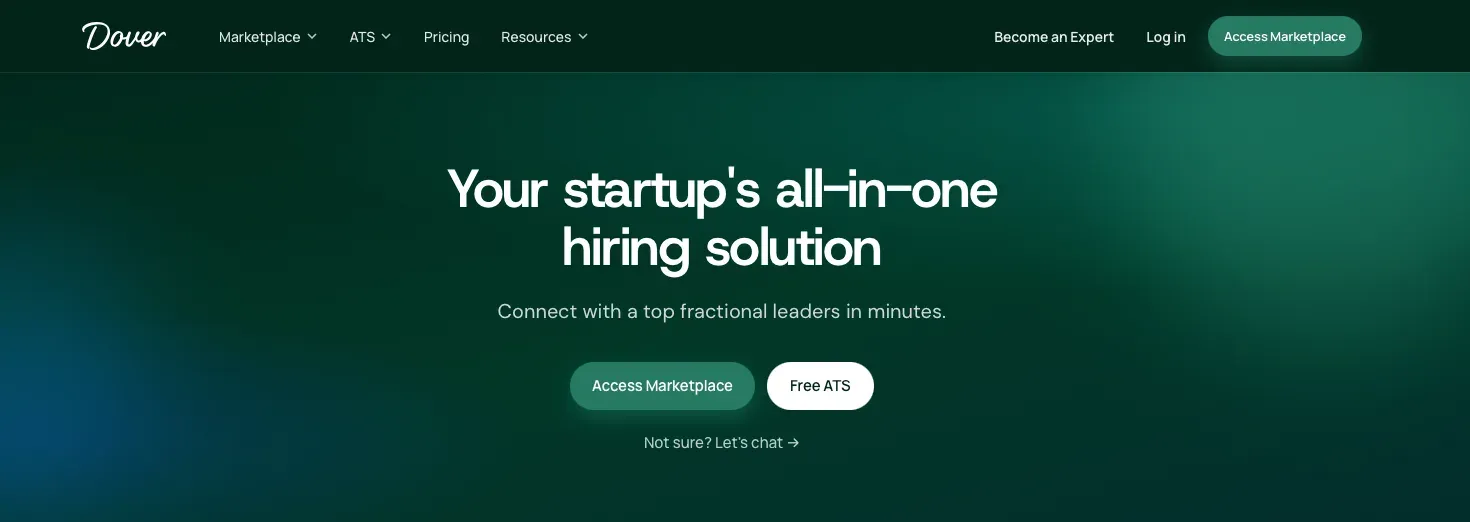
Dover’s free ATS solves that coordination problem directly. You write a job once, distribute it to 100+ boards including LinkedIn and Indeed with one click, and every application lands in a single pipeline. Setup takes under 5 minutes, there are no limits on jobs or users, and the free tier costs nothing indefinitely. If you’re wondering how the Dover ATS is free, the business model explanation is worth reading.
For teams that want human support beyond software, Dover’s recruiter marketplace connects you with fractional recruiters at rates starting around $75/hour, no retainer, with most searches averaging $2,000-$7,000 per hire. Actual cost varies with the recruiter’s hourly rate and the type of role. Every recruiter carries verified reviews from real engagements, so you can assess fit before committing. Many fractional recruiting agencies use Dover as their underlying system, meaning candidate data stays on your side of the relationship and feeds into the same pipeline you are already using. See the full fractional recruiter costs breakdown for more detail.
FAQs
LinkedIn free job posting vs. paid: is the free tier actually usable?
For a single professional role where you want a controlled applicant flow, yes. The free tier caps you at one active post at a time, and LinkedIn stops surfacing the listing in search results once you hit roughly 10 to 30 applicants, a ceiling LinkedIn does not advertise clearly.
How do I post jobs to multiple free job boards at once without creating separate accounts on each one?
The most direct path is using an ATS that handles syndication at submission. You write the job once inside the ATS, and it distributes across boards simultaneously, including Google for Jobs. Applications from every source land in one pipeline.
When should I add a recruiter to my job posting strategy?
An ATS and multi-board distribution handle the mechanics: getting your listing in front of candidates who are actively searching. That covers a lot of ground for roles with strong inbound demand. Where things fall short is on searches where the right candidates aren’t looking, such as senior individual contributors, specialized technical roles, or niche go-to-market positions. At that point, boards have done what they can, and active sourcing is what’s missing. One way to add that capacity without a separate agency contract is through a recruiter marketplace built on the same ATS you’re already using, where recruiters carry verified reviews.
Final Thoughts on Choosing a Free Job Posting Platform That Actually Works
Every free job posting platform comes with tradeoffs worth knowing before you post. LinkedIn suits a single controlled search, Indeed gives broad reach with throttled visibility, and Google for Jobs covers candidates most boards miss. Running multiple searches or editing listings across sites is where the overhead compounds. Dover’s free ATS handles that coordination: one submission, 100+ boards, all applications in one pipeline. For searches where inbound alone falls short, Dover’s recruiter marketplace adds on-demand fractional recruiters at rates starting around $75/hour, no retainer, inside the same system.