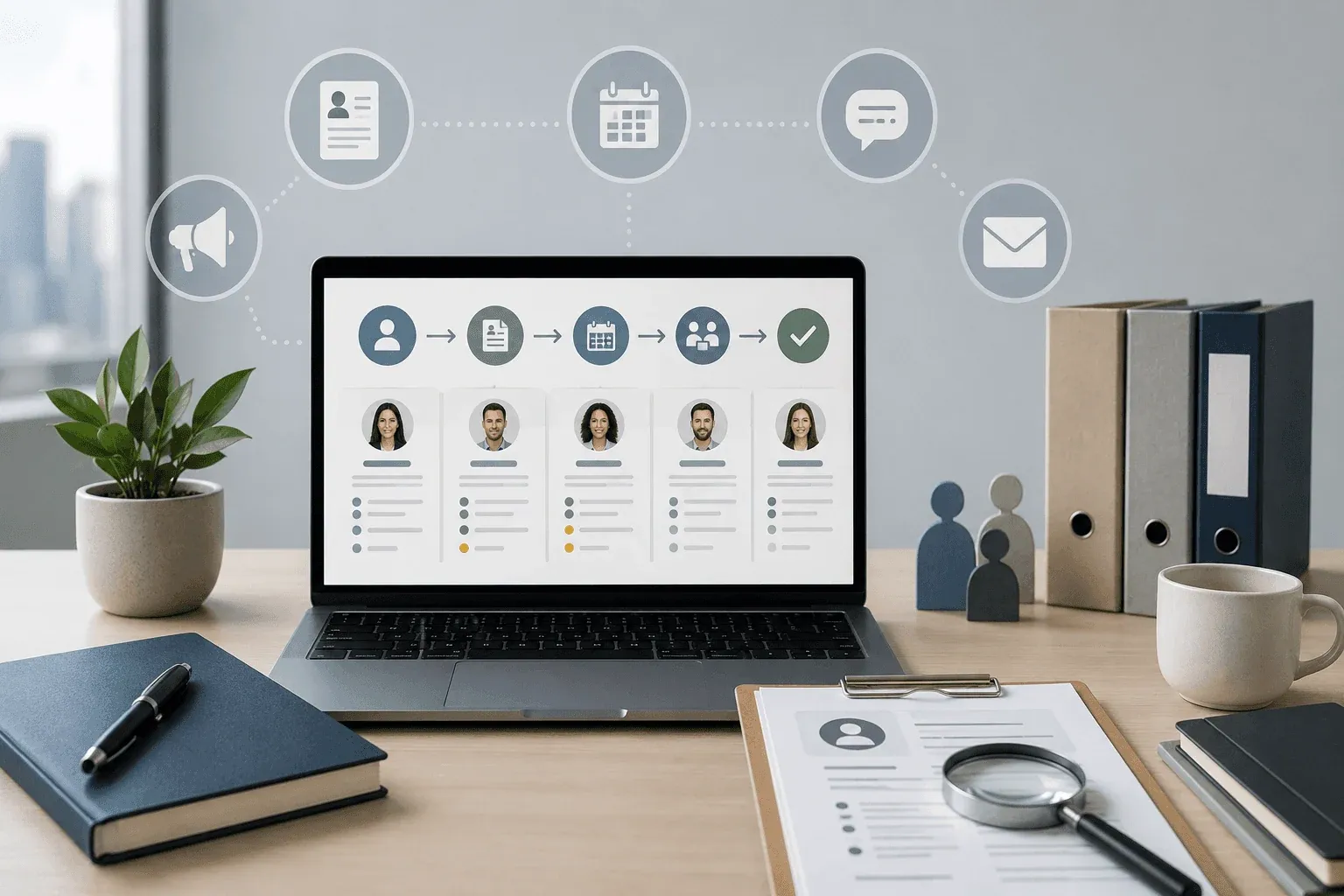
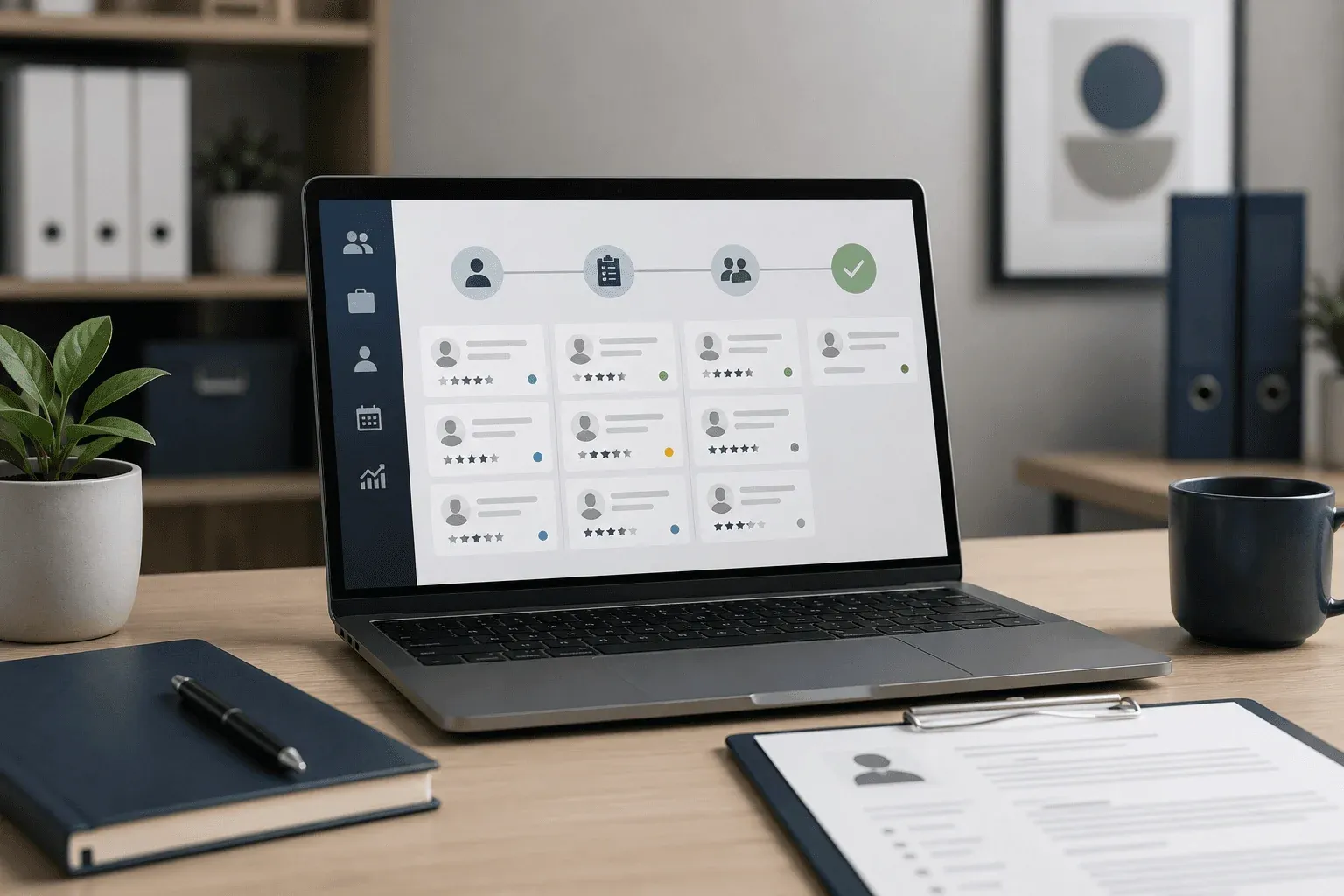
Tracking ten candidates across two open roles sounds manageable until a hiring manager misses a follow-up, a candidate follows up on status you can’t quickly answer, and the spreadsheet hasn’t been touched in a week. Understanding what an ATS is in recruiting, and whether one fits how your team hires, is where most founders land. An ATS (applicant tracking system) is software that keeps that coordination from breaking down, and this guide covers the full picture in plain terms.
TLDR:
-
An ATS replaces the inbox by collecting applications, parsing resumes, and moving candidates through defined stages in one shared place.
-
AI in ATS software can score and rank applicants, but human review still determines who advances; no mainstream ATS is known to reliably detect or reject AI-written resumes.
-
ATS pricing runs from free to $100,000+ annually; free tiers can carry early-stage teams through their first several dozen hires without losing core pipeline features.
-
An ATS manages pre-hire candidate pipelines, an HRIS handles post-hire employee records, and a recruitment CRM tracks passive candidates; most startups only need the first.
-
Some tools pair free ATS software with on-demand recruiting support instead of fixed retainers, covering both tracking and recruiter access on a per-hire basis.
What an ATS Is in Recruiting
An applicant tracking system (ATS) is software that manages job applications from the moment a candidate submits their resume to the moment you make a hire. It collects applications, parses resume data into structured fields, and gives your team a shared place to move candidates through defined stages like phone screen, technical interview, and offer.
The core job of an ATS is replacing the inbox. Without one, applications pile up across email threads, shared spreadsheets, and calendar invites that no single person fully owns. An ATS gives every application a home and every candidate a status.
How an ATS Works: The Hiring Workflow End to End
Job Creation and Distribution
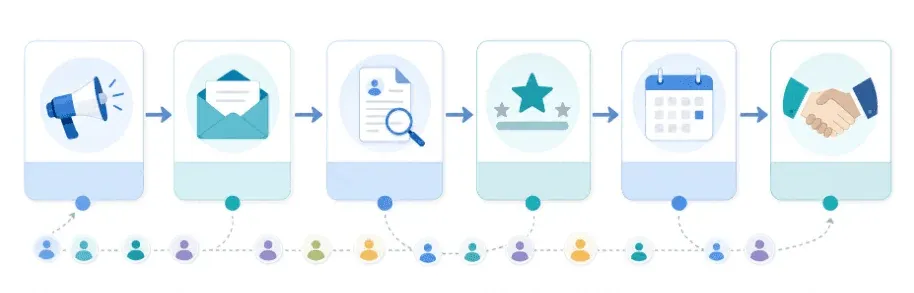
You write a job description inside the ATS, set the required fields, and publish. The system distributes the listing to job boards automatically, anywhere from a handful to 100 or more depending on the tool. Every application that comes back gets routed into a single pipeline, regardless of which board it came from.
Application Review and Screening
As applications arrive, the ATS parses each resume, pulling out structured data like job titles, employers, dates, and skills. Many systems then score or rank candidates against criteria you defined upfront, whether that is years of experience, specific keywords, or required credentials.
Who Uses an ATS and When to Implement One
Hiring managers at growth-stage companies use an ATS to keep multiple open roles organized without letting any candidate fall through. Founders and small teams use free tiers to get a basic pipeline in place before they have dedicated recruiting headcount.
When to Bring One In
The timing question matters more than most founders expect. A few signals suggest an ATS has become worth setting up:
-
You are tracking more than a handful of candidates across more than one open role, and a spreadsheet requires constant manual upkeep just to stay current.
-
Candidates are following up about their status and you have no quick way to check where they are in the process.
-
You are coordinating interviews across multiple interviewers and losing time to scheduling back-and-forth with no central record of feedback.
-
You are posting the same job to multiple boards manually each time a role opens.
Once a second or third role opens concurrently, the coordination cost of not having a system tends to compound faster than the setup cost of getting one in place.
The Real Benefits of Using an ATS
Founders who have spent time sorting through inbound applications in a spreadsheet know what happens after a few dozen candidates pile up: columns drift, follow-up dates get missed, and it becomes hard to tell who got a rejection email and who is still waiting. An ATS removes that friction at the source.
-
Automated status updates and email triggers keep candidates informed without requiring a hiring manager to write individual follow-up messages after every stage moves.
-
Structured interview workflows give everyone on the hiring team the same scorecard and question set, so feedback is comparable across candidates instead of impressionistic.
-
Compliance recordkeeping captures the data trail required for equal employment opportunity reporting and audit readiness, which matters more once headcount grows past a handful of people.
The less obvious benefit is speed. An ATS does not make interviews faster, but it compresses the dead time between them. For a startup competing against larger employers, enterprise ATS platforms for startups often introduce more overhead than they solve, and cutting a week out of the process can be the difference between closing a candidate and losing them to a faster-moving offer.
ATS and AI: What Is Actually Automated
AI has become a genuine part of how many ATS products work, though the gap between what vendors advertise and what actually runs under the hood is worth understanding before you buy.
-
Resume parsing uses pattern recognition to pull structured data from unstructured documents, reading job titles, dates, and skills out of uploaded files so candidates land in the right fields without manual data entry.
-
Candidate scoring ranks applicants against criteria you define, such as years of experience or specific skills, and surfaces higher-matching profiles toward the top of your queue.
-
Automated communication sends acknowledgment emails, status updates, and interview scheduling links based on triggers you configure, reducing the back-and-forth that slows pipelines down.
What AI in an ATS does not do is make hiring decisions autonomously. The screening layer flags and ranks; a human still reviews and advances candidates.
ATS vs. HRIS vs. Recruitment CRM: What Is the Difference
These three categories operate at different stages of the employee lifecycle, and mixing them up leads to buying software you don’t yet need. A breakdown of HRIS vs. ATS differences makes the distinction clear: one manages the recruiting phase, the other tracks employees over time.
| Tool | What It Manages | When You Need It |
|---|---|---|
| ATS | Pre-hire candidate pipeline | Open roles, inbound applications, interview coordination |
| HRIS | Post-hire employee records, payroll, benefits | Once you have employees to administer |
| Recruitment CRM | Passive candidate relationships, talent nurturing | When proactive sourcing is a core part of your strategy |
A recruitment CRM sits on the opposite end. Where an ATS manages active candidates who have already applied, a CRM helps you build relationships with passive candidates who haven’t applied yet.
How Much Does an ATS Cost
The price range is wide: you can run a meaningful hiring process for free, or spend $100,000 a year on recruiting software. What drives costs up is usually per-seat licensing, job volume limits, ATS integrations with payroll or HRIS tools, and implementation help. Free tiers often get dismissed as stripped-down, but that is not accurate. How the Dover ATS is free makes this clear: some tools offer unlimited jobs and users with no expiration, covering everything a startup needs through its first several dozen hires.
How to Choose an ATS for Your Startup
Choosing an ATS involves matching the tool’s actual capabilities to where your team is right now, not where you hope to be in two years.
Consulting a guide to the best applicant tracking systems for 2026 can help narrow the field; for early-stage teams making their first few hires, free ATS options and entry-level plans often cover the basics: job postings, candidate tracking, and interview scheduling. The tradeoff is that free tiers typically cap users, limit integrations, or restrict reporting.
A few variables worth assessing before committing:
-
How many roles you plan to open in the next six months, since some tools charge per job posting instead of per user
-
Whether you need multi-channel sourcing built in or just a place to organize inbound applicants
-
How much of your interview process relies on structured feedback, since scoring and rubric features vary widely across tools
-
Whether your team has someone who can configure and maintain the system, or needs something that works out of the box in minutes
Why Dover Works for Early-Stage Startups
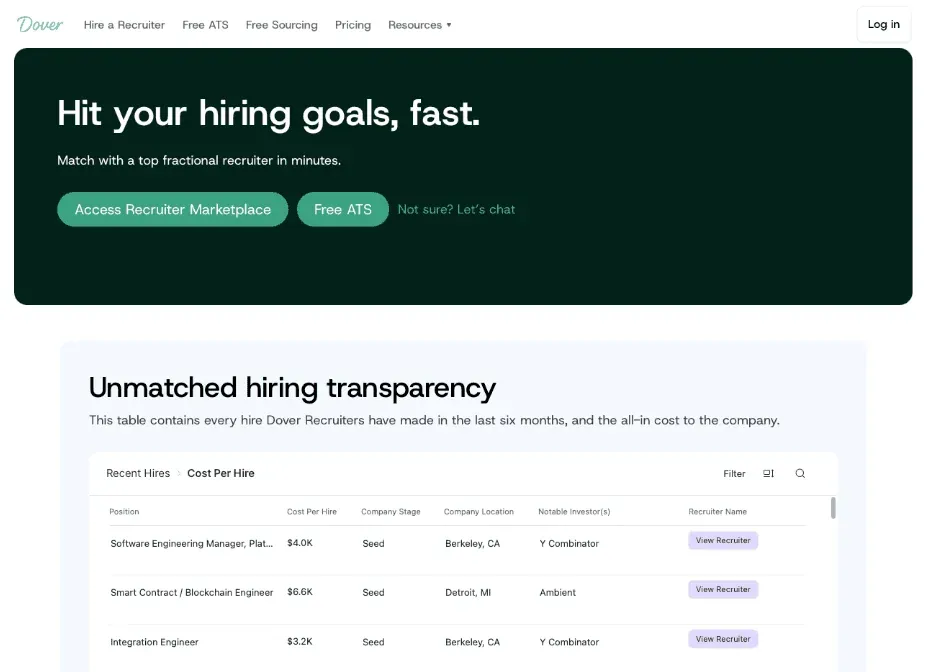
Dover is built for the recruiting reality most early-stage startups face: managing inbound applicants, coordinating interviews, and posting to multiple boards without a dedicated recruiting team or an expensive software contract. The free ATS covers that foundation from the first hire forward, with no limits on jobs or users and setup that takes under five minutes.
The ATS includes job posting to 50+ boards from a single interface, AI-powered applicant scoring, automated interview scheduling, and candidate pipeline tracking. There is no cost tied to the number of roles you open or the number of people on the hiring team, which means the software stays free as headcount and hiring volume grow.
For roles where inbound alone isn’t enough, Dover’s fractional recruiter marketplace lets you bring in an experienced recruiter who sets their own rate, with hires averaging about $4,800, with no long-term contract required. The recruiter works directly inside the same ATS, so the hiring team has real-time pipeline visibility without managing a separate coordination layer.
Frequently Asked Questions
What is an ATS in recruiting, and how is it different from an HRIS like Workday?
An ATS (applicant tracking system) manages the pre-hire candidate pipeline: job postings, application review, interview coordination, and offer management. An HRIS like Workday handles post-hire employee records, payroll, and benefits. Workday does include a recruiting module, but its architecture was built around employee administration first, which is why teams hiring at volume often run a standalone ATS alongside it instead of relying on Workday’s recruiting features alone.
Is there a free applicant tracking system that actually works for early-stage startups, or do you need to pay for something useful?
Several free ATS options are genuinely functional for early-stage teams, not stripped-down trials. Dover’s free ATS, for example, includes job posting to 50+ boards, resume parsing, candidate tracking, interview scheduling, and AI-powered applicant scoring with no limits on jobs or users. Free tiers tend to have ceilings in reporting depth or advanced integrations, but for a startup managing its first several dozen hires, those limitations rarely surface before paid features become worth considering.
Can an ATS detect or reject AI-generated resumes?
No mainstream ATS reliably identifies AI-generated resumes. Some products integrate third-party AI content detection tools, but those carry meaningful false-positive rates and no standardized methodology. Candidates who format their documents for clean parsing tend to move through screening regardless of how the content was written. The ATS filters on criteria you configure (years of experience, skills, credentials), not on how a resume was drafted.
Final Thoughts on Choosing the Right ATS and Recruiting Tools for Your Startup
Understanding what an ATS is in recruiting is a starting point; the right fit depends on where your team is right now, not where you hope to be in two years. Free tools can carry early-stage teams further than most founders expect, and Dover is one concrete place to start: a free ATS with no user or job limits, setup in under five minutes, and access to fractional recruiters when a role needs more than software alone.