You’re three weeks into setting up an enterprise ATS, and you still can’t post a job without configuring role templates, requisition approvals, and permission hierarchies that assume a recruiting team you don’t have. The system was designed for organizations with dedicated HR staff and multi-department workflows. For a startup trying to hire quickly, that complexity compounds fast. An enterprise ATS too complex for startups doesn’t professionalize your hiring process. It turns into another bottleneck slowing you down.
TLDR:
-
Enterprise ATS products were built for Fortune 500 HR teams with dedicated administrators, not founders managing recruiting alongside every other business function.
-
Setup and onboarding can run weeks or months, pulling focus from actual hiring when small teams need to move fast on two or three critical roles.
-
A poorly scoped ATS implementation can cost as much in lost recruiter productivity as the license itself, particularly in the first six months.
-
Startups need software that posts jobs in minutes and moves candidates through stages in a few clicks, not approval chains and compliance workflows built for multi-department review.
-
Some tools pair a free ATS with on-demand recruiting support, matching how startups actually hire: inconsistently, across roles that vary in urgency, with no institutional memory of last quarter’s process.
Why Enterprise ATS Systems Are Built for the Wrong Buyer
Enterprise ATS products were built to serve procurement cycles, compliance checklists, and HR departments with dedicated administrators. The buyer profile that shaped their feature sets is a Fortune 500 company with hundreds of open roles, a legal team with specific audit requirements for applicant tracking systems, and an IT department to manage integrations. That context produced software loaded with approval workflows, permission hierarchies, and configuration layers that assume someone’s full-time job is managing the system itself.
Startups occupy a completely different hiring reality. A founding team or early operator is typically running sourcing, scheduling, and candidate communication alongside every other business function. The complexity baked into enterprise ATS products doesn’t disappear because the company is smaller; it just falls on fewer people.
| Aspect | Enterprise ATS | Startup-Focused ATS |
|---|---|---|
| Setup Timeline | Weeks or months with vendor-led implementation and dedicated resources required before posting first job | Under five minutes to set up with jobs posted and applications collected the same day |
| Pricing Structure | Base contracts in tens of thousands annually plus per-seat charges, module add-ons, and implementation fees | Free core ATS with optional recruiter support billed at $75 to $125 per hour or $2,000 to $7,000 per hire |
| Primary User | Dedicated HR teams with administrators, IT support, and multi-department approval workflows | Founders and hiring managers running recruiting alongside other business functions without dedicated staff |
| Core Workflow | Multi-level approval chains, compliance audit trails, role-based permissions, and HRIS integrations for enterprise governance | Post jobs in minutes, collect applications centrally, move candidates through stages with a few clicks, gather quick feedback |
| Training Requirements | Multi-day onboarding sessions, vendor-led walkthroughs, and sometimes certified administrators to operate basic functions | Flat interface where hiring managers see what they need to act without training or administrative delegation |
Where the Mismatch Shows Up
The gap between enterprise ATS design and startup needs tends to surface in a few predictable ways:
-
Setup and onboarding in enterprise systems can run weeks or months, often requiring dedicated implementation support. For a startup that needs to start interviewing candidates quickly, that timeline can delay hiring when it matters most.
-
Role-based permissions and multi-level approval chains are built for organizations where hiring decisions touch legal, finance, and executive review simultaneously. For a team of five, those structures add friction without adding value.
-
Reporting and analytics suites sized for quarterly board reviews generate dashboards that small teams rarely have time to interpret, let alone act on.
-
Integration requirements assume an existing tech stack of HRIS, payroll, and compliance tools. Startups without those systems often pay for connectors they don’t need, which is why small business hiring software takes a different approach.
The core issue is that enterprise ATS products charge for depth that early-stage teams won’t use and can’t afford to manage.
The True Cost of Enterprise ATS Goes Far Beyond the License Fee
The license fee is usually the number founders fixate on, but it rarely tells the whole story. Enterprise ATS pricing often starts with a base contract in the tens of thousands of dollars annually, then layers on per-seat charges, module add-ons, and implementation fees that can push total first-year costs considerably higher.
Beyond the invoice, there are soft costs of hiring that accumulate just as fast. Configuration and onboarding for an enterprise system can take weeks or months, pulling engineering time and recruiting attention away from actual hiring. Training non-technical hiring managers on a system built for dedicated HR teams adds friction at every step. And when the system requires a dedicated administrator to keep workflows running, you are effectively hiring for a role that exists only to manage your hiring software. Enterprise ATS deployments can exceed $100,000 annually when you factor in all the hidden setup and training costs.

There is also the cost of delay. Every week spent configuring approval chains, setting up compliance workflows, or troubleshooting integrations is a week your pipeline sits idle. For a startup trying to close two or three roles quickly, that lag can affect offer timelines, candidate experience, and whether strong candidates stay engaged at all.
Some estimates suggest that a poorly scoped ATS implementation can cost as much in lost recruiter productivity as the license itself, particularly in the first six months. For early-stage teams with lean headcount, that tradeoff is hard to absorb without feeling it across the business.
Feature Bloat Creates Friction Instead of Solving Problems
When an ATS is built for a 500-person HR team, every feature it ships reflects that team’s reality: compliance workflows, granular permission hierarchies, multi-department approval chains, HRIS integrations that took six months to configure. For a startup hiring its first ten engineers, those features don’t fade into the background. They get in the way.

The friction shows up immediately. Before you can post a job, you’re configuring role templates, setting requisition approval flows, and mapping fields that assume a recruiting org that doesn’t exist yet. Onboarding alone can take weeks, and that’s before a single candidate enters the pipeline.
There’s also a cognitive cost that’s harder to measure. Every unnecessary menu, unused integration tab, and required field that doesn’t apply to your context pulls attention away from the actual work of hiring. For a founder or hiring manager running recruiting as one of a dozen responsibilities, that overhead compounds fast.
The irony is that enterprise ATS products often advertise depth as a feature. But depth only helps when you have the headcount to use it, which is why comparing applicant tracking systems for your actual needs matters. Without that, you’re carrying the weight of a system designed for scale you haven’t reached, and paying for it in time every time you open the tool. Feature bloat in enterprise software creates complexity that drains productivity instead of supporting it.
What Startups Actually Need From Hiring Software
Strip away the enterprise complexity and the startup hiring workflow is short: post a job, collect applications centrally, move candidates through a few stages, gather quick feedback from a small group of interviewers, and extend an offer.
What that workflow needs from software is equally straightforward. Jobs should go live in minutes. Applications from multiple sources should land in one place automatically. Moving a candidate from screen to offer should take a few clicks, not a configuration session. Feedback from two or three interviewers should be easy to collect and compare without a dedicated HR coordinator managing the process.
The list of things a startup does not need is longer: compliance audit trails built for compliance-heavy industries, multi-department approval chains, headcount planning modules, and integrations with enterprise HRIS systems the team has never heard of.
The mismatch matters because every feature a startup does not need still costs something. It costs time during setup, confusion during onboarding, and friction every time someone on the team opens the tool and has to work around menus built for a different kind of organization.
How Dover Removes Complexity Without Sacrificing Capability
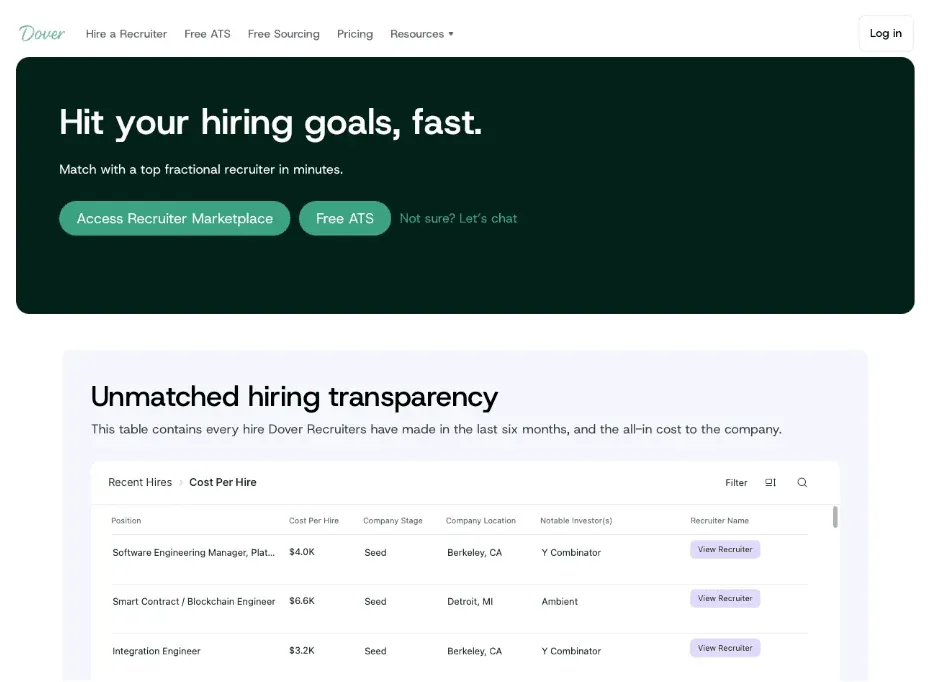
Dover’s free ATS is built around the reality that early-stage teams don’t have time to configure scoring rubrics, train hiring managers on multi-tab dashboards, or audit compliance workflows before making their first offer. The setup takes under five minutes, and the core pipeline view gives everyone on the team the same unambiguous picture of where each candidate stands.
Where enterprise tools layer complexity on top of collaboration, Dover keeps the interface flat. Hiring managers see what they need to act. Founders don’t need to delegate ATS administration to someone whose actual job is something else entirely.
The recruiter marketplace adds a dimension that no amount of configuration in a legacy system can replicate. When a search needs more hands-on work, Dover connects teams with experienced recruiters who have deep startup hiring backgrounds, without requiring a separate vendor relationship or a retainer commitment. The cost per hire runs $2,000 to $7,000, with recruiter support billed at $75 to $125 per hour, while the core ATS remains free.
That structure matters because it matches how startups actually hire: inconsistently, across roles that vary in seniority and urgency, with a team that has no institutional memory of last quarter’s hiring process. A free ATS with on-demand recruiting support fits that pattern in a way that an enterprise system scaled for procurement cycles and HR departments simply cannot.
Frequently Asked Questions
How long does enterprise ATS implementation take for a startup?
Enterprise systems can take weeks or months, often requiring vendor-led onboarding, workflow configuration, and IT support before posting your first job. Startup-focused ATS tools can be set up in under five minutes, letting you post jobs and collect applications the same day.
Can a startup use an ATS without hiring a dedicated HR administrator?
Yes, if you choose tools built for small teams. Enterprise ATS products assume someone’s full-time job is managing the system, but startup-focused tools keep the interface flat so founders and hiring managers can post jobs, move candidates, and gather feedback without training or administrative delegation.
How does fractional recruiting pricing compare to traditional agency fees?
Traditional agencies charge 15 to 25% of first-year salary as a placement fee, running $18,000 to $30,000 for a $120,000 hire. Fractional recruiters bill hourly at $75 to $125, with most roles filling in 20 to 30 hours of work, putting total cost around $2,000 to $7,000 per hire.
Final Thoughts on Enterprise ATS Complexity That Doesn’t Scale Down
An enterprise ATS too complex for startups doesn’t get simpler because your team is small. The feature depth enterprise products charge for doesn’t become useful just because you need hiring software. Setup timelines that assume dedicated implementation resources, approval chains built for multi-department review, and integrations with systems your team hasn’t heard of create friction at every stage. Dover takes a different approach: a free ATS built for early-stage teams, with on-demand recruiter support available when searches need more hands-on work, so the tool fits how startups actually hire instead of the other way around.