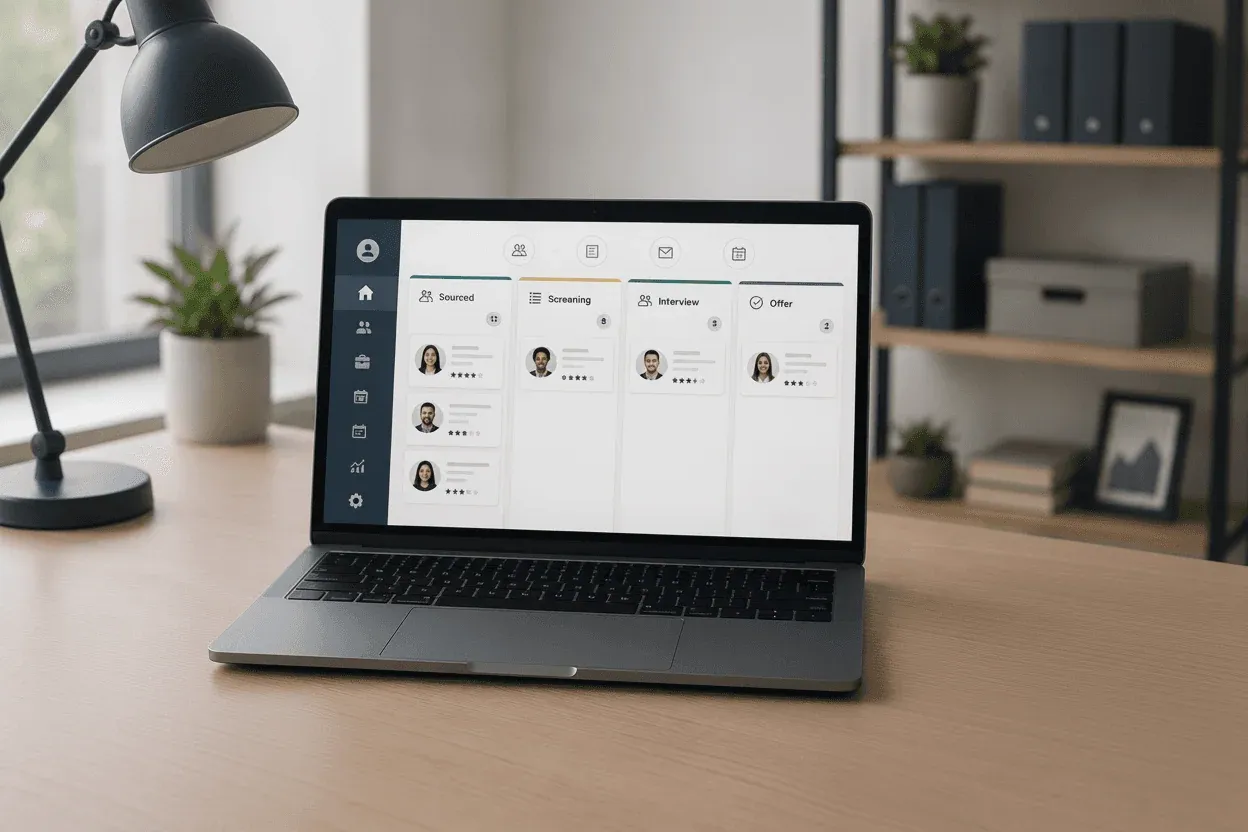

Building a startup team is exciting and demanding at once. You don’t need a large software budget or a full-time recruiting staff to hire well, just tools that keep candidates moving and scale as your headcount grows. Below is a breakdown of the must-have categories every startup recruiting tech stack should cover, and what to look for in each one.
TLDR:
-
A startup recruiting tech stack covers 8 core categories: ATS, sourcing, scheduling, CRM, referrals, collaboration, background checks, and onboarding.
-
Referred candidates tend to have shorter time-to-hire and lower cost-per-hire than candidates sourced from job boards, per SHRM research.
-
More than half of startup talent teams now use AI across multiple hiring workflows, making AI-assisted tools a baseline expectation in 2026.
-
Tools that don’t integrate with each other create friction; choosing platforms with native integrations or open APIs keeps your stack usable.
-
Some tools combine a free ATS with on-demand recruiting support, giving teams on a tight budget a way to manage pipelines without adding full-time headcount.
Applicant Tracking System (ATS)
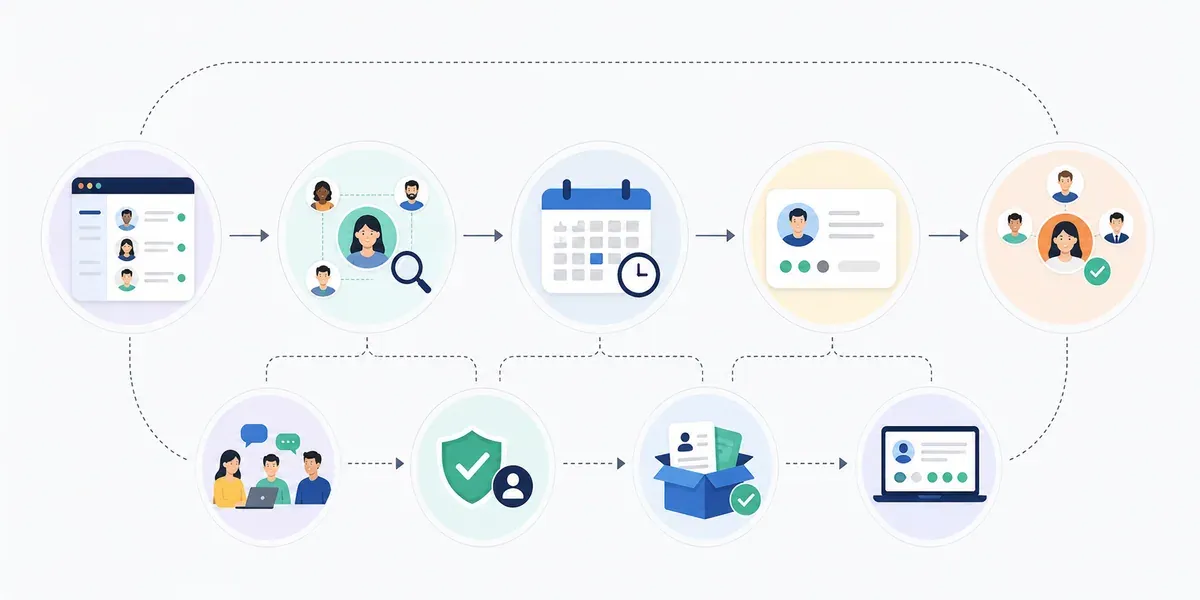
An ATS organizes and centralizes candidate data, tracking applicants at every stage so none of them fall through the cracks. It handles pipeline management well on its own, but some searches outgrow what internal bandwidth can cover: a specialized role, a senior hire, or no recruiter on staff to run sourcing. At that point, a fractional recruiter can plug in on top of the existing ATS without the team switching systems or re-entering candidate data elsewhere.
Dover’s Recruiting Partners marketplace is built on the same ATS, so when a search needs more hands-on support, a fractional recruiter steps directly into the existing pipeline instead of starting a new one. There’s no handoff to a separate system and no re-entering candidate history. Each recruiter in the marketplace carries vetted, real client reviews, so a team can check track record before bringing someone onto a search.
Key benefits of an ATS include:
-
Simplifies job description creation and posting to job boards
-
Automates tasks like email follow-ups and interview scheduling
-
AI can help score resumes and surface strong candidates for recruiter review
Dover offers these benefits in a free ATS, with AI applicant scoring available on the $199/month Premium plan. Check out Dover’s free ATS to see how it can improve your recruiting tech stack.
Candidate Sourcing Tools
Candidate sourcing tools help you find talent across platforms and cut down time-to-hire. Some features to look for include:
-
Job description generation and templates
-
Job board posting tools
-
Resume sorting and filters to find candidates
Startups commonly turn to tools like LinkedIn Recruiter, SeekOut and Gem to find candidates across platforms. Dover’s platform has sourcing tools to help you automate and simplify the sourcing process.
Interview Scheduling and Video Interviewing Platforms
Coordinating interviews across multiple candidates, roles and interviewers gets complicated fast. 2026 hiring research finds that interviews per hire are up 33% overall as hiring teams grow more selective, which makes scheduling tools that can:
-
Automate scheduling and sync calendars with candidate availability
-
Automate scheduling and follow-up communications so candidates stay engaged
Dover has you covered for easy interview scheduling, and a video interviewing platform makes connecting with candidates easy at any time of day, even for on-site teams. Popular options include:
-
Zoom
-
Willo
-
Google Meet
Recruiting CRM (Customer Relationship Management)
A recruiting CRM helps you build and nurture relationships with potential hires, keeping candidates engaged and feeling respected throughout the hiring process.
Some features to look for in your CRM include:
-
Tracking candidate interactions
-
Managing hiring pipelines
-
Features to personalize and automate communications
Dover gives you tools for keeping candidates engaged. If you need additional help engaging candidates and getting them through recruitment, we also offer our Recruiting Partners marketplace. This marketplace lets you instantly connect with freelance startup recruiters who are ready to help you with any hiring task, including candidate relationships. Dover functions as the underlying system many fractional recruiting agencies run on, rather than a standalone marketplace layered on top of someone else’s tools. Each recruiter listed carries vetted reviews from past clients, so you can read real feedback before choosing who to work with.
Employee Referral Platforms
Employee referrals can be one of the best ways to find qualified and culturally aligned candidates. Your team knows what the company needs, and they may already have connections that can step in and start making an impact. Referral platforms make it easy for team members to submit referrals, with benefits like:
-
Gamifying referrals with rewards or incentives
-
Creating a simplified process for referrals
-
Reduced hiring costs and improved quality of new hires
Research from SHRM’s 2025 benchmarking data finds that referred candidates tend to have a shorter time-to-hire and lower cost-per-hire than candidates sourced from job boards.
If you need a referral platform, you could consider platforms like:
-
Boon
-
Teamable
-
EmployUs
Collaboration and Feedback Tools for Hiring Teams
Recruiting is a team effort, and collaboration tools help keep hiring managers, recruiters and interviewers on the same page for better decisions and better hires.
Some must-have features of collaboration tools include:
-
Centralized location to share candidate evaluations and feedback
-
Real-time communication
-
Integration with your ATS for smooth updates
Some popular collaboration tools include:
-
Slack
-
Trello
-
Notion
Background Check and Assessment Tools
Background check and assessment software verifies candidates’ credentials and skills while confirming compliance and accuracy. Key benefits include:
-
Automated background screening to verify employment history, criminal records and other relevant information
-
Skill assessment templates tailored to specific roles
-
Reduced risk of bad hires by confirming candidates meet the job requirements
Some popular background check and assessment tools include:
-
Checkr
-
HireRight
-
Codility
Onboarding and Employee Engagement Tools
Onboarding and employee engagement tools help new hires settle in and stay with the company once they accept an offer.
-
Digital onboarding checklists for new hires
-
Training tools and resources for new hires to access
-
Engagement and feedback surveys to give you insight into employee preferences and the onboarding process
Some popular onboarding and employee engagement tools include:
-
BambooHR
-
Lattice
-
Trello
| Tool Category | Primary Purpose | Key Feature | Dover Covers It? |
|---|---|---|---|
| Applicant Tracking System (ATS) | Organize and track candidates through the hiring process | AI assistance to score resumes (Premium) | Yes |
| Candidate Sourcing | Find qualified candidates across platforms | Job board posting and resume filters | Yes |
| Interview Scheduling | Coordinate interviews across candidates and interviewers | Calendar syncing and automated follow ups | Yes |
| Recruiting CRM | Build and nurture candidate relationships | Pipeline management and personalized communication | Yes |
| Employee Referral | Encourage team referrals for qualified candidates | Gamified rewards and a simple referral process | Yes |
| Collaboration & Feedback | Keep hiring teams aligned on candidate decisions | Shared evaluations and real-time communication | Yes |
| Background Check & Assessment | Verify candidate credentials and skills | Automated screening and skill assessment templates | No |
| Onboarding & Engagement | Integrate and retain new hires | Digital checklists and engagement surveys | No |
What’s New in Startup Recruiting Tech (2026)
According to Ashby’s 2026 State of Startup Hiring report, more than half of startup talent teams now use AI across multiple hiring workflows, which suggests AI-assisted sourcing, screening and scheduling have become a baseline expectation rather than a differentiator. For startups building their stack now, tools without some form of AI assistance may add friction that competitors have already reduced.
Founders searching for the best hiring tools for YC-backed startups often land on the same shortlist: an applicant tracking system, a sourcing tool and some way to loop in outside recruiting help without a full-time hire. Many YC startups lean on a mix of spreadsheets early on, then move to dedicated recruiting platforms once the first few roles get hard to fill or coordinate. For teams just starting to hire, a free ATS matters because budget is tight and headcount for recruiting operations is usually zero. Dover’s free ATS fits each of these scenarios: it gives bootstrapped startups a no-cost way to post jobs, track candidates and manage a pipeline, and it pairs with on-demand recruiters when a YC startup needs more hands-on sourcing support without a long-term commitment.
Integrating Your Recruiting Tools for Better Results
A few practices keep tools working together instead of against each other. Integrating them is key to building a smooth and usable recruiting tech stack.
-
Choose platforms that offer native integrations or open APIs
-
Use tools that sync data across systems
-
Train your employees on your stack and confirm they have the knowledge and resources to use it well
-
Regularly review your stack and upgrade your tools or adjust them as needed
As one example, Dover’s ATS connects with calendar tools so interview times sync with candidate availability without anyone manually checking schedules. The same connection can push candidate status updates into Slack, so a hiring manager sees a candidate move from phone screen to onsite in a channel they already check, rather than logging into a separate system to find out.
Why a Recruiting Tech Stack Matters for Startups
It might seem like a lot of tools, but each one removes a specific slowdown that a growing startup can’t afford while building a team in a competitive job market. The right stack gets you faster hiring speed, a better candidate experience and easy scaling as headcount grows. Which tools belong in that stack often comes down to where a startup is in its hiring curve and how much internal bandwidth exists to manage each process.
How Dover Fits Into a Startup Recruiting Stack
Dover’s free ATS covers the categories that create the most coordination friction for early teams: job posting to 50+ boards, candidate pipeline tracking, interview scheduling, and AI-powered resume scoring on the Premium plan. The free tier has no limits on jobs or users, so a seed-stage team can start managing candidates on day one without a software budget. Several fractional recruiting agencies run their work through Dover’s system directly, and the recruiters listed in the marketplace carry vetted reviews from past engagements. When a search gets difficult to fill or the internal bandwidth simply runs out, Dover’s Recruiting Partners marketplace connects startups directly with experienced fractional recruiters who work inside the same ATS, giving founders real-time visibility into sourcing activity without switching systems or handing off pipeline ownership to an external vendor.
For a startup weighing which tools belong in its stack, Dover’s model covers the structural bind most early teams face: the free ATS replaces the need for a paid tracking tool, while on-demand recruiting support replaces the need for a full-time recruiter or a contingency agency. Whether a team is filling its first two roles or scaling through a Series A hiring push, the stack does not require a ramp-up commitment or a contract to get started.
FAQs
Can I build a startup recruiting stack without paying for an ATS?
Yes. Free ATS options exist that cover the core functions most early-stage teams need, including job posting to 50+ boards, candidate pipeline tracking, and interview scheduling, without per-seat fees or annual contracts. Dover’s free ATS, for example, has no limits on jobs or users and pairs with on-demand recruiting support when a search needs more hands-on work.
How do I integrate multiple recruiting tools without creating a fragmented hiring process?
Choose tools that offer native integrations or open APIs so candidate data syncs across systems instead of living in separate places. As one example, an ATS that connects with calendar tools and pushes status updates to Slack means a hiring manager sees a candidate advance without logging into a separate system to check.
Do I need a recruiter if I already have an ATS?
An ATS keeps candidates organized and moving through each stage, but it won’t source passive talent, qualify a resume against a role’s real requirements, or close a candidate who has a competing offer. If a role sits open past a normal timeline, carries senior or specialized requirements, or the internal team has no spare hours to run outreach, a fractional recruiter working inside the same pipeline can cover that gap without replacing the ATS or adding full-time headcount.
Final Thoughts on Building a Recruiting Stack That Actually Works
Getting started does not require getting everything right at once. Most early teams do well with three things: a way to track candidates, a way to reach them, and a way to schedule without the back-and-forth. The right startup recruiting tech stack grows from there as specific friction points appear. Dover pairs a free ATS with on-demand fractional recruiters inside the same system, so pipeline visibility stays intact when a search needs more hands-on work than the internal team can cover