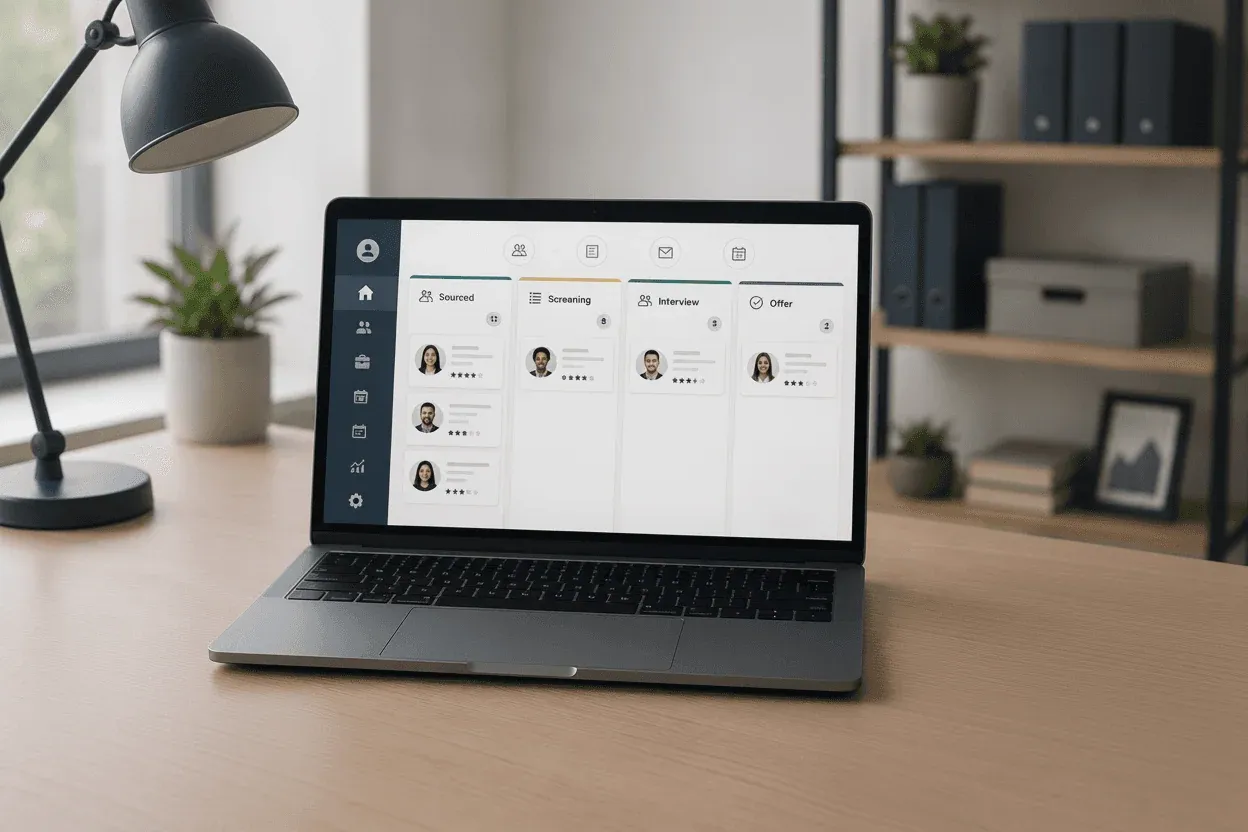

Once you’re filling more than one or two roles at a time, candidates stall, follow-ups slip and good applicants fall through the cracks. A founder’s spreadsheet or inbox can track a handful of hires, but it starts to break down as soon as hiring picks up pace. Tailoring an ATS to startup hiring needs is how teams keep candidates organized and moving through the pipeline without adding coordination overhead, though not every ATS fits a startup’s limits, so this post covers what to look for in one built for your stage and how to pick the option that fits.
TLDR:
-
Startups need an ATS built for simple setup, candidate tracking, automation, and job board posting.
-
Recruitment automation can cut time-to-hire by up to 30% by handling scheduling and outreach.
-
AI-assisted screening tools can score and sort resumes against your criteria, reducing manual review time.
-
Some free ATS tools cover candidate tracking and job board distribution with no paid plan required.
-
Some tools go further by pairing a free ATS with on-demand recruiting support, so teams can add sourcing help for harder searches without switching systems or signing a contract.
Why Startups Need a Customizable ATS

Startups operate in a fast-paced world where demand for new employees can hit as soon as you start to grow. During the early stages, you might have the time to carefully hire your small team, but the number of roles and volume of applicants can quickly get out of hand when you scale up. Having an ATS helps you adapt to these shifts. ATS adoption research suggests that more than 86% of recruiters report reduced time-to-hire after implementing one. An ATS also allows you to keep the hiring process efficient without sacrificing quality, so you end up with the right person for the role.
Customizable ATS platforms are especially advantageous because you can tailor your ATS to your hiring needs. Whether you need to simplify hiring workflows, automate repetitive tasks or look at your hiring metrics, an ATS can be adjusted to keep your hiring processes consistent and effective, and ATS adoption benchmarks show that 79% of recruiters report higher hire quality after implementation. With that in mind, let’s look at the features you should look for in your applicant tracking system.
Key Features to Look for in an Applicant Tracking System
You’ll likely find that the startup-focused ATS options are focused on intuitive design, easy setup and simplicity without all of the bells and whistles of those Applicant Tracking Systems built for large companies.
Meanwhile, the ATS options built for larger companies tend to prioritize a more in-depth, feature-heavy platform. This is because in-house recruiting teams for larger companies have huge hiring demands and they have time and headcount to focus on hiring, which isn’t typically the case with most startups. So, if you’re a startup, you should look for an ATS that offers features like:
| Feature | What it does | Why startups need it |
|---|---|---|
| Candidate Tracking | Gives a top-down view of every applicant and their current stage in the pipeline. | Keeps strong candidates from stalling between stages when a founder is context-switching across a dozen other priorities. |
| Automation | Handles follow-up emails, interview scheduling, and status updates without manual input. | Recruitment automation research indicates companies using automation for sourcing and scheduling report up to 30% faster time-to-hire on average. |
| AI Applicant Scoring | Scores and ranks resumes against parameters you define, so the strongest candidates surface first. | Cuts the time spent on manual resume review when inbound volume spikes, without requiring a dedicated recruiter to triage the queue. |
| Analytics | Tracks metrics like time-to-hire and candidate drop-off rates across the pipeline. | Surfaces where searches stall, whether that’s at the screening stage, between interviews, or at offer, so the process can be adjusted before a role stays open too long. |
| Sourcing & Job Board Distribution | Generates job descriptions and distributes them across job boards; some tools also support direct outreach to passive candidates. | Posting to a single board limits reach; broad distribution and outreach tools widen the top of the funnel without adding manual work per board. |
| Pricing | Ranges from free tiers covering core tracking and posting to paid plans adding AI scoring, automation, and advanced analytics. | For a pre-Series A team, paying for a feature set you can’t yet use adds cost without benefit. A free plan that covers the core workflow is the practical starting point. |
An ATS handles the coordination layer: tracking candidates, scheduling interviews, posting to job boards. But some roles push past what software alone can move. Senior hires, specialized technical searches, or roles where passive sourcing is the only real path forward often need hands-on recruiting work that the ATS can’t substitute for, and that gap usually shows up as a team scales or a search gets harder to fill on its own.
Once you choose your ideal ATS, the next step is tailoring its features to fit your hiring needs. Let’s take a look at what you can do to make your ATS work for you.
Putting These Features to Work
Not every ATS delivers these features equally well. Some free tools cover only the basics, like candidate tracking and job board posting, while leaving automation and scoring behind a paid plan. Dover is one option built to offer the full set without that tradeoff.
How Dover’s ATS for Startups Works
Dover’s ATS was designed specifically to meet the hiring needs of startups, with job board distribution to 50+ boards, candidate tracking, email templates, and interview scheduling in one system, plus AI applicant scoring on the Premium plan.
One of Dover’s standout features is AI applicant scoring (Premium, $199/month), and the scoring criteria can be set per role rather than applied as one fixed standard across every opening. A senior engineer search can weight toward depth of technical background and past scope, while an ops hire can weight toward process experience and tool familiarity. Pro tip - start with the most qualified candidates first and schedule them for interviews quickly.
Beyond scoring, Dover covers the rest of the hiring workflow too: candidate tracking, AI job description generation, job board distribution, and email templates for candidate follow-ups. The system scales whether a team is filling two roles or twenty: the core ATS is free with unlimited users, jobs, and candidates, and Premium ($199/month) adds AI applicant scoring, the AI notetaker, and advanced scheduling.
For roles that need more hands-on sourcing than a founder or hiring manager can give on top of a regular workload, Dover also offers access to an experienced fractional recruiter, averaging $4.8k per hire with no long-term contract required. For context, SHRM’s 2025 hiring cost benchmark puts the average non-executive cost per hire at $5,475 — before traditional agency fees, which can add 15-25% of first-year salary on top. Rather than working from a separate system, the recruiter sources and screens candidates directly inside the same pipeline the hiring team already uses, so the team keeps full visibility into the search without taking on the sourcing work itself.
Dover also serves as the foundational infrastructure that fractional recruiting agencies are built on. Each recruiter in the marketplace carries verified reviews from prior engagements, so teams can assess fit before committing, a level of transparency that traditional agency relationships rarely offer.
Because the recruiter and the hiring team see the same pipeline in real time, there’s no handoff between separate tools for the status of a candidate or who reached out last. That shared view is what removes the coordination overhead that typically comes with bringing in outside recruiting help, where a vendor works from its own systems and updates have to be relayed back manually.
A free ATS and on-demand recruiting support living in one system means a startup’s hiring setup can stretch from a founder making the first few hires to a team managing a dozen open roles at once, without switching tools or renegotiating a contract each time hiring volume changes. Because Dover is the layer fractional recruiting agencies operate on, teams that want agency-level search capability get it inside the same pipeline they already use, with full visibility and no separate vendor handoff. For a closer look at how the two work together, the ATS with fractional recruiter guide walks through the combined setup in detail.
FAQs
What is the best free ATS for startups in 2026?
For startups that need a capable ATS without paying for one, Dover is one of the few fully free options that includes candidate tracking, job board posting, and email templates in a single platform. Most alternatives offer a free tier that caps active job postings, limits team seats, or restricts key features behind a paid plan — Some competitors have historically imposed meaningful restrictions on their free tiers — Breezy HR, for example, has limited free accounts to a single active position, and Zoho Recruit’s free tier has carried similar limits — while others like Manatal and Workable have not offered a free plan at all, though these details can change. Dover’s free plan doesn’t carry those constraints, which makes it the practical default for a seed-stage team that isn’t ready to commit to a monthly recruiting software contract.
Do I need a recruiter if I’m already using an ATS?
An ATS handles the coordination layer, tracking, posting, scheduling, and screening inbound applicants, but it doesn’t source candidates or run a full search on its own. For roles that fill reliably from inbound applicants, an ATS on its own is enough. For senior, specialized, or low-inbound roles where passive sourcing is the only real path, an ATS without recruiting support leaves the search stalled at the sourcing stage. The decision point is role complexity and sourcing difficulty, not company size: some teams pair a free ATS with a fractional recruiter for specific searches, with the recruiter sourcing and screening inside the same pipeline so the hiring team keeps visibility without taking on the sourcing work itself.
What hiring tools do YC-backed startups typically use?
Among YC companies, Ashby, Greenhouse, and Lever appear frequently, particularly at the Series A stage and beyond, when dedicated recruiting operations headcount can justify the setup and licensing costs those platforms carry. Wellfound (formerly AngelList Talent) is widely used for sourcing, especially for early technical roles. For pre-seed and seed-stage YC companies still in the founder-led hiring phase, the stack tends to be lighter: a free ATS for pipeline management, Wellfound for sourcing, and LinkedIn for outbound. Dover is used by a number of early-stage YC-backed teams specifically because the free plan removes the cost barrier during the phase when hiring volume doesn’t yet justify a paid platform.
What are the best hiring tools for YC-backed startups?
The right stack depends on where the company is in its growth curve. At the pre-seed and seed stage, most YC founders are making hiring decisions directly, which means the priority is reducing coordination overhead rather than building sophisticated recruiting infrastructure. A free ATS with optional AI scoring (like Dover), a sourcing channel like Wellfound, and a structured interview process covers most of what an early-stage team needs. As the company scales toward Series A and beyond and brings on dedicated recruiting or people ops headcount, platforms like Ashby or Greenhouse become more relevant; they’re built for teams that can absorb the configuration burden. The tool should match the stage; adopting enterprise recruiting software before you have the headcount to run it typically creates more overhead than it removes.
Final Thoughts on Choosing an ATS for Your Startup
The best time to set up an ATS is before hiring volume makes the absence of one painful. Tailoring an ATS to startup hiring needs means matching the system to where the company actually is: for roles that fill from inbound applicants, the ATS on its own is the right tool; for searches that need active sourcing, pairing that same ATS with a fractional recruiter who works inside the pipeline removes the sourcing burden without giving up visibility into the search. Dover pairs both in a single system, with no contracts and no per-seat fees, and serves as the infrastructure layer fractional recruiting agencies are built on, so teams can access agency-level support without the overhead of a traditional agency engagement.