
When you’re building an AI startup, every technical hire can make or break your product roadmap, but most recruiting options force you to choose between expensive agency contracts and trying to screen hundreds of engineers yourself. Traditional agencies can lock you into long-term commitments before you know your hiring velocity, while going solo means spending precious founder time reviewing every candidate. A startup recruiter who understands both AI technical requirements and early-stage constraints changes this equation entirely. Here’s what you need to know about the recruiting services that actually work for AI startups in 2026.
TLDR:
-
AI job postings grew 36% year-over-year in Q1 2026, with senior ML engineers facing 70% counter-offer rates.
-
Founder-led hiring processes that close inside six weeks win offers at twice the rate of slower loops.
-
Traditional agency placement fees run 15-30% of first-year salary; fractional recruiters bill at $75-$125/hour.
-
The right recruiting model depends on whether your constraint is sourcing, bandwidth, or hiring infrastructure.
-
Some tools pair a free ATS with on-demand recruiting support at $2,000 to $7,000 per hire, no retainer required.
What Is AI Startup Recruiting?
AI startup recruiting involves specialized talent acquisition services designed for AI companies and new tech startups. These recruiting agencies understand the complex technical requirements, fast-paced environments, and unique cultural needs of AI-focused companies.
Unlike traditional recruiting, AI startup recruiters combine deep technical knowledge with startup expertise. They help founders build teams that can drive new ideas and scale rapidly without getting bogged down in lengthy hiring processes.
The focus is on sourcing candidates with specialized AI/ML skills such as machine learning engineers, data scientists, research scientists, and technical product managers. The U.S. Bureau of Labor Statistics projects data scientist employment growth of 34% through 2034, and demand for the full range of AI/ML roles is expanding well ahead of the available talent supply.
The 2026 market has made this harder in concrete ways. AI job postings grew 36% year-over-year in Q1 2026, rising from 35,445 in Q1 2025 to 55,374 in the same period this year, according to Broadbean’s Q1 2026 data. Senior AI and ML engineers now command base salaries of $240K to $520K, with 70% of accepted offers facing a counter. Time-to-fill for senior AI/ML roles averages 8 to 12 weeks even with a dedicated recruiter, and founder-led processes that close inside six weeks win offers at twice the rate of slower loops. The supply-demand gap is not closing: AI-native startups and frontier labs absorb the majority of senior talent, leaving a thin middle market for earlier-stage companies.
AI startup recruiting requires recruiters who can assess technical depth beyond buzzword matching and understand how skills translate to actual business value in fast-moving environments.
This article will help you review recruiting options based on proven criteria including technical expertise, startup experience, and ability to deliver quality candidates quickly.
How We Ranked Best Recruiting Agencies for AI Startups of August 2026
Our analysis was based on publicly available information and review of key criteria that matter most to AI startups. We assessed recruiting agencies based on their technical screening skills, startup-specific experience, speed of delivery, and market positioning.
We focused on agencies who show actual understanding of AI technical roles instead of generic tech recruitment. This includes their ability to assess candidates for machine learning engineering, data science, research scientist positions, and other AI-specific roles.
The ranking considers factors such as specialized AI/ML expertise, proven track record with startups, candidate quality, and pricing models. We also reviewed their experience working with early-stage companies and understanding of startup environments where speed and cultural fit matter as much as technical skills.
External sources confirm that proper AI recruiting requires deep technical screening, actual industry knowledge beyond buzzword bingo, and genuine understanding of how skills translate to business value.
1. Best Overall: Dover
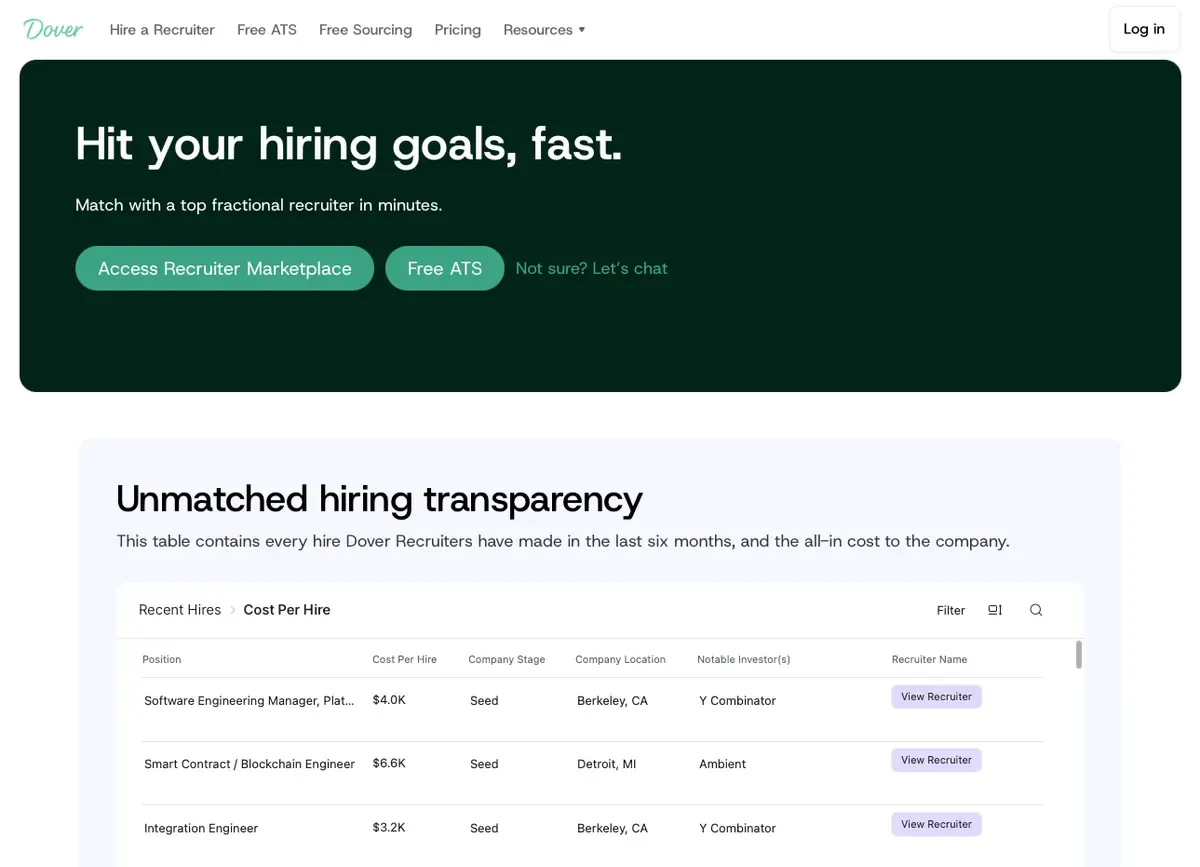
Dover combines a free all-in-one ATS with access to an on-demand marketplace of experienced fractional recruiters who focus on startup hiring. The system lets AI startups source, track, and manage candidates efficiently while using expert recruiters when needed.
Key strengths include AI-powered candidate scoring and resume ranking designed for startup needs, plus a network of vetted fractional recruiters with proven AI/startup expertise. Recruiter profiles in the marketplace include verified reviews from companies that have worked with them, giving hiring teams a concrete signal on fit before committing to a search. The integrated sourcing tools include a LinkedIn extension and automated job board posting to over 100 job boards.
Dover’s fractional model provides AI startups with experienced recruiting expertise without agency contracts or full-time hiring commitments. You pay hourly for the help you need, when you need it.
The free ATS includes unlimited users and jobs, eliminating upfront platform costs that can strain early-stage budgets. This combination of free software plus flexible recruiting support makes it ideal for AI startups at any stage.
Bottom line: Complete recruiting solution combining free software with expert fractional recruiters
2. Moonhub
Moonhub provides AI-powered recruiting services for startups and growing companies. The service uses AI to source and vet candidates before presenting them to hiring teams, claiming to reduce time-to-hire by 50%.
What They Offer
Their service includes AI-powered candidate sourcing and screening, automated outreach and candidate engagement, plus recruiting partner support for final candidate evaluation. The service focuses heavily on automation to make the initial stages of recruiting smoother.
Moonhub’s approach focuses on using proprietary AI to identify and engage candidates who might not be actively job searching but could be good fits for AI startup roles.
Limitation: Requires major platform onboarding and setup time compared to more flexible solutions.
Bottom line: AI-focused recruiting service with automated screening features.
3. Rocket
Rocket operates as a tech recruiting firm that combines experienced recruiters with AI-powered sourcing tools. They focus on startup-to-enterprise clients and offer embedded recruiting team services for companies that need ongoing hiring support.
What They Offer
Tech-specialized recruiters with AI/ML knowledge work alongside proprietary sourcing software and candidate databases. They provide full-service recruiting including sourcing, screening, and closing candidates.
Their partnership model is designed for ongoing recruiting needs, making them suitable for AI startups planning major team expansion. The recruiters understand both technical requirements and startup culture.
Limitation: Traditional agency model requires longer-term contracts and higher commitment levels.
Bottom line: Tech recruiting agency with AI-enhanced sourcing tools and startup experience.
4. Wellfound
Wellfound provides recruiting services primarily through their job board and hiring tools focused on startup hiring. They offer both self-service tools and managed recruiting options through their RecruiterCloud service.
What They Offer
The startup-focused job board gives access to candidates already interested in startup environments. AI-powered candidate matching helps connect companies with relevant talent from their database.
Their RecruiterCloud service provides managed recruiting for companies that want more hands-on support beyond just job posting. The service focuses on startup-minded candidates who understand the unique challenges of early-stage companies.
Limitation: Platform primarily serves as job board with limited hands-on recruiting support.
Bottom line: Startup job board with AI-enhanced matching and optional recruiting services.
5. Contrario
Contrario is a managed hiring network helping growth-stage startups and enterprises fill hard roles fast. They specialize in difficult-to-fill technical positions using AI-powered expert recruiters.
What They Offer
AI-powered candidate filtering and screening focuses on hard-to-fill technical roles. Their network of expert recruiters handles complex searches that require deep technical evaluation.
The white-glove delivery service presents highly vetted candidates, reducing the time hiring managers spend reviewing unqualified applicants. They focus on roles that typically take months to fill through traditional methods.
Limitation: Limited to growth-stage companies and may not serve early-stage startups effectively.
Bottom line: Managed hiring network specializing in difficult technical roles for larger startups.
Why Dover Is the Best Recruiting Agency for AI Startups
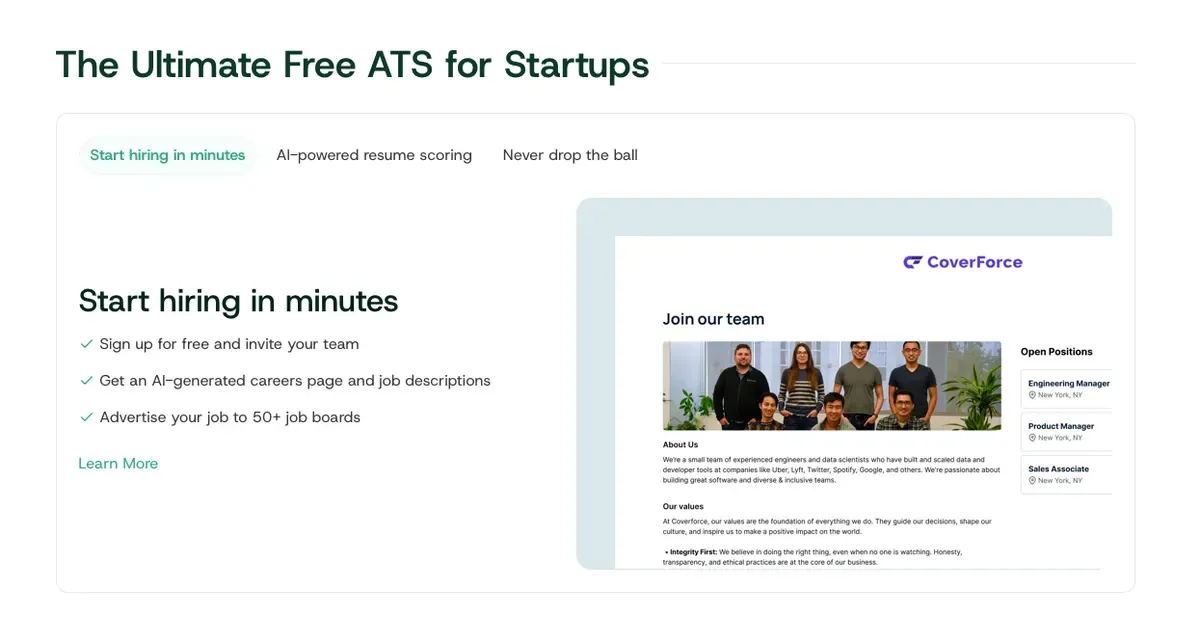
Most AI startups need two things at different times: a reliable system to manage their hiring pipeline, and recruiting capacity when searches get hard. An ATS covers the day-to-day layer: job posting, candidate tracking, scheduling, and applicant scoring. A fractional recruiter covers the sourcing and closing layer: identifying passive candidates, running outreach, and driving technical searches where inbound won’t get you there. Dover covers both in one shared system.
For many early hires, the free ATS alone may be enough. It posts to 100+ job boards with one click, scores applicants against your criteria, tracks every candidate from first contact through offer, and includes an AI Interview Notetaker for transcription and feedback. For a founder running outreach directly, setup takes under five minutes.
The decision to add a fractional recruiting model typically comes down to three signals: the role requires sourcing passive candidates (senior ML engineers, research scientists), the founding team lacks recruiting bandwidth, or hiring is ramping fast enough that a founder running every search becomes the bottleneck. At that point, a fractional recruiter works inside the same ATS, picking up sourcing and outreach without any pipeline disruption.
Dover’s sourcing tools feed into this model: LinkedIn outreach, employee referral tracking, and AI-powered candidate scoring all run through the same system whether the hiring team is self-serving or working alongside a fractional recruiter. Fractional recruiters on Dover typically bill at $75 to $125/hour, and most standard roles close in 20 to 30 hours of recruiter time. That works out to $2,000 to $7,000 per hire, with no retainer and no contract. For context, SHRM’s 2026 recruiting benchmarks puts the non-executive average at $5,475 before any agency markup is factored in.
Dover also serves as the foundational system that fractional recruiting agencies are built on, giving those agencies the ATS, sourcing tools, and shared pipeline they need to run searches for their own clients. For AI startups hiring directly, that same infrastructure is available at no cost on the software side, with fractional recruiter access layered in on demand.
| Feature | Dover | Moonhub | Rocket | Wellfound | Contrario |
|---|---|---|---|---|---|
| Free ATS | ✓ | ✗ | ✗ | Basic | ✗ |
| Fractional Model | ✓ | ✗ | ✗ | ✗ | ✗ |
| AI-Powered Screening | ✓ | ✓ | ✓ | ✓ | ✓ |
| Startup Specialization | ✓ | ✓ | ✓ | ✓ | Limited |
| No Contracts Required | ✓ | ✗ | ✗ | Varies | ✗ |
| Integrated Sourcing Tools | ✓ | Limited | ✓ | ✓ | Limited |
| Technical Recruiting Expertise | ✓ | ✓ | ✓ | Limited | ✓ |
FAQs
How much should AI startups expect to pay for recruiting services?
Recruiting costs vary a lot based on the model you choose. Traditional agency placement fees typically run 15-30% of first-year salary for tech and engineering roles. Fractional recruiters usually work hourly at $75-$125 per hour (up to $250/hour for specialized roles). Some tools charge monthly subscriptions ranging from $500-$5,000 depending on features and support levels.
When should an AI startup hire external recruiting help?
Most AI startups benefit from external recruiting help when they’re hiring their first 3-5 technical employees, during rapid scaling phases, or for particularly difficult roles like senior ML engineers or research scientists. The BLS research scientist job outlook projects 20% employment growth through 2034 for computer and information research scientists, reflecting how competitive this talent pool has become. The key is finding flexible support that matches your current hiring volume and budget constraints.
What’s the difference between fractional and traditional recruiting agencies?
Fractional recruiters work on an hourly basis without long-term contracts, making them ideal for startups with fluctuating hiring needs. Traditional agencies typically require retainers or work on contingency with placement fees. Fractional recruiting offers more flexibility and often better alignment with startup budgets and timelines.
Final Thoughts on AI Startup Recruiting Solutions
Hiring for an AI startup means working in a talent market where specialized skills are genuinely scarce and traditional recruiting timelines rarely match the pace most teams need. The right setup depends on where your actual constraint is: in candidate sourcing, in recruiting bandwidth, or in building the hiring infrastructure that makes future searches faster. An ATS alone may be enough for well-scoped roles with strong inbound interest. For senior or specialized searches, a fractional recruiter working inside that same ATS can close gaps that software alone won’t fill. Dover’s model combines a free ATS with on-demand fractional recruiters in one shared system, which is one concrete example of that layered approach at a cost structure well below traditional agency fees.