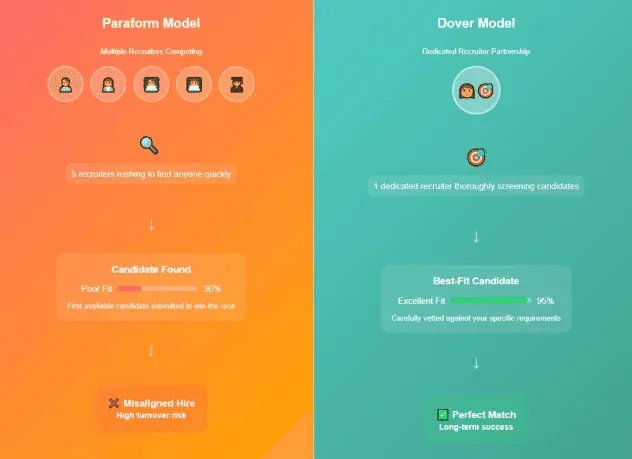

If you’re at 15 or 20 employees and still personally running searches between product reviews and customer calls, you’ve probably already crossed the in-house recruiter threshold without a clear plan for it. Knowing when to hire your first recruiter at a startup is one thing. Figuring out whether a full-time recruiter vs fractional support actually makes financial sense for your hiring volume is where most founders get stuck, and it’s worth thinking through before a stalled search forces the decision for you.
TLDR:
-
Many startups begin to experience recruiting bottlenecks between 15 and 20 employees, when referral networks thin and concurrent searches stack up.
-
A fully loaded in-house recruiter can cost $90,000 to $160,000 annually before a single hire closes, including tools and ramp time.
-
Four signals indicate you’ve crossed the threshold: too many concurrent searches, rising bad-hire costs, slipping candidate experience, and a dried-up referral pipeline.
-
Contingency agencies charge 15% to 25% of first-year salary per hire; full-time recruiters carry fixed overhead regardless of hiring volume.
-
Some tools pair free ATS software with on-demand recruiting support at $2,000 to $7,000 per hire, which can fit the uneven hiring pace most teams at this stage actually run.
The 15-to-20 Rule Explained
The 15-to-20 rule is a rough threshold that many early-stage teams hit before they consciously recognize it: once a company reaches somewhere between 15 and 20 employees, the informal hiring processes that carried them through the first year start to break down.
Below that number, founders and hiring managers can typically absorb recruiting into their existing workload. Roles open infrequently enough that a mix of referrals, LinkedIn outreach, and the occasional agency engagement gets the job done. There’s no systemic pressure to build a repeatable process because the volume doesn’t warrant one.
Once headcount climbs toward 20, though, the math changes. At that size, most companies are running two to four open roles at any given time, and the coordination overhead alone starts consuming hours that founders and functional leads can’t easily spare.
There are a few reasons this specific range tends to be the inflection point:
-
Referral networks begin to thin out, since the people closest to the founding team have largely already been hired or referred in. New roles require reaching candidates who don’t already know the company, which takes active sourcing work. These are among the clearest signs your startup needs a recruiter.
-
Candidate volume increases faster than internal bandwidth. More applicants, more scheduling, more follow-up, and more drop-off if the process moves slowly.
-
The cost of a slow or failed hire grows alongside the team. At 10 people, one open role is 10% of headcount. At 20, the stakes per hire haven’t shrunk, but the organizational complexity of filling it correctly has grown.
The True Loaded Cost of a Full-Time Recruiter
When founders start calculating whether a full-time recruiter makes financial sense, the base salary is usually the first and last number they consider. That framing understates the real cost by a considerable margin.

A full-time in-house recruiter in the U.S. typically earns between $70,000 and $120,000 annually, depending on market and seniority, consistent with BLS wage data for HR specialists. But salary is only part of the picture. The true cost across hiring models includes considerably more. Employers generally add 20 to 30 percent on top of base compensation to cover payroll taxes, health benefits, and retirement contributions. Layer in onboarding, recruiting tools, and any job board spend, and the fully loaded annual cost often lands between $90,000 and $160,000 before a single hire is made.
The contrast with fractional recruiting is structural, not purely numerical. A fractional recruiter charges on a per-hour or per-hire basis, and fractional recruiter costs vary by engagement scope, which means cost tracks directly with hiring activity. When hiring slows, spend drops. A full-time hire carries fixed overhead regardless of whether the company is actively filling five roles or none.
For a startup hiring fewer than four or five people per year, the math on a full-time recruiter rarely works in isolation. SHRM’s 2025 cost-per-hire benchmark puts the average non-executive hire at $5,475; spreading a full-time recruiter’s annual overhead across only a handful of placements pushes the effective per-hire cost well above that, without the flexibility to scale down when hiring slows.
Signals You’ve Crossed the Threshold
Four concrete signals suggest a startup has crossed into full-time recruiter territory.
Hiring Velocity Has Outpaced What Founders Can Manage
When a founding team is running more than three to four concurrent searches, the coordination overhead alone starts to crowd out product and customer work. Sourcing, screening, scheduling, and following up across multiple roles simultaneously stops being a side task and becomes a job in itself.
The Cost of a Bad Hire Has Become Unacceptable
At 15 to 20 employees, the team is still small enough that a single wrong hire in an engineering or go-to-market role can visibly drag performance. Research on bad hire costs suggests the average runs around $17,000, with some estimates reaching 30% or more of annual salary when you factor in lost productivity, rehiring, and onboarding time.
Candidate Experience Is Slipping
Slow follow-up, inconsistent interview processes, and missed communications tend to surface when no one owns recruiting full-time. Candidates notice, and at a stage where employer reputation is still forming, those impressions carry weight.
Referral Pipelines Are Thinning Out
Early-stage teams often fill their first 10 to 15 roles largely through founder networks and employee referrals. That pipeline has a ceiling. Employee referral data shows that 88% of employers consider referrals their best source of quality hires, but once the warm network is largely tapped, sourcing requires a different skill set and consistent time investment that a fractional arrangement may not cover at the volume needed.
Full-Time Recruiter vs. Fractional Recruiter
| Full-Time Recruiter | Fractional Recruiter | |
|---|---|---|
| Cost structure | Fixed annual salary + benefits | Hourly or per-hire fees |
| Best fit | Consistent hiring volume, 4+ roles/year | Burst hiring, defined projects |
| Continuity | High, embedded in team | Variable, shared across clients |
| Ramp time | Weeks to full productivity | Faster to start, less context over time |
| Risk | Overhead cost during slow periods | Availability gaps during urgent searches |
The choice often comes down to predictability. The fractional vs. full-time recruiter decision hinges largely on whether you can forecast consistent hiring volume. If you can forecast 15 to 20 hires over the next 12 months, a full-time recruiter starts to pay for itself. Below that threshold, fractional support tends to offer better cost alignment with actual output.
A free ATS handles the infrastructure layer regardless of which model you choose: pipeline tracking, job board distribution, candidate communications, and scheduling. The question of whether to bring in a recruiter is a separate decision about sourcing capacity. When inbound applications are thin, referrals have dried up, or a role requires active outreach into a specialized talent pool, a fractional recruiter adds that capacity without changing the underlying system or committing to a full-time salary.
Recruiter vs. Agency vs. Fractional: A Decision Framework for Startups
Once headcount climbs toward 15 or 20, most founding teams weigh three options: a full-time recruiter, an agency, or a fractional arrangement. Each carries a different cost structure and set of tradeoffs.

| Model | Typical Cost | Best For | Main Limitation |
|---|---|---|---|
| Full-time recruiter | $80K to $130K+ salary plus benefits | Teams hiring 6 or more roles per year consistently | High fixed cost; takes months to ramp |
| Contingency agency | 15% to 25% of first-year salary per hire | Urgent, one-off searches | Incentives favor speed over fit; expensive at volume |
| Fractional recruiter | Varies by engagement scope | Startups in a growth burst or testing hiring needs | Less embedded in company culture than a full-time hire |
How Dover Fits Startups Approaching the 15-to-20 Threshold
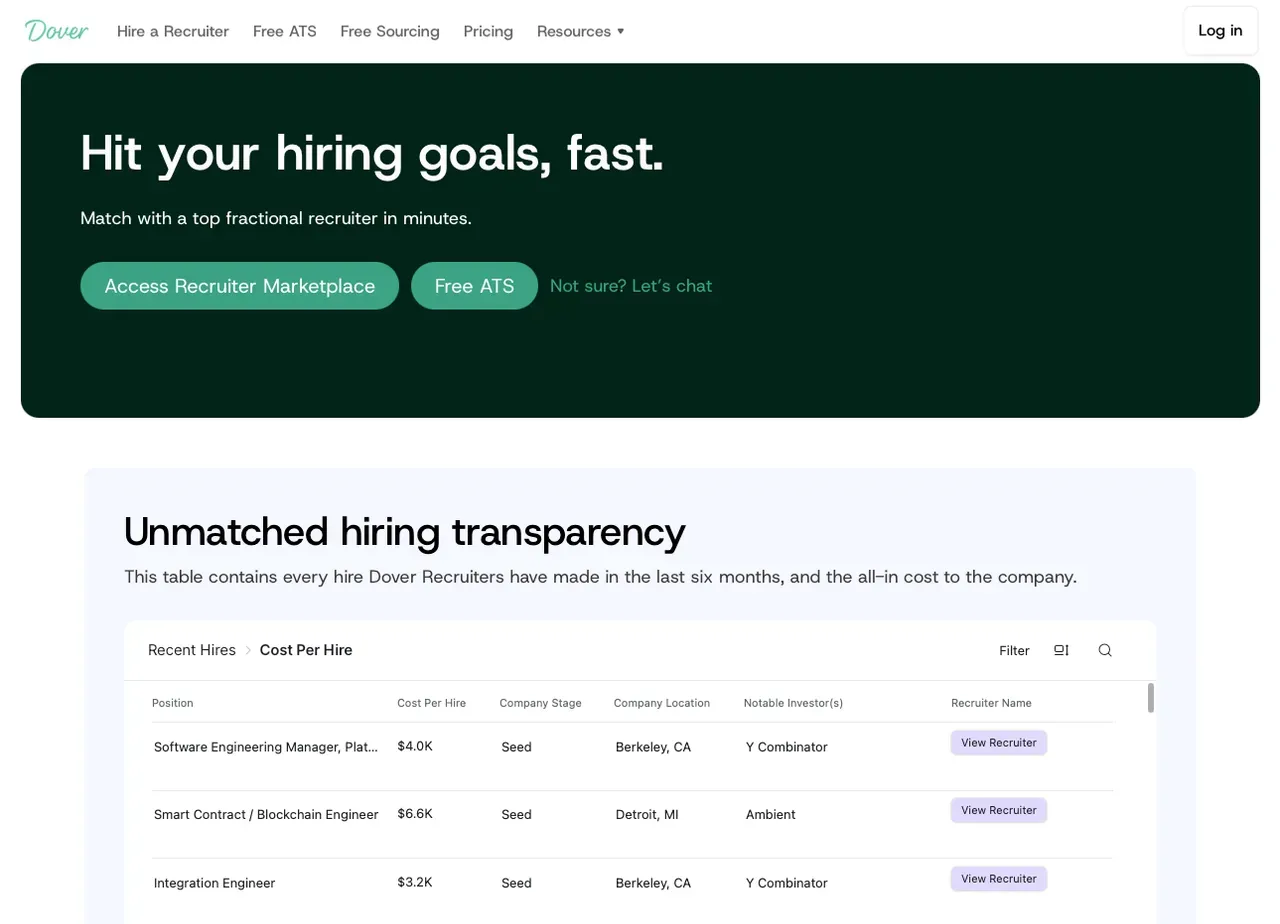
Running an ATS from one vendor and recruiting support from another creates a coordination gap: candidate status lives in two places, outreach can duplicate, and the internal team and the recruiter spend time on handoffs instead of hiring. The cleaner setup is a shared system where both sides work from the same pipeline. Dover’s free ATS gives teams that foundation: internal hiring managers and fractional recruiters see the same candidate data in real time. When a search needs more hands-on work, fractional recruiter access is available on a per-hire basis, typically ranging from $2,000 to $7,000 per hire with no retainer required. The recruiter works directly inside the same pipeline the team already uses, which means no duplicate outreach, no candidate status gaps, and no coordination overhead.
That infrastructure is also the layer fractional recruiting agencies build their searches on. When an agency runs a search inside Dover, the internal team keeps full pipeline visibility without managing a separate system or waiting on status updates. Recruiters in the marketplace carry verified reviews from prior engagements, which gives teams a track record signal before committing to a search.
For startups hovering around 15 to 20 employees, that model tends to fit the hiring reality well. Searches at this stage are often uneven: a few roles open at once, a quiet stretch, then two or three more. Paying a full-time recruiter’s salary through the slow periods rarely makes sense, and contingency agency fees can run 15 to 25 percent of first-year salary per placement, which adds up quickly on engineering and product hires.
FAQs
When should a startup hire its first full-time recruiter vs. sticking with a fractional recruiter?
The 15-to-20 employee range is where the question becomes worth running the numbers on seriously. If you can forecast 15 or more hires over the next 12 months and hiring is consistent instead of bursty, a full-time recruiter’s loaded cost of $90,000 to $160,000 annually starts to pay for itself. Below that volume, a fractional recruiter keeps your cost variable and tied to actual hiring activity instead of anticipated headcount plans.
What’s the real loaded cost of a full-time in-house recruiter vs. fractional recruiting for a startup?
A full-time recruiter’s base salary of $70,000 to $120,000 grows to $90,000 to $160,000 once you factor in payroll taxes, benefits, tooling, and ramp time. Fractional recruiting through a service like Dover typically runs $2,000 to $7,000 per hire at $75 to $125 per hour, with no retainer and cost that scales down when hiring slows. For startups filling fewer than four or five roles per year, the fractional math is usually better aligned with actual output.
Can I build a repeatable hiring process without a full-time recruiter at the 15-employee stage?
Yes, though the model needs to change from what worked at five employees. A free ATS handles pipeline organization, job board distribution, and candidate tracking without recruiting headcount, while a fractional recruiter can cover active sourcing and closing for specific searches. The combination gives you process continuity between hiring bursts without carrying a fixed salary through the slow periods.
What signals tell you a startup has crossed the in-house recruiter threshold?
Four concrete signals tend to appear together: founders are running more than three to four concurrent searches, a single bad hire has become visibly disruptive to team performance, candidate follow-up is slipping because no one owns the process full-time, and the referral network that filled the first 10-15 roles has largely run dry. When all four are present, the coordination overhead has become a job in itself.
Final Thoughts on Building Your First Recruiting Function
Knowing when to hire your first recruiter for a startup is easier to judge in retrospect than in the moment. By the time searches are visibly stalling and candidates are going cold, the cost of waiting is already in motion. Your hiring volume, role complexity, and how much you can absorb in fixed overhead are the three numbers worth running before you commit to any model. Dover is one concrete implementation of that framework: a free ATS that keeps the pipeline organized from day one, paired with on-demand fractional recruiters at $2,000 to $7,000 per hire when a search needs more active sourcing or closing work, no retainer required.