
You’re weighing an agency contract for a $160K hire, including what happens if the person leaves early. A replacement search may be covered, but a refund and your team’s repeat interview work are separate questions. Building a recruiting agency cost breakdown around the signed terms, internal hours, and a separate vacancy estimate gives you a firmer basis for deciding whether the fee is worth it.
TLDR:
-
At a 15% to 25% agency fee, a $160K base-salary hire adds $24K to $40K in placement cost.
-
Internal hiring labor and extra expenses add to that total, while lost output is a separate estimate.
-
Payment triggers and refund terms vary by contract, and a replacement search is not a cash refund.
-
Scope of work, the pricing basis (base salary only versus bonuses and commissions), and capped expenses all change the final cost.
-
Some free ATS tools pair with separately paid fractional recruiters, since software alone is not recruiting.
Recruiting Agency Cost Breakdown for a $160K Hire
The placement fee is paid on top of compensation, not deducted from the employee’s pay.
Calculate it as: agreed compensation basis × contracted fee percentage. This example uses base salary and models a 15 to 25 percent placement fee, part of the broader range of recruiter fees you might encounter, not a universal rate.
| First-year base salary | Illustrative fee rate | Placement fee | Salary-plus-fee subtotal |
|---|---|---|---|
| $160,000 | 15% | $24,000 | $184,000 |
| $160,000 | 20% | $32,000 | $192,000 |
| $160,000 | 25% | $40,000 | $200,000 |
Subtotals exclude benefits, internal recruiting work, and other expenses.
Recruiting Agency Fee Structures and Payment Triggers
-
Contingency: a success fee is payable upon placement; the contract defines the trigger.
-
Retained search: payments fund work upfront or at milestones and may remain payable without a hire.
-
Flat-fee: a fixed amount sets the price; the agreement determines whether payment depends on success.
-
Hourly: charges reflect hours worked, generally payable even without a hire.
Invoice dates and payment deadlines depend on the recruitment fee agreement. Permanent placement fees differ from temporary staffing markups on worker hours and temp-to-hire conversion charges, which fall outside this direct-hire cost breakdown.
What the Placement Fee Covers
A recruiting agency cost breakdown depends on what the placement fee includes. The written proposal should specify:
-
Role intake to agree on requirements.
-
Candidate sourcing and outreach.
-
Screening and interview coordination.
-
Reference checks and offer support.
Your team retains responsibility for technical assessment, the hiring decision, onboarding, and employee compensation.
Compare quotes using the same scope and clear handoff ownership.
Ask whether paid assessments, background checks, advertising, and candidate travel are included or billed separately. A lower fee percentage may cover fewer services.
Factors That Change an Agency’s Quote
Scarce skills and senior roles can require deeper sourcing and assessment. Location limits, search complexity, and urgency may affect an agency’s quote; exclusivity can change the terms it offers.
The contract’s definition of compensation also matters. Including bonuses and commissions alongside base salary increases the fee even when the quoted percentage stays unchanged.
A higher quote should come with a clear scope of work, similar to considerations founders weigh when comparing Dover vs Robert Half for startup hiring. Specialist research or added assessment may warrant a higher price; the percentage alone tells you little about the service you will receive.
Internal Hiring Costs Beyond the Agency Invoice
Internal hiring time belongs in your recruiting agency cost breakdown. Multiply interviewer, hiring manager, and coordinator hours by their loaded hourly costs, including employer-paid benefits. Include preparation and debriefs, add expenses outside the agency’s scope, and check for duplicate charges.

When using BLS compensation data, distinguish benefits as a share of total compensation from a markup on wages. In the BLS Employer Costs for Employee Compensation release, benefits made up 30.0 percent of private industry compensation in June 2026, which works out to about 43 percent on top of wages. Use actual employer costs for your team instead of applying a national benchmark directly.
Vacancy and Replacement Costs Beyond the Hiring Budget
An open role may require overtime or interim coverage, both cash expenses. Delayed delivery and lost contribution are less certain opportunity costs; estimate them separately using your project schedules and margins.
If a hire leaves early, sourcing, interviewing, and training may restart. A replacement-search clause may cover the agency’s next search but leave your team’s repeat work unpaid, a distinction worth reviewing in a Paraform vs Dover comparison.
Build low and high scenarios from business assumptions, not universal vacancy or bad-hire multipliers. Published estimates vary widely: Gallup’s replacement-cost analysis puts the cost of replacing one employee at one-half to two times annual salary, while a Center for American Progress review of turnover case studies found a median cost closer to one-fifth of salary for positions other than executive and physician roles, based mostly on lower-salary case studies from 1992 to 2007. Count delayed revenue and lost productivity once if they reflect the same missed output.
Contract Terms That Change the Final Cost
The placement fee is only part of the agreement. Contract terms determine when you owe it and what happens if the search or hire falls through:
-
Confirm payment triggers, invoice deadlines, minimum fees, and expenses requiring approval.
-
Check cancellation charges and whether exclusivity limits other hiring channels, a factor worth weighing against the best startup recruiting agencies.
-
Separate replacement-search rights from cash refunds. Check eligibility and notification deadlines if the role changes or the employee leaves.
-
Clarify candidate ownership periods, prior-applicant exceptions, duplicate submissions, and fees for later hires into different roles to reduce fee disputes.
A Worksheet for the Fully Loaded Recruiting Cost
| Worksheet line | Your amount |
|---|---|
| Agency invoice using signed terms | $___ |
| Additional recruiting cash expenses | $___ |
| Allocated internal labor | $___ |
| Recruiting subtotal: sum above | $___ |
| Opportunity-cost scenario, separate | $___ |
| Annual compensation and onboarding, excluded | $___ |
| SHRM’s 2025 nonexecutive average | $5,475 reported nonexecutive average cost per hire; not an agency placement fee or directly comparable to the agency fee table above |
Replace the illustrative placement rate with your contracted rate. Use actual costs where available and record assumptions beside estimates; the total depends on your search.
Ways to Negotiate Agency Costs Without Reducing Search Quality
Negotiate around work your team can absorb and commitments you can keep:
-
Request base-salary-only pricing and capped expenses.
-
Seek clear replacement terms with workable claim deadlines.
-
Offer volume commitments only for approved hires, an approach often used when engaging fractional recruiting services.
-
Ask for a lower fee if your team handles part of the search.
Exclusivity or retained work may change pricing, but neither guarantees a hire. Weigh sourcing restrictions and upfront payment risk against savings. Compare written proposals for equivalent deliverables and your team’s remaining workload alongside the fee percentage.

Agency, Founder-Led, In-House, Fractional, and RPO Hiring Compared
Each cost structure tends to fit different conditions: agency support aligns with a specialized, intermittent search where urgency, vacancy costs, and limited team capacity favor outside help, while the other models below fit other combinations of volume, urgency, and available bandwidth.
-
Founder-led hiring with an ATS covers job posting, candidate tracking, and interview feedback, but someone on your team still sources, screens, and closes candidates, which can strain capacity on senior or specialized roles.
-
In-house recruiting may suit ongoing hiring volume, often around 15 to 20 hires a year.
-
Fractional recruiters add sourcing and screening capacity for part of the week, typically working inside your existing ATS, which may fit teams hiring roughly 5 to 50 roles a year or a search that has outgrown internal bandwidth.
-
RPO generally takes responsibility for an agreed portion of recruiting beyond a single placement.
The tradeoff depends on total costs, responsibilities your team retains, search difficulty, and expected hiring volume. There is no universal break-even point.
How Dover Fits Into the Recruiting Cost Comparison

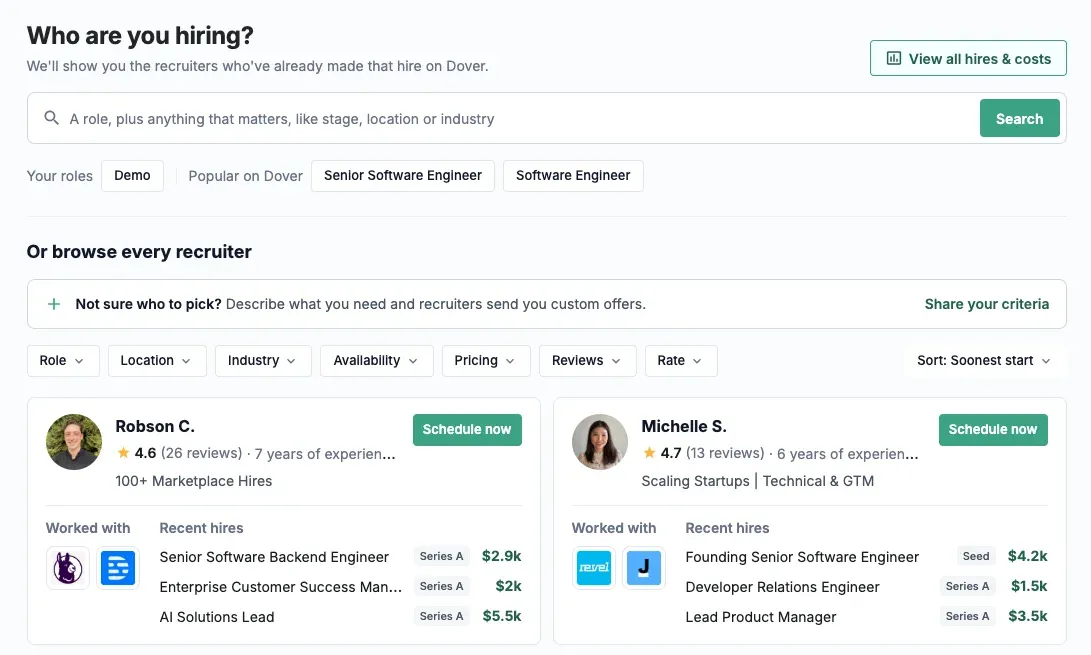
An ATS and recruiting support cover different lines in this cost breakdown. Software tracks candidates, stages, and feedback, while a recruiter supplies the sourcing, screening, and closing work an agency fee would otherwise pay for. Dover’s pricing separates those layers: the core ATS plan is free with unlimited jobs and users (a Premium ATS plan runs $199 per month), and fractional recruiters are a separately paid service. Billing follows hours worked instead of the candidate’s salary. Dover’s marketplace hires average about $4,800 per hire across all roles, though cost varies with role seniority and hours needed, and the public cost-per-hire table shows what each completed hire has cost.
Fractional recruiters tend to work most cleanly when the recruiter and the hiring team share one ATS, giving both sides real-time visibility into sourcing activity and candidate flow. That can reduce handoff overhead and duplicate outreach, while an agency search often keeps its sourcing notes and outreach history in the agency’s own systems. In Dover’s model, each fractional recruiter sets their own hourly rate, and recruiters can work inside Dover’s ATS alongside your internal team or in tools you already use. When they work in your Dover account, the pipeline history stays there after the engagement ends.
FAQs
How do you account for a free ATS in your recruiting agency cost breakdown?
Record the free ATS subscription as $0, but budget separately for paid recruiting support and your team’s time. If you use both an agency and a fractional recruiter, assign sourcing, screening, and coordination responsibilities in writing so overlapping work does not inflate the budget.
Do you need a recruiter if you already use an ATS?
Not always. An ATS organizes postings, applicants, interview stages, and feedback, but it does not find passive candidates, run screens, or negotiate offers. Teams with steady inbound applicants and spare interview time can often run searches themselves, while senior, specialized, or urgent roles may need added sourcing capacity from a fractional recruiter or an agency.
Do you need an ATS before bringing in a fractional recruiter?
An ATS is not a prerequisite for working with a fractional recruiter, since recruiters can work in existing tools such as Ashby, Greenhouse, Lever, or a spreadsheet. What changes is where pipeline history and sourcing notes live once the engagement ends: inside a tool your company already owns, or inside the recruiter’s own system, where that record may not transfer. Dover pairs a free ATS with fractional recruiters in one system for teams that want both.
Final Thoughts on Recruiting Agency Costs and Weighing the Fee Against Your Hiring Needs
A recruiting agency cost breakdown is only useful once it covers the full recruiting subtotal under signed terms, with vacancy cost estimated as a separate line rather than folded into the fee percentage. An agency can suit a specialized, intermittent search where urgency outweighs the cost of outside help, while teams with steady hiring volume or spare interview capacity often find that software paired with part-time recruiting support covers more of the work. One version of that second model pairs a free ATS with fractional recruiters who work separately for pay inside the same system as the hiring team. The right choice depends on how many roles you are filling, how hard the search is, and how much sourcing and screening your team can absorb on its own.