
At a glance
- Length
- 30 minutes
- When
- Same day, after written feedback
- Who decides
- The hiring manager
- Output
- A decision and its rationale
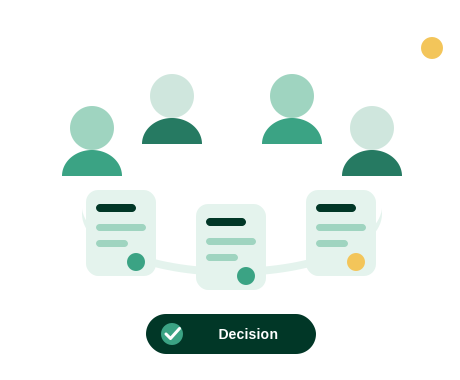
An interview debrief is a short meeting after the interviews where the team shares what it saw and decides whether to hire. It is for hiring managers, recruiters and founders who want faster, fairer decisions than a chain of Slack messages gives them. This guide covers why debriefs matter, when to run one, a 30-minute agenda, the rules that keep it honest, how to handle disagreement and bias, a decision framework, a template and what to send candidates afterward.
Why debriefs exist
Without a debrief, decisions drift. Each interviewer forms an impression, the loudest or most senior opinion wins in a hallway and the candidate waits. A debrief gives you a single moment to combine independent evidence, resolve differences and decide, while the interviews are still fresh. It works best on top of a structured loop, with the same questions and the same rubric for every candidate. See interview process best practices and the interview scorecard guide.
When to run the debrief
Run it the same day as the final interview, or the next morning. Speed matters because memory fades and strong candidates take other offers. In Dover’s analysis of how fast companies move, quick, tight processes convert better, as covered in our breakdown of phone screen to onsite conversion.
Run it only after every interviewer has submitted written feedback on their own, ideally within a few hours of their interview. If the feedback is not in, move the meeting, not the rule. A debrief that starts with half the feedback missing becomes a discussion of impressions.
Who attends
- The hiring manager, who owns the decision.
- Every interviewer who met the candidate, including the most junior.
- A facilitator, usually the recruiter or a trained interviewer, who keeps time, runs the order and records the outcome.
Keep the group small, ideally five or fewer, and leave out people who did not meet the candidate. They have no evidence and will bring opinions.
A 30-minute agenda
| Minutes | Segment | What happens |
|---|---|---|
| 0 to 2 | Frame | The facilitator restates the role, the must-have criteria and the decision to make. |
| 2 to 7 | Silent review | Everyone reads the submitted scores and notes. No discussion yet. |
| 7 to 20 | Evidence round | Go criterion by criterion. Each interviewer shares what they saw, junior first. |
| 20 to 26 | Disagreements and gaps | Resolve differences. Name what is still unknown, and what would settle it. |
| 26 to 30 | Decide | The hiring manager decides, and the facilitator records the decision, the rationale and the next step. |
Rules for a good debrief
- Feedback is submitted before the meeting. Interviewers write their ratings and notes independently, before they see anyone else’s. This protects against anchoring on the first strong opinion.
- Evidence over vibes. Replace “I liked her” with “She walked through a migration she led, named the tradeoff and the result.” Ask “what did you see or hear?” when someone offers a conclusion. A phrase like “not a culture fit” is not evidence.
- Speak junior first. The most senior person speaks last, so they do not set the tone. Everyone’s view is heard before the hiring manager’s.
- Stick to the criteria. Discuss only the scorecard criteria, not anything else that comes to mind, such as hobbies, accent or schools.
- The hiring manager decides. Debriefs are not votes. People advise, the hiring manager decides and everyone commits to the outcome, even if they disagreed.
- Record the decision and the reason. Write down the decision, the two or three facts that drove it and the next step. It protects the candidate, the team and your records.
Handle disagreement
Disagreement is useful when it is about evidence and harmful when it is about taste.
- Separate observation from conclusion. Ask each person for what the candidate said and did, then for what they concluded.
- Check against the same criteria. If one interviewer rated communication a 2 and another a 4, compare what each one saw. They may have asked different questions.
- Name the open question. Often the debate comes down to one unknown, such as whether the candidate can handle ambiguity. Decide how to test it, such as a 30-minute follow-up call or a reference check (how to check references).
- Do not average your way out. Two 4s and a 1 is not a 3. Find out why the 1 exists.
- Default to the manager’s decision. If the group is still split, the hiring manager decides, and writes the rationale.
Avoid bias in the room
The debrief is where bias can sneak back in, even after a structured loop. Counter it with a few habits:
- Use the same criteria for everyone. Judge each candidate against the rubric, not against the last candidate, and not against a mental picture of the “ideal” hire.
- Watch the loaded language. Comments about “polish,” “presence” or “gut feel” often stand in for similarity to the interviewer. Ask for the behavior behind them.
- Beware of halo and recency. One great answer or one rough moment should not outweigh the whole interview.
- Do not discuss protected characteristics such as age, family plans, health or ethnicity, or proxies for them. In the US, the EEOC lists the practices that are prohibited in hiring.
- Review your patterns. Over time, look at who advances at each stage and why. See how to interview diverse candidates.
Use a simple decision framework
Decide on the evidence for each criterion, not on a feeling. This framework keeps the outcome clear.
| Outcome | What it looks like | What to do |
|---|---|---|
| Strong yes | Meets or exceeds the bar on every must-have, with concrete evidence | Move to the offer or references quickly |
| Yes | Meets every must-have, with minor gaps you can coach | Proceed, and note the growth areas |
| Unclear | One must-have is unknown, or interviewers disagree on evidence | Add one targeted step, then decide within two days |
| No | Misses a must-have, or evidence is weak on several | Reject kindly, and record the reason |
A useful rule is to decide your threshold in advance, for example “no score below 3 on a must-have criterion, and the hiring manager is a yes.” Then apply it the same way for every candidate. If the answer is yes, go to how to make an offer.
Copyable debrief template
Use one copy per candidate. The facilitator fills it in during the meeting and saves it with the candidate’s record.
Candidate: [Name]            Role: [Job title]
Date: [date]                 Facilitator: [Name]
Hiring manager (decides): [Name]
Interviewers: [Names and stage each one ran]

Before the meeting
[ ] All feedback submitted before the meeting
[ ] Must-have criteria: [1], [2], [3]
[ ] Decision threshold: [e.g. no score below 3 on a must-have, manager is a yes]

Evidence by criterion (junior first)
[Criterion 1]: [Scores] | [Evidence: what the candidate said or did]
[Criterion 2]: [Scores] | [Evidence]
[Criterion 3]: [Scores] | [Evidence]

Strengths: [2 to 3 specific points]
Concerns: [2 to 3 specific points, with evidence]
Open questions: [What we still don't know, and how we will find out]

Decision: [Strong yes / Yes / Unclear / No]
Rationale: [The 2 to 3 facts that drove the decision]
Next step: [Offer / references / follow-up / reject], owner [Name], by [date]
Candidate update: [Who tells the candidate, and when]
Tell the candidate what happens next
Candidates remember how you closed the loop. Whatever the outcome, tell them within a day or two.
- If it is a yes, call first, then send the written next steps. See how to make an offer.
- If it is a no, send a kind, specific note: thank them, say it is a no, give one honest, job-related reason if you can and invite them to apply again if that is true. Avoid vague promises such as “we will keep your resume on file” unless you will.
- If you need more time, say so and give a date. Silence is the fastest way to lose a good candidate.
For more on how rejection shapes your reputation, see how to protect your employer brand when you’re hiring.
In Dover, each interview stage has a feedback form that interviewers complete after the interview, so ratings and notes are in before the debrief. Dover’s default scale is 1 to 4, and Premium lets you create custom scales. On the candidate’s profile, the Interview Feedback section shows each interviewer’s feedback and the overall rating, and you need the View all feedback job permission to see everyone’s. On Premium, the AI Notetaker can join Google Meet, Zoom and, with Microsoft Calendar turned on, Teams interviews, record and transcribe them and add AI notes to the feedback form. The notes are only visible in Dover, and candidates do not get copies. Tell the candidate and get their agreement first, as some places require everyone on a call to consent to recording. In the interview plan, turning on Debrief for a stage tells your recruiter to schedule a debrief meeting after it, and you choose its length. When you decide, move the candidate to the next stage or reject them with a saved email template from the same profile. See Interview feedback forms, Dover AI Notetaker, Setting up your interview plan and Candidate profiles.
Train your interviewers to write evidence-based feedback fast, and the debrief gets easier every time. The interviewer training guide covers it, and the interview scorecard guide shows how to build the rubric the debrief relies on. For the deeper dive on scorecards, see our interview scorecard article.
Frequently asked questions
What is an interview debrief?
An interview debrief is a meeting where the people who interviewed a candidate share what they saw and decide together whether to move forward. It is also called a hiring debrief, a post-interview debrief or a hiring committee meeting.
When should you hold the debrief?
Hold it the same day as the last interview, or the next morning at the latest, after every interviewer has submitted written feedback. Memory fades quickly, and candidates who wait for a decision tend to take other offers.
Who should attend an interview debrief?
The hiring manager, everyone who interviewed the candidate and a recruiter or facilitator if you have one. Keep it to people with first-hand evidence, and keep non-interviewers out.
Should interviewers read each other's feedback before the meeting?
No. Interviewers should submit their own feedback before they see anyone else's, so the first opinions are independent and are not anchored by the loudest voice or the most senior person.
How do you handle disagreement in a debrief?
Separate what people saw from what they conclude, and look at each interviewer's evidence against the same criteria. If it is still split, the hiring manager decides, and you can add a short follow-up conversation to test the open question.
What should you tell candidates after the debrief?
Tell them the outcome within a day or two. For a no, send a kind, specific rejection, and for a yes, call first and follow with the written next steps.
Collect feedback and decide in Dover
Have every interviewer submit a feedback form, see all the ratings on the candidate's profile and move the candidate to the next stage or reject them from the same place. The ATS is free.