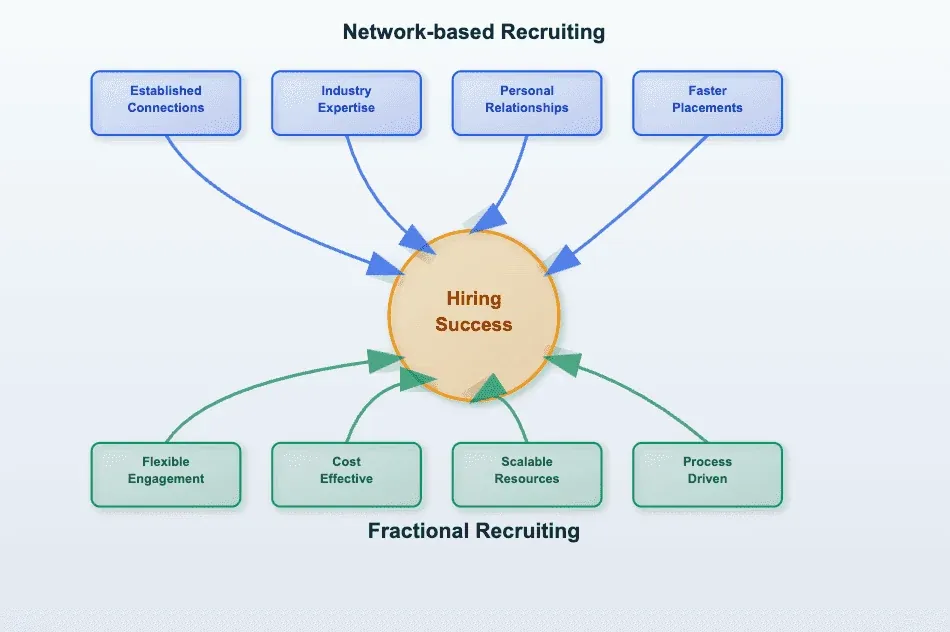

Finding the right recruiting partner as a startup founder can feel like working through a maze of confusing options and conflicting advice. Each route feels like a dead end, until you get an aerial view. So when you’re trying to build your team on a tight budget and timeline, comparing various approaches and understanding which hiring platform or fractional recruiter actually deliver results becomes important to your company’s success.
TLDR:
-
Bamboo Talent is a retained executive search firm focused on NYC senior leadership roles, not typical startup recruiting needs.
-
Retained search firms charge $100K+ upfront and target C-level positions, making them unsuitable for most early-stage companies.
-
Some fractional recruiting marketplaces offer startup-focused recruiting at 3-5x lower cost than traditional agencies.
-
Most startups need flexible, mid-level hiring support instead of expensive executive search services.
-
The best recruiting approach depends on your stage, budget, and specific role requirements.
What Bamboo Talent Is and How It Works
Let’s clear up some confusion right away. Multiple companies use the “Bamboo” brand name in recruiting and HR, which can make research frustrating for founders.
Bamboo Talent is a retained search firm that connects NYC’s senior leadership and executive talent to a handpicked portfolio of technology businesses. They operate as a traditional executive search firm, which means they work on retained fees and focus on senior leadership positions.

But here’s where it gets tricky for most startup founders. Retained search operates on a completely different model than what makes sense for early-stage companies. You’re paying big fees upfront for executive-level searches, typically targeting roles with compensation packages well into the six figures.
If you’re a seed-stage startup looking to hire your first few engineers or a Series A company needing to build out your marketing team, this probably isn’t the right fit. Most startups need what a startup recruiter actually provides: flexible support for mid-level roles without massive upfront commitments.
Bamboo Talent Features
As a retained executive search firm, Bamboo Talent offers several particular services that work well for their target market of well-funded companies seeking senior leadership.
Their retained search model means you pay fees upfront, typically ranging from 25-35% of the first-year compensation for the role you’re trying to fill. This gives you dedicated attention and resources, but it also means a major financial commitment regardless of outcomes.
They focus mainly on the NYC market, which can be an advantage if you’re building a team in New York and need someone with deep local networks and market knowledge. Their handpicked portfolio approach means they work with a curated selection of technology businesses instead of taking on every client.
The sustainable recruitment practices they focus on include building long-lasting relationships with both clients and candidates. This relationship-focused approach can be valuable for executive-level searches where cultural fit and long-term success matter more than speed to hire.
However, this model creates some important distinctions from other recruiting approaches. Retained search differs greatly from contingency recruiting (where you only pay if they make a successful placement) and fractional recruiting (where you pay for time and expertise instead of per-hire bounties).
Key Limitations and Gaps
Several limitations make Bamboo Talent a poor fit for most startups. Cost is the biggest one: retained search fees hit $100K or more for a single hire, only making sense when a role’s compensation exceeds $500K. For a senior engineer at $150K total comp, that fee represents a third of their first-year cost.
Geography is another constraint. Bamboo Talent focuses on NYC, which doesn’t help if you’re hiring remotely or outside that market. On top of that, retained searches typically take 60-90 days, a timeline most startups can’t afford when a role is blocking product or go-to-market work. And because the model targets executive-level searches, it’s not built for the volume mid-level hiring most early-stage teams actually need.
Who Should Use Bamboo Talent
Despite the limitations for most startups, Bamboo Talent makes sense in specific scenarios.
-
Well-funded startups at Series B or later stages often need executive-level talent and have budgets that can support retained search fees. If you’re hiring a CRO or VP of Engineering and have raised major funding, the investment in professional executive search can pay off through better candidate quality and market insights.
-
Companies with budgets exceeding $100K for single hires. At this level, the search fees become a reasonable percentage of total hiring costs, and the additional services (market research, compensation benchmarking, strategic guidance) provide real value.
-
Organizations needing NYC-based senior leadership talent. If physical presence in New York matters for your executive hire, working with a firm that understands the local market can be worth the premium.
For most seed and Series A startups, the upfront costs and inflexibility are a poor fit. Retained search doesn’t scale across multiple mid-level hires or adapt to the bursty, unpredictable hiring patterns most early-stage companies deal with.
Recruiting in 2026: What Has Changed
SHRM’s 2026 AI in HR report found AI adoption in talent functions rose from 26% in 2024 to 39% by early 2026, narrowing the tooling gap between in-house and fractional recruiting. At the same time, Crunchbase Q1 2026 data showed $300B flowing into startups, up more than 150% year-over-year, putting more companies in aggressive hiring mode simultaneously. Retained search timelines of 60 to 90 days do not fit post-funding hiring sprints, and fractional models that scale recruiter hours up or down based on pipeline have become the practical default for most startups.
Best Startup Recruiting Alternatives
Given the limitations of traditional retained search for most startups, let’s look at better alternatives that actually match startup needs and budgets.
Dover takes the top spot as the best recruiting solution for startups in 2025. Our fractional recruiting marketplace connects you with experienced startup recruiters who work on an hourly basis instead of charging per-hire bounties.
Here’s how the economics work out:
| Recruiting Model | Typical Cost Per Hire | Payment Structure | Best For |
|---|---|---|---|
| Dover Fractional | Avg. $2K-$7K | Hourly, pay as you go | Most startup roles |
| Retained Search | $50K-$150K+ | 25-35% upfront | Executive positions |
| Contingency (Paraform) | $15K-$50K+ | 15-25% on placement | Mid to senior roles |
| In-house | $80K+ annually | Full-time salary | High-volume hiring |
Because you’re paying for work done instead of a bounty per hire, Dover’s cost per hire is typically 3-5x lower than contingency recruiters. Each recruiter carries verified reviews and performance data, so founders can assess track records before any hours are booked. For a closer look at how hourly rates stack up against placement fees, see fractional recruiter hourly rate vs. agency fees. Dover also serves as the infrastructure layer that fractional recruiting agencies build on, so pipeline visibility and ATS data stay consistent whether you work with one recruiter or a full agency team.
Paraform offers a contingency model. You only pay on a successful placement, but fees typically run $15K-$50K+ per hire and add up quickly across multiple roles. Traditional agencies require exclusive agreements and large upfront payments. In-house recruiting only makes sense at 20+ hires per year. For most early-stage teams, Dover’s hourly model with experienced startup recruiters offers better cost control and flexibility.
How to Decide a Recruiting Platform for Your Startup
Choosing the right recruiting approach comes down to aligning with your hiring needs, budget, and company stage. Here’s a practical framework for making this decision.
-
Budget considerations: If you have less than $50K allocated for recruiting a specific role, retained search probably doesn’t make financial sense. Fractional recruiting or contingency models offer better cost alignment with startup budgets.
-
Hiring timeline: Need someone in 30 days or less? Retained search timelines often don’t match startup urgency. Fractional recruiters can move faster because they’re not conducting exhaustive market research for every search.
-
Role levels: C-level executives might be worth retained search costs, especially at later-stage companies. But for engineering managers, product managers, or senior individual contributors, fractional or contingency recruiting typically provides better value.
Growth stage influences your optimal strategy:
-
Seed: Fractional or DIY hiring. Flexibility and cost control matter more than full-service support.
-
Series A: Fractional for most roles; contingency for critical senior positions.
-
Series B+: Retained search becomes viable for executive roles; fractional for team-building hires.
The key is matching your recruiting approach to your actual needs instead of defaulting to what seems most “professional.” Choosing the right recruiter requires a candid assessment of your budget, timeline, and hiring volume.
Why Dover Works Well as a Bamboo Talent Alternative

For startups that need recruiting support without committing to retained search fees, Dover’s model fixes the core mismatch directly. Where Bamboo Talent requires a sizable upfront investment for executive-level searches, Dover’s fractional marketplace lets you engage an experienced recruiter for the specific roles you’re actually hiring: engineers, product managers, go-to-market hires. Recruiters set their own rates, you pay only for time worked, and the total cost per hire typically averages $2,000 to $7,000 with no retainer and no long-term contract. Actual cost varies with the recruiter’s hourly rate and the type of role.
The free ATS that comes with every Dover account also changes the coordination picture. Your fractional recruiter and your internal team work from the same pipeline, so there’s no separate status-sharing step and no candidate data that disappears when the search ends. For a seed or Series A team that may run several hiring sprints over the next 12 months, that shared infrastructure compounds in value in a way a one-off retained search engagement never can.
Dover also functions as the infrastructure layer that fractional recruiting agencies build on. Whether a startup works with an individual fractional recruiter or a full fractional recruiting agency, the ATS, pipeline visibility, and candidate data all stay in one place. That consistency matters when hiring needs shift between sprints or when multiple recruiters touch the same search.
FAQs
When does it make sense to use retained search?
Retained search works best for C-level executives at well-funded companies (Series B+) where the role’s compensation exceeds $300K annually and you have budget for $75K+ in search fees.
What hiring tools do most YC startups use?
Most YC startups begin with a free ATS to manage inbound applications and distribute job postings across multiple boards, then layer in fractional recruiting support when they need to scale quickly. Dover’s free ATS is used by over 100 Y Combinator companies and pairs with on-demand fractional recruiters, making it a common choice across the YC portfolio. For executive or senior hires, some YC-backed companies use contingency recruiting platforms or, at later stages, retained search. The typical pattern is free-or-low-cost ATS infrastructure combined with fractional or contingency recruiting for active searches.
Do fractional recruiters work with an ATS?
They work better when there is one. When a fractional recruiter and the internal hiring team share the same applicant tracking system, both sides have real-time visibility into the candidate pipeline. Without a shared system, handoffs tend to create gaps: candidates fall through, outreach gets duplicated, and status updates require back-and-forth communication instead of a single source of truth.
Final Thoughts on Choosing the Right Recruiting Partner for Your Startup
Retained executive search firms like Bamboo Talent serve a real purpose for well-funded companies filling a CRO or CFO seat. For most seed and Series A founders, though, the retained model’s cost structure and timeline create more friction than value. The practical alternative is pairing solid recruiting infrastructure with on-demand expertise you can dial up or down as your hiring needs shift. Dover’s free ATS and fractional recruiter marketplace are built for exactly that operating reality: no upfront commitment, full pipeline visibility, and recruiters who know startup hiring from the inside out.