
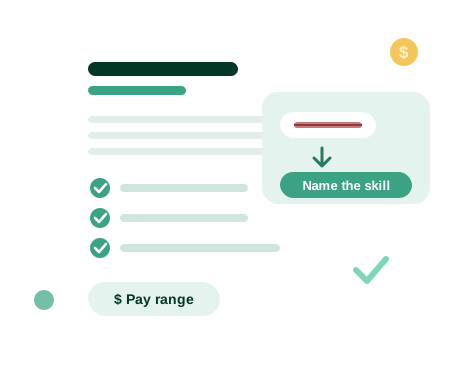
A good job description names the role clearly, says what the person will do and achieve, separates must-haves from nice-to-haves, and states pay, location and process up front. It also avoids language that quietly narrows who applies. Writing it carefully attracts more qualified people, including candidates who would otherwise talk themselves out of applying.
This guide covers what to include, which wording to change, a template you can fill in, and a checklist for review before you post. For a longer walkthrough with role examples, see Dover’s job description guide.
What to include in a job description
Use the same order every time so candidates can scan it.
Job title
Use the title people search for, such as “Senior Backend Engineer” instead of “Code Wizard”. Add the level if it matters, and keep internal naming out of it.
Summary
Write three to five sentences on why the role exists, who it reports to, and what success looks like. Lead with the work and the impact, not company boilerplate.
Responsibilities
List five to eight responsibilities in priority order, starting with what takes most of the person’s time. Start each with a verb, and be specific: “own the weekly pipeline report” beats “support reporting”.
Must-haves and nice-to-haves
Keep must-haves to what someone truly needs to do the job on day one or to learn quickly. If someone could succeed without it, it is a nice-to-have. Long lists of requirements and inflated experience or degree requirements shrink your pool without improving it. Explicitly say that people who meet most of the must-haves should still apply.
Pay range
Add the base range, and mention equity, bonus and benefits if relevant. Some places also require a general description of benefits in the posting. Pay transparency laws apply in a growing number of places, so check what applies in each location where you hire; see compensation requirements for job postings.
Location and schedule
State whether the job is on-site, hybrid or remote, which locations or time zones you can hire in, and any travel expectations. If it is relevant, say whether you can sponsor visas. Do not require US citizenship or prefer a particular visa status unless a law or contract requires it; see the wording check below.
Hiring process
List the steps and rough timing: for example, a recruiter screen, a working session and a final conversation. Candidates apply more confidently when they know what to expect, and you can reuse the list in your interview process. Say whether the role is open now and roughly when you expect to close applications. Postings that never close erode trust, and some places require a close date; see compensation requirements for job postings.
If AI tools screen or score applicants, tell candidates. Illinois requires notice when AI is used in hiring decisions (DLA Piper summary), and New York City has bias audit and notice rules; see the NYC Local Law 144 guide. A short notice in the posting or on your careers page, with a way to ask for an accommodation, covers the common cases. Check whether the rules where you hire require it in the posting itself.
About the company and how to apply
Keep the company paragraph short and factual. Close with how to apply and what you will do after: confirm receipt, and reply within a stated time.
Biased language to avoid
Wording can signal who “belongs” in the role. Research on gendered wording in job ads has found that masculine-coded words can reduce how much a posting appeals to women; one widely cited study is Gaucher, Friesen and Kay (2011). You do not need a perfect score, but you can remove obvious problems.
| Instead of | Try | Why |
|---|---|---|
| Rockstar, ninja, guru | Name the skill: “experienced in [skill]” | Slang and superlatives signal a narrow image of the ideal hire |
| Aggressive, dominant, competitive | “Ambitious,” “results-driven,” or describe the target: “hit quarterly goals” | Masculine-coded personality words can deter qualified applicants |
| Digital native | “Comfortable with [tools]” | Can read as a signal about age |
| Young, energetic team | “Collaborative team of [size]” | Age references can exclude, and may be unlawful |
| He or she, “the candidate… he” | “You” or “they” | Avoids gendered assumptions |
| Culture fit | “Values we look for: [specific behaviors]” | Vague fit criteria let personal bias creep in |
| Must lift 50 lbs, must be able to stand all day (if not essential) | State only the essential physical requirements, and say accommodations are available | Unnecessary requirements can exclude people with disabilities |
| 10+ years of experience | State the scope you need: “has led [type of project]” | Years are a weak proxy for ability |
| Fast-paced, scrappy | Describe the actual conditions: “small team, shipped weekly” | Cliches are vague and can deter people who want clarity |
Also check for:
- Degree requirements that the work does not need.
- Long must-have lists with many tools. Qualified people often hold back unless they meet every item. Say clearly that people who meet most requirements should still apply.
- Acronyms and company jargon that outsiders will not understand.
A short, honest equal opportunity statement is a reasonable addition. Make it real by backing it with your process: for ideas, see how to source candidates and how to show your commitment to inclusive hiring.
Check your wording for legal risk
A posting should describe the job, not the person you hope to hire. The EEOC’s rules on job advertisements bar notices that show a preference for, or discourage applicants because of, a protected characteristic. Before you post, scan for:
- Targeted language. Phrases such as “diverse candidates only” or “preferred: [protected group]” state a preference. Law-firm summaries of the EEOC’s June 2026 enforcement plan (Cooley, Troutman) point to ads seeking “diverse candidates” as language to review. Welcoming everyone who meets the requirements is safer than targeting anyone.
- Age. “Recent graduate”, “young” and “digital native” can read as an age preference.
- National origin and language. Ask for “fluent in English” only if the job requires it. “Native English speaker” is a problem.
- Citizenship and visa status. Do not require citizenship or prefer a visa type unless a law, contract or government requirement says so.
This is general information, not legal advice. Rules vary by location and are changing, so ask counsel before you use targeted language.
Job description template
Copy this, replace the brackets, and delete anything that does not apply.
[Job title]
[Company] | [Location or remote policy] | [Full-time / part-time / contract]
Pay: [range], plus [equity / bonus / benefits highlights]
Application deadline: [date, or "We expect to close applications on [date]"]

About the role
[3 to 5 sentences: why this role exists, who it reports to, and what
success looks like in the first year.]

What you will do
- [Responsibility 1, most important or time-consuming]
- [Responsibility 2]
- [Responsibility 3]
- [Responsibility 4]
- [Responsibility 5]

What you bring (must-haves)
- [Skill or experience needed to do the job]
- [Skill or experience needed to do the job]
- [Skill or experience needed to do the job]

Nice to have
- [Helpful but not required]
- [Helpful but not required]

What we offer
- Benefits: [general description, for example health coverage, retirement plan, time off]
- [Equity, flexibility, growth]

Our hiring process
1. [Application review, with timing]
2. [Intro call, X minutes]
3. [Working session or interview]
4. [Final conversation and decision]

About [Company]
[2 to 3 sentences: what you do, who you serve, stage, team size.]

How to apply
[Link or instructions.] [If you use AI to screen or score applications: a one-sentence notice and how to ask for an alternative.] If you meet most of these requirements but not all,
we still encourage you to apply. [Company] is an equal opportunity employer.
If you need an accommodation during the process, contact [email].
If you would rather start from a draft, Dover’s ATS can draft a job description with AI from a few details about the role, and post the job to 50+ job boards; see how to draft a description with AI. Always edit the result against the checklist below.
Job description review checklist
Before you post, check each item.
- The title is one candidates search for.
- The summary says what the person will do and achieve.
- Responsibilities are in priority order and start with verbs.
- Must-haves are limited to what the job needs, and nice-to-haves are labeled.
- Degree and years-of-experience requirements are justified by the work.
- A pay range is included, and meets local posting rules, including benefits and an application close date where required.
- Location, schedule and visa policy are clear.
- The hiring steps and timeline are listed.
- No gendered, age-coded or slang wording remains.
- Nothing states a preference for or against a protected characteristic, citizenship or visa status unless a law requires it.
- A notice is included if AI screens or scores applicants.
- Acronyms and internal jargon are explained or removed.
- The accommodation and equal opportunity language is present and accurate.
- Someone outside the hiring team read it and could say what the job is.
- You listed it where your target candidates look; see job boards and sources.
Frequently asked questions
What should a job description include?
A standard job title, a short summary of the role, prioritized responsibilities, must-have and nice-to-have qualifications, the pay range, the location or remote policy, and what the hiring process looks like. Add a short note on how to apply.
How long should a job description be?
Long enough to be specific and short enough to skim, usually a few hundred words. If a qualified reader has to scroll to find the requirements, cut or reorganize.
Should you list salary in a job description?
Yes, where you can. Some places require pay ranges in postings, so check the rules for each location where you hire. Even where it is optional, a range saves time for you and the candidate.
What words should you avoid in job descriptions?
Avoid terms that signal a narrow image of the ideal person, such as rockstar or ninja, and words that describe personality instead of the work. Replace them with the specific tasks and skills the job needs.
Can a job posting say it wants diverse candidates?
Be careful. An equal opportunity statement is standard, but wording that prefers or discourages applicants because of a protected characteristic can create legal risk, and law-firm summaries of the EEOC's June 2026 enforcement plan point to ads seeking diverse candidates as language to review. Welcome everyone who meets the requirements, and check targeted language with counsel.
Do I have to tell applicants if I use AI to screen them?
In some places, yes. Illinois requires notice when AI is used in hiring decisions, and New York City has bias audit and notice rules for automated employment decision tools. Check the rules where you hire, and put a short notice in the posting or on your careers page if you use AI to screen or score applicants.
Can AI write a job description?
AI can produce a good first draft from a few details about the role, but you should edit it for accuracy and for the language checks in this guide. Dover's ATS can draft a job description with AI.
Do this with Dover
Track every candidate in Dover's free ATS, and bring in a vetted fractional recruiter from the Marketplace when you need extra hands.