

After funding, the biggest challenge to startup growth is hiring the right people, in the right roles, at the right time. Get it wrong and you burn runway, lose momentum, and spend months rehiring. Hiring has evolved meaningfully in recent years, with fractional recruiters, free applicant tracking systems (ATS), and better approaches that give early teams more structure, less scrambling, and a real shot at getting it right the first time.
TLDR:
-
Early-stage funding fell 14% year over year in Q1 2025, making every seed hire a decision that needs to hold up under tighter runway.
-
Your founding engineer is typically your first hire post-close; sales vs. marketing sequencing depends on whether you’re B2B or B2C.
-
Fractional recruiters run $75-200+ per hour or $3,000-8,000 per month, and work best when hiring volume spikes or roles fall outside your expertise.
-
Skipping references, hiring only for today, and unclear equity terms are the most common mistakes that create downstream problems.
-
Some tools pair a free ATS with on-demand recruiting support, letting early teams track candidates and access experienced recruiters without a full-time recruiting hire.
Understanding the Seed Stage Hiring Market in 2026
The seed stage looks different in 2026. Global seed funding hit $12 billion in Q1 2026, up 31 percent year over year according to Crunchbase News, though seed deal counts fell 30 percent in the same period. Capital is concentrating into fewer, larger rounds.
More capital means better-funded rivals bidding for the same engineers and go-to-market talent. With deal counts down 30 percent, the startups that closed rounds are competing harder for top candidates. For context on where investors set the bar today, startup funding benchmarks show how much traction expectations have risen at the seed stage.
The Typical Hiring Timeline for Seed Startups
First Engineering Hire: Your Founding Engineer
Your first hire is likely your founding engineer. This person should be able to:
-
Design and develop a technical foundation that supports your company’s mission
-
Make key technology decisions
-
Eventually lead and mentor junior engineers
-
Work directly with customers and feedback loops
Timeline: Typically your first hire after closing the seed round.
The Junior Engineer: Building Your Technical Foundation
As your product grows, a junior or mid-level engineer is a natural next hire.
Timeline: Usually 3-6 months after your founding engineer.
What to look for:
-
Eagerness to learn and adapt
-
Strong technical basics
-
Cultural fit with your founding engineer
-
Ability to work across the stack
Sales vs. Marketing: Which Comes First?
B2B Startups: Hire a salesperson first to convert warm leads into customers as you learn who your best customers are.
B2C Startups: Start with marketing to learn which customer channels work best and drive business growth.
Timeline: Typically 6-12 months in, after your core product is built and seeing traction.
Setting Up Your Hiring Infrastructure: The ATS Foundation
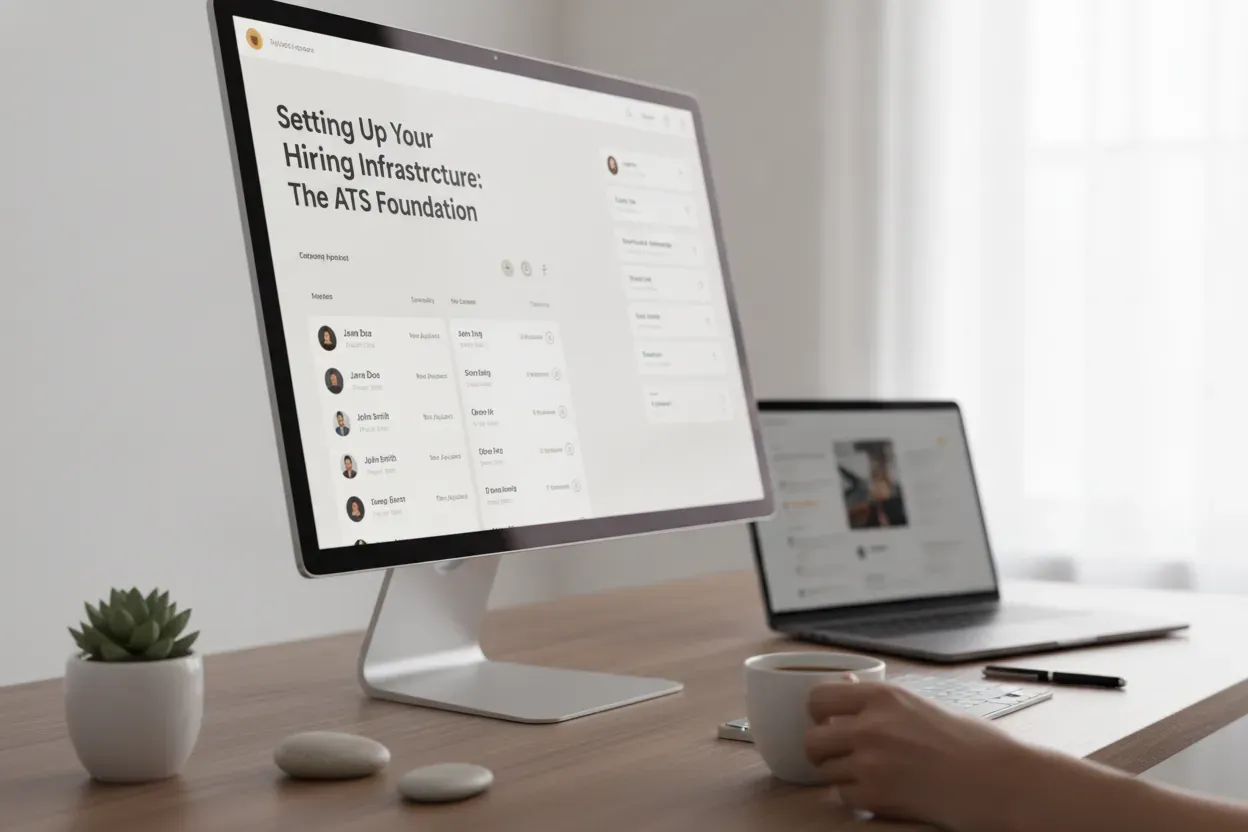
You can get started with an applicant tracking system like Dover’s free ATS at no cost.
“Dover’s ATS simplifies the hiring process and provides an excellent level of support, which made for a smooth migration during implementation!” - Julie Yang (East Side Games)
Why You Need an ATS
Organization: Keeps candidates, notes, and communication in one place.
Team collaboration: Get a centralized hiring pipeline view and collaborate easily.
Professional candidate experience: Nothing says “not ready to hire” like losing resumes in your inbox.
Scalability: Start with an easy to use ATS built for startups that can grow with you.
Key ATS Features for Seed Startups
| Feature | Why It Matters | Dover’s Solution |
|---|---|---|
| AI-powered candidate scoring | Saves time reviewing resumes | ✅ Automatic ranking |
| One click job posting | Reach more candidates easily | ✅ Post to 50+ boards |
| Team collaboration | Get input from your whole team | ✅ Feedback and scorecards |
| Career page builder | Professional candidate experience | ✅ No code careers page |
| Mobile friendly | Review candidates on the go | ✅ Fully responsive |
Setting Up Your Hiring Process
A simple, effective process for most seed startups:
-
Application: Candidates apply through your careers page
-
AI screening: Your ATS automatically scores and ranks candidates
-
Phone screen: 15-30 minute conversation to assess basic fit
-
Skills assessment: Role specific evaluation
-
Team interview: Cultural fit and team dynamics
-
Reference check: Verify past performance
-
Offer: Negotiate terms and close
This process holds whether you’re running it internally or working with outside recruiting support. Fractional recruiting agencies plug directly into your ATS instead of operating in a separate vendor system, so sourcing, candidate notes, and pipeline data stay in one place from day one.
Working with Fractional Recruiters: Your Strategic Hiring Partner
An ATS handles inbound pipeline by collecting applications, scoring resumes, and keeping the team aligned on candidates. What it doesn’t do is go out and find candidates, manage a specialized search, or absorb the coordination overhead when hiring volume spikes. That’s the decision point where a fractional recruiter makes sense: an experienced pro who provides part-time or project-based support, working inside your existing system instead of alongside it.
When to Bring in a Fractional Recruiter
You should consider working with a fractional recruiter when:
-
You’re hiring for roles outside your expertise
-
You need to fill multiple positions quickly
-
Your hiring volume is ramping up after funding
-
You want to build better practices
-
Your team is spending too much time on recruiting
What to Expect from a Fractional Recruiter

A good fractional recruiter refines job descriptions and evaluation criteria, sources candidates actively instead of just posting jobs, conducts initial interviews to save you time, and shares market insights on compensation trends.
Fractional Recruiter Pricing
-
Hourly rates: $75-200+ per hour based on experience
-
Monthly retainers: $3,000-8,000 per month for part time support
-
Project based: Fixed fee for specific hiring projects
For a side-by-side fractional vs. agency cost breakdown, the numbers favor fractional for most seed teams. See also the full breakdown of recruiter costs.
One practical distinction before engaging: Dover’s network features vetted recruiters with published client reviews, so you can assess fit based on real feedback instead of relying on an agency’s own account of recruiter quality. Dover operates as the infrastructure layer fractional recruiting agencies are built on, so sourcing history and performance data stay in your ATS after each search closes and carry forward into future searches.
Common Seed Stage Hiring Mistakes (And How to Avoid Them)
Mistake 1: Hiring Too Fast or Too Slow
The problem: Making rushed hiring decisions with the first qualified candidate or taking too long searching for a perfect fit.
The solution: Set a clear hiring timeline and aim to extend offers within 2-3 weeks of starting a search. A fractional recruiter helps maintain speed and quality.
Mistake 2: Focusing Only on Technical Skills
The problem: Organizing your process around intelligence tests and brainteasers.
The solution: Look beyond just skills and experience. Focus on finding people who share your values, show enthusiasm, and connect with your company’s purpose.
Mistake 3: Not Checking References
The problem: Skipping reference checks in a hurry, only to uncover issues later.
The solution: Always check references, especially for senior roles. Let your fractional recruiter handle this.
Mistake 4: Unclear Equity and Compensation
The problem: Not providing clear details about equity and competitive pay packages.
The solution: Get clear on what fair startup equity compensation looks like, use tools like Carta or AngelList, and work with an experienced fractional recruiter.
Mistake 5: Hiring for Today Instead of Tomorrow
The problem: Hiring for an immediate need without considering growth potential.
The solution: Think 12-18 months ahead. Hire people who can grow into those future roles.
Putting It All Together: Your 2026 Hiring Roadmap
Phase 1: Foundation — Month 1-2
-
Set up your free Dover ATS
-
Create basic job descriptions
-
Build a simple careers page
-
Define company values and culture
Phase 2: First Hires — Month 3-6
-
Hire your founding engineer
-
Consider a fractional recruiter for specialized roles
-
Start building your employer brand and document your hiring process
Phase 3: Scale — Month 6-12
-
Add junior engineer
-
Hire sales or marketing lead
-
Implement employee referral program
-
Start tracking hiring metrics
Phase 4: Optimize — Month 12+
-
Refine process based on data
-
Build hiring playbooks per role
-
Prepare for Series A hiring surge
How Dover Fits Into Seed Stage Hiring
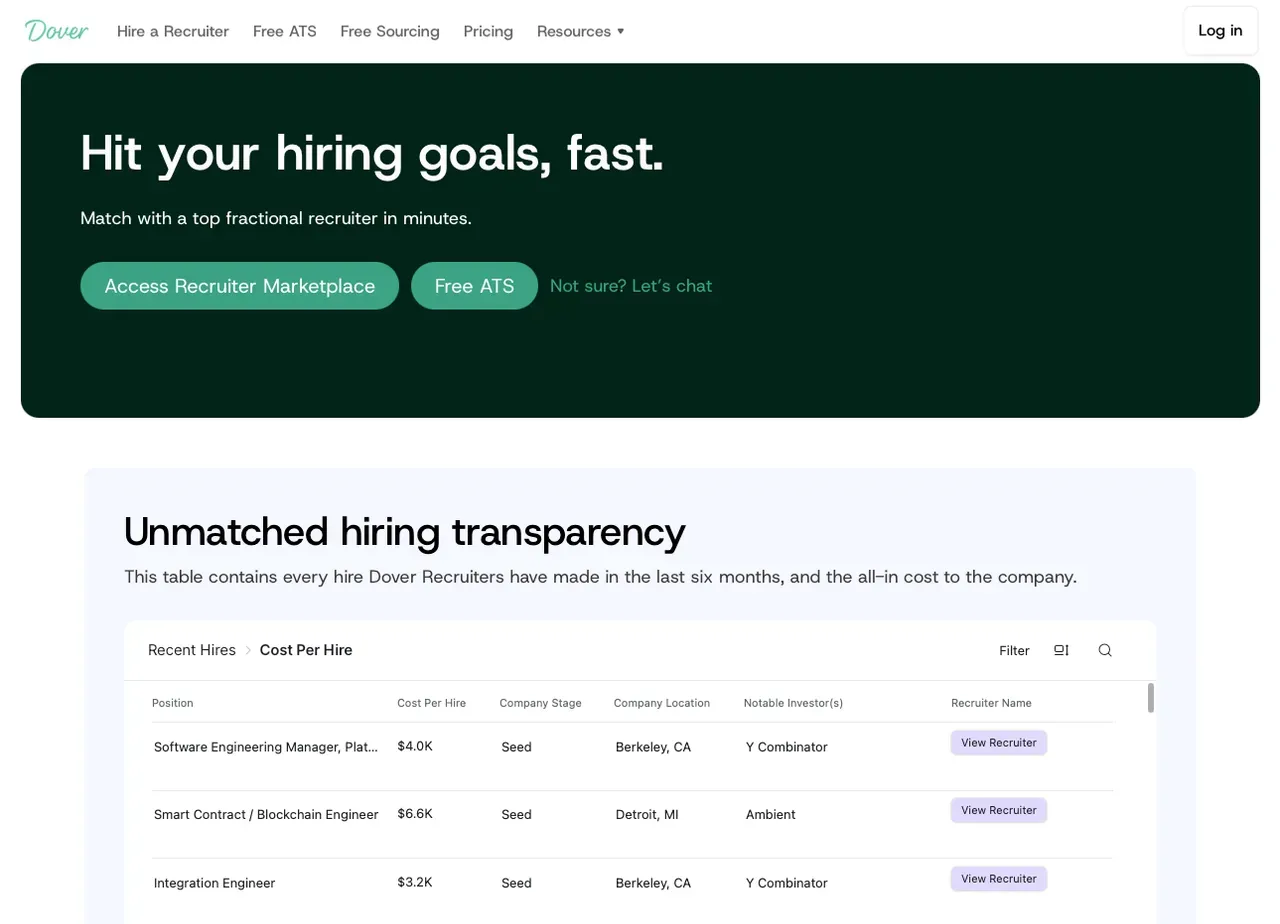
Dover’s free ATS is built as the Day 1 hiring infrastructure for early-stage teams. It takes under five minutes to set up, posts to over 50 job boards in one click, scores and ranks incoming applicants automatically, and gives your whole team a shared pipeline view through a no-code careers page. There are no seat limits, no user caps, and no cost to get started, so you can build a repeatable hiring process from your first role without committing to enterprise software you’ll outgrow or replace.
When hiring volume picks up or a role falls outside your core expertise, Dover connects you with experienced fractional recruiters through a network built on vetted profiles and published client reviews. Recruiters set their own rates, and a typical hire comes in at $2,000 to $7,000 total (about $4,000 per hire on average), a fraction of what a contingency agency charges. There’s an $800 fully refundable deposit to get started and no long-term contracts, so you can engage a recruiter for a focused search and step back once the role is filled.
What makes the combination work for seed teams is that both sides share the same system. Dover operates as the infrastructure layer fractional recruiting agencies are built on, which is why recruiters and your internal hiring leads work from the same ATS. Sourcing activity, candidate notes, and pipeline data stay in one place instead of being split across vendor portals, and every search builds on prior intelligence instead of starting fresh.
FAQs
What’s the right hiring sequence for a seed startup after closing funding?
Most seed startups hire a founding engineer first, then add a junior or mid-level engineer within 3-6 months as the product grows. Sales vs. marketing sequencing comes after that, typically 6-12 months in, and depends on your model: B2B startups benefit from a salesperson first to convert warm leads, while B2C companies tend to start with marketing to identify which acquisition channels actually work.
Fractional recruiter vs. hiring a full-time recruiter for a seed startup?
A fractional recruiter makes more sense at the seed stage for most teams. Fractional recruiters typically run $75-200+ per hour or $3,000-$8,000 per month, and you engage them when hiring volume spikes or a role falls outside your expertise, with no ongoing overhead when searches aren’t active. A full-time recruiter becomes worth considering around 15-20 annual hires, when the consistent workload warrants a loaded cost of $85,000-$170,000 per year.
How do I avoid the most common equity and compensation mistakes when making seed stage hires?
Set clear equity and compensation terms before you extend an offer, not during negotiation. Use tools like Carta or AngelList to model equity fairly, and work with a recruiter who has startup compensation experience to benchmark against current market rates. Undefined or inconsistent terms create downstream problems that can affect retention and culture as the team grows.
Final Thoughts on Hiring as a Seed Startup in a Tighter Market
Seed stage hiring is harder to get right than it looks. Every role carries outsize weight when the team is small, runway is finite, and each person shapes the culture and velocity of everything that follows. Getting the sequence right, building repeatable process from day one, and knowing when to bring in outside help separate startups that scale cleanly from those that backtrack and rehire. Dover’s free ATS gives early teams a foundation to track candidates and run a consistent process without upfront cost. The fractional recruiter marketplace, where hires have averaged about $4,000 with no long-term contracts, lets you bring in experienced hiring support for high-stakes roles without committing to full-time recruiting headcount.