

You landed here searching “what is a recruiter” because you need to understand the role from the inside, whether that’s to pursue it yourself or to figure out which recruiting model makes sense for your hiring situation. Recruiters do more than post jobs and wait for applications to roll in. They source candidates actively, run screens, coordinate interviews, and close offers, but the structure they work under, corporate, agency, or fractional, determines how they get paid, how fast they move, and whether their incentives line up with yours.
TLDR:
-
Recruiters find and hire talent for companies, working in-house, through agencies, or fractionally.
-
Entry-level recruiters earn around $49,000 while experienced technical recruiters make $80,000 to $110,000.
-
You can break into recruiting without a degree through coordinator roles or free HR certifications.
-
Fractional recruiters cost $2,000 to $7,000 per hire vs. traditional agencies at $18,000 to $30,000.
-
Some modern platforms offer hourly fractional recruiters and a free ATS for startups hiring 5 to 50 roles annually.
What Is a Recruiter?
A recruiter is the person responsible for finding, attracting, and hiring talent on behalf of a company or a candidate, sitting between organizations that need people and professionals looking for their next opportunity.
Recruiting involves more than posting a job and waiting. Recruiters source candidates actively, screen resumes, conduct initial interviews, coordinate the hiring process, and often negotiate offers. Some work inside companies directly; others operate through agencies or independently. The job requires equal parts people skills and process discipline.
“Recruiting is sales, research, and project management rolled into one job title.”
Whether filling one role or scaling an entire team, a good recruiter shapes who gets hired and that shapes everything else.
Types of Recruiters: Corporate, Agency, and Fractional Models
Not all recruiters work the same way. The model matters as much as the person, especially if you’re trying to figure out which type of recruiting support actually fits your situation.
Corporate (In-House) Recruiters
These recruiters work directly for one company, usually full-time, embedded in the HR or people team. They know the culture deeply but only hire for that single organization.
Agency Recruiters
Agency recruiters work for a staffing or search firm and serve multiple clients at once. They typically earn a commission tied to successful placements, which creates speed but can misalign incentives.
Fractional Recruiters
Fractional recruiters operate on an hourly or part-time basis, functioning as an extension of a company’s team without the overhead of a full-time hire. Startups and growing companies often turn to this model when hiring volume isn’t consistent enough to support a full-time headcount but the need is too real to ignore.
What Does a Recruiter Do on a Daily Basis?

The recruiting cycle follows a recognizable pattern across most roles, though the daily texture changes depending on whether you’re in-house, at an agency, or working fractionally.
A typical recruiter’s day includes core recruiting responsibilities such as:
-
Reviewing new applications and scoring resumes against role requirements
-
Sourcing passive candidates through LinkedIn, job boards, or outreach tools
-
Conducting phone screens to qualify fit before passing candidates to hiring managers
-
Coordinating interview schedules across multiple time zones and stakeholders
-
Following up with candidates to maintain momentum in the pipeline
-
Debriefing with hiring managers after interview rounds
-
Drafting and negotiating offer letters
Agency recruiters often juggle this across several clients simultaneously. Corporate recruiters go deeper on fewer roles but spend more time in internal meetings. Fractional recruiters focus on highest-impact activities, sourcing and closing, since their time is contracted by the hour.
Recruiter Salary: What Do Recruiters Make in 2026?
Recruiter pay varies considerably depending on where you sit in the profession. The average base salary for a recruiter in 2026 is roughly $62,247, with entry-level roles starting closer to $49,461 for those with under a year of experience.
| Role | Average Annual Salary |
|---|---|
| Entry-Level Recruiter | $49,461 |
| Mid-Level Recruiter | $62,247 |
| Technical Recruiter | $80,000 to $110,000 |
| Senior / Executive Recruiter | $100,000+ |
Location moves the numbers meaningfully. Recruiters in higher-cost markets like New York City or California often earn above national averages, sometimes by 20 to 30%, while those in lower cost-of-living markets may land below them. Agency recruiters frequently earn a lower base but stack commission on top, so total compensation can swing well above or below their in-house counterparts depending on the market.
Contract and fractional recruiters typically bill between $75 to $125 per hour. For a full-time recruiter on staff, loaded costs including salary, benefits, and overhead often run $85,000 to $170,000 annually.
How to Become a Recruiter (With or Without a Degree)
Recruiting has no single required credential. Most job postings ask for a bachelor’s degree, but the field is full of people who came from sales, customer service, teaching, and other people-facing careers who found their footing without a traditional HR background.
What matters more than your degree is whether you can build rapport quickly, stay organized under pressure, and communicate clearly. Those skills transfer from almost anywhere.
To break in without experience, focus on a few concrete steps:
-
Get familiar with an ATS and common sourcing tools like LinkedIn Recruiter to show you understand the basic workflow of finding and tracking candidates.
-
Take a free or low-cost HR certification (SHRM, AIHR, or similar) to signal seriousness to hiring managers who might otherwise overlook your application.
-
Apply for coordinator or sourcing roles before jumping to full-cycle recruiter positions, since those entry points build credibility fast.
-
Offer to help a small business or startup with hiring, even informally, to build a track record you can reference in interviews.
Military experience is another legitimate path. The Army, Navy, and Air Force all have dedicated recruiter roles that provide structured training and real-world talent acquisition experience, often with a two to three year service commitment attached.
For most career changers, agency recruiting offers the fastest entry point, since many firms will hire people with strong communication skills and train them on the job.
Specialized Recruiter Roles: Tech, Startup, and Industry-Specific Recruiting
Recruiting specializations matter because each niche demands a different skill set. A healthcare recruiter handling licensing requirements operates in a completely different world from someone closing engineers at a seed-stage startup.
Startup recruiting is its own discipline. Early-stage companies can move faster than larger enterprises, sometimes filling roles in a few weeks compared to longer hiring cycles at larger organizations. Candidates get assessed on cultural fit within small, high-stakes teams, and conversations about equity compensation are standard. A startup recruiter who can’t explain a vesting schedule or speak to runway won’t last long.
Tech recruiting sits in similarly high demand, requiring enough technical fluency to screen engineers credibly without being an engineer yourself. Other sought-after specializations include:
-
Executive and leadership search, where relationships and discretion matter as much as sourcing ability
-
Healthcare and clinical staffing, shaped by licensing requirements and regulatory constraints
-
Legal and compliance recruiting, which calls for familiarity with credentials and firm culture
-
Sales and go-to-market hiring, where quota attainment history and ramp time drive decisions
-
Diversity-focused recruiting, which requires intentional sourcing strategies and structured interview design
The more specialized the niche, the higher the earning potential and the narrower the talent pool you’re working with.
Fractional Recruiters vs. Traditional Agencies: Cost and Model Comparison
The cost gap between these two models is wide enough to matter for most hiring budgets.
Traditional agencies charge 15 to 25% of a candidate’s first-year salary. On a $120,000 hire, that’s $18,000 to $30,000 per placement, typically paid regardless of how long the search took. Fractional recruiters bill hourly, typically $75 to $125 per hour, and most hires land somewhere between $2,000 to $7,000 total.
Beyond cost, the incentive structures differ. Agency recruiters get paid per placement, which can push toward speed over fit. Fractional recruiters, working as an extension of your team, are judged on whether the hire actually works out.
For companies making fewer than 15 to 20 hires per year, fractional support often makes more sense than carrying a full-time recruiter’s $85,000 to $170,000 loaded cost. The tradeoff is less internal institutional knowledge over time, which matters more as headcount grows.
Career Path and Job Outlook for Recruiters
Recruiting careers follow a recognizable ladder, even if the pace of progression varies by setting.
Most people start as sourcing specialists or recruiting coordinators, handling logistics and pipeline support before moving into full-cycle roles. From there, the typical path runs through senior recruiter, then into team lead or talent acquisition manager territory. Those who go deep on strategy often land as heads of talent or VP-level leaders overseeing entire recruiting functions.
Agency vs. Corporate Career Tracks
Agency and corporate tracks diverge over time. Agency recruiters can build books of business and move toward leadership or launch independent practices. Corporate recruiters often develop deep domain expertise and shift into HR business partner or people operations roles.
Job growth in the field is steady. The BLS projects HR specialist roles to grow roughly 8% through 2033, faster than average across occupations. Demand for technical and executive recruiters in particular remains strong as competition for specialized talent stays high.
Recruiters who lean into sourcing tools, AI-assisted screening, and data-driven hiring decisions are pulling ahead of those who rely on relationship management alone.
How Dover Helps Companies Access Fractional Recruiting Expertise
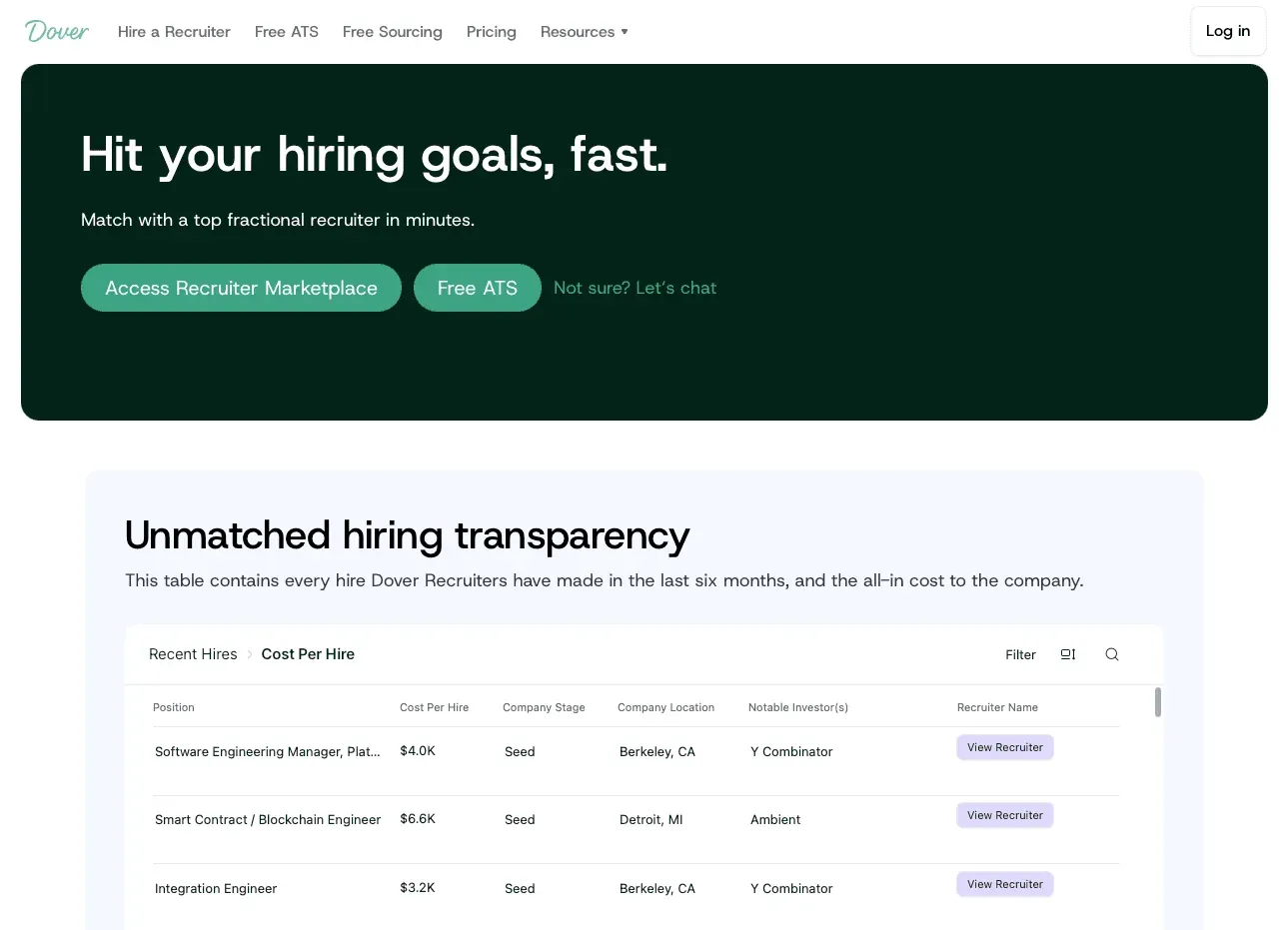
Dover brings together two things growing companies often need: a free ATS to manage their hiring pipeline and a marketplace of experienced fractional recruiters who work as part of your team on an hourly basis.
Instead of paying 15 to 25% placement fees, companies access recruiters at $75 to $125 per hour, with most roles coming in between $2,000 to $7,000 total. Getting started requires only an $800 fully refundable deposit, with no contracts or long-term commitments. You can ramp up or pull back as hiring needs change.
Every recruiter in the network has gone through a selective vetting process and brings real startup hiring experience. Both the recruiter and your internal team work from the same ATS, so sourcing activity, candidate flow, and pipeline health stay visible in real time.
For companies hiring 5-50 roles a year, it can be a practical middle ground between going it alone and overpaying an agency.
Frequently Asked Questions
Can I become a recruiter without a degree?
Yes. While many job postings list a bachelor’s degree as a requirement, recruiting is full of people who came from sales, customer service, teaching, and other people-facing careers without traditional HR credentials. What matters more is whether you can build rapport quickly, stay organized under pressure, and communicate clearly, skills that transfer from almost anywhere.
How much does it cost to hire through a traditional agency vs. fractional recruiting?
Traditional agencies charge 15 to 25% of a candidate’s first-year salary, $18,000 to $30,000 for a $120,000 hire, paid regardless of how long the search took. Fractional recruiters bill hourly at $75 to $125 per hour, with most hires landing between $2,000 to $7,000 total, making them more cost-effective for companies making fewer than 15 to 20 hires per year.
What is a recruiter salary for entry-level positions?
Entry-level recruiters with under a year of experience typically earn around $49,461 annually, with mid-level recruiters averaging $62,247. Location moves these numbers meaningfully; recruiters in New York City or California often earn 20-30% above national averages, while those in lower cost-of-living markets may land below them.
Final Thoughts on Understanding Recruiters
Asking “what is a recruiter” matters when you’re hiring one or considering the profession yourself. The daily work looks similar across agency, corporate, and fractional models, but the incentives and cost structures create very different experiences for everyone involved. For teams that need real recruiting help without a full-time hire or agency fees, Dover offers fractional recruiters and a free ATS as a practical middle ground. The profession keeps growing because hiring the right people still shapes everything else.