


Your team member refers someone, the candidate gets hired, and the referral bonus never arrives because somewhere between intake and offer, the attribution got lost. This isn’t a program design problem. It’s a tracking problem. Without a proper employee referral tracking ATS, referral credit disappears into Slack threads, hiring managers forget who introduced which candidate, and your source data shows “other” where it should show a name. When employees submit referrals and never see results, they stop participating. The cost goes beyond bonus payouts. You’re losing the trust that makes referral programs work in the first place.
TLDR:
-
Referrals convert to hires at 4x the rate of job board applicants yet get lost in manual tracking.
-
Broken attribution kills program participation when employees never learn what happened to their referrals.
-
Your ATS should auto-flag referred candidates at submission and lock attribution through every stage.
-
Clean referral data reveals which employees refer top performers and where candidates drop off.
-
A free ATS with built-in referral tracking captures source data automatically and gives employees real-time pipeline visibility.
Why Employee Referrals Get Lost Without Proper ATS Tracking
Referrals make up just 7% of job applications, yet they account for 30 to 40% of actual hires. A referred candidate is 4x more likely to receive an offer than someone who came through a job board. Few other recruiting channels consistently match those conversion rates.
The problem isn’t that startups ignore referrals. It’s that they track them poorly. Without structured employee referral tracking in an ATS, referral credit gets lost in email threads, Slack messages go unlogged, and hiring managers forget who introduced which candidate. A hire gets attributed to “other” in your source data, the referring employee never gets recognized, and your reporting tells you nothing useful about where your best candidates actually come from.
The Hidden Cost of Manual Referral Tracking
When referral programs run through spreadsheets, Slack messages, and calendar reminders, the tracking gaps add up fast. A referred candidate gets submitted, a recruiter forgets to log the source, and suddenly there’s no record connecting that hire to the employee who made the introduction. The referral bonus never gets paid, the employee feels overlooked, and the next time they think about referring someone, they don’t bother.

The downstream recruiting costs can add up quickly. Beyond the missed bonus payout, companies lose visibility into which referral sources are actually producing quality hires. Without clean referral data, it’s impossible to know whether your referral program deserves more investment or less.
Why Spreadsheets Break Down at Scale
-
Ownership is unclear: when multiple recruiters touch a candidate, there’s no single system tracking who submitted the referral or when.
-
Status updates fall through: candidates move through stages without the referring employee ever knowing, which damages trust in the program.
-
Attribution gets lost at hire: even when early tracking exists, connecting the original referral source to a completed hire requires manual reconciliation that rarely happens consistently.
How Broken Referral Attribution Kills Program Participation
Employee referral programs run on trust. When someone submits a name and never hears what happened to that candidate, they draw a conclusion: their effort didn’t register. That conclusion spreads. One person mentions it in a team meeting, another echoes the experience, and the program quietly develops a reputation problem that no bonus amount can repair.
This is where programs collapse. Early referrers who had good outcomes become internal advocates for participating. When attribution breaks and those contributors disengage, there’s no one left modeling the behavior for new hires. Referral programs need social proof to survive, and that proof disappears when follow-through does.
Worth considering: the employees most likely to refer great candidates are often your strongest performers. They have the deepest networks. Losing their participation costs more than the raw numbers suggest.
What ATS Referral Tracking Should Actually Do
Good referral tracking isn’t about adding features to an ATS. It’s about removing the friction points where attribution typically breaks.
A well-built system should do four things clearly:
-
Flag referred candidates at the moment of submission, not as a retroactive cleanup task after a recruiter remembers to update the source field
-
Lock referrer attribution to the candidate record so it survives every stage change, from initial screen through offer accepted
-
Give employees a one-click path to submit a referral without requiring a separate portal, a new login, or a message to HR
-
Show real-time pipeline status to both the recruiter and the referring employee automatically, without anyone needing to ask
That last point is where most tools fall short. When referring employees can watch their candidate move through stages on their own, you close the feedback loop that usually erodes participation. The referring employee feels seen, and the recruiter doesn’t field status check emails. Everyone wins.
The Referral Data Most Startups Never See
Most startups know their referral hire count. Few know which employees refer candidates who actually perform well, which referrers produce hires that stay past the one-year mark, or how referral candidates compare in time-to-hire against sourced and inbound applicants.

That data exists once referral attribution is clean end-to-end. With proper tracking, you can see:
-
Which employees refer most frequently, and whose referrals convert at the highest rates
-
Whether referral candidates clear interview stages faster than other sources
-
Where in the funnel referred candidates drop off, and whether the pattern points to a sourcing issue or a process one
-
How participation trends over time across the team
The strategic shift happens when you stop treating referral tracking as bookkeeping and start treating it as a feedback loop. If one engineer’s referrals consistently produce strong hires, including those who stay past the one-year mark, that is worth knowing. It is also worth telling them.
Why Dedicated Referral Tools Often Create More Problems
Standalone referral tracking tools promise simplicity, but they often introduce friction that slows down the programs they’re supposed to support. When referral data lives in a separate system from your ATS, your recruiting team ends up manually aligning two sources of truth, and those gaps are where candidates get lost.
There’s also the question of adoption. Asking employees to log into yet another tool to submit referrals adds steps that most people won’t bother with. SHRM research on broken referral programs shows participation drops sharply when the submission process feels burdensome.
-
Duplicate candidate records become common when referral tools and your ATS don’t sync reliably, making it hard to know who owns the relationship.
-
Referral bonuses get delayed or miscalculated when hire attribution isn’t clearly tied back to the original submission.
-
Reporting becomes manual work instead of something your ATS generates automatically.
The result is a program that looks active on paper but quietly underperforms because no one trusts the data behind it.
| Tracking Method | Attribution Accuracy | Employee Experience | Recruiter Workload | Reporting Capability |
|---|---|---|---|---|
| Spreadsheets | Breaks down when multiple recruiters touch a candidate. No automatic connection between submission and hire. | Employees never know what happened to their referrals. No visibility into pipeline status. | Manual data entry at every stage. Constant reconciliation between systems to track bonuses. | Requires manual aggregation. Historical data often incomplete or misclassified. |
| Standalone Referral Tools | Creates duplicate candidate records when sync fails. Attribution gets lost between the referral tool and ATS. | Requires separate login. Extra steps reduce participation rates across teams. | Recruiters align two sources of truth. Bonus calculations delayed by sync issues. | Siloed from hiring data. Can show referral submissions but not conversion through pipeline stages. |
| ATS with Built-in Referral Tracking | Locks referrer attribution to candidate record at submission. Survives every stage change automatically. | One-click submission with real-time pipeline visibility. Employees see progress without asking. | No manual entry. Source data captured at intake and flows through to reporting. | Shows which employees refer top performers, conversion rates by source, and where candidates drop off in funnel. |
Setting Up Referral Tracking That Actually Gets Used
Every referral tracking setup fails or succeeds based on how easy it is to actually use. If submitting a referral takes more than one step, most employees skip it. Embed a submission link directly in Slack or your existing ATS instead of routing people through a separate portal.
Introduce the program at onboarding. New hires are often the most motivated referrers, especially in their first 90 days when their previous network is freshest. A single mention at launch is rarely enough to build consistent participation.
Audit Your Source Fields
Before any of this scales, check whether your ATS source fields are set up to capture referrals correctly. A few things worth reviewing:
-
Source field options should include a dedicated “Employee Referral” entry, separate from generic “Internal” or “Word of Mouth” categories.
-
Make sure the referring employee’s name is a required field, not optional, so bonus tracking stays accurate.
-
Review historical data for misclassified referrals that may have been logged under other sources.
How Dover’s Free ATS Makes Referral Tracking Simple for Startups
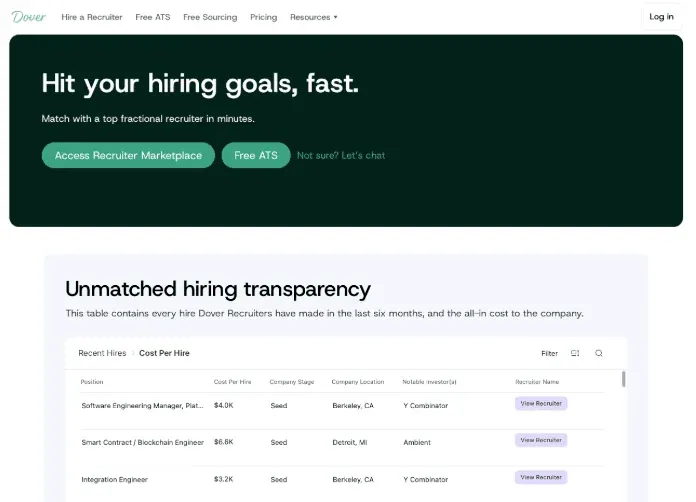
Dover’s free ATS is built with referral tracking as a first-class feature, not an afterthought. Every candidate in your pipeline can be tagged with a referral source at intake, so you always know who came in through a warm introduction and who found you through a job board.
When a referred candidate moves through stages, Dover logs that source automatically. Hiring managers and recruiters see referral attribution without digging through emails or spreadsheets. At any point, you can pull a clear view of which employees are generating referrals, how those candidates are progressing, and whether they’re converting to hires at a higher rate.
For startups running lean, this matters. You don’t need a dedicated recruiting ops person to get clean referral data. The structure is already there, so your team can spend time on conversations instead of chasing down who referred whom.
Frequently Asked Questions
Can I track employee referrals without a separate referral platform?
Yes. A well-built ATS can handle referral tracking directly, capturing referrer attribution at submission and maintaining it throughout the hiring process. Separate referral tools often create reconciliation problems between systems and lower participation because employees have to use another login.
How do I get employees to actually submit referrals?
Embed a one-click submission link directly in Slack or your ATS instead of routing people through a separate portal, and introduce the program at onboarding when new hires’ networks are freshest. Make the referring employee’s name a required field so bonus tracking stays accurate and employees trust they’ll get credit.
Why do referral programs lose participation over time?
When employees submit referrals and never hear what happened to those candidates, they conclude their effort didn’t register. This reputation spreads quickly among teams, and once early referrers who had good outcomes disengage, there’s no one left modeling the behavior for new hires.
Final Thoughts on ATS Referral Tracking That Actually Works
Your employee referral tracking ATS should tell you who referred whom, how those candidates moved through your pipeline, and whether your strongest referrers are the people you think they are. When that data lives cleanly in one place, you can actually act on it instead of guessing. Dover makes this straightforward for startups. We can walk through your setup if you want a second set of eyes on what’s working and what’s not.


-for-recruiting-in-may-2026-hero-fd0fc0f6.CdG1MPH0_jE4Sd.webp)