

The gap between needing recruiting help and being able to afford a full-time recruiter is where most early-stage companies get stuck. A fractional recruitment agency fills that gap with access to experienced recruiters on a part-time or project basis, billed hourly or per role. You get someone who integrates with your team, understands your hiring bar, and runs the full process from sourcing through offer without the fixed cost of a salary. It’s a model built for companies hiring five to fifty roles a year who need more than a job posting but less than permanent headcount.
TLDR:
-
Fractional recruiters embed in your team and charge hourly or monthly, aligning incentives with quality instead of speed to close.
-
Companies hiring 5 to 50 roles per year see the best fit, avoiding $85,000+ full-time recruiter costs.
-
Typical pricing runs $75 to $150 per hour or $3,000 to $10,000 per month, often cheaper than 20-30% contingency fees across multiple hires.
-
Fractional recruiters handle sourcing, screening, and coordination, working inside your ATS and calendar with little ramp time.
-
Some services pair fractional recruiters with built-in applicant tracking systems, keeping candidate data and recruiter activity in one workflow.
What Is a Fractional Recruitment Agency?
How you pay a recruiter matters more than it seems. When an agency earns a percentage of each placed candidate’s salary, every incentive points toward closing quickly instead of finding the right fit. A flat hourly rate or monthly retainer changes that equation.
The model developed partly in response to how poorly traditional agencies fit early-stage companies. A conventional agency operates at arm’s length: they receive a job description, run their own search, and deliver candidates with limited visibility into your team’s culture or priorities. Fractional recruiting inverts that. The recruiter integrates into the client team, learns the hiring bar, and works as a near-internal partner on a flexible, ongoing basis.
What “Fractional” Actually Means in Practice
“Fractional” refers to a working arrangement, not simply a pricing model. The recruiter attends your syncs, works inside your systems, and develops an understanding of what makes a hire succeed at your company. That depth separates the model from a typical agency engagement, where the relationship begins and ends at the job description.
How Fractional Recruitment Works
A company brings in a recruiter or small recruiting team on a part-time or project basis, scoped to a defined number of hours per week or a fixed set of roles. The recruiter operates as an embedded member of the hiring team instead of an outside vendor filling orders.

Most engagements start with an intake process where the fractional recruiter learns the company’s hiring priorities, culture, and role requirements. From there, they own the full recruiting workflow: writing job descriptions, sourcing candidates, running initial screens, coordinating interviews, and managing offer conversations. The company retains final decision-making authority throughout.
Typical Engagement Structures
Fractional recruiting arrangements generally fall into a few common formats:
-
Hours-based retainers, where a recruiter commits a set number of hours per week (often 10 to 20) at an agreed hourly rate, giving companies predictable capacity without a full-time headcount commitment.
-
Per-role project work, where the engagement is scoped around filling a specific number of positions, with a defined start and end point tied to hiring goals.
-
Interim full-time coverage, where a fractional recruiter steps in at near-full capacity during a hiring surge, then scales back once the immediate need is met.
The recruiter typically works within the company’s existing tools, whether that means an applicant tracking system, a Slack workspace, or a shared calendar for interviews. Some fractional recruiters bring their own tools and networks, which can shorten the ramp time on new searches.
What separates this from contingency recruiting is the billing structure and the working relationship. Fractional recruiters charge for time and capacity, not placement outcomes, which tends to align their incentives more closely with the company’s actual hiring quality instead of speed to close.
Benefits of Hiring a Fractional Recruitment Agency
The number of fractional professionals in the workforce roughly doubled from 60,000 in 2022 to 120,000 in 2024. The practical advantages are largely structural:
-
Cost: Full-time recruiters carry $85,000 or more in base salary plus benefits, while fractional arrangements let you pay for capacity only when you need it.
-
Flexibility: A fractional recruiter can scale up during a hiring surge and step back once roles are filled, fitting the uneven rhythms most early-stage teams experience.
-
Speed to productivity: Fractional recruiters come with existing sourcing workflows and candidate networks, so ramp time is minimal.
-
Specialist access: Technical or executive roles benefit from a recruiter with years in that function. Fractional arrangements make that depth accessible without full-time cost.
When to Consider Fractional Recruiting
Fractional recruiting fits companies hiring roughly 5 to 50 roles per year. Below that volume, a founder can usually manage searches personally. Above it, a full-time recruiter typically makes financial sense around 15 to 20 annual hires.
A few situations push companies toward fractional arrangements regardless of volume:
-
A funding round triggers a sudden hiring ramp and you need capacity fast without committing to permanent headcount
-
A specialized role, such as a senior engineer or technical GTM hire, where generalist sourcing consistently underperforms
-
A budget that rules out agency fees at 15 to 25 percent of salary but needs more support than a job posting alone
Cost of Fractional Recruitment Agencies
Pricing varies depending on engagement type, role seniority, and how much of the hiring process the agency owns.

Most fractional recruiters charge in one of three ways:
-
Hourly rates fall between $75 and $150 per hour, suited for companies that need help in short, defined bursts.
-
Monthly retainers range from $3,000 to $10,000 per month and work best when hiring needs are consistent over a quarter or more.
-
Per-hire fees are less common, typically landing between 10% and 20% of first-year salary depending on role complexity.
What Drives Cost Up or Down
Role seniority matters most: director-level positions require more sourcing effort and longer interview cycles than individual contributor roles. Recruiters with technical or niche experience command higher rates. Agencies that own the full process from sourcing through offer management charge more than those handling only outreach or screening.
The math usually favors fractional over contingency when running multiple searches at once. Contingency recruiting fees can reach 20% to 30% of first-year compensation per hire, which adds up quickly across several roles. Fractional arrangements spread that cost more predictably over time.
Common Roles Filled Through Fractional Recruiting
Fractional recruiting is most useful where hiring is time-sensitive, highly specialized, or both.
-
Technical and engineering roles
-
Go-to-market roles
-
Operations and finance
-
Executive and leadership searches
Fractional Recruiting vs Traditional Agencies vs In-House Recruiters
The choice comes down to hiring volume, predictability, and upfront cost. Traditional agencies charge 15% to 25% of first-year salary on contingency, workable for a single urgent hire, but incentives favor speed over fit. In-house recruiters solve alignment but add fixed cost: a full-time recruiter in a major metro area runs $80,000 to $120,000 per year before benefits, which rarely pencils out below five hires a year. Fractional recruiters sit between those two: you pay for actual work on a per-hour or per-hire basis, with no long-term headcount commitment. The tradeoff is continuity: a fractional recruiter may work across several clients, which can affect responsiveness during high-demand periods.
| Model | Pricing Structure | Best Fit Hiring Volume | Incentive Alignment |
|---|---|---|---|
| Fractional Recruiting | $75 to $150 per hour or $3,000 to $10,000 per month retainer | Companies hiring 5 to 50 roles per year who need ongoing support without full-time headcount | Paid for recruiting work regardless of outcome, removing pressure to close quickly over finding the right fit |
| Traditional Agency | 15% to 25% of candidate’s first-year salary on contingency basis | Single urgent hires where speed matters more than deep process alignment | Paid only on placement, which can mean speed takes priority over quality and culture fit |
| In-House Recruiter | $80,000 to $120,000 per year in base salary plus benefits and overhead | Companies filling 10 or more roles per year with consistent, predictable hiring needs | Fully embedded in team culture with no external fee pressure, focused on long-term hiring quality |
When Each Model Makes Sense
-
Traditional agencies are worth considering for high-urgency, one-off hires where speed matters more than deep process alignment, and where you’re comfortable paying a premium to outsource the whole search.
-
In-house recruiters make sense once hiring volume is consistent enough to support the fixed cost, usually when a company is filling ten or more roles per year and wants a recruiter deeply embedded in the team’s culture.
-
Fractional recruiting tends to work best for startups in active hiring phases that need experienced support across sourcing, outreach, and coordination without committing to full-time headcount.
Choosing a Fractional Recruitment Agency
The decision comes down to a few concrete factors:
-
Specialization fit: Recruiters focused on engineering, sales, or executive roles will build a relevant pipeline faster than generalists if your openings are concentrated in one area.
-
Pricing structure: Hourly arrangements suit sporadic hiring; retainers work better for consistent volume across a quarter.
-
Recruiter continuity: A single point of contact builds context on your culture and bar over time, which improves candidate quality.
-
Contract flexibility: Month-to-month terms protect you if a fundraise is delayed or headcount plans shift.
-
Process transparency: Ask how they source, what screening criteria they apply, and how they track pipeline progress.
Clarity on your hiring cadence and role complexity narrows the field before you get on a call.
How Dover Combines Fractional Recruiting with an Integrated ATS
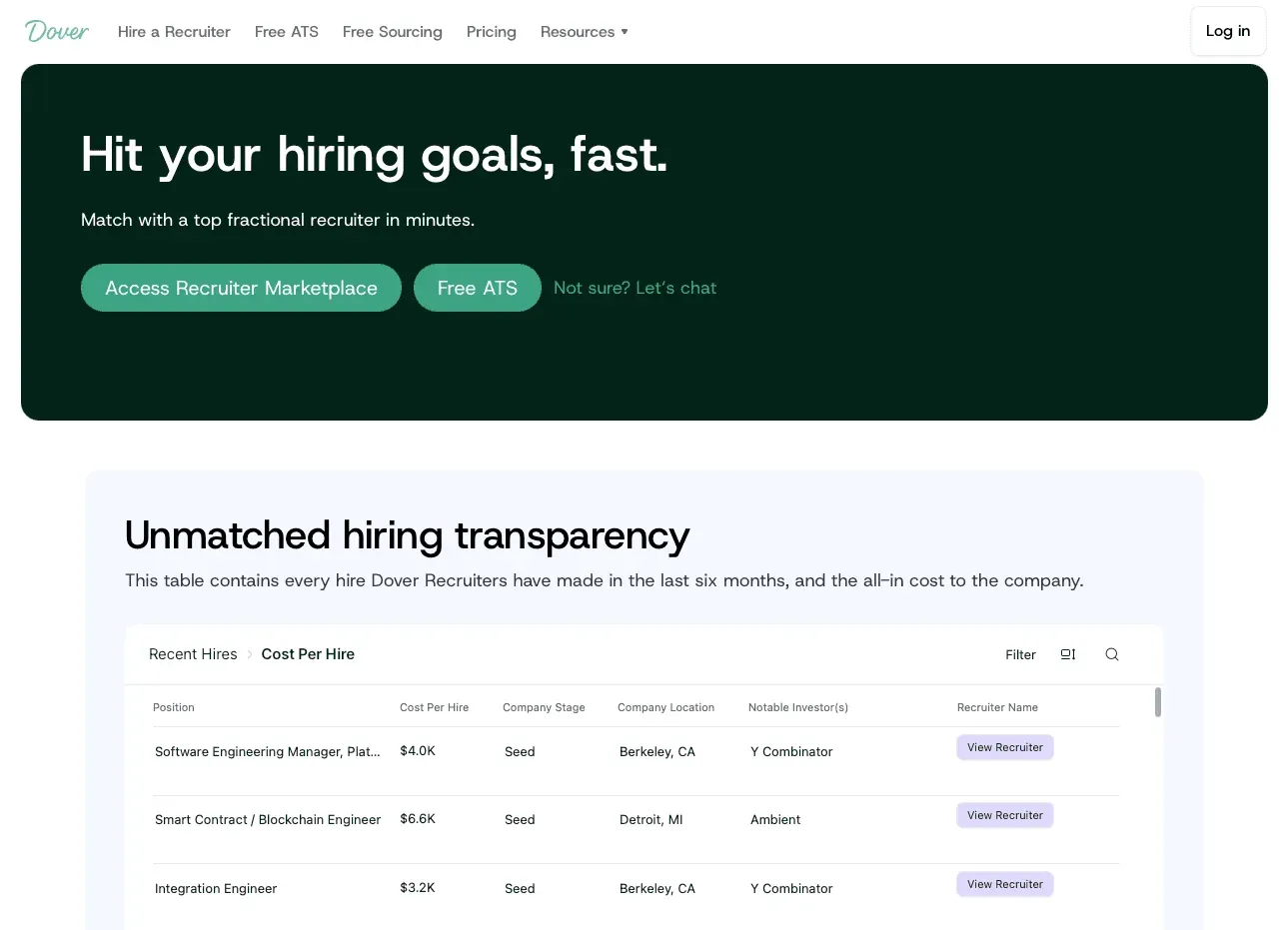
Dover pairs a dedicated fractional recruiter with a built-in ATS, so sourcing, outreach, applicant tracking, and candidate communication run through one workflow instead of disconnected tools.
The recruiter handles the active work: building sourced pipelines, running outreach, screening candidates, and coordinating interviews. The ATS captures every action in one place, giving founders visibility into where candidates are and what’s stalled. A common failure mode in early hiring is losing qualified candidates mid-process to scattered handoffs across spreadsheets and email threads.
Pricing runs $4,800 per hire depending on role complexity, with recruiters setting their own rates. There’s an $800 refundable deposit to get started, setup takes under five minutes, and roles are distributed across 50+ job boards as part of the standard workflow.
FAQs
Can a fractional recruiter fill technical roles without in-house engineering context?
Yes, if they specialize in technical recruiting. Recruiters with engineering hiring backgrounds can screen for skills and assess culture fit before candidates reach your hiring manager, though your team still needs to define the technical bar and run final evaluations.
When should I hire a full-time recruiter instead of going fractional?
Around 15-20 annual hires is when a full-time recruiter makes financial sense. Below that, fractional arrangements let you pay for recruiting capacity only during active hiring periods instead of carrying $85,000+ in fixed salary year-round.
What’s the best way to work with a fractional recruiter without losing control of hiring?
Give them access to your tools (ATS, Slack, calendars) and treat them as an embedded team member who attends syncs and learns your hiring bar. They own sourcing, screening, and coordination; you retain final decision authority.
Final Thoughts on Fractional Recruiting for Startups
A fractional recruitment agency fills a real gap for teams that can’t support full-time recruiting headcount but need more than occasional agency hires. Your decision comes down to whether your hiring volume and budget align with paying for capacity over paying per placement, and that answer tends to shift as your team grows. Dover pairs a dedicated fractional recruiter with a built-in ATS, keeping sourcing, tracking, and candidate communication in one workflow for teams that want that setup.
Frequently Asked Questions
Can a fractional recruiter fill technical roles without in-house engineering context?
Yes, if they specialize in technical recruiting. Recruiters with engineering hiring backgrounds can screen for skills and assess culture fit before candidates reach your hiring manager, though your team still needs to define the technical bar and run final evaluations.
When should I hire a full-time recruiter instead of going fractional?
Around 15-20 annual hires is when a full-time recruiter makes financial sense. Below that, fractional arrangements let you pay for recruiting capacity only during active hiring periods instead of carrying $85,000+ in fixed salary year-round.
What’s the best way to work with a fractional recruiter without losing control of hiring?
Give them access to your tools (ATS, Slack, calendars) and treat them as an embedded team member who attends syncs and learns your hiring bar. They own sourcing, screening, and coordination; you retain final decision authority.