

Your last three job postings got buried. The candidates who did apply weren’t even close. You need help, but a full-time recruiter feels premature and agencies quote fees that don’t add up for a single hire. When you hire a freelance recruiter, you get something in between: sourcing and screening for individual searches without long-term commitments. This guide walks through when it makes sense, how to find the right person, what pricing models to expect, and how to make the engagement work.
TLDR:
-
Freelance recruiters charge 15-25% of first-year salary on contingency ($18,000-$30,000 for a $120,000 hire) or $50-$150/hour ($2,000-$7,000 total per completed hire), compared to agency fees that can run higher with less direct control.
-
Choose contingency pricing for one-off hires where you want zero upfront risk, hourly rates for specialized roles where fit matters more than speed, or fractional arrangements when you need consistent support across multiple roles.
-
Write detailed intake documents that go beyond the job description, give feedback within 48 hours of screens or interviews, and include your recruiter in debrief conversations so they can calibrate faster.
-
Move to a full-time internal recruiter around 15-30 employees, once you fill four to six or more roles per quarter consistently and freelance per-hire costs exceed what a salaried recruiting hire would cost annually.
-
Some newer solutions combine free applicant tracking software with on-demand recruiting support at $75-$125/hour, letting you manage inbound pipeline yourself and bring in help when specific searches require proactive outreach.
What Is a Freelance Recruiter?
A freelance recruiter is an independent hiring professional who works with companies on a contract basis, filling roles without being on payroll. Unlike agency recruiters who represent a staffing firm, or in-house recruiters tied to a single employer, freelance recruiters operate independently, typically managing sourcing, outreach, screening, and interview coordination across multiple clients at once.

Most freelance recruiters specialize by function or industry, whether that’s engineering, finance, operations, or go-to-market hiring. That specialization is what makes them useful: a company that needs to hire two senior backend engineers can bring in a recruiter who already knows the candidate pool, the relevant compensation ranges, and the technical signals worth screening for.
There are a few models worth knowing:
-
Contingency freelance recruiters get paid only when a placement is made, usually a percentage of the new hire’s first-year salary. This can create incentive misalignment, since speed tends to get rewarded over fit.
-
Retained freelance recruiters receive an upfront fee to run a search. This structure works better for senior or hard-to-fill roles where a thorough, exclusive process is worth paying for.
-
Fractional recruiters embed with a team part-time, handling recruiting operations over weeks or months. This is common at early-stage startups that need consistent recruiting support without a full-time hire.
-
Hourly or project-based recruiters charge for specific deliverables, like a sourced candidate list or a set of screened phone interviews.
The right model depends on hiring volume, urgency, and how much hands-on ownership you want the recruiter to take on.
Why Companies Hire Freelance Recruiters
Hiring freezes get the headlines, but the more common reality for growing companies is a different kind of problem: the need to hire quickly without the overhead of a full-time recruiting team. A freelance recruiter fills that gap by working on specific roles or projects, typically on a contract or per-hire basis, without the fixed salary, benefits, and ramp time that come with a permanent hire.
The reasons companies turn to freelance recruiters tend to fall into a few patterns:
-
Surge hiring: A product launch or funding round creates a short window where headcount needs to grow fast, but the demand won’t support a full internal team afterward.
-
Specialized roles: Technical, executive, or niche positions often require sourcing expertise that generalist HR teams don’t have. A freelance recruiter with a focused background can reach candidates that standard job postings won’t surface.
-
Coverage gaps: When an internal recruiter goes on leave or a team is between hires, a freelancer can step in without a long onboarding process.
-
Cost control: For early-stage companies, paying per placement or by the hour is often more predictable than the retainer fees that traditional search firms charge.
How Much Does Hiring a Freelance Recruiter Cost?
Freelance recruiter pricing follows a few distinct models, and the one you choose affects both your upfront costs and your total cost per hire.
The most common structure is contingency-based fees, where recruiters charge a percentage of the hired candidate’s first-year salary. For freelance recruiters, that range typically falls between 15% and 25%, though senior or specialized roles can push toward the higher end. On a $120,000 engineering hire, that translates to anywhere from $18,000 to $30,000. Industry benchmarks for hiring costs can help contextualize these figures against broader recruitment spending.
Hourly and retainer arrangements are the other common models. Hourly rates for independent recruiters often fall between $50 and $150 per hour depending on specialization and experience level. Retained engagements, where you pay upfront for dedicated search effort, can run from a few thousand dollars monthly to well over $10,000 for niche technical roles.
| Pricing Model | Typical Cost | Best For | Key Tradeoff |
|---|---|---|---|
| Contingency | 15-25% of first-year salary | One-off hires with no upfront budget | Incentivizes speed over fit |
| Hourly / Project | $50-$150/hr | Specialized roles where fit matters most | Costs can rise if the search runs long |
| Retained | $3,000-$10,000+ upfront | Senior or hard-to-fill searches | Requires budget commitment before a hire |
| Fractional | Ongoing monthly rate | Early-stage teams with multiple open roles | Less flexible to pause than per-hire models |
Where to Find Freelance Recruiters
The options range from general freelance marketplaces to specialized networks, and each carries different tradeoffs on quality, speed, and initial vetting burden.
General marketplaces like Upwork and Fiverr list many self-described recruiters. Reviews and completion rates provide some signal, but domain specialization is hard to verify quickly. LinkedIn is better for targeted outreach: search by function and industry, then look for practitioners whose experience includes relevant placements rather than just titles. Founder Slack groups and peer networks often surface warm referrals from someone who has already run the engagement, which cuts the vetting work considerably. Recruiter-specific marketplaces organize practitioners by specialty, and some pre-screen for startup experience, shifting more of the verification work off your plate before the first conversation.
How to Vet and Hire a Freelance Recruiter
Finding the right freelance recruiter is as much about fit as credentials. Freelance recruiter compensation varies considerably by specialization and experience level. Before committing, probe a few things directly.
-
Role and stage match: Ask for specific placements at comparable company stages. Experience filling Series B engineering roles reads differently than high-volume GTM recruiting at a later-stage company.
-
Methodology: How do they source? Active outreach and community networks produce different pipelines than posting to job boards and waiting.
-
Track record: Specific examples are a good sign. Vague generalities about past work are not.
-
Tech stack compatibility: Will they work inside your existing ATS, or expect a separate workflow? Separate systems create visibility gaps you will feel mid-search.
-
Communication cadence: Define update frequency before the engagement starts.
-
Values alignment: How they talk about candidate experience tells you how they will represent your company to passive candidates who have not heard of you yet.
Best Practices for Working with Freelance Recruiters
Once a recruiter is hired, the engagement quality depends almost entirely on how well you set them up. Vague briefs produce mediocre pipelines. Slow feedback stretches timelines and frustrates candidates who go cold waiting for next steps.
A few practices that tend to separate productive engagements from ones that drift:
-
Write a real intake document. Go beyond the job description: include what good looks like at 90 days, which tradeoffs you’ll make on requirements, and what your culture penalizes. A recruiter can’t represent you well without this.
-
Define candidate ownership early. Who follows up after an offer? Who handles rejections? Ambiguity here damages the candidate experience and sometimes the hire.
-
Give feedback within 48 hours of a screen or interview. Recruiter momentum depends on knowing what’s landing and what isn’t.
-
Include the recruiter in debrief conversations, even briefly. They calibrate faster when they hear how the hiring team is reacting to candidates, instead of getting a filtered summary afterward.
When to Hire a Full-Time Recruiter Instead
Freelance recruiting fits well when hiring is intermittent. Once volume becomes consistent, the economics shift.
A practical threshold to watch: around 15 to 30 employees, and once your company expects to fill four to six or more roles per quarter on an ongoing basis, a full-time recruiter becomes more cost-effective. At that hiring pace, per-hire or hourly arrangements can add up to more annually than a typical internal recruiter salary, and a dedicated internal person compounds in ways a freelancer cannot. They build institutional knowledge, develop calibrated relationships with hiring managers, and carry context from one search into the next.
Below that volume, or when hiring needs fluctuate quarter to quarter, the flexibility of a freelance arrangement typically makes more sense.
Dover: Free ATS Plus On-Demand Recruiting Expertise
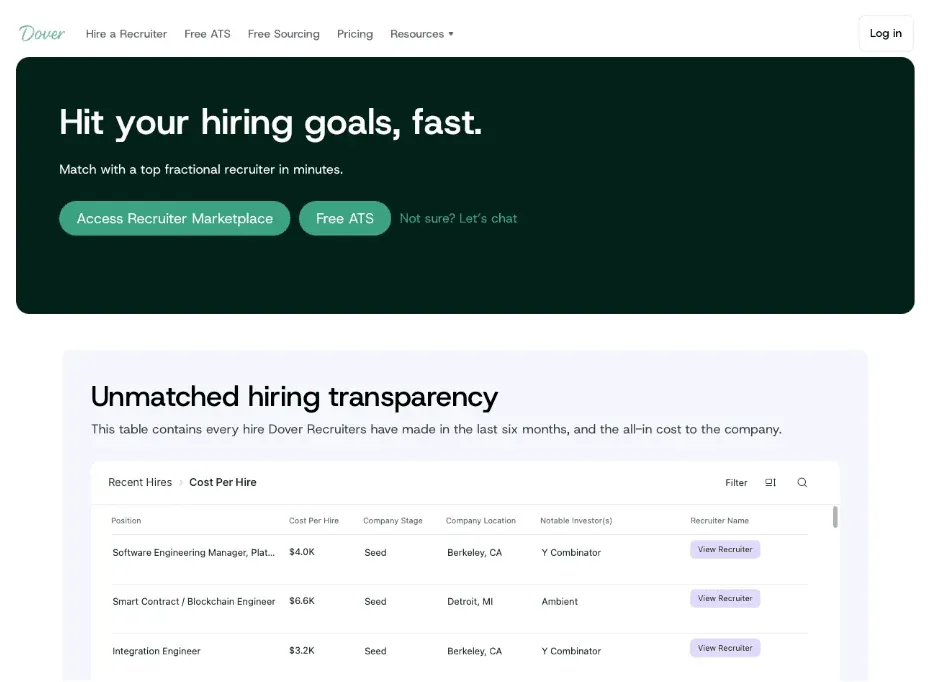
Dover sits at an unusual intersection for recruiting tools: it combines free applicant tracking software with access to on-demand recruiting support, so early-stage teams can manage their own pipeline without committing to a full-time recruiter or paying a traditional agency retainer.
The ATS itself takes under five minutes to set up and posts to 100+ job boards automatically.
For teams handling inbound volume, that alone removes a considerable amount of manual coordination. But where Dover differs from a standalone ATS is what happens when a search gets complicated.
Frequently Asked Questions
What’s the best way to hire a freelance recruiter?
You want a recruiter with deep domain expertise in your specific function or industry, not technical skills. Look for practitioners whose past placements match your role type and company stage, then verify their sourcing methodology and how they’ll integrate with your existing workflow before starting.
When should I hire a full-time recruiter instead of using freelance recruiting?
Around 15-30 employees, once you’re filling four to six or more roles per quarter consistently, a full-time internal recruiter often becomes more cost-effective than per-hire arrangements. Below that volume or when hiring fluctuates quarter to quarter, freelance flexibility makes more sense.
Can I use a freelance recruiter without switching my current ATS?
Yes, if the recruiter will work inside your existing system. Ask upfront whether they’ll operate in your ATS or expect a separate workflow. Separate systems create visibility gaps and coordination friction you’ll feel mid-search.
Final Thoughts on Hiring a Freelance Recruiter for Your Team
Knowing when and how to hire a freelance recruiter can make a real difference for growing teams that need reliable hiring without the overhead of a full-time internal function. The right freelance recruiter brings domain knowledge, a warm candidate network, and the flexibility to engage only when you need them. If you want a setup that gives you even more control, Dover combines a free ATS with on-demand recruiting support, so you can manage inbound pipeline yourself and bring in expert help the moment a search calls for it.