
Your recruiting steps probably look fine on paper. You’ve got job descriptions, interview loops, and offer templates ready to go. But if your time-to-fill keeps stretching past 40 days and your best candidates keep vanishing before you close them, something in your process is leaking talent faster than you can source it.
TLDR:
-
Strong hiring starts with a clear job requisition that aligns stakeholders on role scope, reporting structure, and success metrics before sourcing begins.
-
Structured interviews with consistent scoring rubrics improve candidate evaluation quality compared to unstructured conversations and can help teams make more consistent hiring decisions.
-
Employee referrals and proactive outreach to passive candidates help build a warm talent pool that reduces time-to-fill before a role even opens.
-
Companies hiring 5-50 roles per year typically spend 15-25 hours weekly on recruiting, costing $3,000-$5,000 in lost productivity.
-
Fractional recruiting platforms combine a free ATS with hourly recruiters to help startups fill roles for $2,000-$7,000 per hire, with no contracts or placement fees.
1. Identify Your Hiring Needs and Create a Job Requisition
Hiring without clarity is just expensive guessing. Before you post a single job description, you need to know why this role exists, what gap it fills, and what success looks like in the first 90 days.
Start by working with your hiring manager to map the skills your team currently lacks against what the business actually needs. From there, separate the must-haves from the nice-to-haves and document them clearly. A candidate who checks every box on a wishlist rarely exists, and chasing them will stall your search.
Get stakeholder alignment early. When everyone agrees on the role scope, level, and reporting structure upfront, you avoid the back-and-forth that drags out time-to-fill. Document it in a formal job requisition before sourcing begins.
2. Develop a Job Description That Attracts Top Talent
A well-written job description does more than list responsibilities. It shapes who applies, how many apply, and whether the right candidates bother clicking at all.
Start with the job title. Titles like “Rockstar Sales Ninja” may feel creative but they hurt searchability and often confuse candidates. Stick to recognizable titles that reflect how people actually search for roles.
From there, keep the structure clean:
-
Open with a short paragraph about the company, the team, and why the role exists, giving candidates immediate context for what they are joining.
-
List responsibilities in order of importance so candidates understand what the day-to-day actually looks like.
-
Separate required qualifications from preferred ones, since conflating the two discourages otherwise strong applicants from applying.
-
Include a compensation range where possible, as job postings with salary ranges attract more qualified applicants and reduce wasted time on both sides.
3. Build Your Sourcing Strategy and Talent Pipeline
Sourcing works best when it starts before a role is open. Proactive outreach to passive candidates gives you a pool to draw from instead of scrambling once a position needs to be filled.

Employee referrals are worth focusing on early. Referred candidates are often hired faster than those sourced through traditional channels, and they tend to ramp up faster once on board. A low-friction referral program your team can actually use is worth setting up before your next role opens.
Your sourcing mix should also include:
-
LinkedIn outreach to passive candidates who match your target profile, since many strong hires are not actively job searching
-
Niche job boards and talent communities specific to your industry or role type, where competition for attention is lower
-
Re-engaging past finalists from previous searches who were strong but not selected at the time
Warm candidates already in play can cut weeks off your time-to-fill without sacrificing quality.
4. Screen and Shortlist Qualified Candidates
After collecting applications, the real work begins: separating genuinely qualified candidates from those who simply applied. This stage can consume enormous recruiter time if done without a clear system.
Most hiring teams start with resume screening against a defined criteria checklist, then move to a brief phone or video screen before advancing anyone to the full interview loop. A structured screen typically covers:
-
Confirmation of non-negotiable requirements like location, compensation expectations, and work authorization
-
A quick read on communication skills and professional presence before investing more interview time
-
Preliminary assessment of relevant experience and motivation for the specific role
SHRM talent acquisition guidance suggests recruiters spend considerable time reviewing resumes that never move forward, which points to the value of writing precise job descriptions upfront. A tighter spec produces a more relevant applicant pool and makes shortlisting faster and more accurate throughout your hiring workflow.
| Recruiting Model | Time Investment Per Week | Cost Structure | Best For |
|---|---|---|---|
| In-House Recruiting | 15-25 hours weekly for companies hiring 5-50 roles per year, split across sourcing, screening, and coordination | $3,000-$5,000 in lost productivity per role, plus $85,000-$170,000 annual salary if hiring a full-time recruiter | Companies with consistent, high-volume hiring needs who can support a dedicated recruiting team |
| Traditional Agency | Minimal internal time but limited control over candidate quality and timeline | 15-25% placement fee of first-year salary, typically $15,000-$30,000 per hire with no guarantee of time-to-fill | One-off executive searches or hard-to-fill specialized roles where speed matters less than finding a rare skill set |
| Fractional Recruiting (Dover) | Startup team handles final interviews and offers while recruiter manages sourcing and initial screening | $2,000-$7,000 per hire based on hourly work, no contracts or long-term commitments required | Startups hiring 5-50 roles annually who need experienced recruiting support without full-time headcount or agency fees |
| No Recruiters | Full recruiting workload remains with hiring team, with software handling candidate tracking and communication | No direct cost for software but requires 15-25 hours weekly of internal team time | Teams with strong internal recruiting skills who need workflow organization but can handle sourcing and closing themselves |
5. Conduct Structured Interviews and Assessments
The typical U.S. time-to-fill has reached 44 days, and bloated interview loops are a major contributor. Every extra round you add gives strong candidates more time to accept competing offers.
Structured interviews help you move faster without cutting corners. When every candidate answers the same competency-based questions in the same order, you get comparable data instead of impressions shaped by whoever talked longest. Build a scoring rubric before the interview starts, not after reviewing notes.

A three-stage process works for most roles:
-
A hiring manager screen focused on experience and role fit
-
A panel interview or working session with relevant stakeholders
-
A short work simulation testing practical skills, scoped to under two hours of candidate time
That loop can run in under two weeks if you keep it tight from the start. A four-hour take-home signals disrespect for candidates and will quietly cost you applicants near the top of your funnel.
6. Make the Offer and Negotiate Terms
Getting to an offer means little if you fumble the delivery. The strongest candidates often have competing offers in motion, so timing here is measured in hours, not days.
Call before you send the written offer. A verbal conversation lets you gauge enthusiasm and surface concerns before the candidate reviews paperwork alone. Be ready to discuss equity, flexibility, and start date openly instead of waiting for them to push back first.
If they need time, stay engaged. Candidates who go quiet after an offer often received a counter they feel awkward raising with you directly. A brief check-in every couple of days keeps the relationship warm without applying pressure.
When a Candidate Counters
Counteroffers are normal, and how you respond sets the tone for the employment relationship. A few things worth keeping in mind:
-
Know your flexibility before the call. Having a clear sense of your ceiling on salary, equity, and other terms means you can respond with confidence instead of stalling while you get internal approvals.
-
Separate compensation from other factors. Candidates sometimes counter on salary when the real concern is remote flexibility, title, or start date. Asking open questions can surface what actually matters.
-
Set a clear deadline. Leave the offer open-ended and it can drag indefinitely. A reasonable but firm timeline respects both sides and keeps your process moving.
7. Onboard New Hires for Long-Term Success
A structured onboarding process separates companies that retain top talent from those that lose new hires within the first 90 days. Effective onboarding improves new hire retention by 82% and productivity by over 70%, according to research widely cited across HR literature.
Good onboarding covers more than paperwork and system access. It connects new employees to the team, clarifies expectations, and gives them early wins that build confidence and commitment.
Key onboarding elements to get right
-
Send a welcome package before day one with role context, team introductions, and any pre-reading so the new hire arrives prepared.
-
Assign a dedicated onboarding buddy or manager who checks in regularly during the first 30, 60, and 90 days.
-
Set clear performance milestones early so new hires understand what success looks like in their first quarter.
-
Schedule structured feedback conversations to catch disengagement before it becomes resignation.
How Dover Simplifies the Recruiting Process for Startups
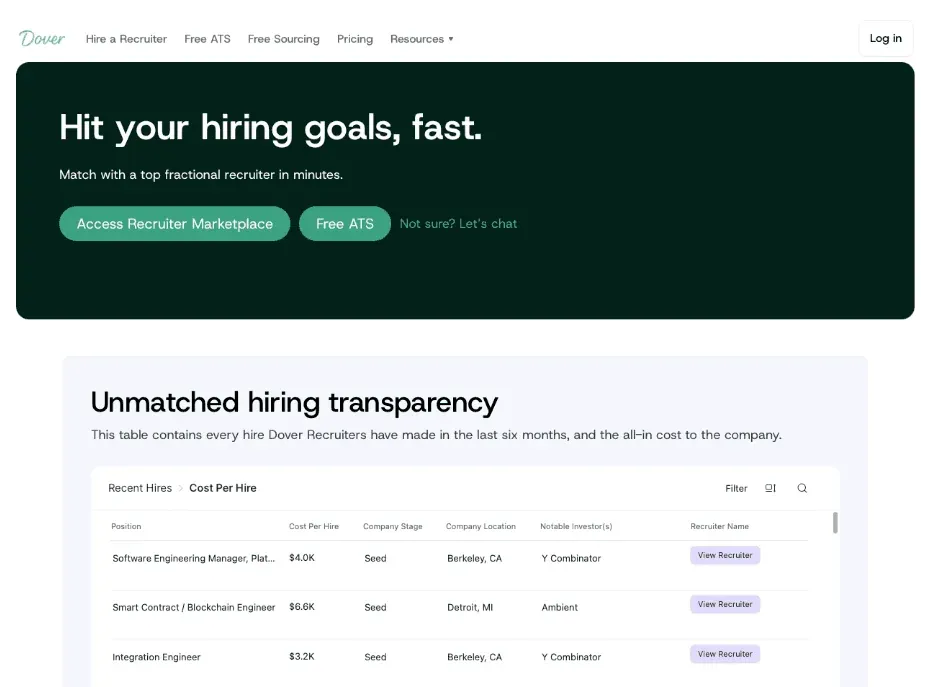
Each step covered in this guide maps to a real gap in how startups typically handle hiring. Dover’s free ATS gives you one system to track candidates from job requisition through offer, with no setup costs or per-seat fees. For the stages that consume the most recruiter time like sourcing and screening, Dover’s fractional recruiter marketplace connects you with experienced recruiters who bill hourly instead of charging placement fees.
The average cost per hire sits around $4,700, and most companies working with Dover spend roughly $2,000 to $7,000 per hire depending on role complexity. For startups hiring 5 to 50 roles per year, that range matters. You can scale recruiting support up when hiring is active and pull back when it slows, without a long-term contract or a full-time recruiter on payroll.
Frequently Asked Questions
Can I hire without a full-time recruiter on payroll?
Yes, fractional recruiters work hourly on specific roles instead of joining your team full-time. Most companies hiring 5-50 roles per year can use fractional recruiting support for $2,000-$7,000 per hire instead of paying $85,000-$170,000 annually for a full-time recruiter.
How long should a structured interview process take?
A three-stage interview loop can run in under two weeks if you keep it focused: a hiring manager screen, a panel interview or working session, and a short work simulation scoped to under two hours of candidate time. Every extra round gives strong candidates more time to accept competing offers.
What’s the difference between the selection process and the recruiting process?
The selection process refers to screening, interviewing, and choosing candidates from your applicant pool, while the recruiting process covers the full cycle from identifying hiring needs through onboarding. Selection process steps are a subset of the broader recruitment process steps in HR.
Final Thoughts on Your Recruiting Strategy
The difference between a 30-day hire and a 90-day slog often comes down to whether you have a repeatable process in place before the role opens. These recruiting steps work best when you refine them over time instead of reinventing your approach with every new position. Dover’s ATS keeps your pipeline organized without setup costs, and fractional recruiters give you experienced help on the stages that eat the most time. If you’re not sure where to start, you can book a quick call to talk through your current hiring needs.